Lifelong Learning Strategies for Self-Directed Adults
Adults face structural barriers to learning, not just scheduling problems.
There's a number that should bother anyone who works in learning and development. According to OECD data, only about 8% of adults are enrolled in formal learning programs at any given time. Yet 37% are picking up job-related skills through non-formal means, and in the UK, a 2024 survey on adult participation found that more than half of adults had engaged in some form of learning over the prior three years, the highest figure since that survey began. Meanwhile, research from CAEL suggests that over 42 million U.S. adults between 25 and 64 intend to enroll in education or training within two years.
Intent is not the problem. Something else is.
The rise the UK data captures was driven largely by self-directed and online learning, often pursued for personal rather than professional reasons. Adults are already orienting toward ownership of their own learning. The question worth sitting with is why that instinct so often stalls before it compounds into anything durable.
The real barriers adults face (and why "just find the time" misses the point)
Every conversation about adult learning eventually arrives at time. And it's not wrong, exactly. OECD data shows that among adults who wanted to learn but didn't, 48% cited lack of time due to family or work obligations. That's the top barrier by a wide margin, ahead of cost, ahead of availability.
But a 2025 paper in the journal Adult Learning makes a distinction worth pausing on. The authors argue that framing time scarcity as a scheduling problem, something individuals can solve through better prioritization, misrepresents what's actually happening. Time constraints for adults aren't scheduling inefficiencies. They're structural. They emerge from caregiving responsibilities, shift work, economic precarity, and the compounding obligations of a full life. You can't productivity-hack your way out of structural conditions.
There's also an age gradient buried in the UK data: likelihood of participation decreases by roughly 4% for each additional year of age. That's not about motivation declining with age. It's about obligations accumulating.
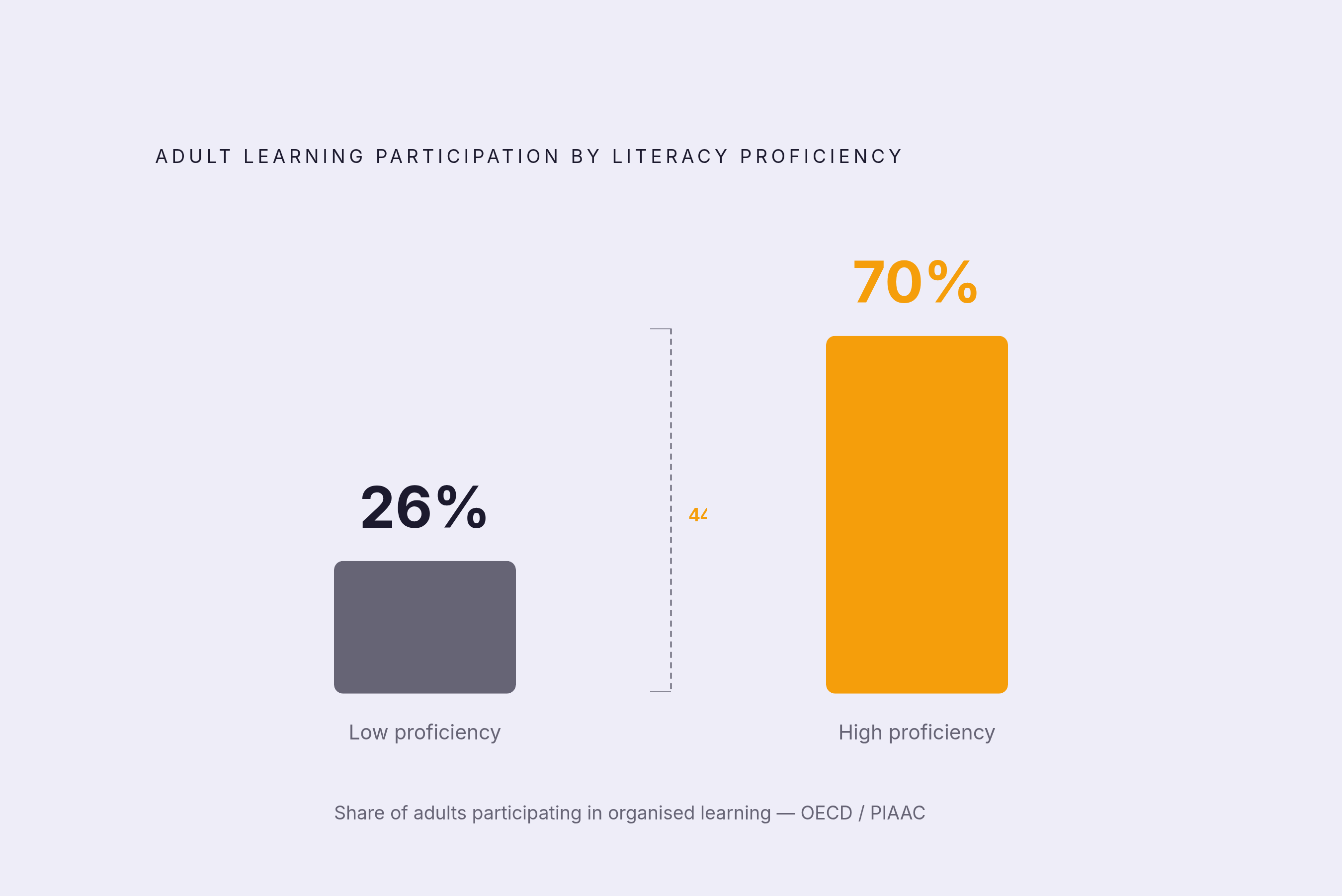
What makes this sharper is the participation gap among adults with low literacy proficiency. High-proficiency adults participate in learning at around 70%. Adults with low proficiency participate at around 26%. The people who most need upskilling are the least likely to pursue it, and the least equipped to navigate the systems that help them. The barriers compound for the people already behind.
The reason this matters for anyone building a personal learning system is that the barriers aren't character flaws. They're features of adult life. Any system that pretends they don't exist, or implicitly demands that you overcome them through discipline, is going to fail most people most of the time. A useful system has to work inside those constraints.
How adults learn differently from students (and what that means for designing a personal system)
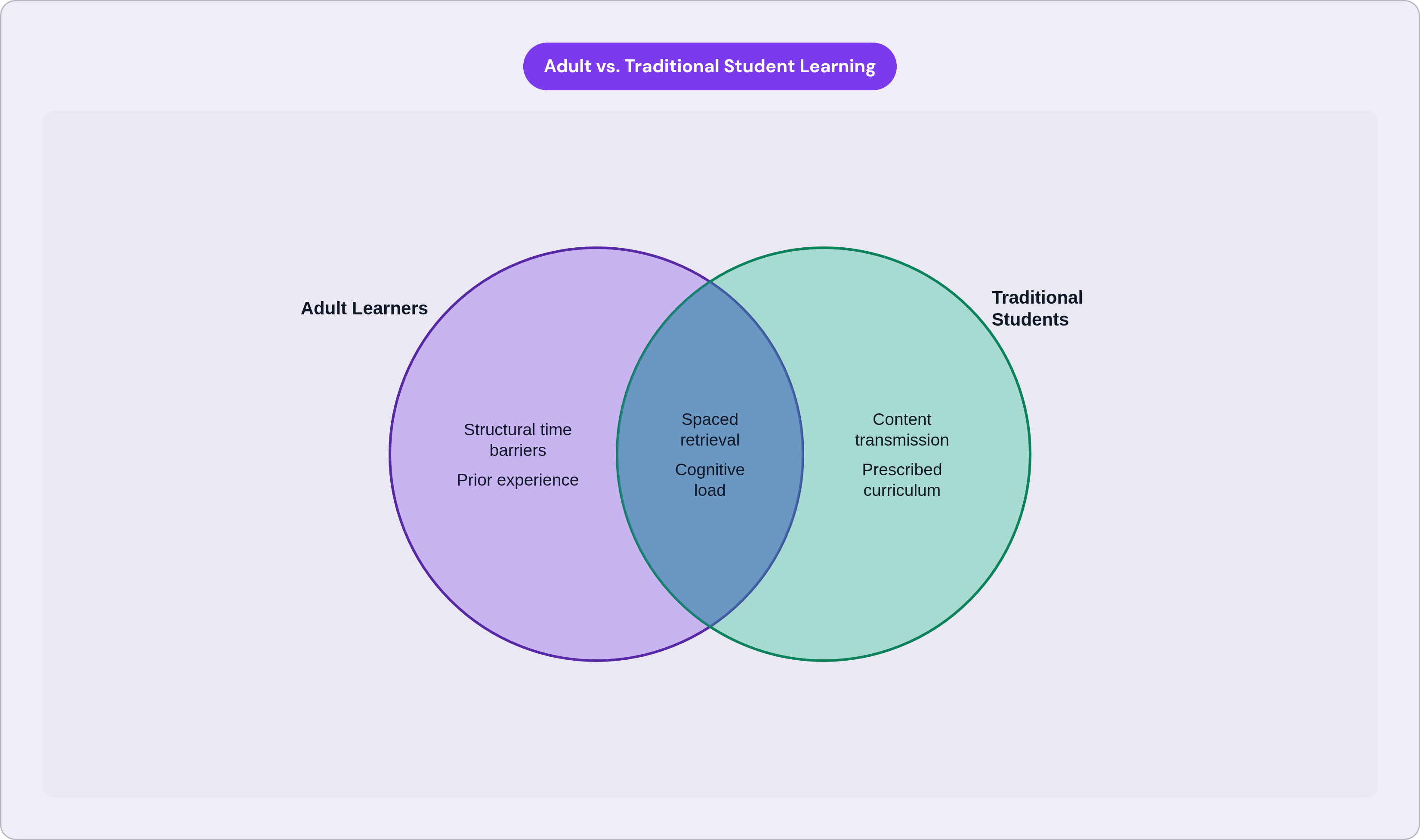
Malcolm Knowles spent decades articulating what most experienced educators already sensed: adult learners are a fundamentally different audience than traditional students, and the difference isn't just motivational. His framework of andragogy identifies several characteristics that distinguish adult learning. Adults are self-directed. They bring significant prior experience that shapes how they interpret new information. They're goal-oriented and, crucially, relevance-focused. They learn best when new material connects to problems they're already trying to solve.
Traditional pedagogy doesn't assume any of this. It treats the learner as a vessel for content transmission. That model works tolerably well when you're twelve and your only job is being a student. It breaks down almost immediately when you're a working adult with competing responsibilities and a pre-existing body of knowledge and opinion.
What Knowles called self-directed learning, or SDL, goes further than simply studying independently. It describes a disposition: the learner takes initiative in identifying what they need to know, locates and evaluates resources, monitors their own progress, and adjusts accordingly. It's not just learning on your own, it's treating your own development as a legitimate project with real ownership.
A later framework, heutagogy, extends this further still, arguing for near-total self-determination in learning, particularly relevant in digital environments where the learner can select their own tools, set their own pace, and design their own sequence. The learner isn't just executing a prescribed curriculum; they're constructing one.
The practical implication of all this isn't that adults need more motivation. It's that they need structures that respect what they already know and connect new learning to problems that are already live for them. A system built on that premise doesn't have to fight the learner. It runs with them.
Why spacing and retrieval matter more than how many hours you put in
Here's something I've watched play out repeatedly, in myself and in people I've worked with. Someone decides to get serious about learning a new domain. They carve out a Saturday, spend four or five hours reading deeply, feel productive, and then don't touch the material for two weeks. When they return, most of it is gone. They blame themselves for not retaining information, when the real culprit was the schedule, not the effort.
The cognitive science on this is unambiguous. Spaced repetition, distributing review sessions across time rather than concentrating them in a single block, produces dramatically better long-term retention even when total study time is held constant. The mechanism isn't mysterious: spacing forces the brain to reconstruct a memory rather than simply recognize one. That effortful reconstruction is what drives the material into long-term storage and slows decay.
A 2025 prospective study published in Academic Medicine found that spaced repetition improved both learning and retention among practicing physicians engaged in ongoing professional development. This is important because the research base on spaced repetition was built mostly on students; this extends the finding explicitly to working adults maintaining expertise in real time.
Retrieval practice compounds the benefit further. Re-reading feels productive but is largely passive; the brain recognizes the material without having to reconstruct it. Active recall, writing out what you remember from memory, self-quizzing, explaining a concept aloud without looking, forces the kind of effortful processing that encodes information more deeply. Interleaving, mixing topics within a single review session rather than batching by subject, improves transfer, the ability to apply knowledge in novel contexts.
For a busy adult, the practical shape of this is actually favorable. Short review sessions distributed across a week outperform a single long session. That naturally fits a fragmented schedule rather than requiring you to find a large uninterrupted block.
Building a learning routine inside the constraints of a full life
The microlearning industry exists because of a real constraint. Research widely cited in organizational learning circles suggests that employees have, on average, only around 24 minutes per week available for formal learning. Whether that figure holds precisely across every context is debatable, but the underlying reality isn't: the time available is quite small, and it arrives in fragments.
The instinctive response is to fight the fragmentation, to find a longer block, to protect a sacred learning hour. That instinct is understandable and mostly futile. A more durable response is to design retrieval and reflection directly into the gaps that already exist: the commute, the transition between meetings, the five minutes before a call starts.
Habit-stacking, attaching a new behavior to an established one, reduces the activation cost of starting. You're not deciding each time whether to do the retrieval review; it happens because it's anchored to something you already do automatically.
Goal-setting for adult learners also benefits from a specific reframe. A topic-shaped goal, "learn data analysis" or "understand machine learning," is open-ended and hard to complete. A problem-shaped goal, "understand enough about statistical inference to evaluate the methodology in my team's research reports," has a natural endpoint and a built-in success criterion. The second kind of goal gives you a way to know when you're done.
Structurally, it helps to distinguish between learning modes and assign each to appropriate time slots. Acquisition, reading, watching, listening, requires relatively uninterrupted focus and belongs in whatever longer blocks you can find. Retrieval, flashcards, self-quizzing, writing a summary from memory, can survive lower-attention windows; a bus ride, a lunch break. Application belongs embedded in actual work, not added on top of it. OECD data shows that 28% of employees report learning by doing on a daily basis; informal workplace learning is already happening for most people. The system's job is to make it deliberate.
A brief weekly review, ten minutes, no more, asking what you covered, what has stuck, and what needs another pass, keeps the system self-correcting without becoming a project in itself.
Keeping learning connected to real goals so motivation doesn't collapse
OECD data finds that 46% of adults describe non-formal job-related learning as "very useful," with another 31% calling it "moderately useful." That's a strong signal: when learning is tied to real tasks, adults recognize the value and judge the investment worthwhile.
The most common stated motivation for adult learners is improving job performance or opening new professional opportunities. Abstract self-improvement, learning for its own sake, is a weaker engine than a concrete near-term problem. Adults know this about themselves, even if they don't articulate it explicitly.
Research on adults with low basic skills makes this granular in a useful way. For that population, "relevance" means being able to navigate a bank form, support a child's homework, or fill out a government document. It's not about subject matter, it's about immediate application. That pattern scales upward across all skill levels: the more clearly a learner can see where a piece of knowledge lands in their actual life, the more durable the motivation to acquire it.
One practical technique I've found useful is a minimal learning log. Not a reflective journal, just a line per session: what you tried to apply and what happened. It makes progress visible during the periods when the subject matter feels abstract and distant from any tangible outcome.
Project-based framing compounds this. If a learning sequence is anchored to a specific deliverable, a presentation, a decision, a tool you're building, that deliverable creates natural milestones and a clear terminus. The open-ended drift that kills self-directed learning, the sense that you could always know more and therefore never really know enough, has a structural remedy: an endpoint that exists before you start.
When motivation falters, it's worth treating that as a signal rather than a personal failing. It usually means one of two things: the goal has shifted and the material no longer connects to it, or the material has drifted from application toward abstraction. The appropriate response is to re-anchor, not to push through on willpower. Pushing through on willpower works occasionally and burns people out over time.
How context-switching and cognitive load quietly undermine learning (and what to do about it)
Time scarcity is the visible problem. Attention fragmentation is the one that operates underneath it, less discussed and probably equally damaging.
A learning session interrupted by a job demand, a family obligation, or a pull toward notifications doesn't just lose time. It loses cognitive continuity. The research on attention suggests that returning to a complex task after an interruption takes meaningful time to rebuild focus, and the reconstructed focus is shallower than what was interrupted. For learning, where depth of processing drives retention, that's not a trivial tax.
The mitigation isn't about eliminating interruptions, which is mostly not feasible in adult life. It's about matching the type of learning to the cognitive state available. Acquisition tasks, reading dense material, watching a lecture, working through a complex argument, require relatively uninterrupted attention and should be reserved for conditions where that attention is actually available. Retrieval tasks, flashcards, self-quizzing, summarizing from memory, are cognitively simpler in their setup and can survive a noisier environment without much loss.
Adults carry something students typically don't: a large body of prior knowledge and experience directly relevant to what they're learning. That's an asset, but using it deliberately requires a small act of intentional activation. Asking yourself, before engaging with new material, what you already know about this topic, reduces cognitive load by creating hooks for new information to attach to. It's not a shortcut; it's how memory architecture actually works.
Tool proliferation is a quieter version of the same problem. Moving between multiple platforms, note systems, and applications consumes the same mental bandwidth as the learning itself. Every tool-switching decision is a small cognitive expenditure. Consolidating to fewer, well-chosen tools is a structural decision with real downstream effects on how much cognitive energy arrives at the actual content.
The goal is a system that runs mostly on established patterns and minimizes decision fatigue around the learning process, so that the cognitive resources you have are available for the material rather than the logistics of accessing it.
What a sustainable self-directed learning practice looks like in practice
What I've come to after watching this work and fail, in my own practice and in the practices of people I've worked alongside, is that the durable version is not a schedule. It's a set of defaults.
Where does retrieval happen? When does the weekly review occur? How are goals framed? How is application tracked? Those four questions, answered once and embedded into existing patterns, constitute the system. You're not deciding each week from scratch; you're running defaults until the defaults stop working and need adjustment.
The minimal viable version looks like this: one problem-shaped goal at a time; retrieval built into existing gaps in the day; a ten-minute weekly review; application tied to something you're already doing at work or in your life. That's it. Everything else is elaboration on those four elements.
The UK participation data lands here with some weight. The 2024 rise in self-directed learning was driven by adults pursuing learning online for personal and leisure reasons, on their own initiative, without institutional structure. That's a meaningful shift. Adults are already moving toward ownership of their own learning. The strategies in this piece aren't trying to create that instinct; they're trying to make it more durable when the initial momentum fades.
The first few weeks of a new system feel fragile. That's not a sign it isn't working. Systems feel automatic only after the behavior has been repeated enough times to settle into the existing architecture of daily life. The goal during that window is to stay in it, not to feel transformed by it.
A plain caveat, and it's worth stating plainly: no system removes the difficulty from learning. Retrieval is effortful by design. Application requires a tolerance for failure that no framework can manufacture for you. The moments when learning is hard are not design flaws to be engineered away.
What a good system does is make the hard parts purposeful rather than demoralizing. It removes friction from the logistics so that when the work is difficult, you're spending that difficulty on the content, not on the question of whether to show up at all.
Self-directed adult learning doesn't succeed because the learner is unusually disciplined. It succeeds because the system respects how adults actually live, and removes as many points of resistance as possible between what they intend and what they actually do.