Cognitive Biases That Undermine Personal Growth
Neural shortcuts distort self-perception in ways that feel like honest thinking.
How Cognitive Biases Interfere with Growth (and Why the Invisible Ones Do the Most Damage)
The brain is an efficiency machine. It generates shortcuts, called heuristics, to make fast decisions without reprocessing everything from scratch. Those shortcuts work well in most contexts. They misfire badly in others.
Personal growth is one of the worst contexts for them. Growth requires accurate feedback, honest self-assessment, and some reasonable ability to allocate effort where it will actually matter. Biases are systematic distortions in how information gets processed. Put them together and you get something like a navigation system calibrated for different terrain: guiding you confidently toward conclusions that feel right and are frequently wrong.
The dangerous part isn't the distortion itself. It's that the distorted output feels indistinguishable from clear thinking. People don't experience confirmation bias as filtering; they experience it as clarity. They experience self-serving attribution as a fair reading of what happened. The bias doesn't announce itself. It just quietly changes what you see, and what you're capable of seeing.
But what if the most damaging biases are the ones that feel the most like clear thinking? Each bias here operates through a different mechanism and responds to a different approach. The mechanism matters because the counter-move doesn't make sense until you can see what you're actually countering.
Confirmation Bias. How Existing Beliefs Filter Out the Evidence That Would Change Them
Here's what confirmation bias does in practice: it takes whatever you already believe about yourself and turns it into a lens. Evidence that fits the belief gets retained. Evidence that contradicts it gets minimized, reframed, or quietly dropped.
And it works on positive beliefs and negative ones with equal efficiency. Someone convinced they're a poor communicator will read audience silence as boredom, treat one sharp question as confirmation of their worst fear, and mentally file away the three people who sought them out afterward to say the presentation landed as a polite anomaly rather than as data. I spent years watching this happen to a colleague who was genuinely one of the clearest thinkers in the room. Every good meeting left her suspicious. Every stumble felt like proof. The belief stayed intact regardless of outcome, because the belief was doing the sorting.
This is one of the primary engines of impostor syndrome, and the research bears it out in a way that should give anyone pause: ability beliefs remain stable even after the feedback that generated them is later invalidated as erroneous. The belief outlives its own foundation. The evidence that built it gets corrected; the belief doesn't.
There's also a compounding dynamic that makes this worse over time. The stronger the belief, the more aggressively the bias works to protect it. Confirmation bias strengthens the belief; the stronger belief intensifies the bias. It's a closed loop, and it tightens.
One nuance worth holding: not all confirmatory search is irrational. When gathering information is genuinely costly, there's reason to look preferentially for evidence that confirms an already-plausible hypothesis. The problem isn't preferring confirmatory evidence under real constraints. It's applying that preference rigidly when disconfirming evidence is freely available and consequential to get right.
Before interpreting any significant piece of feedback, ask yourself explicitly: what would have to be true for my current belief about this to be wrong? Then find one piece of evidence pointing in that direction before you conclude. Not to force pessimism. Just to break the automatic filter long enough for something that contradicts you to actually land.
Negativity Bias. Why Critical Feedback Lands Harder Than It Should and Praise Barely Registers
The asymmetry here is not subtle. Negative information doesn't just weigh more than positive information; it processes faster, registers more prominently, and gets retained more reliably. There's real evolutionary logic behind this. The bear in the bushes demands more attention than the berry patch. The mechanism that kept your ancestors alive is the same one making your performance review feel catastrophic when it's mostly positive with one pointed critique buried in the middle.
One pointed criticism in a room full of encouragement will dominate the emotional aftermath. A single conspicuous failure can functionally erase a genuine streak of progress. The brain doesn't recalibrate for context automatically.
Research published in 2025 linked higher negativity bias to measurable deficits across emotional regulation, memory, stress management, and resilience. Neuroimaging work suggests this isn't purely a cognitive pattern; it has a physiological substrate involving multiple brain networks. And the effect amplifies specifically for information about your own performance, hitting hardest in people who already carry a negative self-image.
Which produces a particular cruelty in the learning process: the person who most needs to accumulate evidence of progress is the least likely to metabolize it when it arrives. The same neural architecture that protects you from threats also protects you from the discomfort of revising a deeply held negative self-belief. That raises an important question: if the people who most need encouragement are least equipped to receive it, what does that imply about how we design feedback for ourselves and others?
Deliberate, specific logging of what went well, and why it went well, is one of the few counter-moves that actually holds up in practice. Not forced optimism. Not telling yourself everything is fine. A factual record, verifiable and concrete, that counteracts selective memory. Without something written down, progress has a way of disappearing from the accessible past almost entirely. Separately, mindfulness-based practices have shown measurable changes in amygdala reactivity in neuroscience research, which suggests direct work on emotional regulation is worth pursuing alongside the record-keeping, not instead of it.
Self-Serving Bias. How the Habit of Crediting Wins and Deflecting Losses Blocks Honest Self-Assessment
This one doesn't feel like a bias. It feels like a fair accounting of what happened.
When something goes well, you worked hard, made smart decisions, brought the right skills to the moment. When something goes wrong, the scope was unclear, the timing was off, someone else dropped the ball. Both narratives feel accurate as they're being constructed. The asymmetry is the problem.
Self-serving attribution exists for real reasons. It protects self-esteem and maintains motivation, and in moderate doses it's probably adaptive. The cost, though, is significant: if failures are never treated as yours, you don't develop an accurate map of your own weaknesses. The feedback loop that produces skill improvement doesn't close.
There's an equally underappreciated cost on the success side, and this is the part most people miss entirely. If you attribute good outcomes to your own general capability rather than to specific behaviors and conditions, you can't identify what actually produced the result. You can't replicate it intentionally. You got fortunate with yourself, without knowing how. And if you can't identify what caused the success, the confidence that you can reproduce it is less founded than it feels.
In collaborative environments, this compounds quickly. Deflecting failure onto circumstances or teammates, even subtly, damages relationships and closes off the external feedback you most need to improve.
After any meaningful outcome, positive or negative, try writing down one specific thing you contributed to it. One thing. Not a wholesale self-indictment, not a list of external factors that let you off the hook. One concrete contribution in each direction. The practice builds the habit of looking bidirectionally, and it forces a distinction that turns out to be genuinely useful: "I made a poor decision in that moment" is assessable and correctable. "I am a poor decision-maker" is just a verdict with nowhere to go.
Fixed Mindset and Status Quo Bias. The Twin Pressures That Make Staying Put Feel Like the Rational Choice
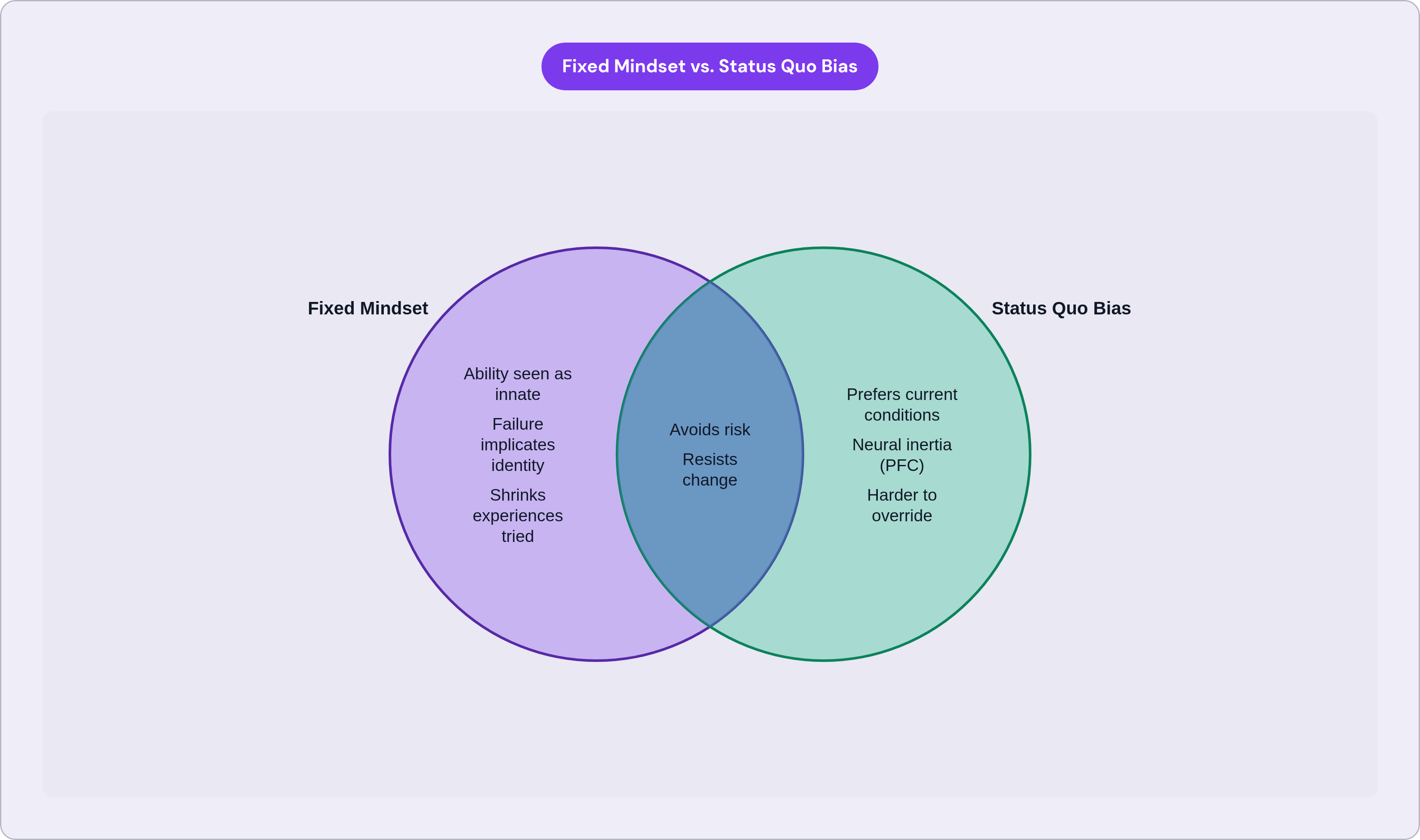
Carol Dweck's distinction between fixed and growth mindsets is probably the most cited idea in popular psychology, and also one of the most frequently misunderstood. The core is straightforward: a fixed mindset treats ability as innate and stable; a growth mindset treats it as developable. What Dweck has been careful to note, and what gets lost in most summaries, is that no one holds one orientation consistently across all contexts. The relevant question isn't which type you are. It's which orientation you're operating from when difficulty actually arrives.
The cost of a fixed mindset shows up most clearly in how failure gets processed. Research using structural equation modeling found that students who believed intelligence was fixed experienced significantly greater self-esteem damage when they failed academically, because the failure implicated who they were rather than what they did in a particular moment. That distinction is almost the whole thing. If failure says something permanent about you, avoiding situations where you might fail becomes the rational self-protective move, which means the mindset actively contracts the range of experiences you're willing to attempt.
Status quo bias is the behavioral expression of the same underlying tendency. It's the preference for current conditions even when demonstrably better alternatives are available. UCL neuroscience research found that the more difficult a decision, the more likely people are to default to the status quo; the prefrontal-basal ganglia circuitry has to be actively engaged to override inertia. Change is literally harder to execute than staying put, at the level of neural architecture. That's not a moral failing. It's the default setting, and it takes real cognitive effort to override.
One trap worth naming before moving on: the false growth mindset. Adopting the vocabulary, saying things like "failure is just feedback," without actually changing behavior when things get hard. Dweck identified this problem herself. It gives people the emotional satisfaction of having addressed the bias while producing none of the behavioral change that matters.
When failure happens, reframe the specific event in writing at the time it occurs, not "I'm bad at this," but "I lack this particular skill, which develops through practice in this identifiable way." Then run low-stakes experiments with change. Small wins build an evidential case that effort produces results, which is exactly the belief a fixed mindset fails to accumulate.
The Sunk Cost Fallacy. Why Past Investment Becomes a Trap for Future Decisions
Years into a career path that no longer fits. Months developing a skill through an approach that clearly isn't working. Deep investment in a relationship that stopped serving your growth some time ago. Evaluated on forward-looking merits alone, the rational response to each of these is to change course. The sunk cost fallacy is what makes that rational response feel like abandonment or defeat.
The mechanism isn't simple economic ignorance. It's a cluster of reinforcing forces operating simultaneously: loss aversion, the endowment effect, ego protection, social norms that treat persistence as virtue and quitting as failure, and confirmation bias pulling attention toward reasons to stay. They compound each other, all pointing in the same direction, which is why the trap is so effective even when people intellectually understand it.
One finding here is genuinely counterintuitive and worth sitting with. Strong evidence of sunk cost susceptibility has been found specifically among high-cognitive-ability subjects. Intelligence is not a defense. If anything, intelligent people are more skilled at constructing post-hoc rationalizations for continuing, which means the bias runs deeper with more cognitive horsepower behind it. The common assumption is that greater intelligence produces better decisions. What the evidence more often shows is that it produces better-sounding justifications for the same flawed ones. One might argue that this makes sunk cost thinking the most dangerous bias for high performers specifically — precisely because their rationalizations are the hardest to detect and challenge.
The right frame, once you can actually hold it: sunk costs are gone regardless of what you decide next. The years invested in the wrong direction are identical whether you stay or leave. The only question that matters is what the best next move looks like from where you actually stand today.
Try the zero-based question. Imagine starting fresh today, with no prior investment in place. Would you choose this path? If not, write down what would specifically have to be true for continuing to be the rational choice. If those conditions aren't met, you now have an honest basis for a decision, rather than an emotional one dressed up as logic.
Hindsight Bias. How "I Knew It All Along" Corrupts the Lessons We Draw from Experience
After the outcome is known, the road to it looks inevitable. The decisions that led there seem obvious in retrospect. The warning signs feel unmissable. Hindsight bias damages learning in two distinct directions, and most people only ever notice one of them.
The first is over-harsh self-judgment. "I should have known better" gets applied to a version of yourself who genuinely did not have the information you have now. The certainty you feel about what was foreseeable is itself a post-hoc construction. The retrospective self is judging the prospective self on grounds the prospective self didn't have access to. The result is shame rather than insight, which generates a lot of emotion without producing anything usable.
The second damage is shallower post-mortems. When an outcome feels retrospectively inevitable, there's little motivation to investigate it carefully. The analysis ends before it generates a real lesson because the lesson already seems obvious. "Of course that's what happened." But that feeling of obviousness is the bias actively suppressing inquiry. The irony: hindsight bias increases confidence in your understanding of what happened while reducing the accuracy of that understanding. Certainty rises; learning quality falls.
Keep a decision journal. Write down your actual reasoning, your predictions, your uncertainties, before the outcome is known. Then compare that record to what happened. This makes viscerally clear how uncertain the situation was at decision time, and it produces honest material for retrospective analysis rather than the tidily inevitable narrative the brain defaults to after the fact.
The Dunning-Kruger Pattern. How Skill Level Shapes the Accuracy of Self-Assessment in Opposite Directions
The original 1999 Dunning and Kruger finding was elegant and uncomfortable in equal measure: the skills required to perform well in a domain are largely the same skills required to recognize poor performance in that domain. People with limited knowledge overestimate their competence not out of arrogance but because they lack the framework to see what they don't know. Cross-national research examining the pattern across 46 countries found consistent evidence of the effect internationally.
The flip side gets considerably less attention, but it's just as consequential. People with substantial knowledge and skill frequently underestimate their relative standing. Expertise reveals the vastness of what remains to be learned, and real competence produces a kind of epistemic humility that tips into underselling: deferring in rooms where your judgment is actually sound, passing on opportunities you're more than qualified to pursue, staying quiet when your read on the situation is genuinely better than the people talking.
Both directions cost you something real. Overconfidence leads to implementing suboptimal strategies and investing effort where it returns the least. Underestimation leads to shrinking, deferring, disappearing from decisions where your perspective would actually improve the outcome. Why exactly does this happen at both ends of the skill spectrum? To understand why this works, we must first look at what self-assessment actually depends on: you can only evaluate your performance relative to a mental model of what good performance looks like — and that model is itself built from the very expertise you're trying to measure.
A scientific nuance worth acknowledging: a reanalysis argued that some of the observed pattern is explained by statistical regression to the mean, a mathematical artifact rather than a purely psychological phenomenon. The debate is ongoing. The general principle, that self-assessment is systematically biased in opposite directions at different skill levels, has held up well enough to be practically relevant, even as the exact mechanism continues to be investigated.
The most practically important detail: the effect is domain-specific. Competence in adjacent areas creates false confidence in the target domain, which makes the bias harder to detect from the inside. External calibration is the counter-move. Seek feedback specifically from people further along in the relevant domain, not just peers, because peers share your knowledge gaps. Track your predictions against actual outcomes over time in the specific domain where you want accurate self-assessment, and build an empirical record of where your judgment runs high and where it runs low.
The Bias Blind Spot. Why Recognizing Bias in General Doesn't Mean Recognizing It in Yourself
Reading everything in this piece does not mean you'll be less subject to these biases in practice. That's not a rhetorical setup; it's the actual finding. The bias blind spot is the tendency to believe you see the world more objectively than others, and that people who disagree with you are the ones operating under distortion. Recognizing that cognitive biases exist as general phenomena does not translate automatically into noticing your own specific biases in specific moments.
This bias functions as a kind of meta-defense. It insulates all the other biases from scrutiny by generating a felt sense of clarity and objectivity. The person most confident they're thinking without distortion is often the least motivated to examine their thinking.
The Ostrich Effect operates alongside it: the tendency to actively avoid negative information, performance data, and critical feedback because engaging with any of it feels threatening. It's a distinct mechanism, but the two travel together frequently enough that naming them in the same breath is useful.
Gay Hendricks described a related pattern he called the "upper limit," where people unconsciously self-sabotage when approaching levels of success or capability that exceed their internal baseline. The resistance doesn't feel like resistance. It feels like a reasonable decision, a sudden external obstacle, or just bad timing. The blind spot is precisely what makes the self-sabotage invisible as such, even while it's happening.
It is also worth considering what this means for every bias described in this piece: if the blind spot is always active, the question isn't whether you're subject to these distortions in this moment — it's whether your thinking environment is designed to catch them when your self-perception cannot. The practical implication of all this: knowing about cognitive biases is not the same as being less subject to them. The counter-moves throughout this piece matter specifically because they create external anchors, written records, structured questions, pre-committed criteria, other people's perspectives, that don't depend on accurate self-perception in the moment to function. You don't need to catch yourself being biased for a decision journal to work. Asking what would have to be true for your belief to be wrong benefits you regardless of whether you can feel your confirmation bias operating.
What Actually Works for Debiasing. And What the Research Says to Stop Expecting
The evidence is fairly clear on both sides of this, and it's worth being direct about the distinction.
What holds up: external anchors, pre-commitment, structured decision processes, deliberate feedback-seeking from people with genuine domain expertise. These work because they don't rely on in-the-moment self-awareness. They create friction between the biased impulse and the consequential action, and that friction does meaningful work even when you're convinced you don't need it.
What fails to hold up: simply learning about biases and expecting that knowledge to reduce their influence. You can understand the sunk cost fallacy with precision and still find yourself constructing elaborate justifications for staying in a situation that stopped serving you two years ago. You can know everything Dunning and Kruger wrote and still overestimate your standing in a new domain. Awareness is necessary; it is not sufficient. Conflating the two is, not incidentally, a form of the bias blind spot.
There's also a category of approaches that feel rigorous but primarily generate the feeling of having addressed the problem. Repeating growth mindset language without changing behavior when things get hard. Journaling that rehearses the same interpretive frames without introducing new ones. Seeking feedback from people who will confirm what you already believe. The form of the counter-move, without the substance of it.
These biases are structural features of human cognition, built on evolutionary foundations, operating below the threshold of ordinary introspection. They will not be eliminated. The realistic goal is to design your thinking environment so they produce less damage: pre-commit before you know the outcome, build records that survive your memory's selective editing, seek perspectives from people who have less investment in confirming what you believe.
Growth is a function of the accuracy of the feedback loops you're running on. Most of those loops are running on distorted inputs right now, in ways that feel entirely normal. The work isn't to be harder on yourself. It's to be more precise about what's actually happening.