AI Work Assistants and Task Ambiguity Resolution
How AI assistants handle unclear instructions determines whether they save you time or waste it.
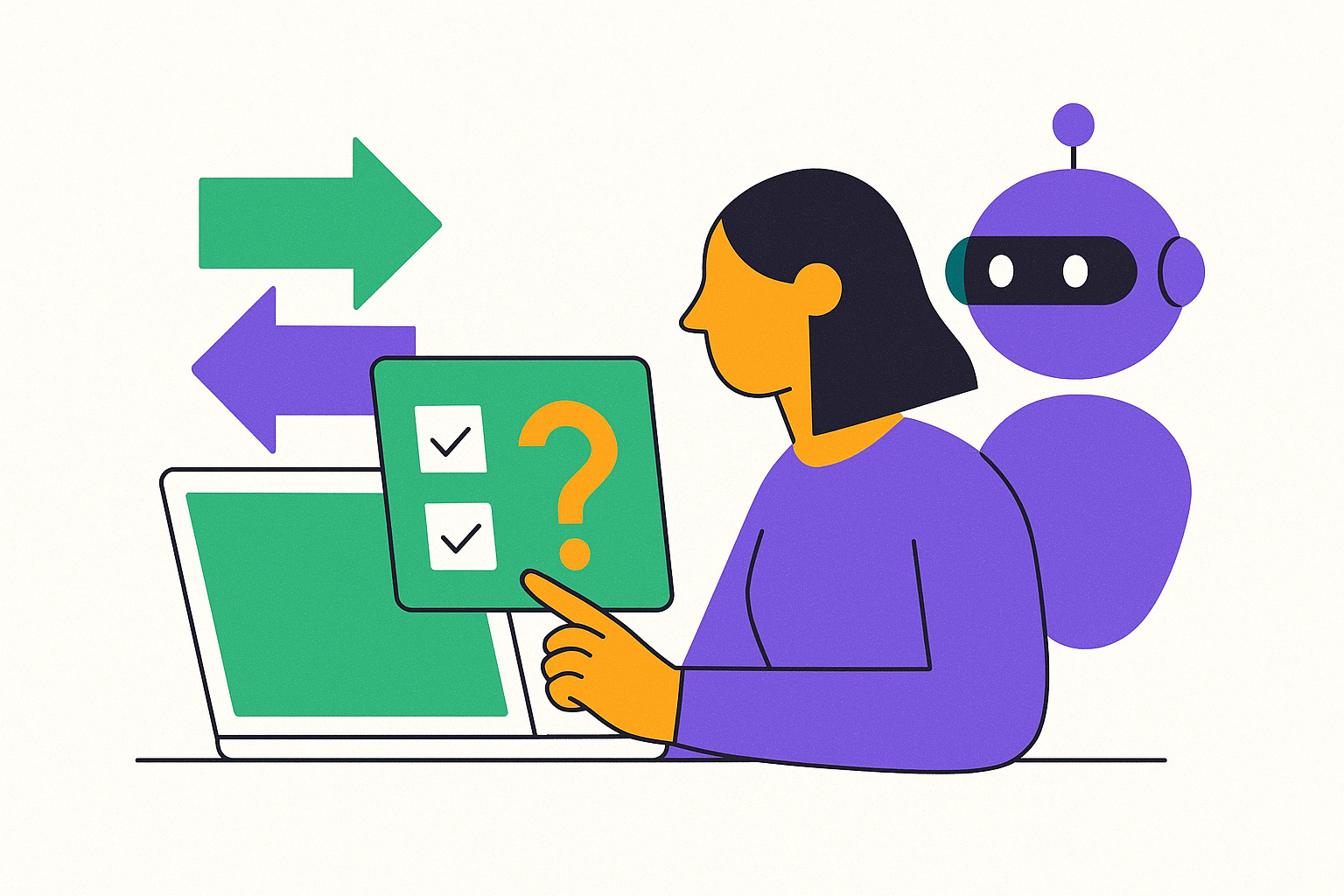
Ambiguity isn't a bug in how people talk to AI. It's the default condition, and how an assistant handles that ambiguity, whether it guesses, asks, or reads the room, decides whether the tool actually saves you time or just moves the work around. I've spent enough time in the guts of these systems to know that the difference between a good AI assistant and a frustrating one rarely comes down to raw model quality. It comes down to what happens in the two seconds after it realizes it doesn't quite know what you meant.
How widespread AI adoption has made the ambiguity problem harder to ignore
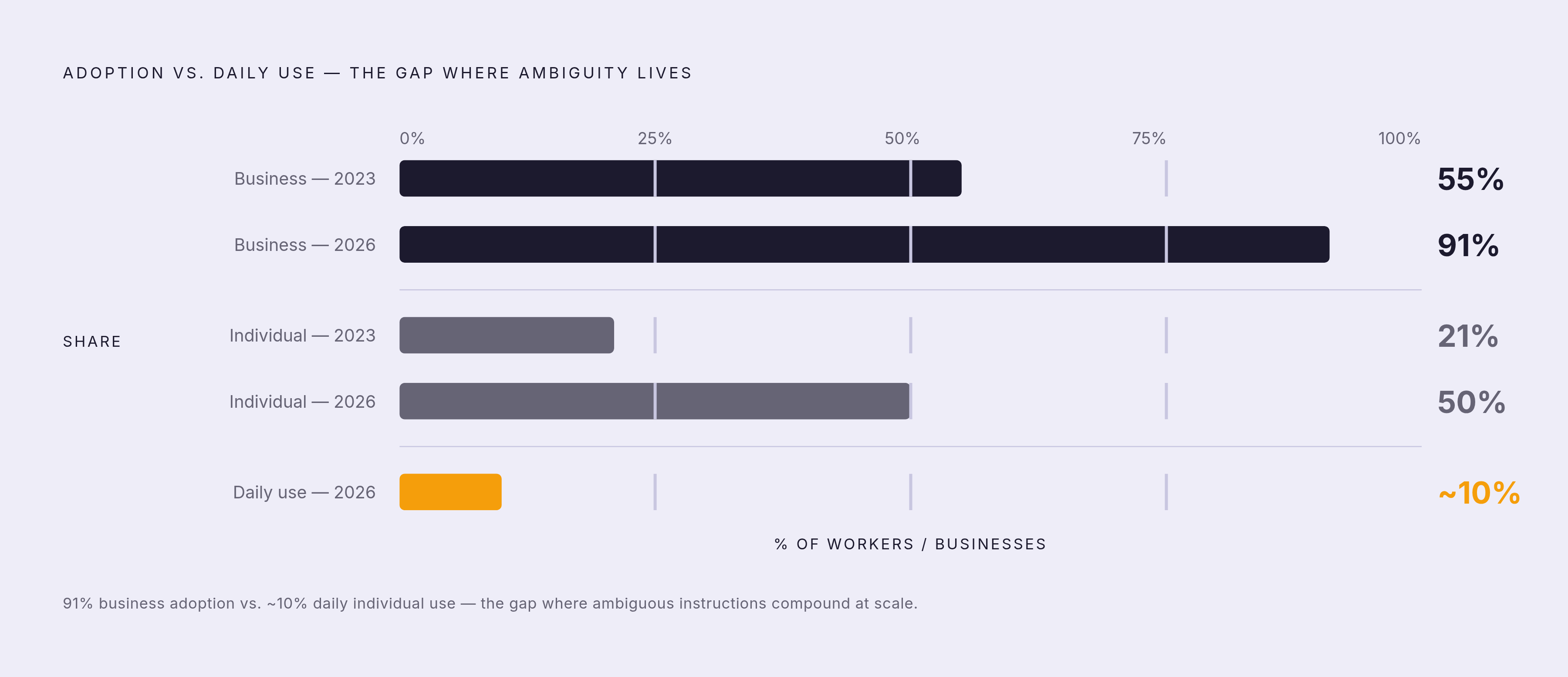
Adoption isn't a fringe story anymore. 91% of businesses reported using AI in at least one capacity in 2026, up from 55% in 2023, according to autofaceless.ai. That's not experimentation. That's infrastructure.
On the individual side, Gallup found that 50% of employed Americans used AI in their job at least a few times during Q1 2026, more than double the 21% recorded back in Q2 2023. But here's the catch: daily use is still concentrated. Gallup's Q3 2025 numbers put daily usage at around 10% of the workforce, and Worklytics found a steep divide by seniority: C-suite weekly usage running 85 to 95%, frontline employees down at 45 to 65%.
So think about what that means for the person building these tools. You're not designing for a narrow band of power users who know how to write a tight, well-scoped prompt. You're designing for a workforce so wide it includes executives who use AI constantly and interns who used it twice last month. The population sending unclear instructions into these systems is enormous, and it's only getting more varied.
Then there's the agent layer. Stack Overflow's numbers show agent usage at work jumping from 31% in 2025 to 59% in 2026. That's not just people asking questions anymore; that's people handing off tasks. Every handoff is a spot where an unclear instruction can turn into an unwanted action. Volume plus delegation equals stakes. Guessing by default stops being a tolerable shortcut and starts being a systemic risk.
What standard LLMs actually do when instructions are unclear — and why it falls short
Here's the uncomfortable part: most LLMs don't handle ambiguity. They paper over it.
The default behavior is to pick the most plausible reading and just run with it, often without telling you a choice was even made. Research on grounding acts in LLMs from 2025 found something telling: these models are far less likely than humans to flag confusing input or push back on it. Humans, when confused, initiate repair. They ask, they pause, they say "wait, what do you mean." LLMs tend to presume common ground exists even when it doesn't.
When a model does ask for clarification, it's usually reactive; it waits until you've already noticed something's wrong, then asks about the wrong dimension of the problem entirely. Standard pipelines treat ambiguity like a vocabulary issue, scanning for fuzzy words, when the real ambiguity is often buried in context the model never had.
The ECLAIR research team illustrated this well. Ask a generic model about an unclear term and it responds with something like "What do you mean by ABC?" That's not a clarifying question; that's a shrug dressed up as a question. A system with actual domain context asks something like "do you mean the dataset or the segment?" One of those you can answer in three words. The other sends you back to square one.
And there's a deeper issue underneath all this: most LLMs struggle to even detect when a problem is underspecified in the first place. That means they're not just occasionally wrong. They're confidently wrong, which is worse.
The METR randomized controlled trial from 2025 makes this concrete in a way that should give anyone pause. Experienced developers using AI coding tools were 19% slower than their baseline, yet afterward, they believed they'd been 20% faster. That gap between felt speed and actual speed is the ambiguity problem showing up as lived experience. Unresolved ambiguity doesn't just produce a wrong answer; it can quietly load more cognitive weight onto the human than doing the task alone would have.
The three resolution strategies AI assistants use — and what each one assumes about the user
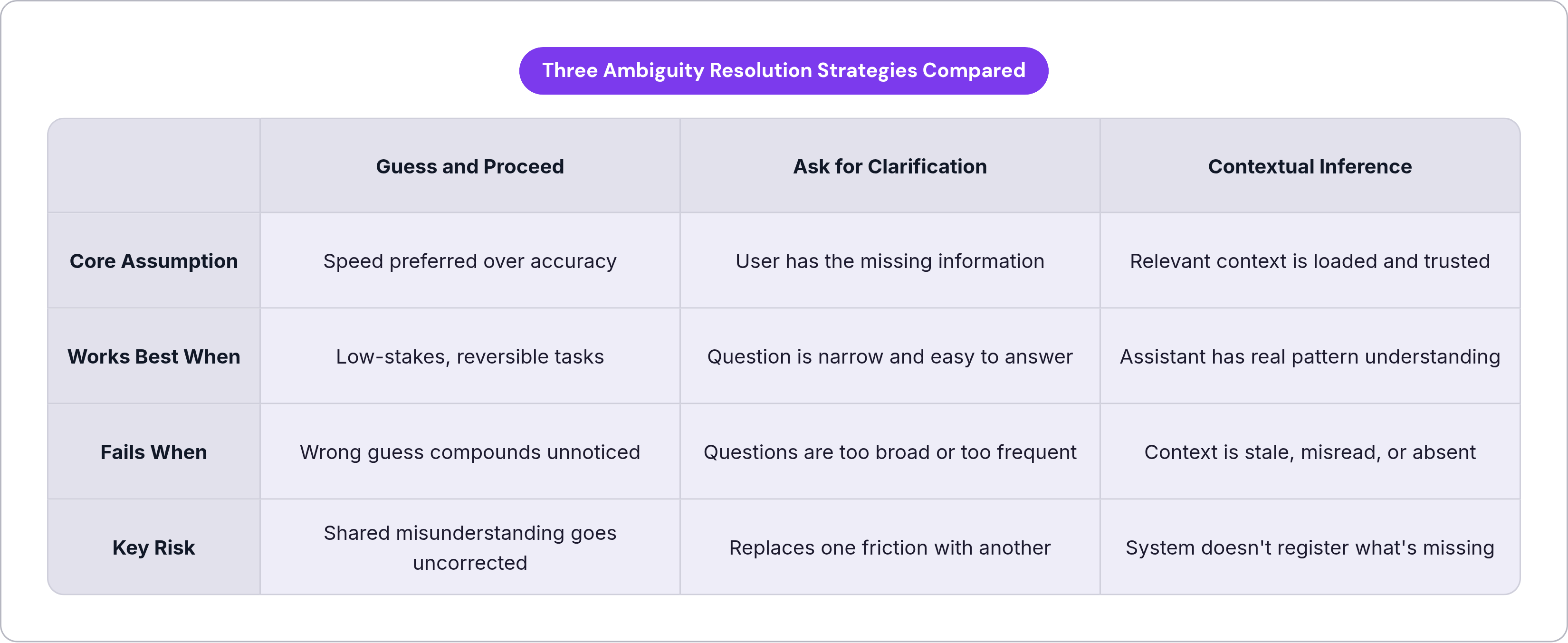
Once you start looking for it, you'll notice every AI assistant falls into one of three patterns when it hits unclear ground.
Guess and proceed. The system makes a silent call, fills in the blanks, and hands you an output as though the instruction had been crystal clear the whole time. This assumes you want speed over accuracy and that you'll catch mistakes on your own. It works fine for low-stakes, reversible tasks where the model's best guess is usually right anyway. It fails badly when the wrong guess compounds quietly: you accept the output, act on it, and only discover the mismatch downstream, sometimes far downstream. Worse, if the AI's confident wrong answer goes unchallenged, you and the model end up sharing the same misunderstanding. Nobody corrects course because nobody noticed there was a fork in the road.
Ask for clarification. The system stops and says, plainly, "I need more information before I can do this." It assumes you actually have the missing information and that the interruption is worth the accuracy gained. This works when the question is narrow and easy to answer, and when a wrong guess would be costly. It fails when the questions are too broad, too frequent, or ask you to specify something you genuinely don't know off the top of your head. That's the calibration problem: knowing when to ask, what exactly to ask, and how many questions is genuinely hard to get right. Get it wrong and you've replaced one form of friction with another.
Contextual inference. The system draws on prior conversation, your history, your role, and domain knowledge to resolve the ambiguity without asking or blindly guessing. This assumes the system has relevant context loaded and that the context can be trusted. It works when the assistant has real pattern understanding of how you work, not just what's in the current chat window. It fails when context is stale, misread, or missing entirely, and the system doesn't even register that something's missing. This is the closest thing to how a sharp colleague operates: reading the situation, not just parsing the words you typed.
Most real systems blend all three. The interesting design question isn't which strategy exists, it's which one leads, and under what conditions the system decides to switch.
How the research on clarification-focused systems shows what better resolution looks like
The most developed enterprise example I've come across is ECLAIR, published by Adobe researchers at AAAI in March 2025. It's a multi-agent setup: one agent detects ambiguity, another generates clarification questions, a third refines the response based on what the user says back. Tested against standard few-shot LLM methods on real-world data from the Adobe Experience Platform AI Assistant, it outperformed them. The modular design isn't just academic elegance either; it addresses practical constraints like latency, precision, and domain-specific jargon that generic models tend to flatten.
The real insight from ECLAIR is subtler than "ask better questions." It's that clarification questions should be scoped by what the enterprise context actually makes resolvable. There's no point asking a question the system has no way to use once answered.
The pattern shows up elsewhere too. ClarifyGPT (Mu et al., 2024) and ClariGen (Miao et al., 2025) built clarification directly into code generation and saw measurable accuracy gains on coding benchmarks. Same mechanism, different domain. Then there's CLARITI, a 2026 reinforcement-learning approach that optimizes for both accuracy and conversational efficiency, hitting strong performance with far fewer questions than baseline systems by prioritizing whatever is most resolvable and most relevant to the task at hand.
There's also a more mathematical way to think about this: treat every clarification question as an investment. Does asking this reduce uncertainty about what the user actually wants, or is it just noise dressed as diligence? That framing gives you a principled way to decide when to ask versus when to just infer and move on.
The thread running through all of this research: systems that handle ambiguity well treat it as a reasoning problem grounded in domain context. Not a text-matching exercise.
Where the productivity evidence actually holds — and where ambiguity erodes it
The productivity story around AI is real, but it's lumpier than the headlines suggest.
Federal Reserve research puts average generative AI time savings at 5.4% of work hours, roughly 2.2 hours a week, with frequent users seeing meaningfully more. But look at where those gains cluster: drafting, research, data analysis, coding, content creation. These are tasks where intent is relatively easy to specify upfront, or where mistakes are visible enough to catch and fix quickly.
Now look at the other side. MIT's Project NANDA, cited via saner.ai, found that 95% of enterprise generative AI pilots in 2025 showed no measurable profit or loss impact, despite tens of billions of dollars in investment. That's a staggering gap between money spent and value realized.
Here's a plausible read on why: tasks that involve judgment, unclear scope, or heavy context, exactly the conditions that breed ambiguity, are where AI assistance tends to stall or misfire. The human ends up spending the time they "saved" fixing what the model got wrong instead.
The NBER field study of 5,179 customer support agents backs this up from the other direction. It found a 14% average productivity gain, rising to 34% for novice workers. But the biggest gains showed up in the most structured tasks, the ones where intent was most predictable going in, not the messiest or most ambiguous ones. So the productivity dividend from AI isn't just a function of the model's raw capability. It's a function of how well the assistant handles the unclear parts of the request. A system that guesses wrong consistently turns saved time into rework, and rework doesn't show up as a line item until you go looking for it.
The control problem that emerges when AI acts on ambiguous instructions rather than just answering them
Answering a question wrong is annoying. Acting on a wrong interpretation is a different category of problem entirely.
There's a term for this that I think deserves more attention: delegation regret. A 2026 controlled study followed 20 university students using a general-purpose AI agent across tasks that varied in privacy sensitivity, stakes, and reversibility. What they found wasn't that the agent made technical errors people were upset about. It's that the agent sometimes acted beyond what the user would have authorized, had they been asked directly.
Trace that back to ambiguity and the mechanism becomes clear: the agent inferred scope from an unclear instruction, and it inferred more autonomy than the user actually intended to grant. That's not a wrong answer. That's an overstep.
The cost of that overstep isn't fixed. On a low-stakes, easily reversible task, guessing wrong and course-correcting is fine, even efficient. On something high-stakes, irreversible, or touching sensitive information, the same guess becomes a genuine liability. The resolution strategy an assistant uses should shift along that gradient, and right now, a lot of systems don't make that shift visibly or reliably.
It's worth considering why developers, of all people, remain the most skeptical group here. Stack Overflow's 2026 pulse survey found developers still prefer predictable, single-agent setups monitored closely by humans over fully autonomous agentic systems. That's not technophobia. That's professional experience talking, the kind you get from watching a system act confidently on the wrong assumption one too many times.
Microsoft's New Future of Work Report from 2025 makes a related point that I think gets underappreciated: as AI capability advances, human judgment becomes more critical in exactly the conditions where ambiguity lives, meaning context, ethics, creativity, not less critical. So the resolution strategy an assistant picks isn't just a UX detail. It encodes an entire implicit theory about what the human-AI relationship is supposed to be.
What makes a clarification strategy feel helpful rather than obstructive in practice
Calibration is the whole game here. One well-placed, well-scoped question at the right moment feels like working with someone sharp. Three broad questions before anything happens feels like being interrogated by a form.
A good clarifying question is one you can answer without needing to be an expert in the system asking it. If the assistant asks you to specify a technical parameter you genuinely don't know, that's worse than the assistant just making a reasonable guess and telling you it did.
That last part matters more than people give it credit for: transparency about what got inferred, even when no question was asked. Something as simple as "I read this as X, let me know if you meant something different" keeps you in the loop without breaking your flow. You stay in control without having to manage every micro-decision yourself.
Memory changes the whole equation too. A system that's learned your recurring tasks, your preferred formats, your typical constraints, can resolve ambiguity through grounded inference instead of interruption. The guess isn't random anymore; it's informed. And the reversibility principle from the delegation research applies directly here: the higher the stakes and the harder something is to undo, the more explicit confirmation is warranted. Routine, low-stakes tasks can run on reasonable inference without anyone needing to sign off.
What separates real augmentation from thinly-veiled automation, in my view, is whether the system surfaces its own reasoning. Does it keep you in the loop at the moments that actually matter, or does it optimize for looking decisive even when it's actually just uncertain and hiding it?
How leading AI work assistants handle ambiguous inputs — what to look for when evaluating them
The question worth asking isn't which assistant is smartest. It's which one handles unclear input in a way that fits how your team actually operates.
A few things worth checking when you're sizing one up:
Does it flag when it's made an inference, or does it present guesses dressed up as settled facts? Are its clarifying questions specific to your domain and easy to answer, or generic filler? Does it get better at reading you over time, reducing how much you have to re-explain? And does it adjust how much autonomy it takes based on the stakes, asking more before something irreversible, less before a low-stakes first draft?
Enterprise tools like Copilot and Gemini for Workspace have moved toward pulling in organizational context, calendars, documents, role information, to cut down on ambiguity through inference rather than back-and-forth questioning. How well that integration actually works varies a lot depending on the setup and how deep the connections run.
Vellum takes a related but distinct approach: the premise is that context and pattern understanding are what make AI assistance genuinely useful, not raw model horsepower. Its reasoning layer is built to learn how a user and team actually work over time, rather than treating every single prompt like a blank slate. That directly cuts down on ambiguity because the inference is grounded in real, accumulated context instead of a generic prior trained on the internet at large. It's a good fit for teams that want their AI to understand how they operate, not just parse what they typed into a box.
What to steer away from: assistants that always proceed silently with zero signal that an inference was made, or ones that ask so many broad clarifying questions upfront that they add more cognitive load than they remove. There's a simple test you can run yourself. Give the assistant a deliberately underspecified task and watch what happens. Does it make a visible, flagged choice? Does it ask one targeted question? Or does it hand you confident-sounding output that happens to be wrong?
What the gap between AI confidence and AI accuracy means for how humans should stay involved
Here's the part that should stick with you longest. A peer-reviewed 2025 study of 666 participants, published in Societies, found a real negative correlation between frequent AI tool use and critical-thinking performance, and cognitive offloading was the mechanism behind it. The effect was more pronounced in younger participants, the group with the least built-up habit of double-checking machine output before trusting it.
That finding sits right next to everything else in this piece and completes the picture. AI systems are often confident even when they're wrong, and ambiguity is exactly the condition under which that gap between confidence and accuracy widens the most. An assistant that guesses silently on an unclear instruction isn't just risking one bad output. It's training you, slowly, to stop checking.
So what does staying involved actually look like? Not hovering over every output the AI produces, that defeats the purpose of using the tool at all. It looks more like paying closer attention exactly where ambiguity was most likely to exist in the first place: the unclear terms, the missing constraints, the assumptions nobody stated out loud. Those are the spots where a system's confidence tells you the least about whether it actually got it right.
The tools that handle ambiguity well don't remove you from the loop. They tell you where the loop still needs you.