Mental Models for Better Decision Making
Naming your hidden assumptions lets you choose better tools for the problem you actually face.

What mental models actually are and what they do in the mind
Your brain cannot hold the full complexity of any real situation. It never could. So it builds compressed, working representations of how things operate and uses those representations to navigate decisions without reconstructing the world from scratch each time. That's a mental model. Not a philosophical abstraction, not a productivity buzzword. A functional cognitive tool you're already running, right now, whether you've named it or not.
What makes this strange is that the model guides your choices even when you can't articulate what it is. You can watch this happen in a meeting: someone defends a decision with confident-sounding logic, and when you press them, what they're actually defending is a tacit assumption they never examined. The reasoning was downstream of the frame. The frame was just never visible to them.
A model you can't name is a model you can't question. You can't swap it, stress-test it, or notice when it's pulling you toward the wrong outcome.
There's an old idea in epistemology worth borrowing: the map is not the territory. Every mental model is a map. Maps are useful precisely because they simplify, but simplification means omission. No two people carry identical maps of the same situation, even when they're staring at the same facts. What looks like a resource constraint to one person looks like a negotiation problem to another. Same terrain, different cartography. Neither map is complete. Both feel like reality to the person holding them.
The implication is counterintuitive. The goal isn't to find the one true model and apply it universally. It's to hold several, understand what each captures and what each leaves out, and get better at choosing deliberately. That's a harder practice than it sounds, which is probably why most people avoid it.
Why most people default to the same few models without realizing it
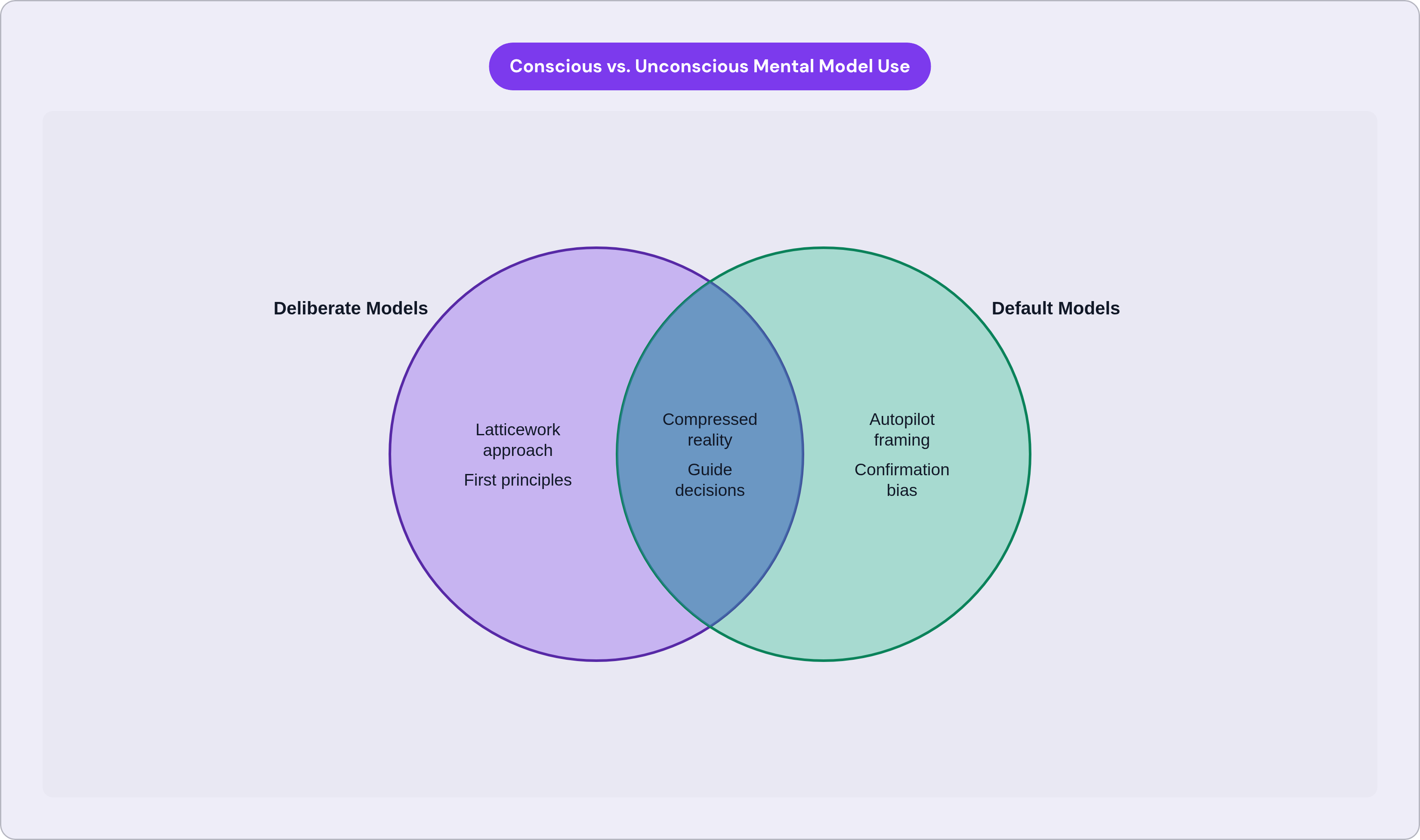
Everyone uses mental models. The gap isn't between people who use them and people who don't. The gap is between those who choose their models consciously and those who let habit choose for them.
In practice, most people rely on the same small cluster of frameworks across every situation, regardless of fit. The model that worked last time gets pattern-matched onto the next situation that feels vaguely similar. The decision feels reasoned. Often it isn't. It's a familiar frame on autopilot, dressed in the language of analysis.
Two people, same information, same decision to make. One spends weeks cycling through scenarios without landing anywhere. The other works through it in two days and arrives somewhere defensible. The difference isn't raw intelligence. It's rarely even experience. It's the tools each person brings, and whether they've noticed which tool they're actually reaching for.
When someone has only one or two models, reality gets contorted to fit those models rather than the reverse. This is how cognitive biases actually operate. Confirmation bias isn't a separate malfunction layered on top of normal thinking; it's what happens when a single mental shortcut gets applied past its useful range. The availability heuristic, attribution errors, overconfidence in familiar domains: these are model-selection failures. They feel like reasoning because the person applying them has no vantage point outside the frame.
Hanlon's Razor makes the point concretely. The principle says to avoid attributing to malice what can be adequately explained by error or miscommunication. When someone defaults to assuming bad intent and keeps being wrong, the problem usually isn't that they lack information. They're applying the wrong explanatory model to human behavior, and nothing in their current toolkit is prompting them to reconsider. The frame keeps fitting just well enough to survive.
The stakes compound from there. Each decision made through the wrong frame creates conditions that the same frame is poorly equipped to diagnose. The error doesn't just produce one bad outcome. It makes the next one more likely.
How Charlie Munger built the case for a deliberate collection of models
Charlie Munger was not a scientist, a philosopher, or an academic. He was a practicing investor and business mind who became one of the most distinctly multidisciplinary thinkers of his era, not because he accumulated information, but because he accumulated structures for understanding.
His core argument was that real comprehension doesn't come from more facts. It comes from building an interconnected web of models drawn from many disciplines: mathematics, physics, biology, psychology, economics, history, philosophy. What he called the latticework. The point wasn't breadth for its own sake. Real-world problems don't respect academic boundaries, and a person equipped with models from only one discipline is structurally blind to the dimensions that only other disciplines illuminate. You can be a deep expert in your field and still be consistently wrong because the variable driving the outcome lives in a domain you never developed tools for.
Munger's practical estimate was somewhere between 80 and 90 key models, drawn across the major fields, sufficient to navigate roughly 90% of the complex situations life generates. Not thousands. Not a lifetime of specialization in every domain. A carefully developed working set.
The structural benefit of the latticework gets underappreciated. When you hold models from multiple disciplines, those models will periodically contradict or complicate each other. That friction is intentional. It enforces intellectual humility in a way that willpower alone can't, because it becomes structurally difficult to cling to one simplistic worldview when you keep encountering frameworks that refuse to confirm it.
The limits are real, though. Multidisciplinary fluency takes time, sustained curiosity, and deliberate practice. The risk is that surface-level exposure to many fields produces shallow cross-disciplinary analogies rather than actual insight. Borrowing the vocabulary of physics to dress up a business argument is not the same as applying physical reasoning. The latticework can become a costume rather than a tool, and that failure mode is hard to detect from the inside.
The underlying principle holds regardless: consciously expanding the range of models available to you, even incrementally, produces better decisions over time. Not because you'll pick the right model every time. Because you'll occasionally pick a better one than you would have otherwise.
First principles thinking: when to break a problem down to its foundations
Most of what we call reasoning is pattern-matching against things that have worked before. That's appropriate most of the time. Precedent exists because reality repeats itself often enough to be worth recording. But sometimes you hit a problem where the conventional frame has already failed, where everyone in the room is stuck in the same assumptions without realizing those assumptions are the actual obstacle.
First principles thinking is what you reach for then. The method: identify what is physically or mathematically true about a problem. Strip away everything that is merely conventional, inherited from earlier constraints, or assumed simply because it's been that way for a long time. What remains is the actual terrain.
The space that opens up is the gap between "physically impossible" and "conventionally assumed to be impossible." That gap is where most genuine breakthroughs live, and it's often wider than people expect when they first look carefully.
The SpaceX case gets cited constantly because it's concrete. The question wasn't what launch contracts had historically priced at, or what the industry assumed was reasonable. It was what the physical materials and processes actually required. The gap between those two numbers turned out to be enormous, and exploiting it restructured an entire industry's cost assumptions.
But applying first principles thinking indiscriminately, to every decision regardless of stakes or novelty, is its own problem. The analysis is expensive in cognitive effort and time. Applying it to decisions that analogy or precedent handle adequately is inefficient at best and paralyzing at worst. The discipline isn't to apply it everywhere. It's to recognize the specific conditions where it earns its cost: high stakes, novel problems, situations where the conventional frame has demonstrably failed you already.
Getting to accurate premises is one thing. What you still need, once you have them, is a way to trace where those premises actually lead before you've committed.
Inversion and second-order thinking: tracing consequences before you commit
Inversion is exactly what it sounds like. Instead of asking "how do I succeed?" you ask "what would guarantee failure?" or "what's currently preventing success?" The shift is small in form and significant in effect. It surfaces blind spots that optimistic planning almost never reaches, for a simple reason: human cognition is naturally oriented toward positive outcomes. Failure scenarios don't arrive voluntarily. You have to go looking for them.
The mathematical lineage runs through Carl Jacobi, the nineteenth-century mathematician who noticed that hard problems often become tractable when you reverse them. Munger imported the principle into everyday decision-making. There's a particular situation where I've found it most useful, not when the decision is murky, but when I'm highly motivated to reach a specific conclusion. That's precisely when optimism is most dangerous. Asking what would make this fail is less a planning exercise than a check on motivated reasoning.
Second-order thinking extends the inquiry one step further. Not "what will happen?" but "and then what?" You map the consequence chain before committing, rather than discovering it afterward when the options are narrower.
Robert K. Merton identified five sources of unintended consequences: ignorance, error, prioritizing immediate interest over long-term outcomes, values that prohibit certain analyses, and self-defeating prophecies. At least four of those five are failures of second-order thinking. The analyst traced the chain until it became uncomfortable or inconvenient, then stopped.
Tesla's extreme-automation strategy is useful here. The first-principles analysis of battery costs was sound. What it failed to surface was what would happen when those physics met a factory full of humans and machines at scale. Operational complexity overwhelming theoretical physical efficiency is a second-order consequence, and it failed to appear because the analysis was focused on the right question at the wrong level.
Inversion maps backward from a failure state. Second-order thinking maps forward from a decision point. Together, they bracket the decision from both directions, which is considerably more reliable than examining it from only one.
Occam's Razor, the Pareto Principle, and probabilistic thinking: managing complexity without drowning in it
At some point in any serious analysis, you face a different kind of problem. Not "what's actually true?" but "how much complexity is actually necessary here?" These three models address that question, and they're worth grouping together because each one is easy to misuse in isolation.
Occam's Razor: when competing explanations fit the available facts equally well, prefer the one requiring fewer assumptions. The principle doesn't claim simplicity is correct. It claims complexity has to earn its place. Every additional assumption is another point of failure, and if the simpler explanation accounts for the evidence, the elaborate one requires justification before it gets your attention.
The caveat matters. A theory too simple fails to capture reality; one too complex collapses under its own weight and becomes untestable. Occam's Razor works as a tiebreaker and a check on unnecessary elaboration. It breaks down the moment someone uses it to justify ignoring evidence because a simpler story is more comfortable.
The Pareto Principle operates differently: roughly 80% of effects come from 20% of causes. The specific numbers are a heuristic rather than a physical law, but the directional insight is robust across a wide range of domains. In any diagnosis, whether of a failing process, a product with low adoption, or a team with chronic miscommunication, the Pareto lens asks which small set of factors is doing most of the causal work. That's where attention and effort should concentrate first, before you spread resources evenly across everything and end up with diluted effort everywhere.
Probabilistic thinking asks you to hold explicit uncertainty. Not "X will happen" and not "I don't know," but "I think there's roughly a 60% chance of X, and here's the reasoning behind that estimate." The value isn't precision. It's that someone who quantifies uncertainty, even roughly, can actually update when new evidence arrives. Someone operating in binary convictions can't, because there's no mechanism for partial updating. They either fully change their mind or they don't, and often they don't.
What connects these three is a concern with calibration: knowing when you have enough analysis to decide, and knowing which direction you're more likely to err. They guard against opposite failures, under-thinking and over-thinking, which is why they're more useful together than any one of them is alone.
Circle of competence: knowing where your models are actually reliable
Every person has a domain where their knowledge is deep and well tested. In that domain, pattern recognition is reliable because it's been calibrated against real outcomes. Outside that boundary, the same confidence can be actively dangerous. The patterns feel similar. The dynamics are different. And the person applying them usually can't tell, because nothing in their current model flags the discrepancy.
The relevant question isn't just "do I understand this topic?" It's "have I made predictions in this domain and been wrong often enough to know where my understanding breaks down?" That second question is harder to answer carefully. The first time I stepped outside a domain where I had genuine depth, I didn't realize I'd done it. The signals that usually told me when I was on uncertain ground were simply absent. That's the specific failure mode: not that you feel uncertain, but that you feel just as confident as you do when you actually know what you're doing.
Fluency in the language of a model is not the same as understanding it well enough to apply it reliably. Someone can describe second-order thinking with precision and still miss the second-order consequences of their own decisions. The verbal model and the operative model are different things. Knowing one doesn't guarantee having the other, and it's easy to confuse them because they feel identical from the inside.
The practical discipline is to ask, before applying a model to a high-stakes decision, whether you understand the domain well enough to know when the model's assumptions hold and when they break. The careful answer is often "not as well as I assumed." That answer is useful. It's also uncomfortable enough that most people find ways to avoid arriving at it.
The circle expands through deliberate practice in adjacent domains, combined with honest tracking of where your predictions were wrong. Not general reading, not passive exposure. Active use, feedback, and revision. That's also what makes the latticework approach work in practice: when ideas from outside your home domain challenge your models, those challenges can only land if you're already tracking where your models have failed you before.
Why deliberately building a wider set of models improves judgment over time
Each model added to a working repertoire doesn't just help in the situations it directly addresses. It changes how adjacent situations appear, because there's a new angle from which to notice things. The repertoire becomes more interconnected over time, and each addition increases the usefulness of what was already there. The growth isn't linear. It compounds, slowly at first, then faster.
Research on mental model formation points to something practically important here: the cognitive effort you invest in actively constructing or revising a model, working through where it applies and where it fails, produces more durable understanding than models absorbed passively. Reading about inversion and actually inverting a high-stakes decision you're currently facing are not equivalent activities. The second one builds something the first one doesn't, and you can feel the difference the next time you're under pressure and reach for a tool that's actually there.
This has concrete implications for how you close feedback loops. When a decision goes wrong, the diagnostic question isn't just "what did I miss?" It's "which model was I applying, and would a different one have surfaced what I missed?" That specific question is what builds judgment over time rather than just accumulating regret. Without it, you learn that you were wrong. With it, you learn something you can use.
The latticework isn't built by memorizing a list of frameworks. It's built by repeatedly choosing models consciously, applying them to real decisions, checking outcomes against expectations, and revising. That cycle is the mechanism. Shortcut any step and you end up with the verbal model rather than the operative one.
What it really comes down to is a single habit: asking "what kind of problem is this?" before reaching for a familiar frame. That question is a meta-practice, a categorization step that sits above all the individual frameworks and activates the one actually suited to the situation. Most people skip it. They reach for what's familiar, which means they're choosing on autopilot. Asking it consistently, before the next decision that actually matters, is the difference between deliberate thinking and sophisticated pattern-matching dressed up as analysis.