AI Memory Systems for Long-Term Personalization at Scale
How AI systems are building persistent memory to learn from users over time.
The transformer architecture has no native mechanism for retaining information across sessions, which means every conversation begins at zero. Engineers did not forget to add persistence; the model simply remembers nothing by design.
You can grow the context window to a million tokens, as some frontier models now support, and the problem does not go away. It shifts shape. Longer windows degrade signal density; the model attends less reliably to content anchored at the far end of a very long context. And when the session ends, the window expires, taking everything with it. Stuffing conversation history into context to simulate memory is also economically unsustainable: costs scale directly with token count. One engineering blueprint from early 2026 found developers spending roughly 15 to 25 percent of interaction time simply re-establishing context with AI agents, which is the kind of overhead that a personal AI assistant like Vellum, one that maintains persistent memory and learns user preferences across sessions, is designed to reduce. That is not a rounding error; it is a direct productivity tax on statelessness.
Sam Altman, in April 2025, described his excitement about AI systems that get to know you over your life. That framing is useful because it names what the industry is actually building toward: agents that track evolving goals, carry organizational knowledge forward across long-running workflows, adapt to individual preferences accumulated over months or years. That ambition requires memory architecture, not bigger windows. The question is what kind.
Cognitive science has had a working taxonomy of memory for decades. The CoALA framework, published by researchers at Princeton in 2023, formalized that taxonomy for LLM agents and gave the field a common vocabulary. IBM, MongoDB, Letta, and Mem0 all use versions of this model in their documentation. When a framework that originated in academic research shows up in the docs of that many production platforms, it has effectively become the de facto standard.
CoALA organizes agents along three dimensions: information storage, action space, and decision-making loop. Memory lives in the storage dimension, and it maps to four types.
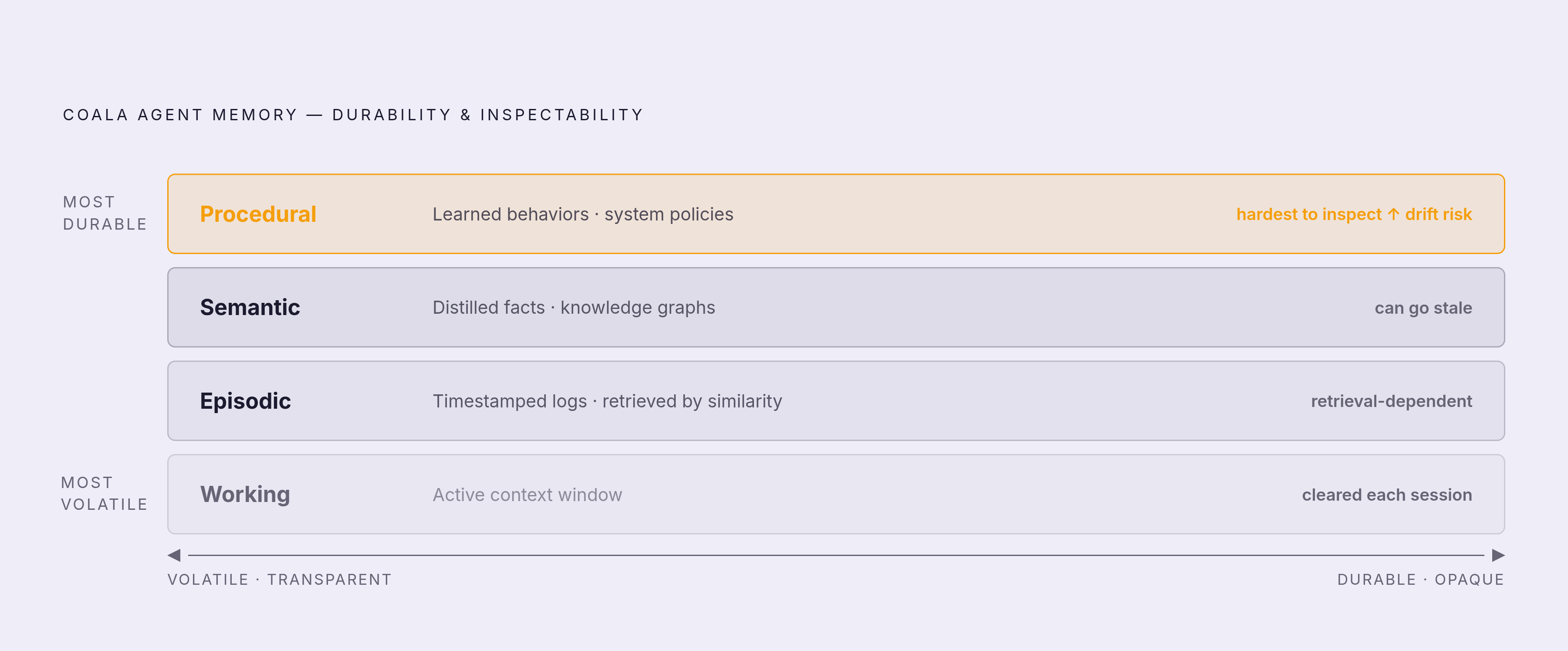
Working memory is the active context window, everything the agent can see right now. No retrieval overhead, effectively immediate, bounded by window size and cost. Volatile by definition: cleared at session end.
Episodic memory is the timestamped log of past interactions and observations, the autobiographical layer. Retrieved by similarity or recency, stored in vector databases or structured logs. This is the closest thing to what users mean when they say "the AI remembered what we talked about last month." It is not perfect recall; it is an indexed approximation of experience.
Semantic memory is distilled knowledge extracted from past experience: key-value stores, knowledge graphs, or structured databases holding refined facts rather than raw conversation history. "This user prefers metric units." "This organization's approval threshold is $50,000." Semantic memory is what episodic memory becomes after it has been processed, compressed, and made queryable.
Procedural memory is the most durable and the hardest to inspect. It encodes learned behaviors, tool preferences, and system-level policies. After an agent learns that a particular user wants concise answers, it permanently adjusts its output style. The agent is effectively rewriting its own instructions based on what worked. That is powerful, and it is also the layer that carries the highest drift risk. I want to sit with that tension for a moment before moving on, because the same property that makes procedural memory useful is what makes it dangerous when things go wrong.
One implementation choice cuts across all four types: the dominant approach is non-parametric memory, meaning information stored in external files and data stores rather than baked into model weights. This makes memory auditable, updatable, and deletable. These are hard requirements for any system that needs to pass a compliance review or respond to a user's right-to-be-forgotten request, not merely nice-to-have properties.
How the four types compose into working memory architectures
No single architecture implements all four memory types equally well. The pattern you choose reflects what the use case actually demands, and the tradeoffs are real in ways that only become obvious when something breaks in production.
Hierarchical memory, inspired by operating systems
The MemGPT research project, which became the commercial platform Letta, treats the LLM as an operating system. Three tiers: core memory always resident in context, archival memory as a vector-searchable long-term store, and recall memory as a recent interaction log. The agent controls paging through LLM function calls, deciding what to promote into active context and what to evict, giving it full autonomy over its own cognitive state.
Letta raised a $10 million seed from Felicis Ventures in September 2024. In LongMemEval evaluations, Letta scored 83.2 percent, the highest among frameworks assessed. The tradeoff is operational complexity: giving the agent control over its own memory means trusting it to make good eviction decisions, and that trust is not always warranted. I have seen this become a real problem when an agent decides to evict exactly the context that would have prevented a downstream error.
Graph-structured memory
Representing memory as nodes and edges that evolve over time changes what kinds of questions a memory system can answer. Static vector retrieval tells you what is semantically similar. Graph retrieval tells you how entities relate and how those relationships have changed. HippoRAG, published in 2024, uses knowledge graphs for information integration. Zep and Mem0 both adopt graph structures in their architectures.
The strength here is temporal evolution. "Portfolio composition changed in March; medication dosage updated in April." Financial services and healthcare are domains where facts regularly contradict each other across time, and graph memory handles that contradiction by maintaining edges with temporal metadata rather than overwriting stale facts.
Flat vector stores
The simplest implementation: embed memories, retrieve by cosine similarity. Lowest operational overhead, easiest to stand up, sufficient for many use cases below a certain scale. The ceiling on precision is real, though, and it deserves more attention than it usually gets.
Hybrid architectures as the production default
In practice, neither vector nor graph retrieval is sufficient alone. Mem0's architecture combines a vector database with a knowledge graph and an extraction pipeline that converts raw conversations into atomic memory facts before storing them. The hybrid acknowledges that semantic similarity and relational structure answer different questions, and production memory systems need to answer both.
Multi-scope memory as a cross-cutting design pattern
Every memory write in a well-engineered system gets tagged with identity scopes: user ID, agent ID, session or run ID, application or organization ID. Those scopes compose at retrieval time; the pipeline merges and ranks results automatically. This prevents cross-user memory leakage, which is an edge case teams often overlook in a multi-tenant system. It is the default threat.
Cognitive and self-organizing memory
Nemori, published in August 2025, represents an emerging direction. It autonomously segments conversation streams into semantically aligned episodes and continually updates semantic knowledge through prediction-calibration loops grounded in the Free-Energy Principle. The shift is from passive fact extraction to active knowledge integration: the system is not just storing what happened; it is revising its model of the world in response to new evidence. That is a meaningful architectural leap, and it gestures at where the field is heading, even if most production teams are nowhere near implementing it yet.
What the current framework ecosystem looks like in practice
Four frameworks dominate the open-source and commercial landscape heading into 2026. Each represents a different bet on which architecture pattern matters most.
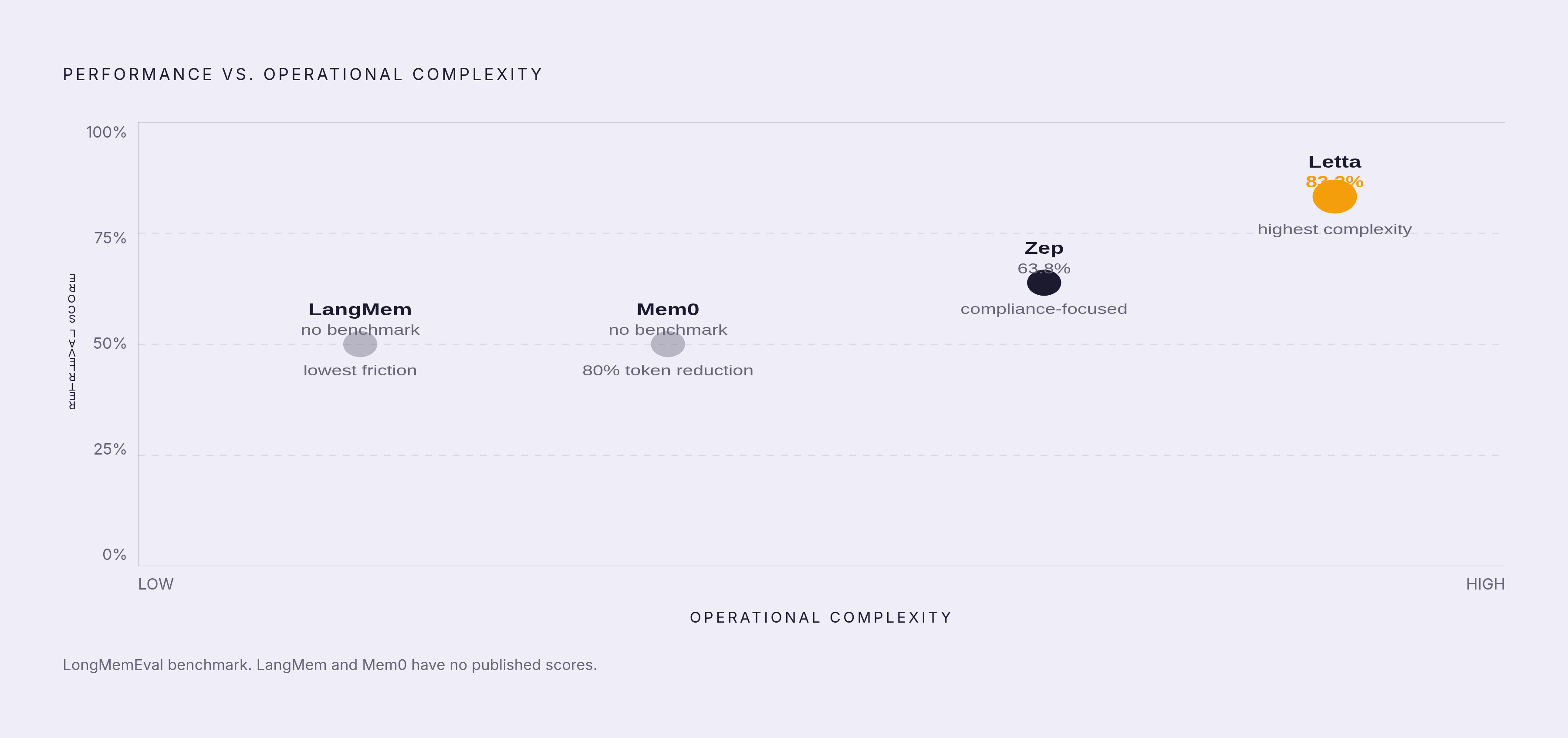
Mem0 has accumulated over 48,000 GitHub stars, positions itself as general-purpose, and was selected as the exclusive memory provider in the AWS Agent SDK. The company claims up to 80 percent prompt token reduction through memory compression, which is a direct cost argument at scale. Mem0 closed a $24 million Series A in October 2025, led by Basis Set Ventures with participation from Peak XV Partners, the GitHub Fund, and Y Combinator.
Zep and its Graphiti layer focus on temporal knowledge graphs and scored 63.8 percent on LongMemEval. The managed Zep cloud carries SOC 2 Type 2 and HIPAA certification. That compliance positioning is deliberate: it is a play for financial services and healthcare, domains where fact evolution is the core memory challenge.
Letta, already described above, leads on LongMemEval with 83.2 percent and dominates the long-running stateful agent sub-criteria. It is the most powerful option and the most operationally complex, a combination that demands honest self-assessment about your team's capacity before adoption.
The retrieval strategy divergence matters: vector memory retrieves by semantic similarity; graph memory retrieves through entities and relationships. Both are useful; neither is sufficient alone. Framework evaluations suggest that vector-only approaches will approach commoditization within roughly twelve months as teams discover retrieval precision degrades below useful thresholds after approximately 500 memory entries.
Platform-level rollouts confirm the directional consensus. Google rolled out Gemini memory in February 2025 and launched Vertex AI Memory Bank with TTL-based expiration for enterprise. OpenAI expanded ChatGPT memory to all users by June 2025. Anthropic introduced conversation recall in August 2025. xAI added long-term memory in April 2025. At the frontier, persistent memory is now table stakes.
Where persistent memory delivers measurable value — and where the architecture requirements diverge
Tribe AI reported in 2025 that optimized memory reduced LLM API costs by 30 to 60 percent and lifted user retention in personalized AI applications by 40 to 70 percent. That is a significant spread in both ranges, reflecting how much architecture choices and use case fit influence outcomes. But the directional claim is consistent across multiple teams.
Healthcare illustrates why the architecture requirements become demanding in real deployments. Abridge uses memory to personalize clinical documentation, drawing on past interactions and physician preferences to generate context-rich medical records. Tools in this space, including Abridge and Microsoft Nuance DAX, have vendor-reported evidence of saving clinicians meaningful time each week. The next architectural frontier in clinical settings involves dynamic environments like emergency rooms, where patients pass between multiple clinicians. Memory must persist across agent handoffs, not just sessions, and that changes the identity-scoping requirements substantially.
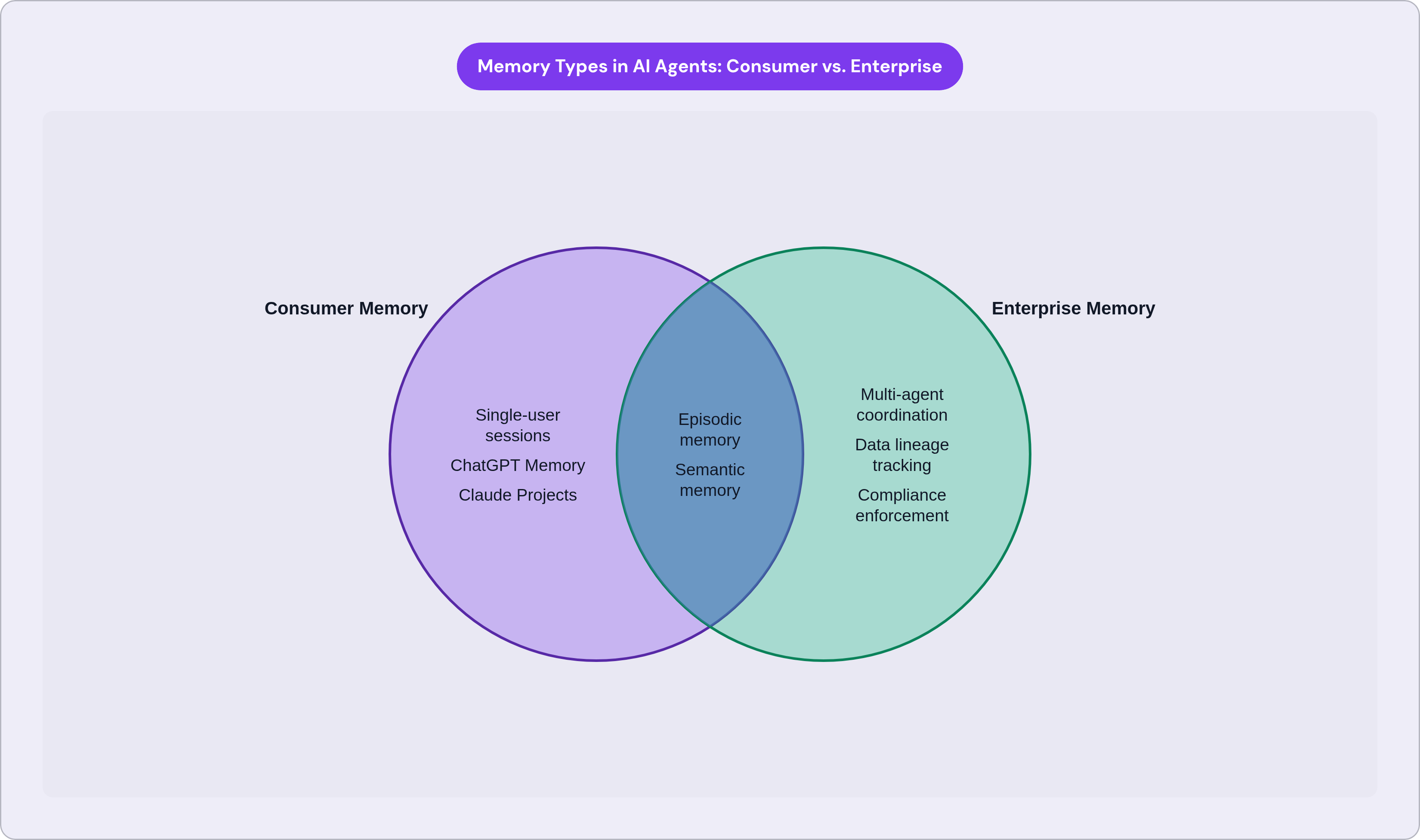
Consumer and enterprise memory are not the same problem, and treating them as equivalent is an architectural mistake. Consumer memory, as implemented in ChatGPT Memory or Claude Projects, personalizes for one user across their own sessions. The failure mode for consumer memory is a bad user experience: annoying, sometimes embarrassing, but recoverable.
Enterprise memory operates at a different order of complexity. It coordinates memory across dozens or hundreds of agents simultaneously, enforces governance policies, maintains data lineage, supports compliance, and provides consistent organizational state across teams. The failure mode is a bad experience only at its mildest; at scale it means agents producing contradictory outputs, compliance violations, or acting on stale, uncertified organizational knowledge. The distance between those two failure modes should inform how much engineering investment each context warrants. I have seen teams underestimate this gap badly, and the debugging sessions that follow are unpleasant.
The scale feasibility question has skeptics whose argument is not frivolous. Per-user models demand nontrivial compute; constructing comprehensive personalized preference datasets across a user base of billions is a genuinely hard problem. The counter-argument is practical: parameter-efficient methods like LoRA enable personalization with minimal per-user overhead. S-LoRA serves thousands of concurrent adapters on a single GPU. Purica demonstrates meaningful throughput improvements for multi-tenant serving. Cold-start for new users remains an active engineering problem. It is solvable, but it requires deliberate design rather than assumption.
How retrieval precision degrades at scale and why vector search alone fails
Here is the geometry problem that vector-only architectures run into eventually. The same property of vector space that makes similarity search work at small scale is the thing that causes it to fail at large scale. As the memory index grows, semantically similar but contextually wrong facts become neighbors in embedding space. An agent that retrieved correctly against 100 documents starts hallucinating against 10,000. A customer-support bot that answered every query correctly in beta starts inventing policies in production. The degradation is not linear, and it is not obvious until it is already causing problems.
The empirical threshold that framework evaluations have surfaced is around 500 memory entries. Below that, vector-only retrieval generally maintains acceptable precision. Above it, precision degrades below useful thresholds for many production use cases. That is not a law of physics, and better index construction or reranking can push the threshold higher. But the ceiling is real. Teams building on vector-only architectures should be testing retrieval quality at the scale they expect to reach, not the scale they are at today.
Temporal awareness is the specific gap that vector search cannot fill by design. Cosine similarity has no concept of "this fact was true in January and was superseded in March." Two facts about the same entity will cluster in embedding space regardless of which one is current. Graph-structured memory with temporal edges on relationships is the engineering response. It adds operational complexity, but it answers a category of question that vector search structurally cannot.
The Mem0 team published a list of open engineering problems in 2026 that maps directly to categories of production failure: temporal abstraction at scale, meaning the ability to model how memories evolve across sessions rather than overwrite each other; memory staleness, meaning the detection and handling of facts that were once correct but are no longer; cross-session identity resolution, matching the same user across devices and anonymous sessions; application-level evaluation frameworks for measuring whether a memory system is actually working correctly in a deployed product; and robust privacy and consent architectures governing who can read, update, or delete a given memory entry.
None of these are theoretical. Each maps to an incident category that production teams have already encountered.
The failure modes that accumulate in evolving memory systems
Static retrieval-augmented generation has a contained failure mode: a retrieval error affects one response. Memory systems that evolve over time have a compounding failure mode. Each wrong fact can be retrieved, acted on, and reinforced in future writes. The errors do not stay isolated; they propagate, and by the time you notice them they have already shaped downstream behavior in ways that are difficult to trace back.
The SSGM Framework paper, published in March 2026, provides a failure taxonomy worth designing against from the start.
Semantic drift is the gradual distortion of facts through repeated summarization. Episodic memory gets compressed into semantic memory; semantic memory gets summarized again over time. Each pass introduces small errors. Small errors compound. A fact that was nuanced and accurate at first encoding becomes subtly wrong, then directionally wrong, then actively misleading. The insidious part is that this happens slowly, in ways that no single retrieval makes obvious.
Procedural drift is the reinforcement of suboptimal workflows. The agent learns the wrong habit, encodes it as procedure, and executes that procedure reliably from then on. Procedural memory is the most durable of the four types; once a behavior is encoded there, it persists and generalizes. An agent that has internalized a bad process will apply that process with consistency and confidence, which is exactly what makes it hard to diagnose.
Hallucination internalization is perhaps the most counterintuitive failure mode, and the one I find most worth dwelling on. The agent retrieves a hallucinated fact from a prior session, treats it as ground truth because it came from memory rather than generation, and begins reasoning from a false foundation. Memory is supposed to ground the agent in reality. Internalized hallucination inverts that function; the memory store becomes a source of confident errors.
These three failure modes share a common structure: they exploit the properties that make memory systems useful in the first place. Persistence, retrieval by similarity, and procedural reinforcement are what make agents intelligent across time. They are also exactly what allows errors to become durable and self-reinforcing. Designing against that requires auditing mechanisms, staleness detection, and the kind of memory governance that most teams implement only after encountering a production incident. That sequencing, governance after the incident rather than before, is a pattern worth actively resisting.
Persistent memory is not a feature you add to an agent. It is a capability that changes the agent's relationship to time, context, and error in ways that surface slowly and compound quietly. The architecture patterns are crystallizing. The failure modes are becoming better understood. The evaluation frameworks are nascent. What is already clear is that the systems being built now will carry their memory architectures for a long time, and the choices made early have a way of becoming very difficult to undo.