LLM Cost and Latency Trade-Offs for Individual Developers
Comparing models requires measuring cost per task, not cost per token.

The core problem for a solo developer building on top of large language models is figuring out how cost, output volume, and latency interact. It's figuring out how cost, output volume, and latency interact, because those three things pull against each other constantly. Pick wrong and you either burn through a budget you didn't plan for, or ship something so slow nobody sticks around to use it.
How providers bill, and the three token categories that matter
Every major provider charges per million tokens, split into two buckets: input (what a person sends) and output (what the model writes back). Output costs more, and there's a real reason for that: generating each token requires a full pass through the model, done one token at a time, in sequence. Reading a prompt is comparatively cheap. Writing a response, token by token, isn't.
That price gap is steep. Anthropic charges roughly 5 times as much for output as input. OpenAI runs closer to 6 times. Practically, that means a chatty model, one that pads its answers, explains itself twice, or adds boilerplate, will hurt a budget far more than a long prompt ever would. Response length, not prompt length, is what drives cost. Response length is.
Then there's a third bucket most developers forget to budget for: reasoning tokens. These are the model's internal "thinking" steps, generated before it writes the answer someone actually sees. They show up on the bill. They don't show up in the output. On reasoning-heavy tasks, the effective cost per useful token can run well above whatever the rate card advertises.
Two more traps come from the tokenizer and context-length pricing structures themselves. Starting with Claude Opus 4.7, Anthropic's newer tokenizer breaks the same piece of text into more tokens than before, somewhere between 0% and 35% more, averaging around 30%. Providers don't price the tokenizer change into a quote up front; the added tokens appear as a bigger invoice for the same work. And long-context pricing has cliffs built into it. Gemini 3.1 Pro jumps to $4/$18 per million tokens once a prompt crosses 200,000 tokens. GPT-5.6 doubles its input rate, and raises output pricing by a further margin, past 272,000 input tokens. Cross that line without knowing it's there, and the bill for that one request looks nothing like the one before it.
So the rate card on a provider's pricing page is a starting point, not an answer. Real cost depends on how verbose the model gets, how much it reasons silently, which tokenizer version is running, and how long the context window stretches.
What the current model tiers cost
Think in tiers by what the task actually needs, not by which provider a developer happens to like.
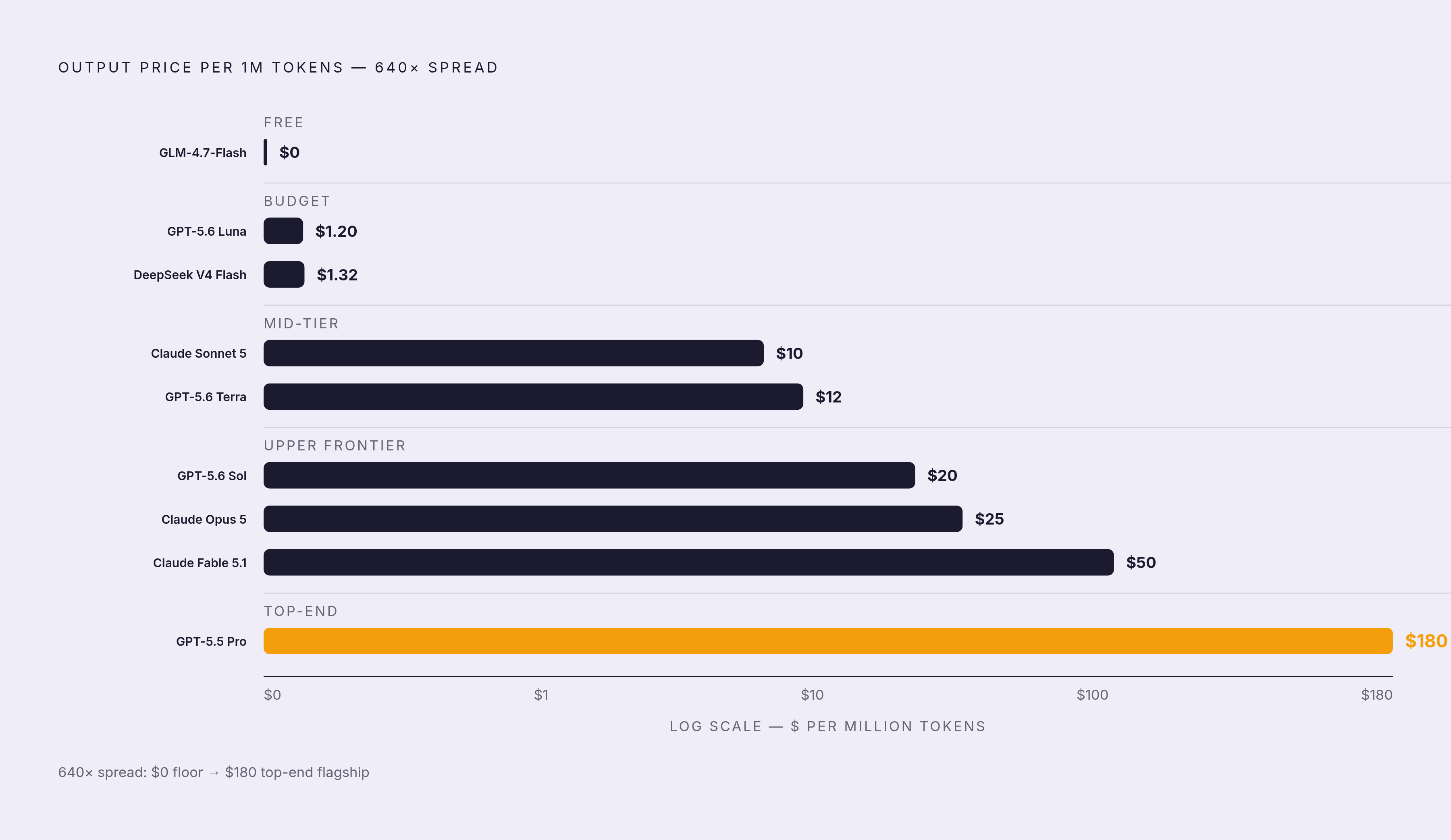
At the absolute floor sit free or near-free models built for high-volume, low-stakes work: Z.AI's GLM-4.7-Flash (free), GLM-5.3-Flash at low flash rates, Ling 3.0 Flash from inclusionAI, and Qwen3.7 Flash. These are fine for classification, formatting, and routing decisions, tasks where the bar for "good enough" is low and mistakes are cheap to catch.
One step up is the budget production tier, where some genuinely strong performance is available cheap. MiniMax M3 runs $0.30/$1.20 per million tokens and scores above 80% on SWE-bench Verified, reportedly the cheapest model to clear that bar. DeepSeek V4 Flash is $0.44/$1.32 at peak hours, half that off-peak. GPT-5.6 Luna, after OpenAI's July 30, 2026 price cut, is $0.20/$1.20.
The real fight is happening at $2 input, the most contested price point in the entire market right now. Claude Sonnet 5 ($2/$10), GPT-5.6 Terra ($2/$12), and Gemini 3.1 Pro ($2/$12) are all camped there, competing directly. Anthropic made its $2/$10 Sonnet 5 pricing permanent on August 10, 2026, and canceled a planned September 1 increase to $3/$15. Providers are choosing to hold this price point rather than raise it, because losing developers to a competitor at the same tier costs more than the margin they'd gain.
Above that sits the frontier tier: GPT-5.6 Sol at $4/$20, Claude Opus 5 at $5/$25, and Claude Fable 5.1 at $10/$50. Fable 5.1 carries a public benchmark score of 84.76, and the related Claude Fable 5 hits 95.0% on SWE-bench Verified, genuinely strong numbers. But the spread across the whole market, from cheapest to priciest flagship output token, runs from around $0.28 per million all the way to $180 per million. That's something like a 640-fold difference on a current price list, with GPT-5.5 Pro at $30/$180 sitting near the top.
For a solo developer picking a workhorse model, two numbers matter most: Claude Sonnet 5's 85.2% on SWE-bench Verified, and Gemini 3.8 Flash as arguably the cheapest model that still clears a score of 70. Pricing for Qwen3.8 Max, GLM-5.3, and Ornith-1.5-397B shows up as "not listed" or conditionally free in current sources, so treat those as unconfirmed until a rate card actually says otherwise.
Why "cheapest per token" is the wrong metric
The math gets misleading if taken at face value. A model that looks cheap per token can still cost more per finished task, because the token count itself isn't fixed. If a budget model produces roughly twice the output tokens of a mid-tier model answering the exact same prompt, its actual bill can end up higher than the "expensive" option. Cheap per token doesn't mean cheap per answer.
The math bears this out in practice: running the same task across models at different price points can produce dramatic cost differences before any batching is applied, differences that never appear when comparing dollar-per-million-token rates on a spec sheet.
Quality failures compound the problem. A budget model that needs three attempts to get a task right, or a longer prompt to compensate for weaker instruction-following, or a human to clean up its output afterward, is not actually the cheap option anymore. It just looks that way on the invoice for a single call.
Reasoning tokens make this worse in ways that are hard to predict ahead of time, especially in agentic pipelines where multiple models hand work back and forth. Those setups burn through far more tokens than a single chat session ever would, and the reasoning overhead stacks at every step.
Real-world benchmarks consistently show that both high-end and budget flash-tier models can hit similar accuracy levels, just at very different price points for the same result. The variable that actually mattered wasn't which model had the best reputation. It was whether the model fit the task. That's the real question to ask: cost per correctly completed task, not cost per token, which means actually running candidate prompts through candidate models and measuring real output lengths before committing to anything.
Latency isn't one number (TTFT, throughput, and total response time each govern different use cases)
Speed gets treated like a single stat, but it's really three, and each one governs a different kind of product.
Time-to-first-token, TTFT, is what a person actually feels when using a chat interface or copilot. Jakob Nielsen's usability research puts one second as the threshold for something to feel conversational rather than sluggish. Cross that line, and perceived responsiveness breaks, even if the full answer eventually arrives fast. As of the Artificial Analysis leaderboard from September 2026, Gemini 2.5 Flash-Lite posts a notably low TTFT. Claude Haiku 4.5 and Gemini 2.5 Flash are both recognized for fast TTFT on medium-length prompts. Those numbers matter enormously for anything with a person sitting in front of a screen waiting.
Throughput, tokens generated per second once the response starts flowing, matters more for long-form output and streaming. On that same leaderboard, Celeris-1, Mercury 2, and Gemini 2.5 Flash-Lite (Reasoning) top the list. Among budget-tier models, Gemini 3.8 Flash is noted for strong throughput performance.
Intelligence and speed trade off hard at the top end. Claude Fable 5, one of the strongest models on raw capability, carries a substantially high TTFT and total response time. That's not a chat model. Put it behind a live interface and users will assume the app is broken. It belongs in batch processing, not real-time interaction.
And "budget" doesn't mean "fast," which trips people up constantly. GPT-4o mini, often treated as the default cheap-and-fast option, ranks far down the throughput list. Gemini 2.5 Flash-Lite, at a comparable price, is recognized for stronger throughput performance. Cheap models are not automatically snappy, so check throughput before building around one.
Agentic pipelines multiply all of this. Chain three or four model calls together, and even moderate per-call latency stacks into several seconds before a user sees anything. Add geography on top: requests coming from Europe or Asia pick up roughly 100 to 300 milliseconds of pure network latency, since most providers run their infrastructure primarily out of US data centers. That's before the model does any actual work.
Llama 4 Scout uses a mixture-of-experts design, activating only a fraction of its total parameters per token, an architectural detail that never appears on a pricing page. That's part of how it hits high throughput without needing the compute a dense model of similar size would demand. Architecture choices like this are invisible on a rate card but affect response speed directly.
Matching model tier to task type, a practical decision matrix
One line sums up the whole trade-off: speed costs money, intelligence costs latency, and verbosity costs both. Every decision here bends around that trilemma.
For simple tasks, classification, extraction, formatting, routing decisions, cost is the variable that matters most. Latency is rarely an issue at these short output lengths, so free or near-free models like Z.AI's GLM-4.7-Flash or Gemini 2.5 Flash-Lite are genuinely viable. TTFT barely registers when the output is three words long.
Medium tasks, content generation, translation, summarization, live naturally in that $2 input war zone. Claude Sonnet 5, GPT-5.6 Terra, and Gemini 3.1 Pro are all reasonable picks here, and they're competitive enough that it's worth running actual output-length tests before choosing, since verbosity swings the real cost more than the sticker price does.
Complex tasks, multi-step reasoning, deep analysis, code generation, call for the mid-to-upper frontier tier: GPT-5.6 Sol at $4/$20, Claude Opus 5 at $5/$25. Cost-per-task thinking matters most here, because a quality failure on a complex task is expensive to fix after the fact, often more expensive than just paying for the stronger model up front.
Critical or batch work, code review, high-stakes decisions, overnight processing jobs, is where flagship models like Claude Fable 5.1 at $10/$50 earn their price, especially when routed through a batch API that cuts the rate to half of synchronous pricing for anything that doesn't need to happen in real time.
None of this works without routing, sending different request types to the model tier that actually fits them, rather than pointing every request at one model out of convenience. Routing is the mechanism that turns this matrix from theory into a working system, and on mixed workloads it can cut costs substantially. It matters even more in agentic setups, where multi-model teams already burn through tokens faster than a single chat session, so tier selection compounds across every step in the chain. The spread between the cheapest output token and a flagship's output token can run several times over on identical traffic. Routing is what turns that gap from a fixed cost into something a developer can actually tune.
The discount stack: where real savings live beyond rate cards
Rate cards are the sticker price. The real savings live in a handful of optimizations most developers don't touch until costs get uncomfortable.
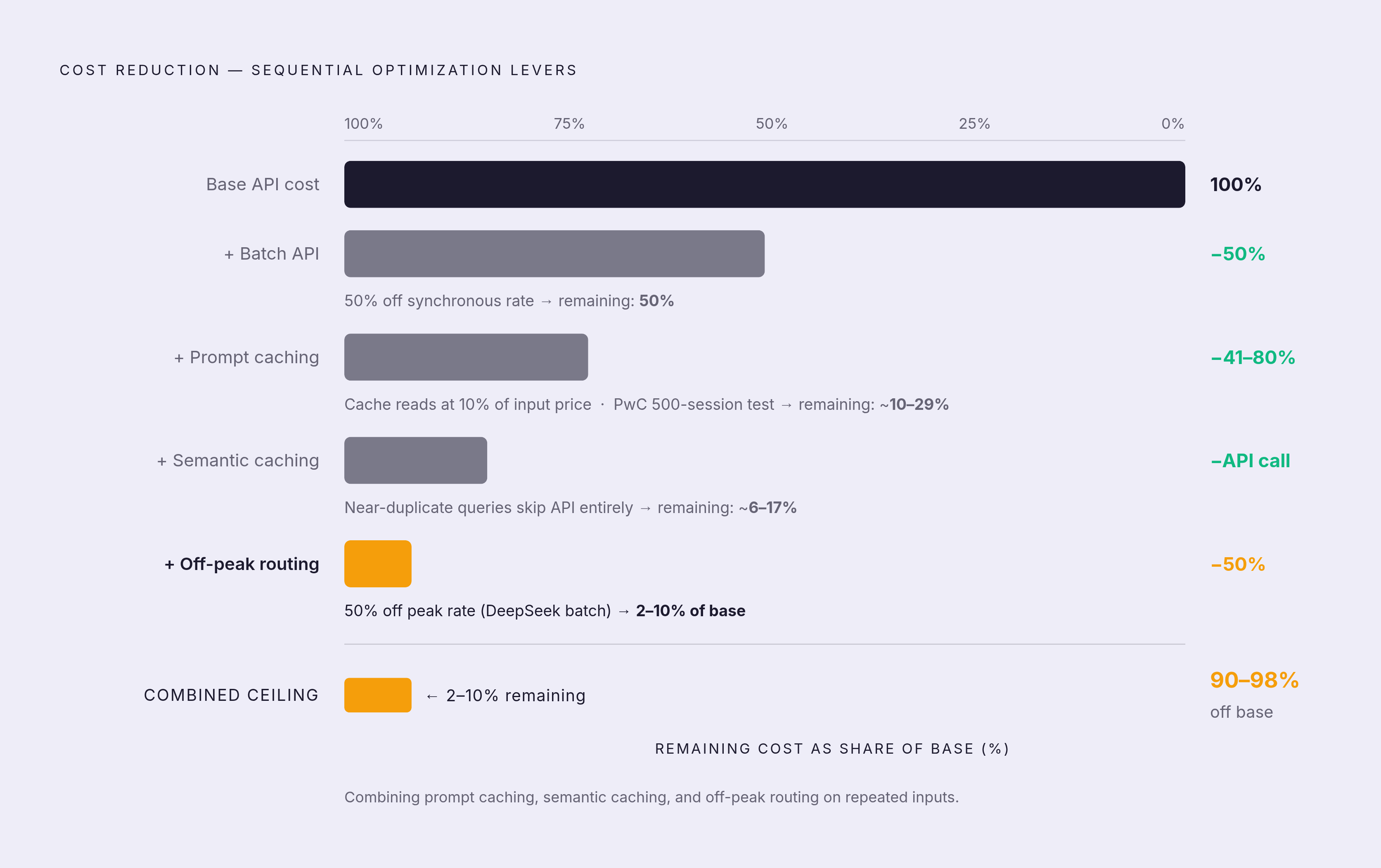
Prompt caching does the most work of any single lever. Research from PwC tested 500 agent sessions using 10,000-token system prompts and found caching cut API costs by 41% to 80%, while also improving time-to-first-token by 13% to 31%, consistent across every provider tested. Anthropic's cache reads cost just 10% of the base input price, a 90% discount on anything cached. The pattern that works: cache the stable system prompt, keep it fixed, and put whatever changes between calls at the end of the request.
Batch APIs are the next lever, and they're close to free money for anything that can wait. Google, OpenAI, and Anthropic all offer 50% off synchronous rates for asynchronous jobs tolerant of up to 24 hours of delay. xAI is the outlier here, offering only 20% off, and only on Grok 4.3 and Grok 4.20; Grok 4.6 doesn't accept batch requests.
Semantic caching catches something exact-match caching misses entirely: a meaningful share of queries hitting any production LLM system are semantically identical to something asked before, just phrased differently. Vector-embedding-based caching can catch those near-duplicates and skip the API call.
Prompt optimization reduces verbosity directly. Prompt optimization techniques can reduce output token consumption substantially while holding accuracy roughly steady. That's a direct answer to the "cheapest per token isn't the same as cheapest per task" problem raised earlier: shrink the output, and the cost curve moves regardless of which model is running.
Then there's timing. DeepSeek's peak/off-peak billing, live since August 16, 2026, cuts off-peak rates to 50% of peak. For batch workloads that don't care what time they run, that's a lever sitting there unused for anyone who hasn't checked the clock.
Stack all of it, prompt caching, semantic caching, and model routing together, and meaningful combined savings are realistic, with the ceiling on repeated inputs (thanks to caching) reaching 90% to 98% off. None of this is automatic, though. Each piece takes engineering time to build and maintain, so the honest framing for a solo developer is a trade: hours spent building the discount stack against dollars saved on the bill. High-volume, repetitive workloads pay that back fastest. A low-traffic side project probably doesn't need all four levers on day one.
Building a sustainable cost model before you commit to a provider
Before locking into a provider, run the actual candidate models on a representative sample of real prompts, not synthetic test cases. Measure the output lengths that actually come back. Factor in retry rates too: a model that fails on the first attempt one time out of five is quietly a different price than its sticker suggests.
Verbosity has to be pressure-tested per model, not assumed. The pricing page tells a developer what a token costs. It says nothing about how many tokens a given model will generate to answer the exact same question, and that number varies enough between models to flip which one is actually cheaper. Benchmark it directly, on real workloads, before committing a production system to any single provider's rate card.