Top Prompt Engineering Courses for Professionals
Learn which prompt engineering course matches your role, not just your resume.
Prompt engineering job postings in the U.S. jumped from about 1,400 to nearly 6,300 between 2023 and 2024, according to Lightcast data cited in Stanford's 2025 AI Index. Industry observers have consistently ranked it among the most sought-after AI skills for 2025. Here's what nobody tells you when you go looking for a course: they are not interchangeable, and picking the wrong one wastes real time and real money.
An engineer building a production system needs something entirely different from a marketer trying to squeeze better copy out of ChatGPT. I've watched people conflate those two problems and end up with a certificate that doesn't match the job they actually have.
What separates a useful prompt engineering course from a generic one
Prompting techniques carry different weight depending on the goal. Chain-of-thought prompting, ReAct patterns, few-shot examples, persona framing, tool-use setups: these change how a model reasons, how grounded its answers stay, how reliable it is across repeated runs. A course that only teaches you to "write clear instructions" is covering maybe a third of the skill, and I'd go further and say that third is the easy third.
Technical depth is where courses split hardest, and this is where I've seen people waste money. Some professionals need to tune sampling parameters like temperature and top-p, or figure out what happens when a conversation overflows the context window. Others will never touch those settings in their working life. Retrieval-augmented generation and prompt chaining matter enormously if you're an engineer wiring a production system together; they're close to irrelevant if you're drafting five variations of an email subject line.
So before you enroll, ask yourself a few things. Does the course require code, which is really the line between developer tracks and no-code ones? Is it hands-on with a real platform, whether that's Vertex AI, Azure, or the OpenAI API, or is it purely conceptual? Does it match the tools your organization already runs on? And does it end in something you can actually show someone: a portfolio project, a skill badge, an artifact with your name attached to it?
On credentials, PECollective's analysis found something I think holds up: one solid university certificate paired with three to five real LLM projects beats stacking multiple premium certifications, for most roles. The applied work carries the weight. Pointing to something you built matters more than counting badges, full stop.
Courses built for engineers and developers integrating LLMs into products
DeepLearning.AI's ChatGPT Prompt Engineering for Developers is free, takes about an hour to ninety minutes, and got updated for GPT-4o in 2025. Andrew Ng teaches it alongside OpenAI's Isa Fulford, built with direct input from OpenAI itself. It covers summarizing, inferring, transforming, expanding, and building a basic chatbot through the API. Over 300,000 people signed up in its first week at launch. That number alone tells you how much trust the developer community placed in it before it even had reviews. It's a strong starting point, short by design, though that brevity cuts both ways: it may not be enough on its own if you're building multi-turn systems or anything RAG-backed.
IBM's Generative AI Engineering Professional Certificate on Coursera runs about six months at six hours a week, included with Coursera Plus. It covers prompt engineering, retrieval-augmented generation, vector databases, responsible AI practices, and the architecture behind models like BERT, GPT, and LLaMA. Nearly 100,000 learners have gone through it, rated 4.7 across 3,410 reviews. It's the longest commitment on this list, but it covers the fullest slice of the production stack I've come across in a single certificate. For engineers or data scientists who want one real credential instead of five short ones, this is it.
Cohere's LLM University is free and self-paced. Its strength is foundation over technique: the course spends its time on why language models behave the way they do, going deeper than surface-level phrasing tips. It's a point worth sitting with: this kind of NLP grounding is often what separates engineers who plateau at mid-level from the ones who make it to senior. It's an investment in depth that outlasts whichever model version happens to be popular this year.
Maven's Applied LLMs is the one premium option here, an 8-week live cohort running several hundred to over a thousand dollars. It leans hard into production-grade, applied workflows over pure theory. The live format brings real peer feedback into the mix alongside the core material. It fits senior engineers or ML practitioners who can justify the cost because they'll use the material next week, not someday down the line.
One more worth flagging here, even though it belongs to the next section too: Google Cloud's Prompt Design in Vertex AI has a place in an engineer's toolkit if the org already runs on Google Cloud.
Courses for product managers and technical business leads who need platform-specific fluency
This group doesn't write production code. They configure AI tools, write system prompts, judge model outputs, and make calls about infrastructure. Platform fluency matters more here than NLP theory ever will, and I'd argue that's the single biggest thing people in this bucket get wrong when picking a course.
Google Cloud's Prompt Design in Vertex AI is free, takes about three hours and forty-five minutes, and ends with a verifiable Skill Badge. It covers structured prompting, parameter tuning like temperature and top-K, and multimodal prompting across text and images using Vertex AI Studio and the Generative AI SDK. For a product lead already on Google Cloud, that badge is something concrete to point to, and the multimodal piece is a real differentiator among free options.
Microsoft's Prompt Engineering Fundamentals, on Microsoft Learn, is free and takes about two hours. It covers Copilot and Azure OpenAI, with learning paths built around different job functions. The technical depth is modest, yet if your org runs on Microsoft 365 and Azure, this is the fastest way to get a whole team speaking the same language about prompt quality.
Vanderbilt's Advanced Prompt Engineering for Everyone, on Coursera, sits at intermediate-to-advanced. It covers in-context learning for more reliable prompting, RAG integration, and template-based output formatting: exactly the depth a PM needs to talk credibly with engineers about system design. It's the natural next step after Vanderbilt's beginner course, which shows up in the next section.
Platform match tends to matter more than the credential itself for this whole group. A Google Cloud Skill Badge signals something real to a team on GCP. A Microsoft Learn path signals the same thing in an Azure shop. Pick based on what your org runs, not which logo looks better on a resume.
Courses for non-technical professionals applying prompt skills in everyday work
Vanderbilt's Prompt Engineering for ChatGPT, on Coursera, runs about 18 hours, free to audit, a modest fee for the certificate. No programming background required, just basic computer skills and access to ChatGPT. Dr. Jules White teaches it, rated exceptionally highly by students, and the course overall holds 4.8 stars across thousands of Coursera reviews. White frames large language models as more consequential to daily work than smartphones were, which is a bold claim, but it tends to land well with business users who take AI seriously without needing to be engineers.
This is the right course for writers, marketers, analysts, educators, legal professionals, anyone using ChatGPT as a genuine work tool who wants noticeably better output without touching code. Pair the certificate with three to five documented projects and it beats the certificate sitting alone on a LinkedIn profile; that portfolio advice applies here just as much as it does for engineers.
Vanderbilt also runs a Prompt Engineering for Educators Specialization, worth knowing about if that's your world. DeepLearning.AI's short courses, free to take, make a good complement: one to two hours each, focused on specific use cases instead of trying to cover everything at once.
Here's the tension, though. Surface-level prompting feels productive. You type something, you get something back, it looks fine on first read. Consistent output you can actually rely on takes more than that first attempt at a prompt, and this is where I think most self-taught people stall out without realizing it. Vanderbilt's course gets at this directly, teaching structured techniques, persona-driven prompts, conceptual chain-of-thought, moving learners past habits that feel like progress but aren't. At this level, "good results" means consistency and less back-and-forth: output that matches what you actually meant, without much concern for token efficiency or API performance. The real measure is not having to ask three times.
How salary and career trajectory connect to which skills a course actually builds
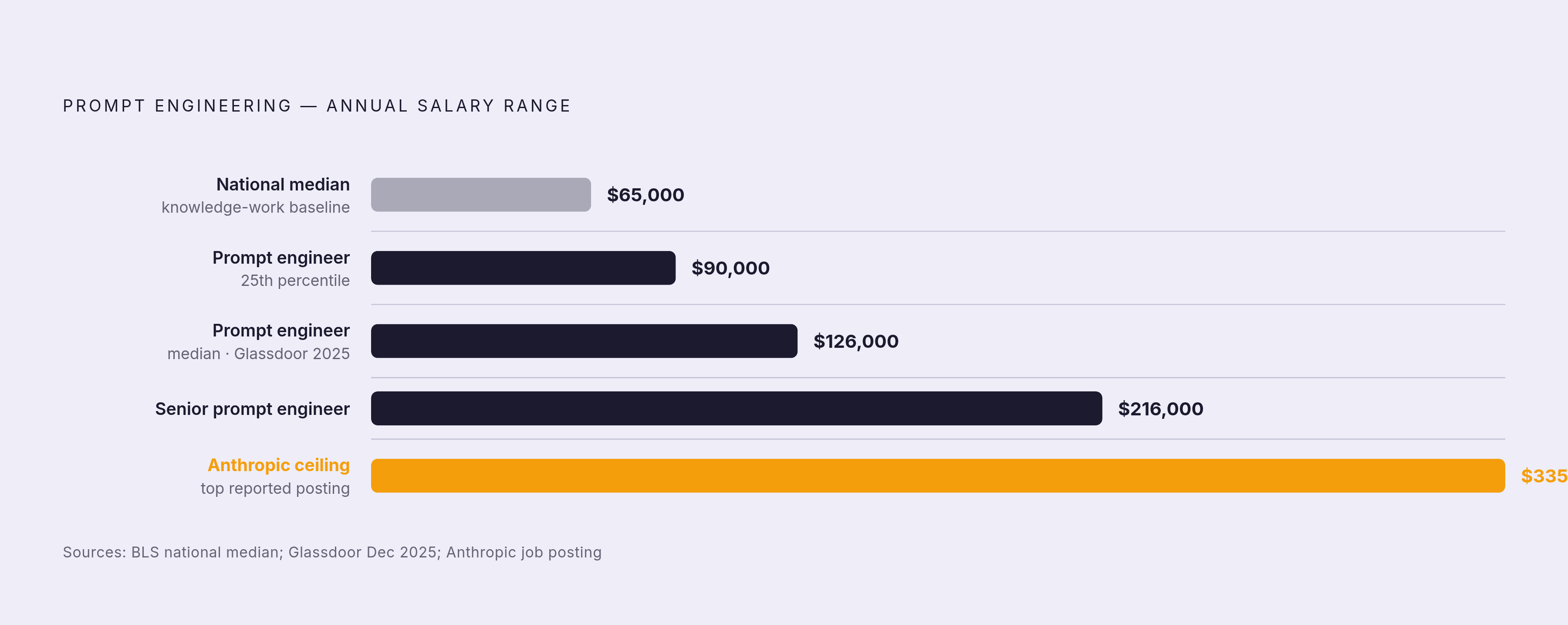
The money backs up the argument that depth matters. Median total pay for a prompt engineer sits at $126,000, per Glassdoor data from December 2025. The 25th percentile is around $90,000, still well above the roughly $65,000 national median wage, and senior roles push to around $216,000. Anthropic's "Prompt Engineer and Librarian" posting reportedly reached as high as $335,000, which tells you how much a company will pay for the right person at the top of this field.
So what separates the top earners from the median? They combine linguistic precision with Python, machine learning knowledge, and data analysis. That's the argument for tracks like IBM's or Cohere's over a single beginner course, if long-term earning is the goal. A one-hour intro course is a fine start; reaching a top-tier salary takes a fair bit more than that alone.
For freelancers, experienced prompt engineers on platforms like Upwork and Toptal command competitive hourly rates for project work, worth weighing if you're considering consulting over full-time employment. Government and enterprise roles, like a Booz Allen Hamilton posting that reportedly went up to $212,000, tend to require demonstrated, verifiable credentials. In those hiring contexts, a skill badge or certificate carries more weight than it would at a scrappy startup that just wants to see your work and doesn't much care where you learned it.
A single course gives you a foundation. It's an early piece of a longer path, not the path itself. The career value builds through applied practice on real problems, and I don't think there's a way around that, no matter how good the course is.
A quick-reference map matching professional role to recommended course path
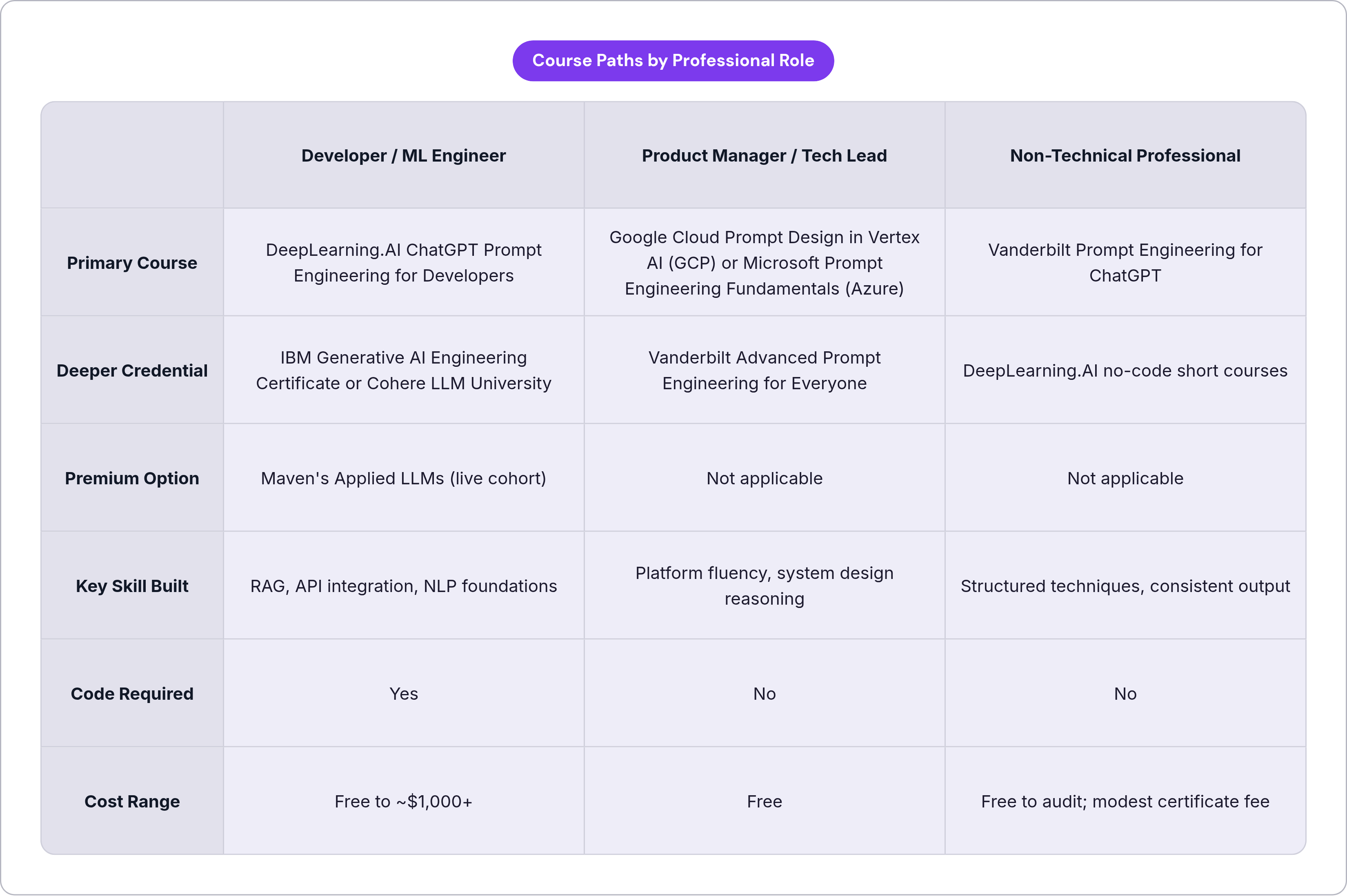
Developer or ML engineer building with APIs: start with DeepLearning.AI's ChatGPT Prompt Engineering for Developers for a fast, free baseline. Deepen with IBM's Generative AI Engineering Professional Certificate if you want RAG and the full production stack, or Cohere's LLM University if you want NLP foundations that'll outlast any one model. Budget allowing, Maven's Applied LLMs adds cohort-based, production-grade practice on top of either.
Product manager or technical business lead: go with Google Cloud's Prompt Design in Vertex AI if your org runs on GCP, or Microsoft's Prompt Engineering Fundamentals if you're on Azure or Microsoft 365. Add Vanderbilt's Advanced Prompt Engineering for Everyone once you need to reason about system design without writing code yourself.
Non-technical professional: Vanderbilt's Prompt Engineering for ChatGPT is the primary credential, supplemented by DeepLearning.AI's no-code short courses for specific situations you run into at work. Educators specifically should look at Vanderbilt's Prompt Engineering for Educators Specialization.
None of these paths fully teach the one skill that matters most in the long run: knowing the difference between a model actually reasoning and a model just producing something that sounds right. A course can't hand you that instinct. The best ones build the habit of questioning what comes out instead of just generating more of it, and that habit, reinforced daily through consistent practice, is the closest thing to a shortcut you're going to find. Everything past that, the projects, the repetition, the failures you learn from, is on you.