Multimodal AI for Everyday Consumer Tasks
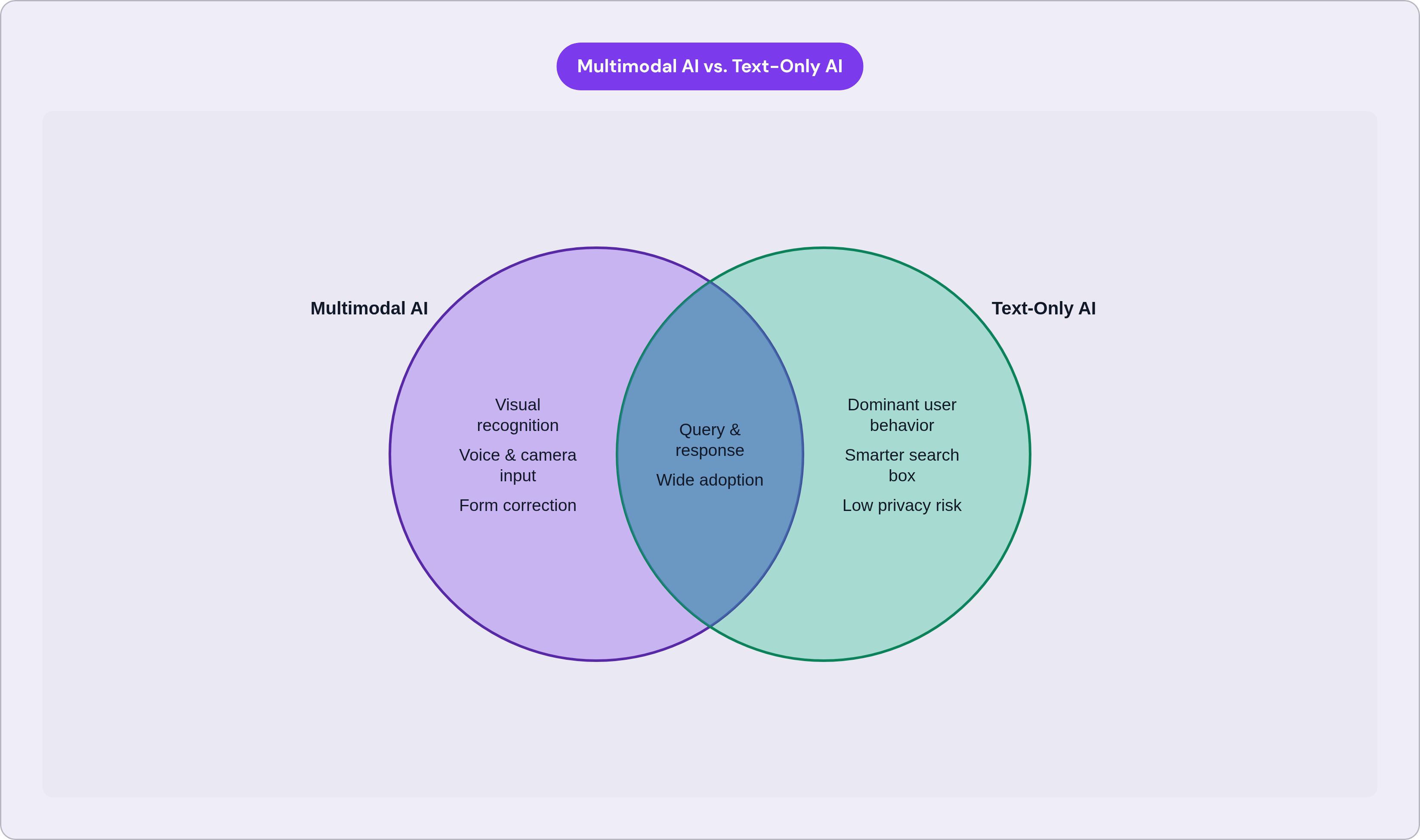
Most people still type into AI tools even though their phones can see and hear.
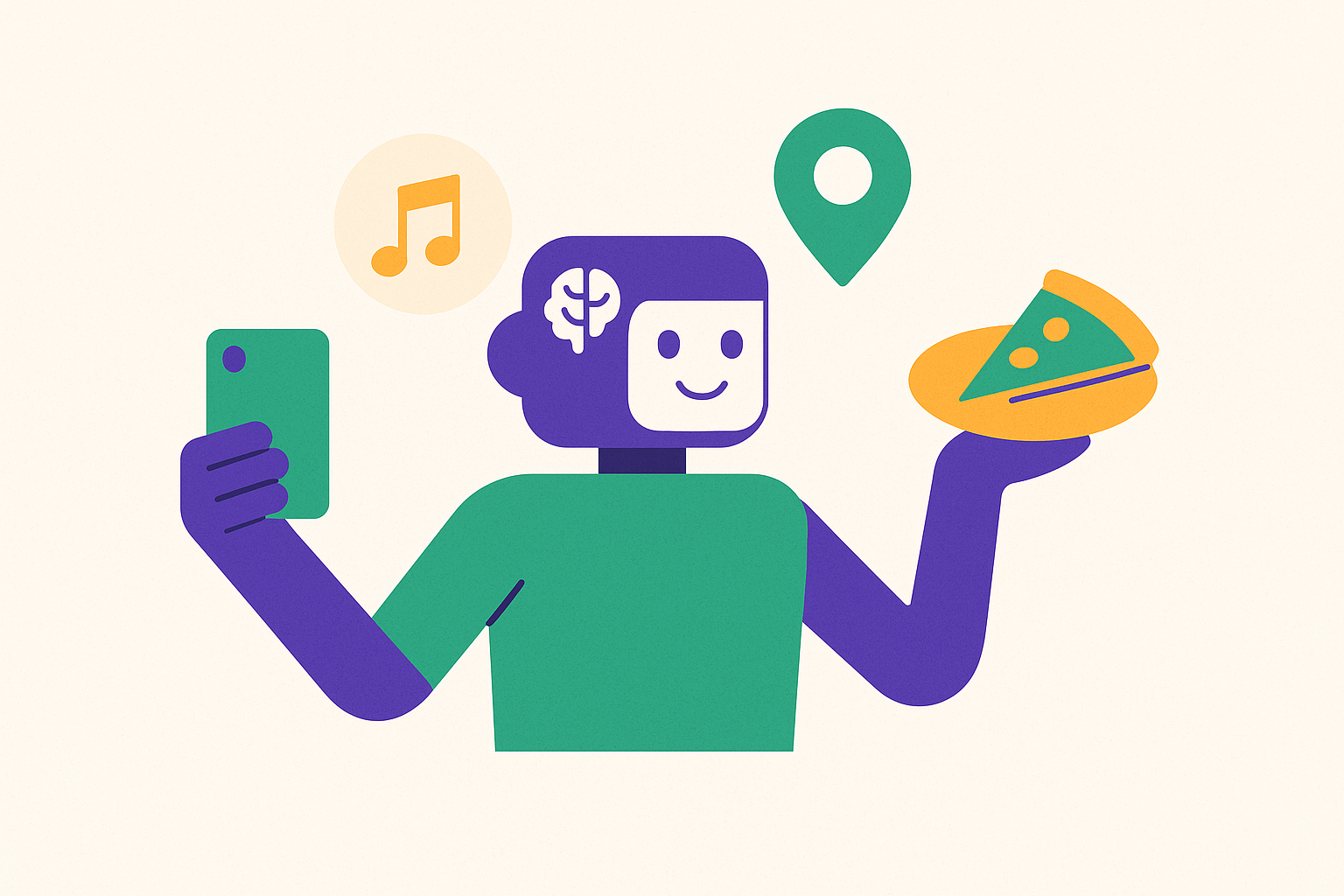
The infrastructure is not the bottleneck. ChatGPT holds roughly 52% of consumer AI tool share, Google Gemini sits around 30%, and Microsoft Copilot around 20%. All three offer multimodal inputs. The camera, microphone, and video options are available on the devices people already carry. And yet, most users engage with these platforms the way they engaged with Google in 2007: type a query, read the result.
Fast Company's reporting from late 2025 characterized this plainly. Despite the underlying models being fully multimodal, the dominant consumer behavior is text-first, often text-only. People are using a sophisticated instrument as a smarter search box. Roughly 1.7 to 1.8 billion people globally were using AI tools as of 2025, and 61% of U.S. adults reported using AI in the past six months. Most of them were typing into a box.
That's the part I keep coming back to. The models underneath those text fields can see, hear, and read simultaneously. The users aren't asking them to. And the question worth sitting with isn't what multimodal AI can theoretically do, but where it produces a meaningfully different outcome for tasks people already perform, and why so much of that capability sits untouched. Why exactly does this happen? The tools are available. The devices are in hand. Something else is keeping people in the text box.
The demographic contours add something here. Gen Z leads in overall AI adoption, but Millennials, the 29-to-44 cohort, use AI more frequently day to day. Young adults 18 to 30 represent the largest ChatGPT user group at 69%. That's the audience most habituated to these tools, and also the audience most likely to reach for camera and voice inputs first, because they're already inside the ecosystem and they're already impatient with friction. Whether that cohort pulls everyone else along is unclear to me. But the behavioral shift, when it comes, will probably start there.
What follows isn't a map of future possibility. It's a closer look at where the friction is lowest right now, where multimodal input earns its place because the alternative, translating a visual or audio problem into text, is demonstrably worse.
Shopping: Pointing a Camera Instead of Describing What You Want
Start with the most intuitive case. You're standing in a store, or scrolling through someone's apartment on Instagram, and you see something you want. You don't know what it's called. You don't know the brand. You don't have the vocabulary to describe it precisely. The text-query model fails almost immediately here, because the search presupposes you can articulate what you're looking for. But what if you could simply point instead?
Google Lens with Gemini integration handles this differently. You point your camera at a piece of furniture, ask where you can buy it in a different color, and the system runs visual recognition, natural language understanding, and real-time inventory lookup as one continuous operation, not three sequential searches. Amazon's Lens Live does something similar for physical objects, collapsing product discovery, comparison, and purchase guidance into a single camera-pointed flow.
The conversion data is real: visual search drives meaningfully higher conversion rates than text-only search for categories where appearance is the primary purchase signal. Fashion, home decor, furniture. The lift doesn't generalize equally to commodities; nobody needs to photograph a paper towel. But for the categories where how something looks is why you want it, the camera input isn't a convenience feature. It's the difference between finding the thing and not finding it.
A PwC survey from 2025 found that 40% of consumers expect to use AI for comparison shopping by 2030. The same survey found that 32% say they would not give an AI assistant full financial access. Both numbers belong together, because they describe the actual consumer posture: growing openness to AI as a shopping aid, persistent resistance to AI as a decision-maker. That resistance is not irrational. Multimodal shopping AI is most useful when it surfaces options and returns that information to the person making the call. The moment it tries to close the loop on your behalf, it has exceeded what most people actually want from it, and they know that already.
Food and Cooking: Where Voice, Image, and Inventory Have to Work Together
Cooking is probably the best single demonstration of why multimodal AI is categorically different from a better text model, because cooking is an inherently multimodal problem. Your hands are wet. The fridge is half-empty. You have a dietary restriction you've already explained three times today to three different people. No single input modality captures all of that cleanly, which is why "what should I make for dinner" has defeated text-based AI assistants for years.
To understand why this works, we must first look at what the AI has to hold simultaneously: identify ingredients from a photo of fridge contents, process a spoken restriction like "no gluten," match what's available against real-time store inventory, and generate a recipe that's actually usable by the person standing in the kitchen right now. A pilot program at Chadstone in Melbourne did something close to this. An AI-powered Food Concierge took ingredient and preference inputs, generated personalized recipes, and routed users to relevant stores, with a generative model interpreting dietary restrictions and adapting in real time.
PwC's projected consumer flow for grocery AI points in the same direction: a voice-commanded system that builds a shopping list from past purchase history, new spoken requests, and video-watching behavior like cooking demos, pulling those different modalities into one coherent recommendation. Voice, purchase history, and video are doing different things, but they feed the same output.
What this means for the user is fairly specific. The AI handles the translation work between "what's in the fridge" and "what's for dinner." The person still decides what they want to eat. That division of labor is where these tools work well. Where they degrade quickly is when the AI lacks access to real-time inventory data or the user's purchase history, because absent those connections, the recommendation slides from personalized to generic, and the whole value proposition collapses into something you could have gotten from a recipe website.
Health and Fitness: Real-Time Form Correction and Health Literacy, with an Important Usage Gap
Only 14% of Americans who engage in health-focused activities use AI to assist them, according to Menlo Ventures' 2025 research. When they do use it, the tasks cluster around structured tracking: nutrition logging, vital monitoring, measurable outputs. The tasks people most want help with, understanding symptoms, deciding whether something warrants a doctor visit, processing a confusing diagnosis, are exactly the tasks they trust AI least to handle. That raises an important question: is this a capability gap, or a trust gap?
I think about that 14% figure differently than most commentary does. It's tempting to frame it as a capability gap, something to be closed through better tools or better onboarding. But that framing isn't right. The tools can already process a photo of a skin condition alongside a description of symptoms alongside a history of prior visits. People avoid doing this because the stakes are high enough that they don't want to outsource the judgment. And frankly, anyone who has watched a confident AI produce a confidently wrong answer on something low-stakes should feel some instinctive caution about letting it weigh in on something that ends in a prescription or a referral. That wariness is proportionate.
Where multimodal AI earns its place in health contexts is narrower. Smart fitness equipment like the Amp home gym uses camera input to monitor movement and provide real-time form correction. The visual input does what a text prompt cannot, which is observe what the body is actually doing. The Withings smart mirror concept combines sensor data, visual assessment, and longitudinal health trends into a daily morning summary. These are form, tracking, and literacy applications, not diagnostic ones.
Health literacy is a third category worth noting. AI tools that simplify complex medical terminology and generate personalized responses to common questions lower the comprehension barrier for users navigating healthcare with limited background. Research published in Frontiers in Digital Health in 2025 supported this application specifically. Separately, Alibaba's open-source Qwen2.5-Omni-7B model, deployable on smartphones, supports real-time audio guidance for visually impaired users, a concrete case where multimodal capability serves a population that text-only AI structurally cannot reach.
Form, tracking, and literacy are where multimodal health AI has found its footing. Clinical judgment is a different matter, and the usage data suggests consumers have already arrived at that conclusion on their own.
Education and Accessibility: Combining Speech, Image, and Text to Reach Learners Text-Only Tools Miss
Here is an access problem that a better text interface doesn't solve. A dyslexic student needs audio. A visually impaired user needs description. Someone learning a second language needs to hear pronunciation and see mouth movement and read the word at the same time. A text-only model serves one of those needs. Multimodal AI can serve all three simultaneously, which changes who the tool actually reaches, not incrementally, but categorically. It is also worth considering what this means for the students that single-modality tools have historically left behind entirely.
Microsoft's Seeing AI reads text aloud, translates it, and explains visuals in one accessibility flow. Microsoft's Reading Progress combines speech recognition with reading support for students with reading difficulties. Language learning platforms are beginning to use audio, video, and text together to correct both pronunciation and physical articulation, checking what the student sounds like and what they look like producing the sound. That's a materially different feedback loop than a text-only correction.
On the assessment side, tools like Gradescope and AI-augmented versions of Turnitin are beginning to evaluate handwriting, voice responses, video submissions, and written text together. That shift allows instructors to assess understanding through more than one channel, which matters considerably for students who demonstrate comprehension better verbally than in writing, or vice versa.
The structural point is this: multimodal AI in education is not primarily about smarter tutoring for students who are already succeeding. It's about reaching the learners that single-modality models, by their architecture, could not. The AI flags, supports, surfaces. The teacher and the learner still interpret, decide, and build the relationship that makes any of the learning stick.
Smart Home and Voice Assistants: Why Adding Vision Changes What a Voice Assistant Can Do
There are 8.4 billion digital voice assistant devices in use globally as of 2024, per Statista. Siri, Alexa, and Google Assistant have been processing speech and text together for years. The meaningful advance isn't that capability. It's what changes when visual context enters the interaction.
Consider what resolves when the assistant can see the room. "Turn off the lights" no longer requires a follow-up clarification about which room you mean. The assistant sees where you're standing, infers the context, and executes. One instance isn't dramatic. Across a day of ambient interactions, removing that friction compounds. The assistant stops asking for disambiguation it can derive visually.
The distribution infrastructure for multimodal interaction at consumer scale already exists in those 8.4 billion devices. The remaining challenge is latency. Processing visual and audio data requires either a round-trip to the cloud, which introduces delay, or local edge computing, which keeps processing close to the device. Edge computing is increasingly viable; Alibaba's Qwen2.5-Omni-7B is deployable on smartphones and laptops, meaning multimodal capability no longer requires a server farm for every interaction.
What complicates the smart home picture is harder to wave away. Adding vision to ambient devices expands the privacy surface area significantly. A device that can see is processing more sensitive data continuously than one that can only hear. Emotion and facial expression recognition in a home environment raises questions about consent and data use that are serious and, at the moment, largely unresolved. More modalities mean more surveillance potential. That's one of the reasons the gap between what these devices can do and what people are actually letting them do is as wide as it is. The capability exists. The permission hasn't followed.
What Makes Multimodal AI Work Technically, and What Still Slows It Down
The architectural shift that made native multimodal processing possible: transformer-based architectures, Mixture of Experts frameworks, and Vision-Language Models that allow different data types to be reasoned over within one model rather than routed between specialized systems. A model that hands off between systems loses context at the boundary. A unified architecture maintains it, and for consumer tasks, that changes what "understanding the situation" actually means in practice.
Gemini 2.5 Pro's two-million-token context window illustrates what this means at scale: the ability to process two hours of video, or an entire codebase, as coherent context rather than fragmented chunks. The model can hold more of your history, your environment, and your current inputs simultaneously, which is a different quality of comprehension than stitching together several smaller inferences.
Organizations using multimodal AI achieve 35% higher accuracy in information extraction tasks compared to single-modality systems. That gain comes from cross-modal context, not simply more data. The modalities corroborate and constrain each other; an image and a spoken description together are more informative than either alone, in the same way that watching someone's face while they speak gives you information their words alone don't carry.
What still slows deployment is a cluster of interconnected problems that don't resolve neatly. Privacy surface area expands with every added modality. Simultaneous processing of voice, video, and text increases both the volume and the sensitivity of personal data collected, and research catalogued on arxiv as of 2024 flagged this as an unresolved design challenge. A 2025 survey of 5,000 respondents found that 43% of consumers remain concerned about privacy or security weaknesses in AI tools. That concern is proportionate.
Regulatory pressure is also sharpening in ways that matter financially. The EU AI Act's compliance deadline of August 2, 2026 mandates machine-readable labeling for AI-generated content, with non-compliance fines reaching up to 3% of global annual turnover. That creates concrete pressure on multimodal consumer products, particularly those operating across European markets.
Better integration across modalities means broader surveillance surface. The more the AI can perceive, the more it knows. That tradeoff is real, it's unresolved, and treating it as background noise understates why so many consumers are making the quiet behavioral choice to keep typing instead of pointing a camera.
Where Multimodal AI Is Most Useful Versus Where It Still Asks Too Much of the User
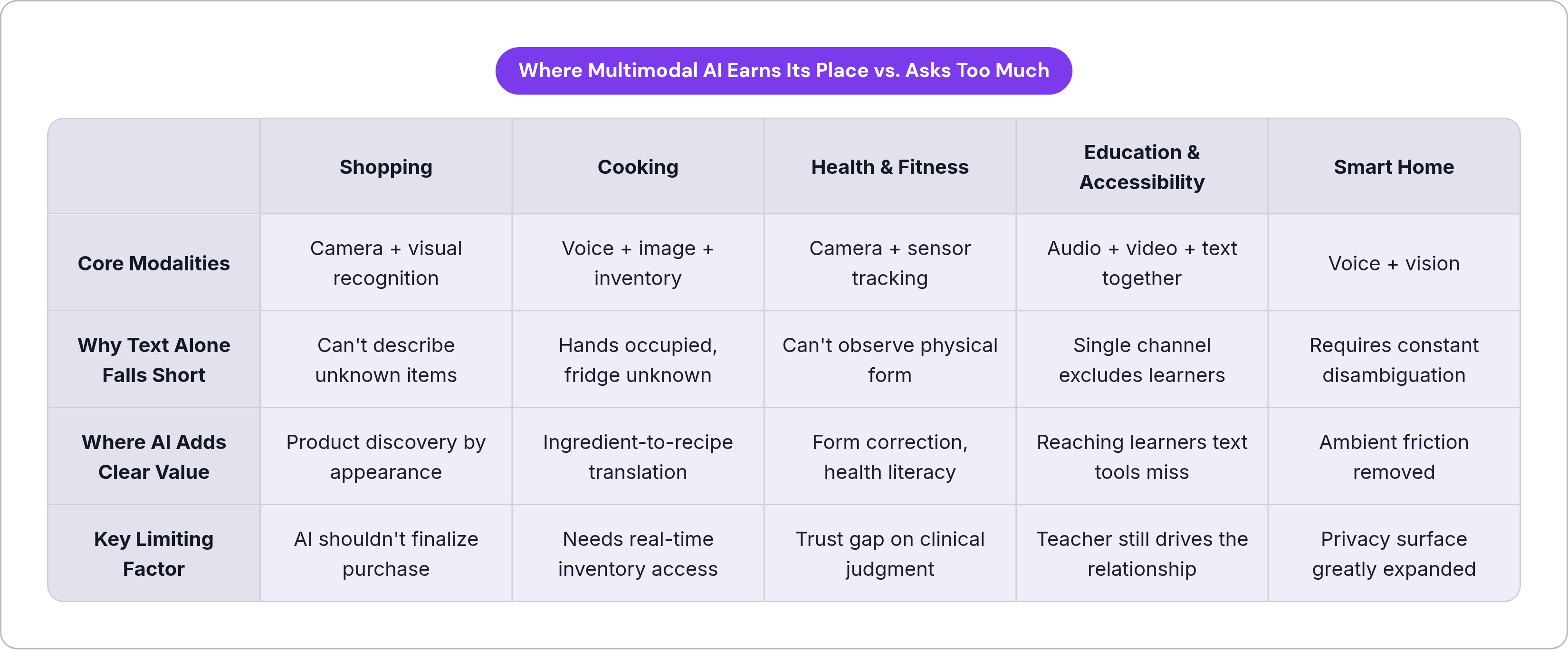
The pattern across every use case here is fairly consistent. Multimodal AI adds the most value where the task is inherently multi-sensory: shopping by appearance, cooking by sight and voice, form correction by movement, accessibility by combining modalities that a single channel can't serve. It adds the least value where the real barrier is trust rather than capability: health decisions, financial autonomy, any domain where the stakes of a wrong output are high enough that people want a human in the loop.
The gap is behavioral, not technical. The tools can process camera and voice input right now. Most users are still typing. The demographic data suggests that gap will narrow from the Millennial and young adult cohorts outward, because those are the people already spending the most time in these environments, already habituated to reaching for their cameras before their keyboards.
What holds across all of this: multimodal AI is most useful when it handles the translation work, what am I looking at, what does this sound like, how do these data streams connect, and returns a cleaner decision to the person holding the phone. It becomes less useful, and less trusted, when it attempts to finalize the decision itself. The 32% of consumers who say they would not give an AI assistant full financial access aren't being unreasonable. They're drawing a line between augmentation and abdication, and that line reflects something real about where these tools are helpful versus where they're being asked to do something they haven't earned the trust to do yet.
The tasks worth paying attention to are the ones that currently require you to translate a visual or audio problem into text before you can get help. Those are the tasks where switching to a camera or voice input produces a meaningfully different result. A different category of outcome entirely, rather than a marginally better one.