Customizing Consumer AI With Personal Context
Personal context helps AI understand your goals and constraints, not track your behavior for ads.
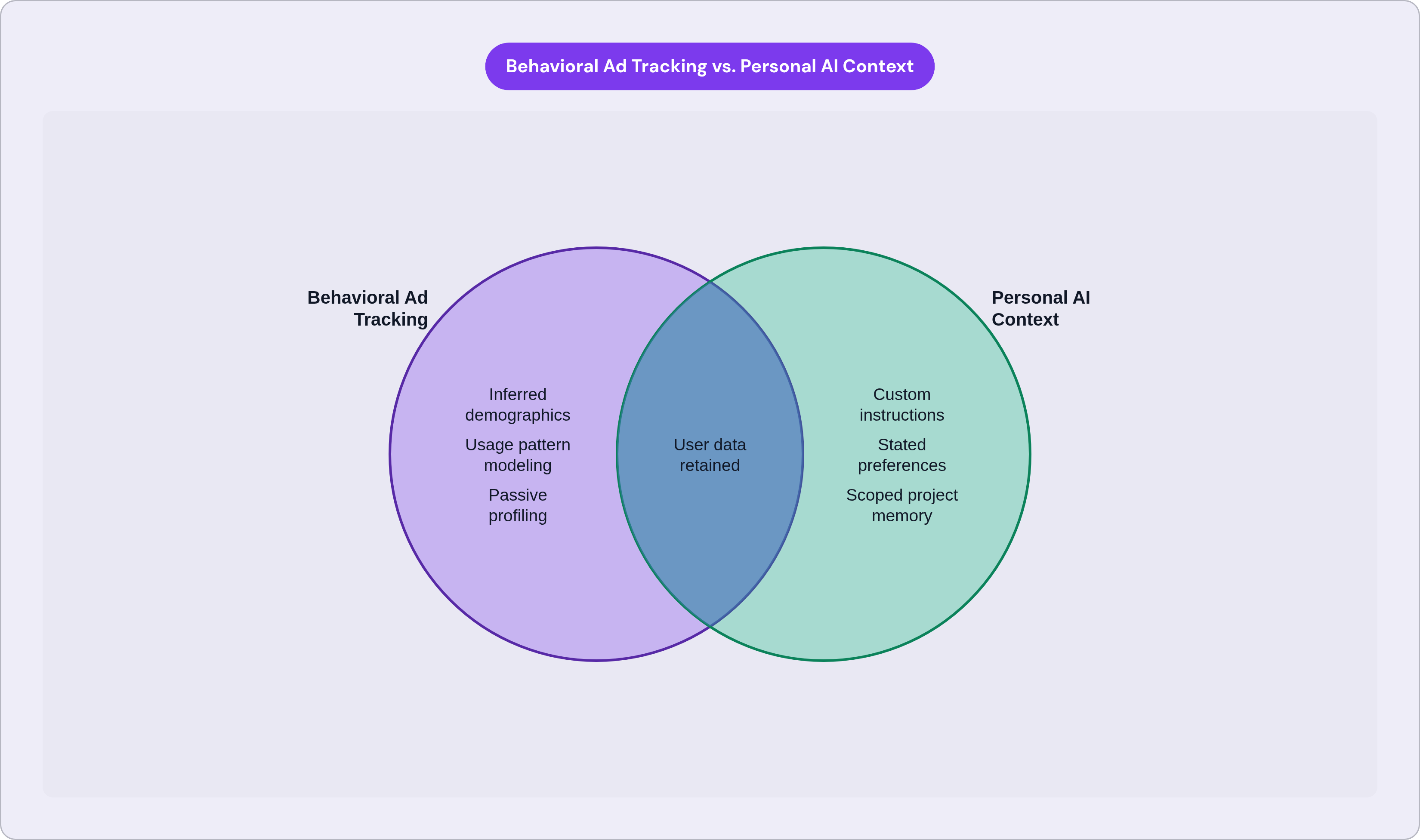
Personal context is not behavioral ad tracking. It's the opposite of a model inferring your demographics from usage patterns to serve you content. Make that distinction clearly, because the two get conflated constantly, and depending on who's doing the conflating, you get either unwarranted anxiety or unwarranted trust.
Think of it as two layers. The first is situational: your role, your goals for a given task, your tone preferences, your current constraints. What's true right now. The second is accumulated: patterns in how you work, preferences you've stated, past decisions you've explained, recurring constraints that shape almost everything you do. What's true over time.
Personalization isn't new. Streaming services adapt to your watch history. Navigation apps learn your commute. But what's changed with AI is the depth of that adaptation. A recommendation algorithm knows what you watched. An AI model with good context can understand why you made a decision, what you're trying to build, how much background you actually need. That's a qualitatively different kind of knowing, and it raises a question worth sitting with: is that depth of adaptation something users are actively choosing, or something quietly accumulating without their awareness?
A June 2025 survey of 250 U.S. adults found that respondents considered health records, fitness data, text conversations, personal notes and journals, and calendar behavior among the most sensitive categories of personal data. That's a heterogeneous list, which makes the point: personal context isn't one thing. It's a stack, and different layers of it become relevant at different moments.
Here's what personal context is not: a data dump. Pasting in your entire work history, every prior conversation, an exhaustive self-description. None of that produces better outputs. The quality and relevance of what you supply matters more than the quantity. A model given noisy, overlapping, redundant context has to work around it rather than with it. I've made this mistake myself, early and often, usually when I was most convinced I was being thorough.
The three technical levers users have for injecting context
Custom instructions and system prompts
Every major platform gives you some version of a persistent instruction layer that fires before any user message arrives. On ChatGPT, it's in Settings under Personalization. On Claude, it lives in Project Instructions. Via the API, it's the system message. Think of it as the "before-you-say-anything" layer: you set role, tone, format, and constraints once, so you don't re-establish them every session.
Done well, this pays disproportionate dividends. Research from GudPrompt published in January 2025 found that well-written custom instructions reduce prompt length by 40 to 60 percent, simply by eliminating repeated context-setting. Across hundreds of sessions, that compounds into something real.
The failure modes are predictable. Most users leave the "about you" field blank because it feels optional. Others write something so generic ("I prefer concise answers") that the model's default behavior overrides it almost immediately. "Concise" means nothing to a system that was already optimized for concision. "No numbered lists, assume I have a legal background, and skip the caveats unless they're material" is a constraint the model can actually work with. Specificity is the whole game here.
Persistent cross-session memory
This is the shift most users have substantially underestimated. As of 2026, ChatGPT, Claude, and Gemini all maintain memory that persists across conversations. The model you open today is not starting from zero. It knows things about you it learned three weeks ago, sometimes things you'd forgotten you mentioned.
ChatGPT's memory was significantly upgraded in April 2025, moving from a curated set of saved facts to a system that references all past conversations. The free-tier rollout followed in June. Per analysis from LumiChats, a typical monthly user accumulates between 40 and 80 stored facts. Most of those users have no idea.
Claude's memory launched for Team and Enterprise accounts in September 2025, extended to Pro and Max users the following month, and reached the free tier in March 2026. The distinguishing design choice is transparency: memory lives in readable, editable markdown files. You can see exactly what the model has retained. There's no inferred profile operating quietly in the background.
Gemini takes a different approach entirely. Its "Personal Intelligence" feature pulls context from across Google's full services stack: Gmail, Docs, Drive, Photos, Maps. The context isn't just what you've told Gemini directly; it's what you've done across your entire Google account. That's the broadest ecosystem integration of the three, and also the most geographically constrained. The feature is restricted in the EEA, UK, and Switzerland due to GDPR rules on automated profiling.
Grok draws primarily from X account history and engagement patterns. The context signal is natively social, which makes it useful for users whose work or intellectual life concentrates on that platform, and considerably less useful for those whose doesn't.
One mechanic on ChatGPT surprises almost everyone who discovers it: deleting a conversation does not delete the facts the model derived from it. Those persist in memory settings and must be cleared separately. On Claude, by contrast, deleting a conversation also removes its derived memories. Same outcome, opposite default behavior. If you care about what persists and what doesn't, this distinction matters more than almost any other configuration detail.
Projects, scoped context, and integrations
Beyond global memory, platforms now offer ways to scope context to a defined purpose. Claude Projects let you attach reference documents alongside system-level instructions, so the context is bounded to a particular workstream rather than applied everywhere. Instructions optimized for legal review work are probably not the instructions you want firing when you're drafting a birthday message.
ChatGPT added support for Model Context Protocol in September 2025 for paying users. MCP connects the model to external services: Jira, Google Calendar, custom APIs. The implication is significant. Context injected this way isn't static; it's live. The model isn't working from what you told it last month. It's working from what's actually in your calendar today.
Context windows function as a more passive lever, but a real one. As of 2025, most large models support between 128,000 and 200,000 tokens; some extreme-scale models handle considerably more. That's enough room to paste in background documents, prior conversation threads, or personal files at runtime, without any persistent storage at all. For users who want the benefit of rich context without the overhead of maintaining a memory profile, this option is consistently underused.
How to think about which context to supply and when
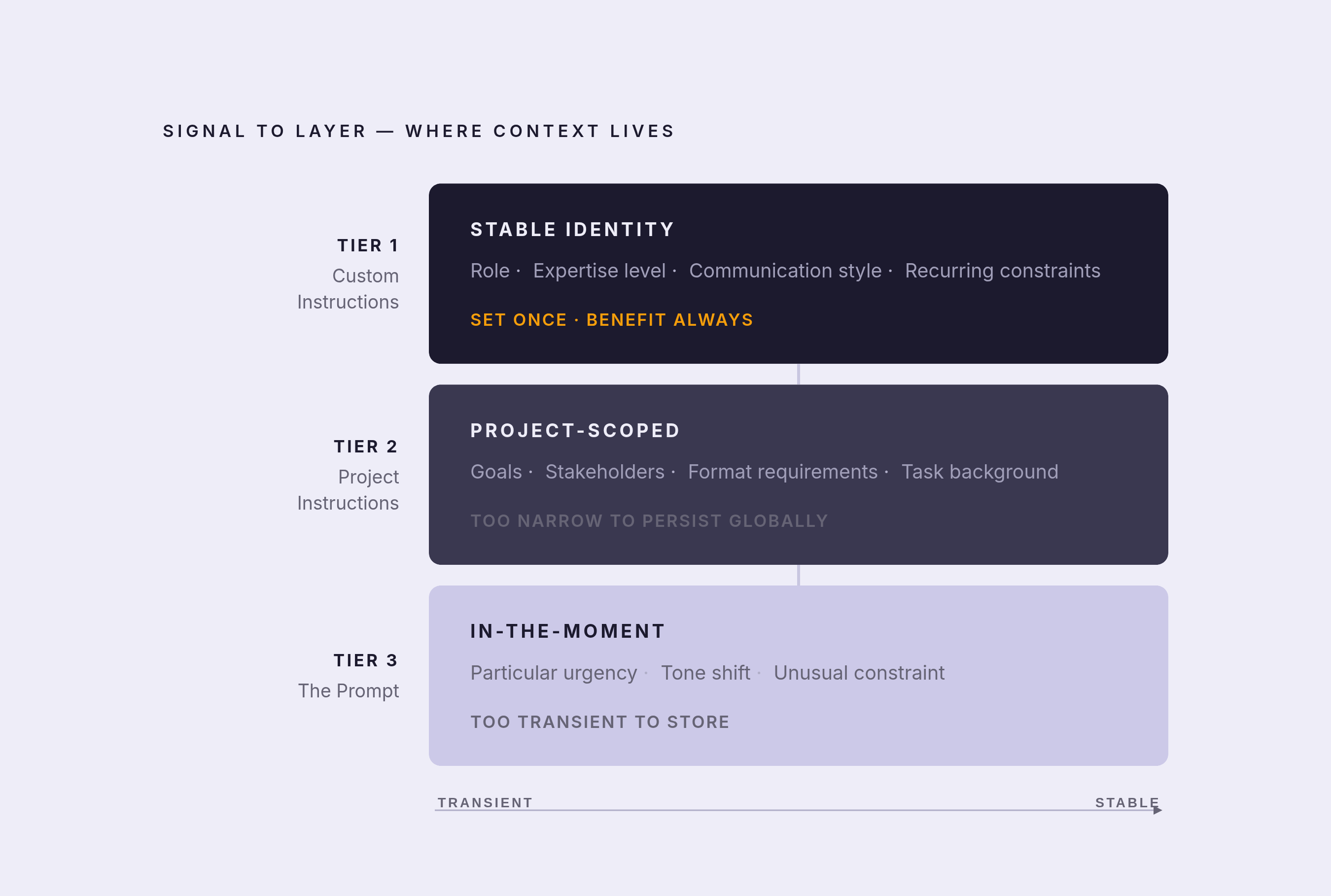
Not all context is equally useful in all situations. The skill isn't supplying more; it's matching the right layer to the right moment.
Stable identity signals belong in custom instructions or persistent memory: your professional role, expertise level, communication preferences, recurring constraints. Set them once, benefit continuously. Project-specific signals belong in project instructions or scoped uploads: the goals, stakeholders, format requirements, and background specific to a particular task. They're too narrow to be globally useful. In-the-moment signals belong in the prompt itself: a particular urgency, an unusual constraint, a shift in tone that only applies today. Too transient to store.
Research from arXiv published in October 2025 examined how different prompting approaches handle personal context at scale. The finding worth internalizing: simple contextual prompting, inserting raw demographic or history metadata directly into a prompt, works adequately at small scale but degrades as the profile grows. Profile-augmented prompting, which involves summarizing and distilling preferences before injection, handles scale better and avoids the cognitive noise that comes from bloated context.
The practical implication is uncomfortable if you like thoroughness: users who paste in everything they've ever written don't perform better than users who curate. They often perform worse. Distillation turns out to be one of the more transferable skills for getting real value out of these tools, and also one of the least discussed.
When writing custom instructions, the questions worth answering are: who you are professionally, what you're trying to accomplish with this tool specifically, how you want responses structured, and what the model should not assume about you by default. That last one is the most underrated. Default assumptions are where the most maddening mismatches happen, and they're the easiest to preempt if you've thought about them in advance.
One maintenance issue that routinely gets ignored: context degrades. Your role changes. Your preferences shift. An instruction written a year ago, calibrated to a previous job, is now actively counterproductive. A stale instruction can be worse than none, because it confidently produces output optimized for a version of you that no longer exists.
How the major platforms differ in what they do with your context
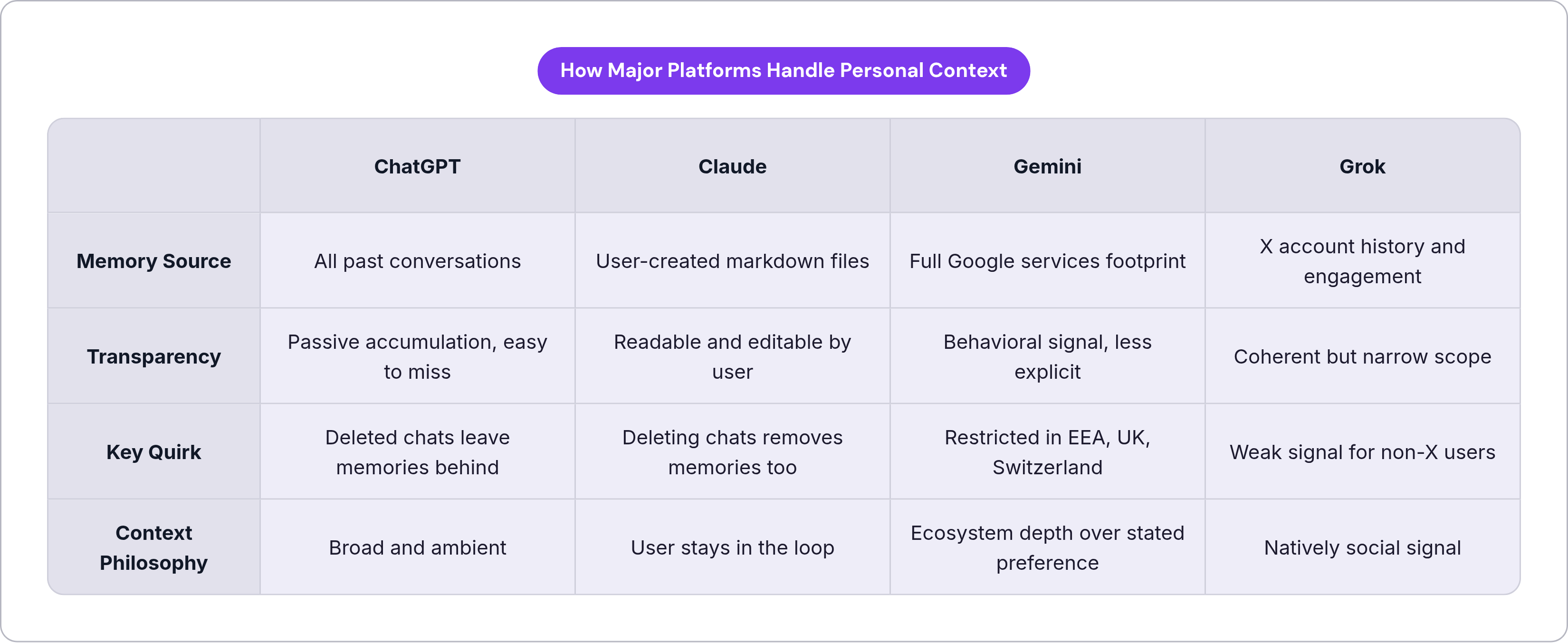
Each platform's context architecture reflects a distinct philosophy, not just a different feature set. Understanding the philosophy helps you anticipate the behavior.
ChatGPT accumulates broadly and passively. The memory profile builds from conversation history whether or not you're actively managing it. At over 810 million monthly active users as of early 2026, the memory rollout happened quietly for most of them. The majority are now operating with a memory layer they've never explicitly configured, which is either a feature or a liability depending on your disposition toward that kind of ambient accumulation.
Claude's approach centers on transparency. Memory is a readable, editable document, not an inferred profile you can't inspect. When Anthropic launched the feature, the explicit emphasis was on user ability to read, edit, and delete individual memory items. The design philosophy assumes you want to be in the loop. Whether most users actually read those files is a different question, and probably an uncomfortable one.
Gemini bets on ecosystem depth. The model's knowledge of you isn't primarily derived from what you've told it; it's derived from your entire Google-services footprint. That's a different kind of context, richer in behavioral signal and narrower in explicitly stated preference. The geographic restriction matters practically: users in the EEA, UK, and Switzerland get a materially different product.
Grok's context is narrower in scope but tightly coherent. If your intellectual and professional activity concentrates on X, the model's context is organically rich. If it doesn't, the signal base is thin, and no amount of configuration compensates for that.
One development worth watching: the portability of accumulated context is increasing. Google launched tools to import chat history and memory from ChatGPT and Claude; Anthropic deployed a similar import feature shortly before. The intent is clearly to reduce the switching cost that accumulated personalization creates. Platform choice is becoming less permanent than it was two years ago, which means experimentation is cheaper now than it used to be.
The risks that come with giving AI more of yourself
Privacy is the most immediate concern, and the regulatory environment is actively reshaping what these products can offer.
Europe's GDPR enforcement accelerated sharply in 2025, producing €2.3 billion in fines, a 38% year-over-year increase. OpenAI received a €15 million fine from Italy's data protection authority specifically for ChatGPT's handling of personal data, citing inadequate legal basis for processing and failures in transparency. That fine is directly relevant to the memory features described here. The same architecture that makes persistent memory useful is the one under regulatory scrutiny.
Gemini's regional restriction for Personal Intelligence is a direct consequence. GDPR's automated-profiling rules made a global rollout legally complicated enough that Google opted for geographic restriction rather than re-architecting the feature. The regulatory pressure isn't abstract; it has already changed what these products look like in practice, depending on where you live.
A subtler risk gets less attention than it deserves. A 2025 Gartner survey of over 1,400 consumers found that a majority reported negative outcomes from personalization, and those users were substantially more likely to regret their decisions and far less likely to re-engage with the service. If personalization produces negative outcomes at scale, why do platforms keep pushing it deeper? The benefits are real. The problem is calibration, not the concept. But that distinction requires you to be paying attention to when the calibration goes wrong, and most people aren't.
What a negative outcome looks like in an AI context is specific: responses so tuned to your stated preferences that they stop challenging your assumptions, confirm existing plans rather than stress-testing them, narrow the range of options surfaced. A model that knows you well and reflects your preferences back at you is not the same thing as a model thinking independently. The former can be useful. The latter is what you need when the decision actually matters.
Practical safeguards aren't complicated. Audit your memory periodically, especially on ChatGPT where memories outlive the conversations that produced them. Be selective about what belongs in persistent memory versus project context versus a one-time prompt; permanence should be earned, not defaulted into. And treat stored preferences as working hypotheses rather than fixed identities, because the most insidious version of personalization is one you've stopped examining.
What separates users who get lasting value from those who don't
The pattern is a compounding one: good context produces better responses, which produces more trust, which produces more specific follow-up, which produces richer context over time. But the loop only starts with deliberate setup, and most people never do the setup.
The investment is front-loaded. Spending thirty minutes drafting custom instructions and doing an initial memory audit pays dividends across every subsequent session. Most users skip this entirely because the fields feel optional and the payoff isn't immediately visible. You don't feel the absence of good context. You just get slightly generic responses and assume that's what the tool is. The absence is invisible, which is exactly what makes it easy to ignore.
What users who actually rely on these tools do differently is less mysterious than it sounds. They treat the setup fields as documents worth drafting carefully rather than form fields worth rushing through. They use projects for distinct contexts, separating work from personal tasks from ongoing research, rather than allowing everything to accumulate in one global memory that serves no particular purpose well. When the model mis-remembers or over-applies a preference, they correct it explicitly rather than working around it.
And they notice, over time, when outputs start narrowing. When the responses feel a little too agreeable, a little too confirmatory of whatever they'd already been thinking. That's when the personalization is filtering instead of helping. Catching that distinction requires more self-awareness than most onboarding flows will ever ask of you, which is probably why it's the skill that separates the people who get lasting value from the people who eventually stop using the tool and say it wasn't that useful.
The underlying disposition isn't technical sophistication. It's a willingness to stay in an ongoing, somewhat critical relationship with the tool: checking what it remembers, questioning when it agrees too readily, updating context when your circumstances change. Supplying personal context well means giving the AI the right signal at the right layer, and maintaining enough distance to catch when tailored responses stop being useful. AI that knows your context well should sharpen your judgment, not replace it. Lose that distinction and the configuration stops mattering.