LLM System Prompts for Consistent Context Framing
System prompts are the only lever applications control to prevent consistent LLM errors.

Every time a large language model generates a response, it's sampling from a probability distribution over possible next words. That's how these models work, not a flaw to be engineered away. Parameter adjustments, like lowering temperature, can narrow the spread of likely outputs, but they can't collapse the randomness to zero. The question isn't how to stop a model from being probabilistic, but where, in the chain of events between a model being built and a response being generated, you can intervene before that randomness starts working against you.
The answer is simpler than it sounds: before the user ever types a word. None of these are things an application controls. The one thing an application controls completely is the instruction set the model reads before the conversation starts, the system prompt. Framing it this way turns a vague complaint, "the model isn't behaving consistently," into a concrete design question: what does the model know, and what is it bound to, before the first token comes out?
This matters because most production failures in enterprise AI systems don't trace back to the model being incapable of the task. Teams that keep swapping models, hoping a newer or bigger one will fix erratic behavior, are often chasing the wrong variable. If the system prompt is vague, informal, or inconsistent, a better model will just be inconsistent with more confidence.
Think of the system prompt as a contract: a document that spells out, before any work begins, what the model is, what it owes the application, and what it's not allowed to do. Every section that follows builds on that definition.
What makes a system prompt a contract rather than a suggestion
A contract works because it leaves nothing open to interpretation on the points that matter. Applied to a system prompt, that means five things need to be spelled out directly: what the model is, what it must do, what information it's allowed to draw on, what limits it has to respect, and the exact shape of the output it needs to produce. You're hoping the model guesses correctly, which is a suggestion dressed up as an instruction.
One way to organize those five pieces is the CO-STAR framework: Context, Objective, Style, Tone, Audience, Response. Response locks down the exact structure the output has to take.
A useful skeleton to picture: a title and intent, then role, then objective, then context, then a set of rules, then output format, then examples, then a way to check the result. A prompt that tells the model what to produce but never says how to confirm the output is correct is a contract with no enforcement clause.
For Claude specifically, explaining why a rule matters tends to work better than just issuing the rule. It's a fact about how the model was trained to respond, not a stylistic flourish.
Boring, specific language beats clever, expressive language here. The goal of a system prompt is to leave as little room as possible for the model to interpret its way into an unexpected answer, not to impress anyone reading it.
How prompt position and structure interact with model architecture
Writing the five contract elements clearly is necessary, but where they sit in the prompt matters just as much, and that answer isn't the same across model families. An architecture reads structure differently from another, so a contract that works for one model can underperform on another even when the content hasn't changed.
Claude models respond best when behavioral boundaries appear early in the prompt. The position is part of how the model weighs what matters, not decoration.
Gemini models, with their large context windows, tolerate long prompts better than smaller-context models do, but they still show a pattern researchers call recall drift. Instructions sitting in the middle of a long system message get recalled less reliably than instructions at the start or the end, and the end tends to carry the most weight. This lines up with a broader pattern documented across model families: a "lost-in-the-middle" effect, where models perform best when relevant information is at the beginning or end of the input, with real degradation in between. So the practical rule holds across architectures even when the exact mechanics differ: put the clauses the application depends on most, first, and let supporting context, examples, and edge cases trail behind.
None of this travels cleanly between providers. Recognizing that a contract written for one counterparty doesn't automatically bind a different one is not duplicated effort.
The compounding cost of informal prompts in agentic pipelines
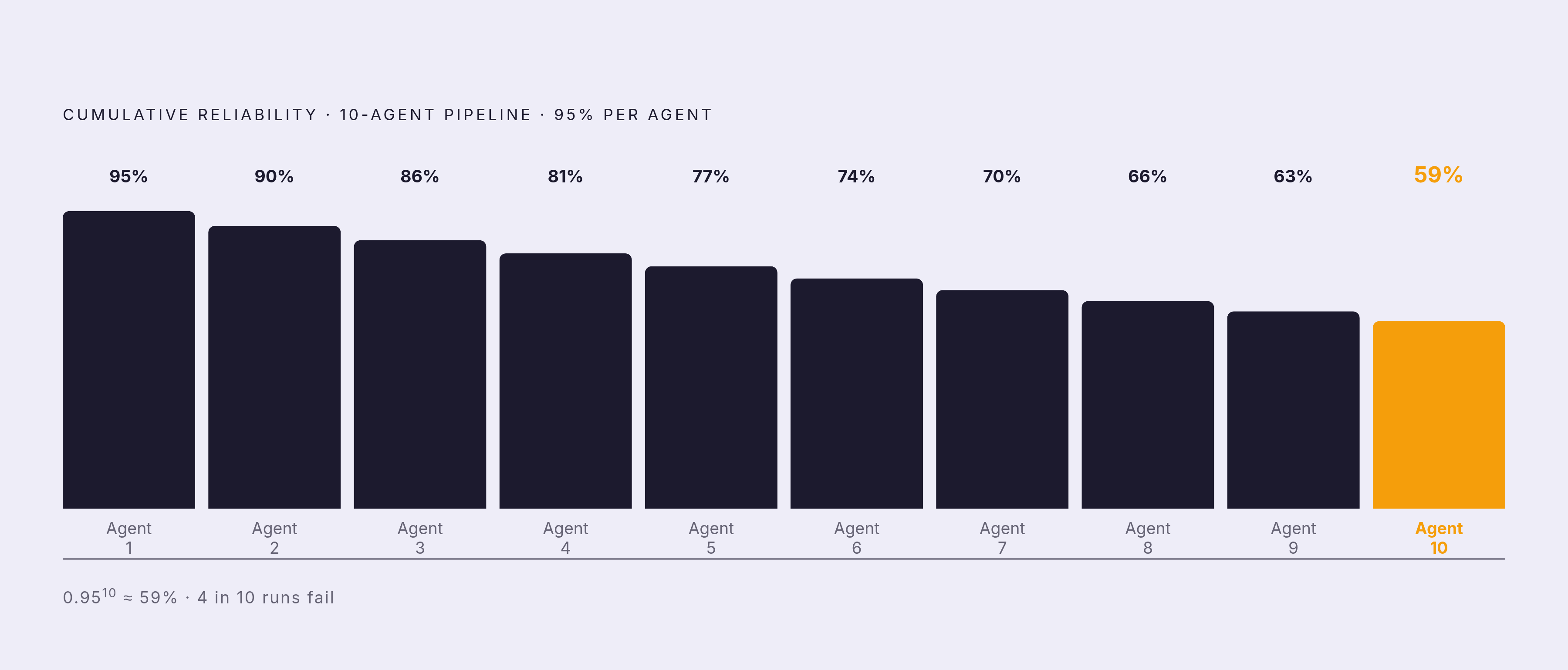
A single informal clause in a single prompt is a manageable risk. One agent, slightly underspecified, might still get the job done most of the time. It's absent, replaced by ten separate improvisations that happen to be talking to each other.
The compounding effect is unforgiving. That's 0.95 raised to the tenth power, and it's not a number any production system can absorb. Nobody would accept that from a single system, yet it's the quiet consequence of chaining high-performing components without a shared, governed instruction set holding them together.
The deeper issue is that each agent in a chain only knows what the prior agent passed forward, plus whatever a human happened to write into its own prompt. Business knowledge that isn't explicitly written into that prompt doesn't travel across the agent boundary on its own. Someone has to manually re-inject it at every step, or it simply disappears from the chain. That's not a model limitation. It's a failure of how the pipeline was architected.
This gets worse as more people touch the system. Manually pasting context into prompts doesn't scale once more than a handful of people are contributing, and most organizations haven't caught up: a large majority of enterprise AI teams still aren't formally governing or versioning their prompts, which wastes engineering time and leaves production systems that nobody fully trusts.
The fix for compounding failure is architecture, specifically, governance over how prompts are built, shared, and maintained across every agent in the chain, not better writing on a case-by-case basis.
What schema-enforced structured output changes about the contract model
For most of the history of prompt engineering, "format" was an instruction, not a guarantee. You told the model what shape you wanted the output in, and you hoped it listened. When a schema gets passed into a structured outputs API, the model physically cannot generate output that breaks the schema, because the tokens that would violate it are never produced in the first place. That's enforcement happening at the level of generation, not a polite request sitting in the prompt.
This is available now across the major providers. OpenAI has its structured outputs API. What this means practically: the output format clause in a system prompt, which used to be the weakest, most probabilistically-honored part of the contract, can now be made structurally binding instead of just requested. That closes a gap that used to exist between what the contract said and what the model actually handed back.
The second development reshaping the economics here is prompt caching. These tools don't replace the discipline of writing a good contract. They raise the payoff for having written one correctly in the first place.
Why framing sensitivity is the hardest part of the contract to lock down
Two prompts that express the exact same intent, using different sentences, can produce results that diverge by a wide margin. It's a property of how these systems read language, not a bug in a specific model.
This isn't a settled argument, and it deserves to be treated as one. A 2025 EMNLP paper by Hua et al. makes a real case that modern large language models are more robust to prompt templates than earlier research suggested, and that some of the sensitivity researchers have documented may say more about how studies are designed than about a genuine flaw in the models. That's a fair point, and it shouldn't be waved away.
But robustness and production risk may be two different concerns, each needing its own answer. Existing fixes, instruction prompting, step-by-step reasoning, steering techniques, help in specific settings, but none of them amount to a general cure.
This is especially consequential wherever the output of a model feeds into a decision with real stakes: financial analysis, legal review, policy evaluation. It's a substantive one.
So what does a contract do when it can't fully guarantee its own stability? "It looks right" isn't a test. Real confidence comes from a fixed evaluation set, built from actual production inputs, each one paired with an expected output or a rubric, run against every single prompt change before it ships. Running that same prompt against at least two different providers shows how tightly the prompt's logic is coupled to one model's particular quirks, and surfaces that fragility on a testing bench instead of during an outage.
Treating prompts as versioned, governed artifacts rather than ephemeral configurations
Once teams apply real version-control discipline to their prompts, the prompts tend to get shorter, not longer. And that compression is only possible because the prompt is versioned: you can't safely delete a clause you have no way to diff against an earlier version.
Versioning matters beyond just trimming length, though. The technical documentation a high-risk deployment has to maintain for audit, which can include system configuration like prompts, falls under Article 11 and Annex IV. The NIST AI Risk Management Framework treats the system prompt as part of what it calls the "AI system map," something that has to be documented, versioned, and reviewed right alongside the model and the training data. A well-written system prompt is not a recognized HIPAA technical safeguard on its own; it's a clause that needs to be auditable, not assumed to be handled.
The earlier point about maintaining separate prompt variants per model family is really a governance practice in disguise. A single prompt routed to multiple providers, with no version history and no independent testing, is an ungoverned shared configuration. Platforms built specifically for prompt versioning, evaluation pipelines, and cross-model testing exist to make this kind of discipline operationally realistic, not just a good idea teams nod along to and never implement. That infrastructure doesn't replace a team's judgment about what the prompt should say. It makes that judgment something the organization can actually track, test, and trust over time.
Security exposures that contract-framed prompts must account for
A system prompt is also a target, and an informal or ungoverned prompt leaves gaps that attackers have already learned to exploit.
The EchoLeak incident, tracked as CVE-2025-32711, affected Microsoft 365 Copilot: a hidden prompt embedded inside an ordinary email caused Copilot to breach its own permission boundaries during what looked like routine work. Sensitive data left the tenant with zero user interaction required to trigger it.
The McKinsey Lilli breach, between February and March 2026, exposed a different failure mode. Tens of millions of chat messages, hundreds of thousands of files, and tens of thousands of user accounts were caught up in it.
At OWASP Global AppSec USA 2025, Jason Haddix documented system prompt extraction succeeding roughly three out of every five times across real enterprise AI assessments. Prompt injection is now serious enough to generate rated, named CVE identifiers. It's a documented, recurring failure mode in production systems, not a hypothetical risk confined to a research paper.
The single most common and most damaging mistake in this category is hardcoding credentials, API keys, or other sensitive identifiers directly into a system prompt. Any secret placed inside a system prompt should be treated as a secret that's already been exposed.
This is where the contract framing earns its keep. Ambiguity in those clauses is what injection attacks are built to exploit. A prompt with clean security properties today can lose them in a single undocumented edit tomorrow, and without a version history, nobody will notice until something breaks.
A structural template for writing system prompts that hold under production conditions
Put the full argument together, and a system prompt built to survive production conditions follows a specific order: role definition first, then behavioral boundaries, then the information the model is permitted to use, then output specification, then a hierarchy of constraints, then a verification clause, with the most critical pieces placed first rather than buried in the middle.
The opening block states what the assistant is and what it does, as a direct statement of role and behavior rather than an aspiration. Instructing the model to state when required information is missing or ambiguous, rather than guessing, closes the hallucination gap far more reliably than a generic instruction to "be accurate.
Next comes the constraints block, listing what the model must never do. No credentials, API keys, or sensitive identifiers belong anywhere in this block or anywhere else in the prompt, given how reliably system prompts can be extracted. The prompt closes with a verification clause: how the output should be checked before anyone accepts it, with the single most important instruction repeated one last time at the very end.
None of this holds on its own, permanently, once written. A prompt built this carefully still needs the versioning, the evaluation sets, and the review discipline covered earlier to remain a contract under real production conditions, rather than a document that was once correct.