80/20 Rule Examples in GTD and Time-Boxing Systems
The 80/20 rule works best when applied after GTD's capture phase, not before it.

The 80/20 rule gets tossed around so often that it's easy to forget where it came from. Vilfredo Pareto, an Italian economist, noticed that roughly 80% of Italy's wealth belonged to about 20% of the population back in the early decades of that century. That observation became the "law of the vital few" or the "principle of factor sparsity," depending on which textbook you read. It's not a math formula. This pattern appears in economics, business, sports, and, most usefully for this piece, in how people manage their work.
Most people trip up before they even get started: the 80/20 split is about causes and consequences, not effort. It's about causes and consequences. Twenty percent of your tasks produce 80% of your results, sure, but that doesn't mean you spend 20% as much energy on them. You still show up fully for that vital fifth of the work. The rule tells you where to point your attention, not how much of it to bring.
That distinction matters a lot once you start applying Pareto thinking to actual productivity systems like a well-known task-management method and timeboxing. Both systems have their own internal logic, and 80/20 doesn't just bolt onto them cleanly. It has to find the right seam.
Where prioritization fits inside GTD
David Allen built GTD around five steps: Capture, Clarify, Organize, Reflect, Engage. Your mind is built for having ideas, not for holding onto them. Your mind is built for having ideas, Allen argues, not for holding onto them. Every open loop rattling around in your head, an email you owe someone, a promise made in a hallway, a task half-remembered, competes for the same limited attention. Get it out of your head and into a system you trust, and the mental noise drops.
Capture is the first move. Everything goes into an inbox: tasks, stray ideas, things you said you'd follow up on. The rule here is simple, capture fast, decide later. Don't filter at the point of entry.
Organize comes next, and this is where the sorting starts. Items get routed to one of several places: the trash, a someday/maybe list, reference files, a projects list, a two-minute-or-less action you just do immediately, a delegation, a context-based next-action list, or straight onto the calendar.
Notice what's missing from that list so far. Nothing about which of these matters more than the others. GTD, at least in its early steps, treats everything as worth capturing and worth organizing. GTD, at least in its early steps, treats everything as worth capturing and worth organizing before priority enters the picture. That's by design, but it also sets up a real friction point once you bring 80/20 into the conversation.
The genuine tension between GTD's completionism and 80/20's selectivism
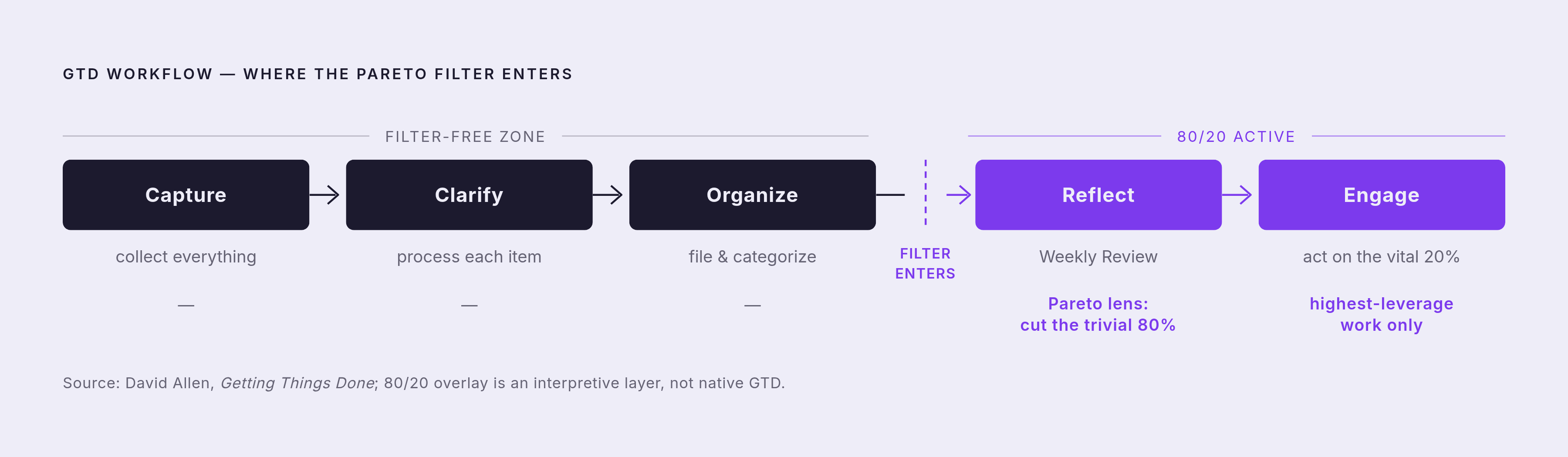
GTD asks you to capture and process everything. The 80/20 rule asks you to act on the vital few and let the rest wait. Those two instructions pull in opposite directions, and pretending otherwise doesn't help anyone.
A question that appears often on GTD forums gets at this directly: if everything is captured, how do you actually sort through a long list of projects and next actions to find the ones that matter most? And is it ever a mistake to just ignore the other 80%?
Fair questions, but skip them and either people stop capturing low-impact items or they drown in a list nobody trusts. Skipping this tension entirely tends to result in one of two things. Either people stop bothering to capture low-impact items at all, which quietly breaks the habit that makes GTD work in the first place, or they end up with a long, fully captured, fully trusted list that nobody actually works from. A list nobody works from is a filing cabinet. It's a filing cabinet.
The Someday/Maybe list is the bridge that resolves a good chunk of this. It's where you park things you believe in but aren't ready to act on yet. In a GTD setup that's actually working, this is where the "trivial 80%" tends to live, not deleted, not ignored, just parked with intention until its moment comes, if it ever does.
Where 80/20 slots into GTD: the Weekly Review and the Engage step
So if 80/20 doesn't belong at the Capture stage, where does it fit? After the list exists, not before. The Pareto lens operates on the master list GTD produces, once everything is already organized.
The Weekly Review is where this happens most naturally. That's the moment you scan every list you've built and decide what the coming week actually needs from you. It's the natural point to ask which 20% of your projects and next actions will drive 80% of the outcomes that matter.
One method that works well here: give each task two scores. A value score from 1 to 10 for impact, and an effort score from 1 to 10 for how much work it'll take. Divide impact by effort, and you get a rough priority ranking. Whatever floats to the top gets your best hours.
The Engage step is where this filtering gets tested against reality. Allen's four criteria for choosing what to work on in the moment are context, time, energy, and priority. Priority was always in there. What 80/20 does is sharpen what "priority" actually means when you're standing at that decision point, phone in hand, deciding what to tackle next.
Why timeboxing pairs naturally with the Pareto lens
Timeboxing means giving a task a fixed, predetermined slot of time. You break the day into chunks, and each chunk forces attention onto exactly one thing.
It's easy to confuse this with time blocking, but they're not the same. Time blocking reserves a period for an activity, full stop. Timeboxing goes a step further: it also caps how long you're allowed to spend on that activity. With time blocking, the scope is fixed but the time can stretch. With timeboxing, the time is the fixed part, and the scope has to flex around it.
That constraint is a direct answer to Parkinson's Law. It's a direct answer to Parkinson's Law, the observation that work expands to fill the time available for its completion. Giving yourself all day for a task means it'll take all day, regardless of how much of it actually needed doing. Timeboxing cuts that off at the root. It prevents the trivial 80% of your task list from quietly colonizing hours that should've gone to the vital 20%.
There's a psychological reason this works beyond just the scheduling mechanics. Timeboxing sets what psychologists call an "implementation intention," meaning you decide in advance what you'll do and when you'll do it. That kind of specific, pre-committed plan is well studied, and it reliably beats vague intentions like "I'll get to it sometime this week."
Practical examples of 80/20 applied inside a timeboxing structure
Timing matters as much as identification. According to Forbes, roughly 69% of people find their productivity sweet spot in the morning. The Pareto-identified task, the one you've already flagged as part of your vital 20%, belongs in that window, not squeezed in after lunch when the tank is half empty.
A few ways this plays out in practice:
Chunked priority boxing. Take a large, complicated priority project and break it into four pieces. Block two-hour timeboxes each morning, one piece per day, across four working days. That leaves the rest of each day open for the smaller, secondary stuff that still needs doing but doesn't drive the outcome.
Day theming. Instead of splitting a task across the week, clear an entire day for it. A work-from-home day with fewer interruptions works well for this. One day, one priority, and the remaining four days absorb everything else.
Sprint prioritization on a software team. When a sprint's time box is fixed and the feature list is flexible, which is basically every sprint ever run, the Pareto principle decides which features (call them A, B, and C) actually make the cut. The team doesn't ask which features are easiest to knock out or which there are more of. It asks which ones deliver the most value, then builds the sprint around those.
Each of these examples does the same underlying thing: it identifies the vital 20% first, then uses the rigid boundary of a timebox to protect it from erosion.
What breaks when people apply 80/20 to productivity systems without care
None of this works if the Pareto principle gets misapplied, and there are a few specific ways that happens.
The first failure mode treats 80/20 as an excuse to coast. Some people hear "20% of the work drives 80% of the results" and translate that into "so I only need to try 20% as hard." Wrong read. The corrected version: you still bring full effort to the 20% you've chosen. The rule tells you where to aim, not how hard to pull the trigger.
The second failure mode is neglect. Pour all your attention into high-impact work, and the administrative stuff, the maintenance tasks, the small recurring obligations, pile up quietly in the background until they become a crisis. This is why GTD's capture discipline matters as a safeguard. It keeps those items visible on a list somewhere, even if they're not getting worked on this week.
Third, there's the trap of over-simplification. Not every project splits cleanly into a vital 20% and a trivial 80%. Complex or creative work often resists that kind of clean division entirely, and forcing the ratio onto something that doesn't fit it can mislead more than it helps.
Fourth, dependency on external factors gets overlooked more than it should. Some outcomes hinge on people, timelines, or conditions outside your control. Applying the Pareto lens without accounting for those dependencies creates a real chance you end up optimizing for the wrong 20%, one that looks high-impact on paper but is actually blocked by something nobody on the team can move.
AI-assisted tools automating the Pareto identification step
Organizations sometimes described under the "Frontier Firms" label are putting the Pareto Principle into practice at a structural level, deliberately focusing teams on the 20% of work that generates 80% of outcomes. AI is starting to make that kind of focus easier to sustain at scale.
What can AI actually contribute here? It can surface patterns across a team's task history. It can flag which project types have historically produced outsized results. It can suggest where timeboxes might be placed. In effect, it takes some of the cognitive load off the Weekly Review's Pareto step, the part where someone has to sit down and manually rank a long list by gut feel.
What it shouldn't do is decide which outcomes actually matter. That judgment call stays with a person. The value AI adds here is speed of identification, not automated prioritization of goals, as these tools get more capable.
The more useful framing is augmentation. Tools that understand context and learn patterns over time, recognizing which meeting types drain hours without producing anything, which project categories keep landing in that vital 20% quarter after quarter, make the combination of 80/20, GTD, and timeboxing scalable without handing the actual thinking over to software. The system still needs a human deciding what counts as a win. AI just gets you to that decision point faster.