Popular Productivity Frameworks Compared
Three frameworks solve different problems, so pick the one matching your actual bottleneck.
82% of people run their days off scattered to-do lists, overflowing inboxes, or plain memory, without any formal system. The average worker gets about two hours and 53 minutes of real, focused productivity out of an eight-hour day. Faced with numbers like that, the instinct is to grab a framework, any framework, and bolt it onto your life by tomorrow morning. This piece pushes back on that instinct.
A framework's real job is narrow: it takes decisions you'd otherwise make on the fly and externalizes them, so you're not spending willpower on meta-work like "what should I do next" every twenty minutes. What it cannot do is fix a mismatch between its assumptions and how you actually think, work, and fail. The question worth asking is which system matches your working style, your failure mode, and the kind of work sitting in front of you.
How to read a framework comparison usefully — the three lenses that actually predict fit
Three things predict whether a framework sticks for you, or quietly dies within three weeks.
First, working style. Do you run one deep project at a time, or juggle a dozen threads that shift daily? Is your job predictable, or does it get rewritten by other people's emergencies?
Second, failure mode. This is the one people skip, and it's the one that matters most. Where does your productivity actually break? Do you forget things? Prioritize the wrong things? Start projects and abandon them halfway? Bounce between tabs so often that nothing gets finished? Or do you spend so much time organizing that the organizing becomes the job?
Third, cognitive load tolerance. Some systems ask for real upfront setup and ongoing maintenance, like a second job you take on to manage your first job. Others only work if they stay light enough to touch for thirty seconds and put back down.
Here's the thing worth sitting with: a framework that "isn't working" for you is often just solving a problem you don't have. Someone with a chronic prioritization problem who adopts a capture system built for chronic forgetting is going to feel like nothing changed, because nothing relevant to their actual bottleneck did.
This is also where a smarter AI layer earns its keep: paying attention to context and rhythm, so it can flag which framework's logic actually maps onto how someone works, rather than how they wish they worked.
With those three lenses in hand, here's how the major frameworks stack up against them.
GTD: the most complete system for people drowning in open loops
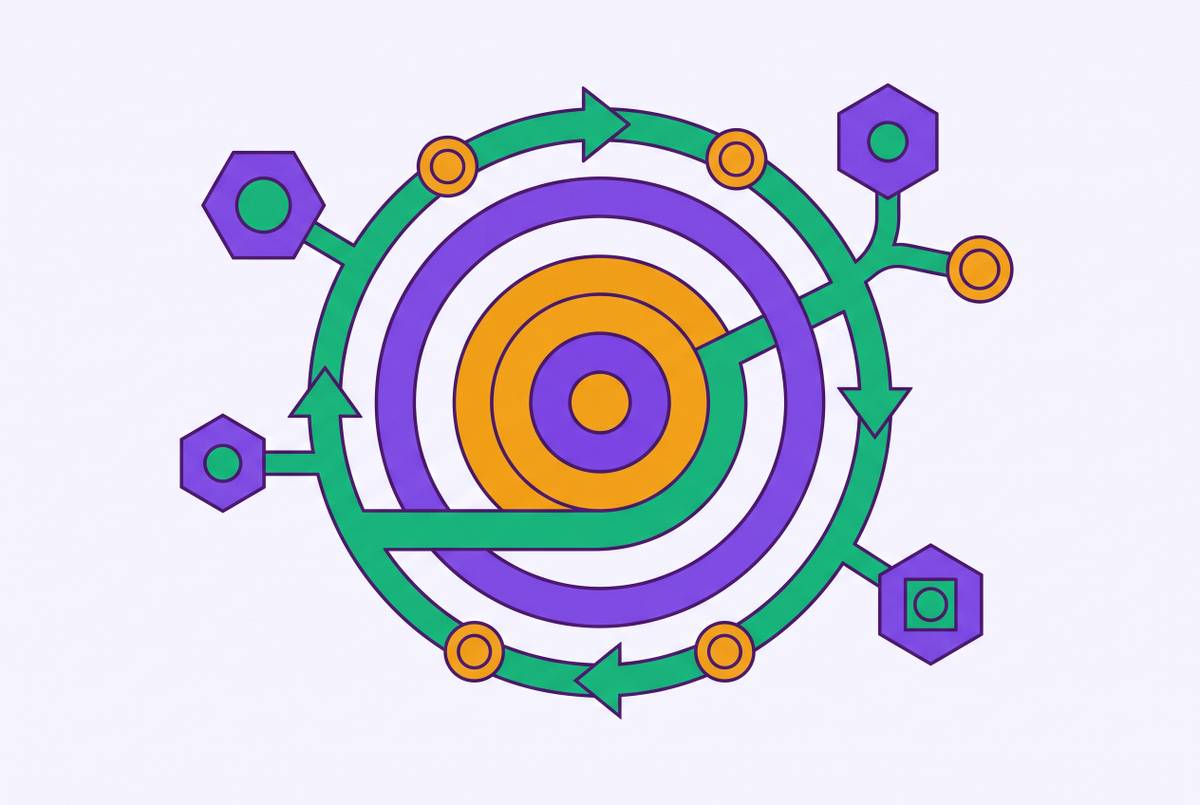
David Allen built Getting Things Done in 2001 around a five-step loop: Capture, Clarify, Organize, Reflect, Engage. The insight underneath it is almost embarrassingly simple once you hear it: your mental RAM is finite. Every open loop you're holding in your head, that email you haven't answered, that appointment you haven't booked, is quietly eating capacity you could be spending on actual work.
Allen calls the Weekly Review the "critical success factor" of the whole system. Skip it once, and the system doesn't just stall, it starts decaying into another pile you're avoiding.
GTD fits people managing many shifting commitments across work and life at once, especially if their failure mode is forgetting things or carrying background anxiety about what they might be forgetting. Knowledge workers with high inbox volume and unpredictable daily priorities tend to get the most out of it.
Where it breaks: the setup cost is real. You're learning new organizational thinking, not just a new checklist. For someone running one simple project, GTD is like bringing a filing cabinet to organize a grocery list. And that Weekly Review discipline is exactly where most people's implementations quietly fall apart; miss it once, and the debt compounds fast.
GTD solves "I have too much to track and I keep dropping things." It does close to nothing for prioritization problems, or for the difference between shallow and deep work.
The Eisenhower Matrix: a prioritization tool, not a task management system
The story goes back to Eisenhower's own operating principle, something like "the urgent are not important, and the important are never urgent," which Stephen Covey later formalized into the four-quadrant model most people recognize today: Do, Schedule, Delegate, Eliminate.
The real value sits in Quadrant 2, important-but-not-urgent work. Most people's days get eaten by Quadrant 1 and Quadrant 3, urgent stuff and fake-urgent stuff, which crowds out the strategic work that only happens when nothing's on fire.
This fits people whose failure mode is reacting to whatever feels loudest instead of whatever actually matters. It's a lightweight decision filter rather than a full system, which is exactly why it can help people with ADHD: it turns an overwhelming list into a simple four-way sort instead of an infinite ranking problem.
Where it breaks down is almost funny in its simplicity: if everything on your plate is labeled urgent and important, the matrix gives you nothing. No traction, no signal. It also doesn't tell you how to do the work, only where it belongs in line. And it demands honesty about what's genuinely important versus what just feels urgent in the moment, which is a harder task than it sounds.
It solves "I'm always busy but never getting to the work that matters." It layers well on top of GTD, prioritizing what's already captured, or alongside time blocking, deciding what actually earns a slot on the calendar.
Time blocking: scheduling work as if attention were a non-renewable resource
Cal Newport has called time blocking the most productive thing he does: assign every hour a job in advance, instead of working reactively off whatever list is loudest that morning. Research published in the Journal of Consumer Research found that people who time block complete 30% more tasks than those working from unstructured to-do lists. Professionals who block time specifically for deep work report 60% fewer distractions during those focused stretches.
Energy-based time blocking pushes further. Research from Harvard Business Review in 2025 found that scheduling cognitively demanding work during someone's actual peak hours, rather than whenever it happened to land on the calendar, produced 43% higher focus quality and 27% better work-life boundaries compared to traditional scheduling.
Who's it for? People with real control over their calendar. If your day is dictated entirely by other people's meetings, this doesn't have much to work with. It fits best when the failure mode is distraction and context-switching rather than forgetting or misprioritizing.
Where it breaks: plenty of jobs, especially ones with heavy meeting loads or reactive responsibilities, simply don't allow that level of control. And rigid blocking can backfire; when reality inevitably disrupts the plan, an over-rigid blocker feels anxious instead of adaptive. The fix is rebuilding the block regularly rather than planning once. It also works best paired with a prioritization layer like the Eisenhower Matrix, so you know what deserves the block in the first place.
It solves "my day disappears and I never get to the work I meant to do."
Pomodoro: a focus technique for people who need external pacing
Francesco Cirillo built this in the late 1980s: 25 minutes of focused work, a 5-minute break, and a longer 15 to 30 minute rest after four rounds. The underlying mechanism is really about pacing, and permission, more than time management. The timer gives you explicit license to stop, which quietly removes the anxiety that comes from open-ended work sessions with no defined end.
Interval length isn't fixed, and shouldn't be. Shorter intervals, 25 minutes or under, suit reactive work, high-frequency decisions, or someone still building focus stamina. Longer intervals, up to 90 minutes, suit creative or analytical work where it takes time just to get into the material before you can do anything useful with it.
A 2024 study in Time & Society looked at Pomodoro adoption inside a digital marketing agency and found something worth noting: the technique let people personalize their own productivity rhythms and supported collective work-life balance goals. That cuts against the common assumption that timed methods just squeeze more output out of individuals under a stopwatch.
It fits people who struggle to start tasks, or who find open-ended blocks mentally draining before they even begin. It also suits interruption-heavy environments, since each interval creates a natural re-entry point after a distraction.
Where it breaks: deep immersion work. A timer going off at minute 25 in the middle of a flow state isn't a gentle nudge, it's a wrecking ball. And for people who work in flexible, intuitive rhythms, the whole structure can feel like a straightjacket.
It solves "I can't get started" or "I work in frantic bursts with no real recovery in between."
Deep Work: a philosophy about what makes knowledge work valuable, not just a scheduling method
Newport's formula is blunt: High-Quality Work equals Time Spent multiplied by Intensity of Focus. Context-switching cuts that intensity by 40 to 60%, which means two hours of interrupted work might produce less than one uninterrupted hour.
The numbers on actual workplace behavior aren't encouraging. Hubstaff's 2025 Productivity Benchmarks found only about 39% of tracked working time goes to genuine deep concentration; the other 61% disappears into meetings, messaging, admin, and the transition time between tasks. Put another way: for every hour of real focus, workers spend roughly an hour and a half on everything surrounding it. ActivTrak's 2025 State of the Workplace report found focus efficiency slipping from 65% down to 62%, with average focused sessions shrinking by 8%. That's a trend heading the wrong way.
Newport lays out four scheduling philosophies: Monastic, Bimodal, Rhythmic, and Journalistic, ranging from mildly disruptive to a total restructuring of how someone works. Most people start Rhythmic, carving out the same deep block daily, and graduate toward Bimodal or Monastic as their capacity for sustained focus builds. Journalistic, snatching deep work opportunistically whenever a gap opens, is the hardest mode by far and really only works once someone's already built serious focus discipline.
This fits knowledge workers whose value comes from the quality of their thinking, not the volume of tasks checked off, and who have enough control over their schedule to actually protect blocks of time.
Worth taking seriously, though: not all valuable work follows the solitary-depth model. Innovation often comes from weak ties, cross-disciplinary contact, hallway conversations, the very things seclusion forecloses. And for someone already buried under overwork, Deep Work can turn into one more source of pressure rather than relief. Newport seems to have absorbed that critique himself: his 2024 follow-up, Slow Productivity, named an Economist Best Book of 2024, pulls back toward sustainability rather than pure intensity.
It solves "I'm busy all day and producing nothing I'm proud of."
PARA and Building a Second Brain: for people whose bottleneck is information, not attention
Tiago Forte built PARA out of necessity, not ideology. Chronic illness forced him to offload memory onto external tools, and the system grew from that constraint rather than from any productivity trend.
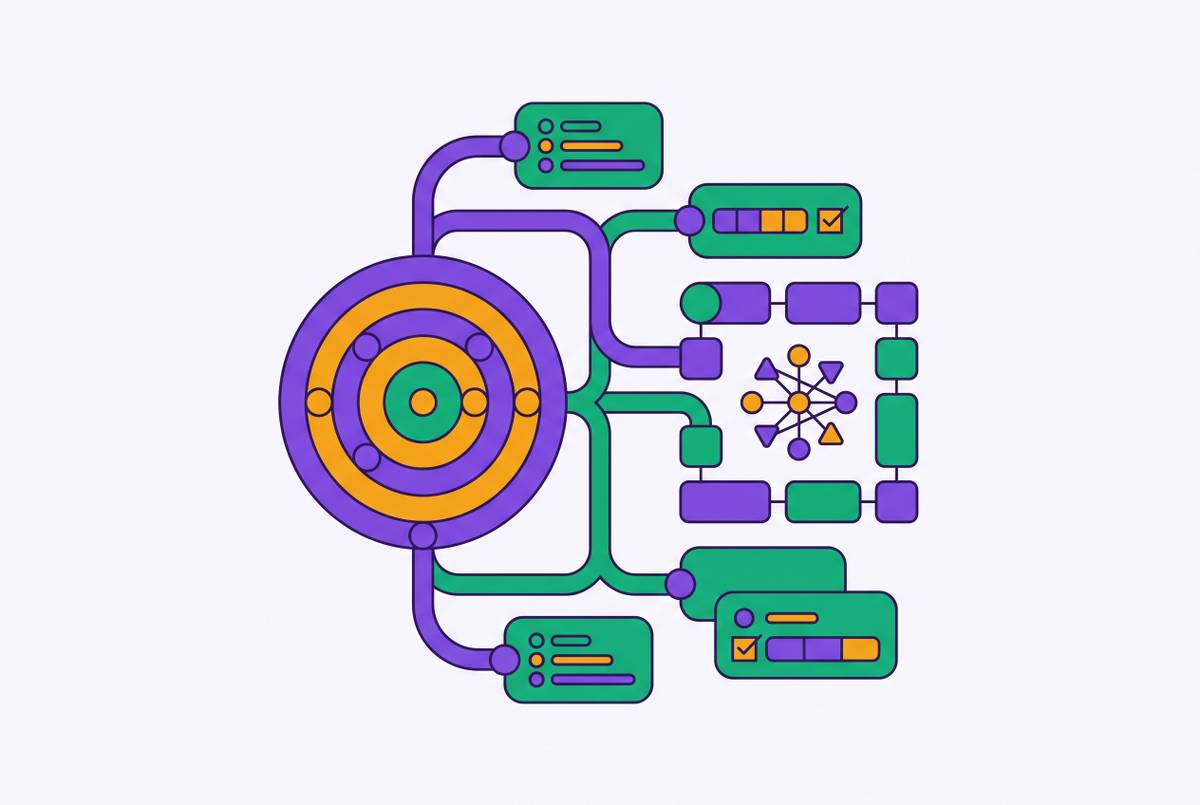
PARA organizes everything into four buckets: Projects, active work with a defined goal, Areas, ongoing responsibilities with no end date, Resources, reference material you might need later, and Archives, anything inactive. The key move is that it sorts by actionability, not topic. A folder organized by subject turns into a museum over time. A folder organized by whether you can act on it right now stays a tool.
The companion workflow, CODE, stands for Capture, Organize, Distill, Express. That last step, Express, is where most knowledge management systems quietly fail people: PARA insists that the entire point of saving something is eventually making something out of it, not just archiving it forever.
This fits people who consume huge volumes of information, research, articles, meeting notes, and can never find the right thing at the right moment. Writers, researchers, consultants, anyone whose job is synthesizing scattered inputs into something new, tend to feel the difference fastest.
Where it breaks: the setup and the ongoing habit of filing and distilling take real discipline, and skipping that habit for a few weeks turns PARA into just another messy folder structure. For someone with a simple information diet, or who works mostly inside structured tools rather than open notes, it's more system than the problem requires.
It solves "I save everything and still can't find anything useful, and I never build on my own past thinking." It pairs naturally with Deep Work, since PARA is where the output of those focused sessions actually lives afterward, and with GTD, since PARA handles all the reference material GTD deliberately keeps out of its action lists.
How frameworks layer — and why mixing them deliberately is different from mixing them randomly
Here's the thing that gets missed in most comparisons: these systems aren't really competing on the same axis. GTD governs capture and commitment tracking. The Eisenhower Matrix governs prioritization. Time blocking governs the calendar. Pomodoro governs pacing inside a single work session. Deep Work governs the philosophy of what's worth protecting in the first place. PARA governs where information lives once you're done with it.
Stacked that way, they function as layers rather than rivals. Someone could capture everything in GTD, prioritize with Eisenhower, block the calendar around what survives that filter, pace the actual sessions with Pomodoro, and file the resulting material in PARA. That's five different problems getting five different tools.
Randomly bolting systems together, though, is a different animal entirely. Running a strict GTD Weekly Review and rigid time blocking and Pomodoro timers all at once, without knowing which failure mode you're actually treating, just adds three new systems on top of the original problem. That's more overhead, not less friction.
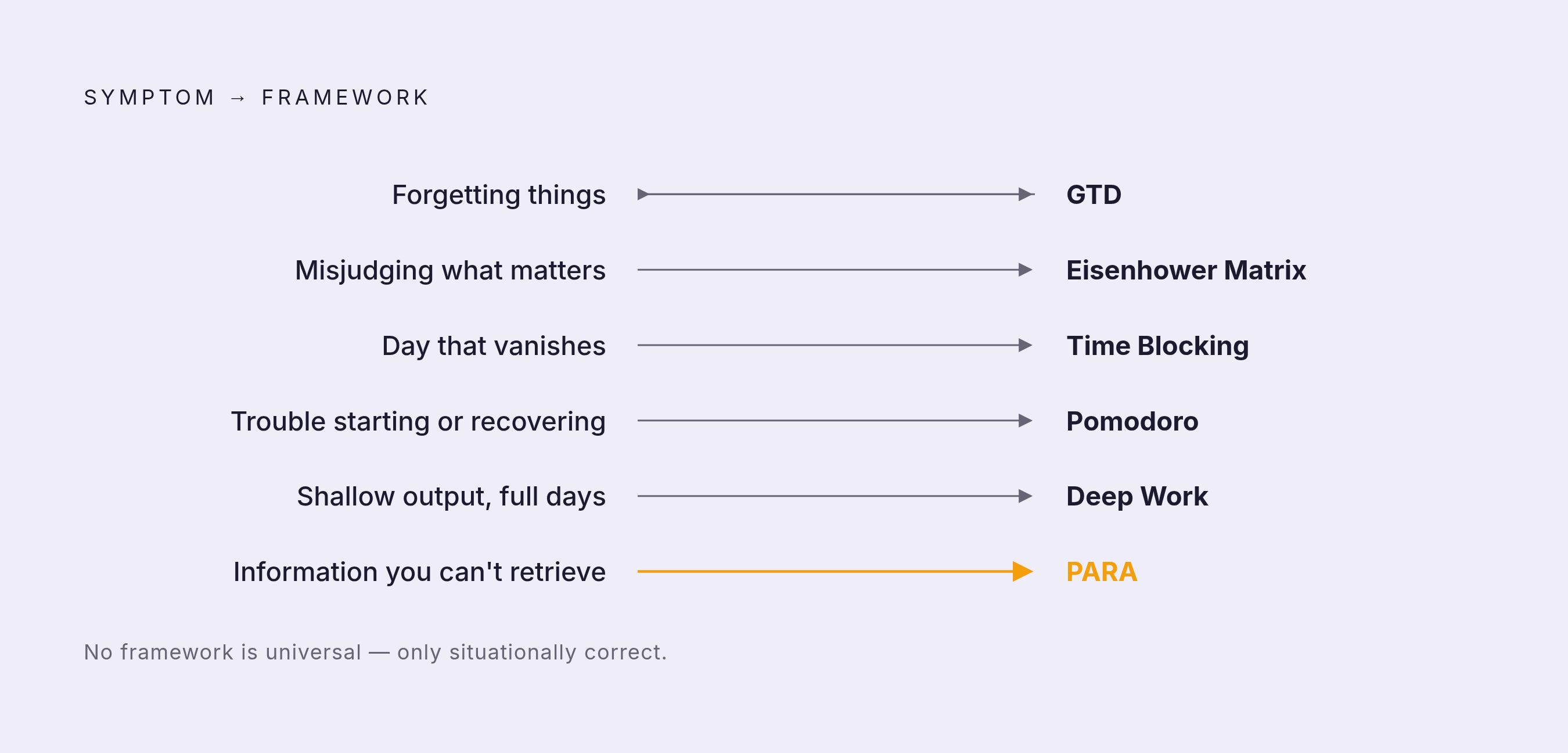
So before adopting anything, ask the only question that actually matters: what's breaking? Forgetting things points toward GTD. Misjudging what matters points toward Eisenhower. A day that vanishes points toward time blocking. Trouble starting or recovering points toward Pomodoro. Shallow output despite full days points toward Deep Work. Information you can't retrieve or build on points toward PARA. Match the tool to the break, not the break to whatever tool is trending this month.