Context Compression Techniques for LLM Prompts
Cutting long prompts down to size without losing what matters.
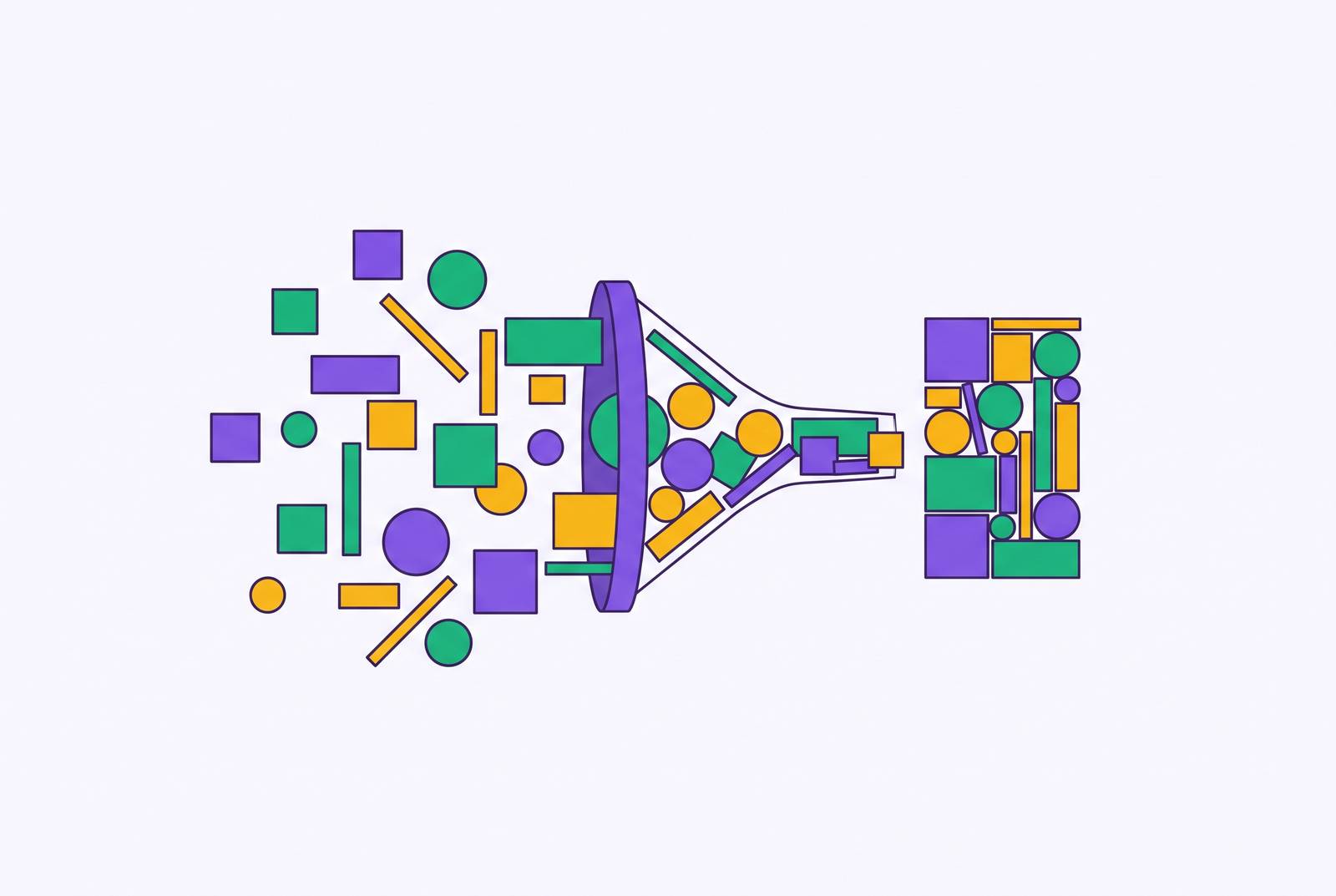
Long context comes at a real cost. Transformer attention scales quadratically with sequence length, so longer prompts drive up compute, memory, and prefill latency faster than per-token price cuts can offset. This piece maps the main compression techniques, what each one trades away, and how to pick the right approach for your use case.
Why long contexts are expensive and why bigger windows don't fix the problem
Context growth is a structural cost problem, not a pricing inconvenience. Zhou et al. (2026) note that transformer attention memory requirements scale quadratically with sequence length. A prompt that doubles in length does not double the work. It multiplies it. That is why real systems still fall back on truncation, segmentation, or multi-stage pipelines, all of which can break cross-segment coherence or remove the one piece of evidence the model needed.
Bigger context windows also fail to solve the useful-content problem. Jha et al. frame the dual challenge directly: long context raises system costs in compute and memory, and it degrades reasoning accuracy when the model must locate evidence scattered across many tokens. Retrieval narrows the haystack. It does not remove the bloat. The technique landscape splits into two broad camps: hard compression, which keeps the prompt as readable text, and soft compression, which replaces context with learned vector representations. Before choosing any tool, you need to know which camp your deployment can even use.
Hard versus soft compression: what the two camps change and why it matters before choosing a technique
Hard compression covers pruning, extractive selection, and abstractive summarization. All of them produce text that any model can consume through an API call with no changes to the inference pipeline. The prompt remains discrete, inspectable, and debuggable. Soft compression works differently. Gist tokens, KV-cache compression, and trained embedding methods encode context into vectors or cache states that the model reads instead of raw tokens.
That distinction decides which techniques are available to you before you evaluate any of them. If you use OpenAI or Anthropic endpoints, soft methods are effectively off the table. You can read the papers, and the compression ratios are impressive, but you cannot deploy them.
The split also governs transparency. A soft-compressed representation is not human-readable. When the model gets something wrong, tracing the failure through an opaque vector is far harder than reading the compressed prompt. For production teams, that debuggability gap matters as much as any benchmark score.
Extractive compression: selecting sentences rather than rewriting them
Extractive compression selects a subset of original sentences and keeps them verbatim. The method sounds almost too simple to compete with more elaborate approaches. Yet Jha et al. find that extractive compression often outperforms all other approaches and enables up to 10× compression with minimal accuracy degradation. They describe the result as surprising, given the volume of claims made for newer methods.
Why does extraction hold up so well? Query-aware selection is the key design axis. The approach shows gains over strong extractive baselines on long-document benchmarks.
This is not exotic infrastructure. Cohere Rerank orders retrieved documents by relevance, so only the top results reach the prompt. These are accessible tools, not research artifacts.
The structural limit is referential dangling. Independent sentence selection can keep the sentence containing an answer while deleting the sentence that defines the entity needed to interpret it. Extraction is strong, but it is not sufficient on its own. The failure modes section returns to this problem in more depth.
Token pruning: what LLMLingua and its variants actually do and where they fall short
Token pruning scores and deletes individual tokens rather than whole sentences. The granularity sounds appealing. The gap is especially visible on QA tasks.
The LLMLingua family from Microsoft Research, released under an MIT license, has a smaller model score each token and remove the low-value ones. LLMLingua reports up to 20× compression with little performance loss on reasoning and conversation benchmarks. The Kong AI Prompt Compressor, an Enterprise plugin for Kong AI Gateway 3.11 and later built on LLMLingua-2, compresses to a target ratio or token count and requires a separate compressor service.
Two caveats temper these numbers. Pruning also adds a step to every request. Its latency and cost must be accounted for, not just the token savings it produces.
The deeper deployment problem: if you specify a compression ratio, you get unpredictable quality loss because compressibility varies by input. That is where Performance-oriented Compression, or PoC, changes the frame. Zhao et al. (2026) ask developers to specify an acceptable performance floor rather than a compression ratio. A lightweight performance predictor then finds the most aggressive ratio that satisfies the constraint. Their context-aware predictor variant, which accounts for each input's intrinsic compressibility, consistently achieves lower performance prediction error than a context-agnostic predictor and adds only a small latency overhead.
The reframe is practical. Instead of asking "what ratio do I set?" you ask "what quality floor can I not go below?" That posture makes compression reliably deployable rather than a gamble on each input.
Abstractive compression: using a model to summarize rather than select
Abstractive compression has a smaller or cheaper model rewrite the context as a condensed summary. It is the strongest option when the goal is to represent the meaning of a large body of text rather than preserve any particular sentence. It is also lossy by design, and it fails unpredictably when specific details matter.
RECOMP trains extractive and abstractive compressors that summarize retrieved documents before they enter the prompt, and it can return nothing when documents are irrelevant. But the technique is not a universal win. Details buried in a section may not survive even the first pass.
The danger zone is any domain where exact phrasing, specific numeric values, named entities, or clause-level precision matters. A legal clause, a medical dosage, or a code identifier cannot be paraphrased without risk of changing its meaning. Abstractive methods belong on research corpora, meeting transcripts, and multi-document RAG results, where the overall meaning is the point and no individual sentence is sacred.
There is a promising direction in RL-based methods. Cmprsr (2025) uses Group Relative Policy Optimization to jointly optimize for compression-ratio adherence and downstream task utility, achieving fine-grained adherence across a wide ratio spectrum. Zhou et al. (2026) point to this as a direction where the quality gap between abstractive and extractive narrows. Production readiness remains an open question, but the trajectory is real.
Soft and trained compression methods: what they achieve and why most teams cannot use them yet
Soft compression methods show the highest theoretical compression ratios. They also require either fine-tuning the target model or access to its internals, which rules them out for any team using a closed API. That is the whole story in one sentence, and it deserves emphasis because the numbers are genuinely impressive.
Gist tokens, introduced by Mu et al. at NeurIPS 2023, train LLMs to distill prompts into a concise set of tokens encapsulating the knowledge of the original prompt, compressing prompts by up to 26× and reducing FLOPs substantially. 500xCompressor goes further, encoding prompts into as few as one token at ratios from 6× to 500×, while retaining a meaningful share of original quality under this regime. But the method requires extensive fine-tuning.
The transparency problem compounds the deployment barrier. Soft-compressed representations are not human-readable, so failures are harder to diagnose and fix than failures in hard-compressed text. Zhou et al. (2026) motivate their training-free hybrid graph approach precisely as an alternative that does not require trained compressors or specialized inference pipelines. The practical gap they address is the barrier that keeps soft methods in the research lab for most production teams.
Provider caching: the cost reduction that requires no compression at all
Before you compress anything, check whether caching already solves your problem. OpenAI's automatic caching applies to eligible requests on supported models, and you need no code changes. Google's Gemini API offers implicit caching, on by default for Gemini 2.5 and newer with no guaranteed saving, and explicit caching with a guaranteed rate and a storage charge.
Caching is not universally free or a guaranteed saving. And there is a critical interaction with compression: compressing a prompt changes its text, which can break a cached prefix. The two mechanisms must be evaluated together.
Caching fits stable content that repeats across requests: long system prompts, fixed tool definitions, RAG corpora loaded once per session. It does not help with highly dynamic or user-specific context that changes every turn. When your context is genuinely novel on every request, caching runs out of road, and the compression techniques above become the only levers left.
Agent context management: why multi-step pipelines need a different compression strategy
Agent pipelines accumulate context in a structurally different way from document prompts. They interleave tool call results, prior reasoning steps, and observation history. The problem is not a single long document. It is unbounded growth across a trajectory, with new tokens stacking up on every round-trip. Applying a uniform compression ratio to that heterogeneous mix fails because history and observations do not compress the same way.
FOCUS (2026), a training-free agent compression approach tested on OfficeBench, demonstrates meaningful API cost reduction relative to the no-compression baseline, with draft-model overhead accounting for only a small share of total cost. Smaller thresholds reduce tokens but cause more frequent compression calls and degrade accuracy. Moderate thresholds for history and observation separately give you the best cost and accuracy trade-off.
Agent-specific compression is now a recognized sub-field. ACON, FOCUS, TokenPilot, and PEEK are 2026 research works on how you must manage history and observation compression within multi-step pipelines. The field is early and promising, not solved.
Where compression fails: referential dangling, output token explosion, and benchmark overfitting
The three most important failure modes are structurally distinct, affect different technique families, and require different mitigations. Treating them together as "quality loss" obscures what actually goes wrong and how to catch it. Referential dangling is the most structurally surprising. It occurs when independent selection retains text containing an answer but deletes the text that defines the entity needed to interpret it. This is a structural failure of extractive methods, and it worsens as compression ratios increase, as documented by research cited in Zhou et al. (2026). The practical mitigation is simple. Keep a small entity glossary, with names, definitions, and IDs, outside the compression budget, and let the compressor operate on everything else.
Output token explosion is the most counterintuitive failure for cost-focused engineers. When compression destroys critical instruction content, some models compensate by generating much longer outputs, which can drive total costs far above the uncompressed baseline. The effect is model-dependent and benchmark-dependent, and it is worst when compressed prompts strip instructions rather than content, per findings cited in Zhou et al. (2026).
Benchmark overfitting is the methodological caveat that explains why published results mislead. Single-benchmark assessments can mislead you about compression safety and efficiency. Additionally, all tested compression methods, including the strongest performers, result in some degree of increased hallucination when applied aggressively, with information loss as the primary driver, per Zhang et al.
The right metric is completed-task quality and total cost, including output tokens and compression overhead, not the percentage of input tokens removed. (2026) operationalize the shift with their PoC framework, specifying a performance floor rather than a compression ratio as a way to make compression deployment reliable. Test compression on your workload, not on the paper's benchmark.
Choosing the right technique for a given use case
No single technique dominates across all use cases. The right choice depends on whether the content is dynamic or stable, whether exact phrasing matters, whether you use a closed API or open-weight infrastructure, and whether the pipeline is a single-turn document task or a multi-step agent trajectory. Start with caching. For stable, repeated context such as system prompts, fixed tool definitions, and shared RAG corpora, evaluate provider caching first. PointFive (2026) marks this as the first thing to check before any compression approach.
For long documents where meaning can be synthesized, reach for extractive compression with query-aware sentence scoring. The empirical evidence from Jha et al. supports extraction before pruning or summarization. Abstractive summarization is appropriate when no individual sentence is critical but overall meaning is, as with meeting transcripts or multi-document RAG results. For precision-sensitive content such as legal text, medical records, code, or multi-hop QA with named entities, avoid abstractive summarization. Use extractive selection with explicit entity preservation to guard against referential dangling, and consider keeping a glossary of key entities outside the compression budget.
For very long prompts where sentence-level granularity is too coarse, token pruning through the LLMLingua family is the entry point. But set a performance floor rather than a compression ratio, using the PoC approach from Zhao et al. (2026) to avoid unpredictable quality degradation.
For multi-step agent trajectories, treat history compression and observation compression as separate problems with different thresholds. Do not apply document-compression techniques uniformly to agent context. Evaluate total API cost including compression call overhead, since a compression round-trip is itself a cost. For open-weight deployments with fine-tuning capacity, soft methods become viable. Gist tokens and KV-cache compression offer the highest compression ratios but require investment in training infrastructure and give up prompt-level auditability. Finally, treat compression as an engineering discipline with its own evaluation loop, measuring task completion quality across diverse inputs rather than a one-time parameter to tune. A platform that supports prompt experimentation and output evaluation across variants makes this loop tractable at scale, and that is what separates teams that compress safely from teams that shrink tokens and lose the reasoning.