RAG Pipelines in Personal AI Knowledge Systems
How to turn personal notes into a searchable AI assistant.
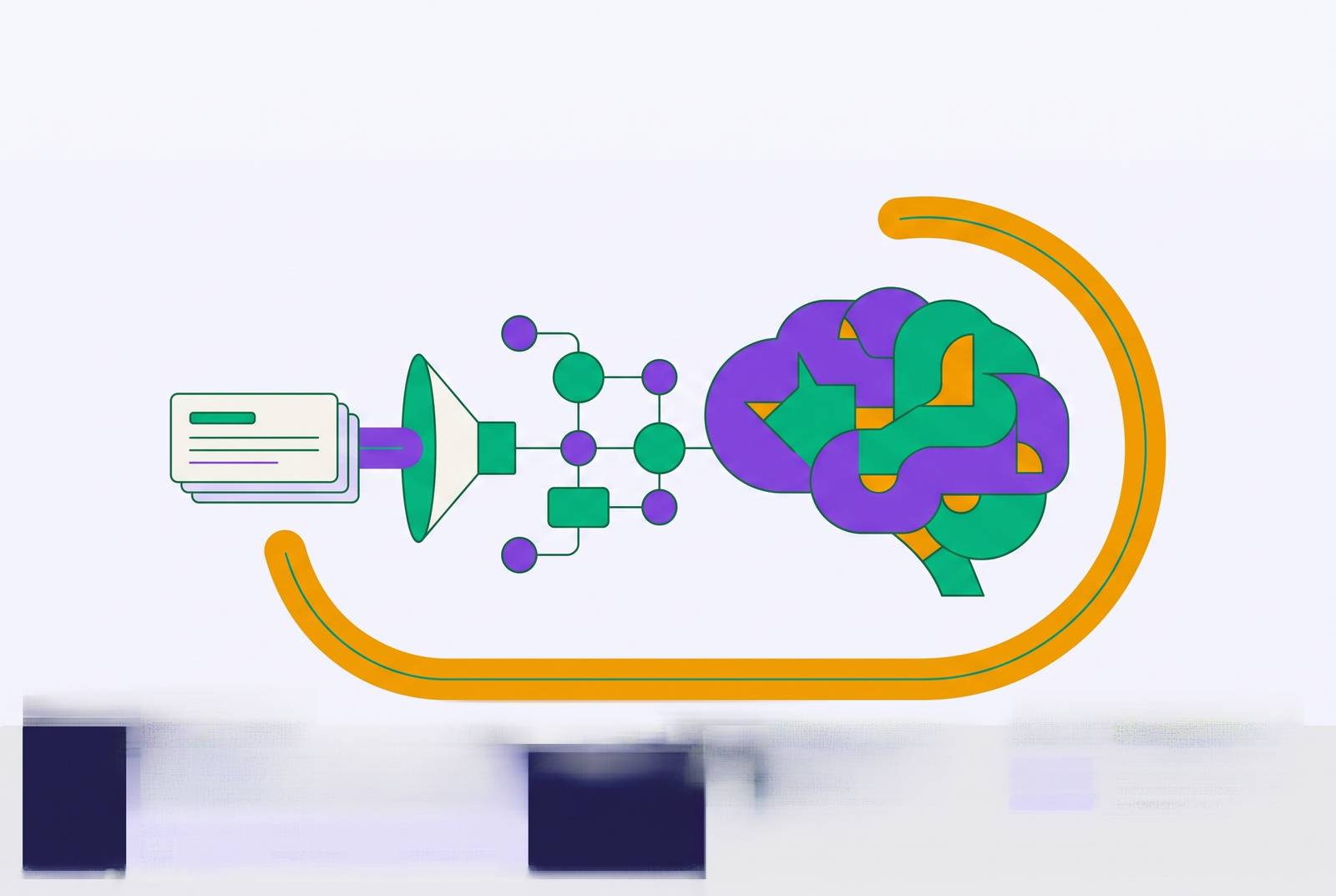
RAG stands for retrieval-augmented generation, and it's the plumbing that turns a pile of personal notes into something you can actually talk to. A chatbot alone only knows what it learned in training. A search bar alone only finds what you already know how to phrase. RAG connects the two: a language model on one side, your documents on the other, joined at the moment you ask a question.
The gap it fills is worth naming directly. A traditional knowledge base, whether that's Evernote, a folder of PDFs, or a wiki, rewards the person who already knows the right word to search. Type the wrong term and the right note stays buried forever. Large language models have the opposite problem: fluent enough to explain almost anything in plain language, but frozen at whatever point training ended, and blind to your notes, your meeting transcripts, the essay draft you wrote last Tuesday.
The 2020 paper by Lewis and colleagues that introduced RAG made one move with big consequences: split the reasoning engine from the knowledge store, and connect them at query time instead of baking everything into one model. That's what lets a personal system answer "what did I conclude about the Henderson project in October" by pulling actual October notes, not by guessing from whatever it absorbed during training.
Get this straight early, because it trips people up constantly: RAG is not a chatbot bolted onto a search bar. It's a pipeline that pulls in candidate material, filters it down, and feeds only the most relevant pieces into the model's working context. Long context windows don't quietly fix this either, no matter how tempting that sounds. Stuffing an entire document store into one giant prompt runs into what RAGFlow's 2025 review of the field calls "Lost in the Middle" degradation: information buried in the center of a long context gets underweighted, and the compute cost of chewing through all that text scales worse than linearly. For most personal knowledge workloads, pulling a handful of the right chunks beats dumping everything on the model at once, and it isn't close.
The four stages every RAG pipeline moves through
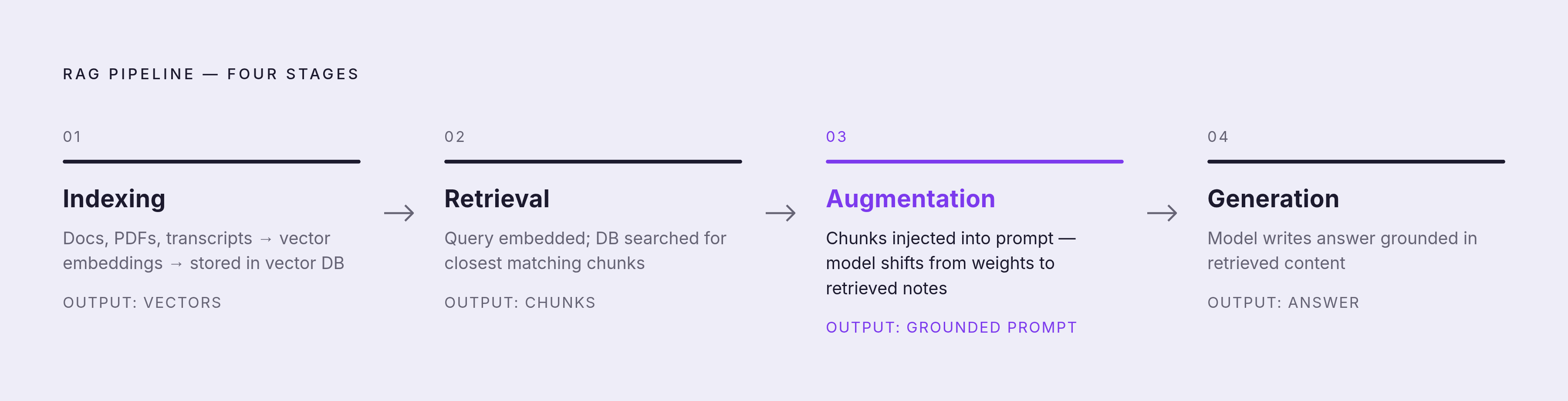
Think of this as an assembly line, not a feature list. Each stage hands its output to the next, and one weak link breaks the whole chain.
Indexing comes first. Source material (Markdown notes, PDFs, meeting transcripts, saved web pages) gets turned into vector embeddings and stored in a vector database. Skip this step and you're back to plain keyword matching, which is exactly the problem RAG exists to solve.
Retrieval happens when a query comes in. The system embeds the question the same way it embedded everything else, then searches the database for the stored chunks whose vectors sit closest to the query's vector.
Augmentation takes those retrieved chunks and drops them into the prompt sent to the language model. This is the pivot point: the model now reasons over material pulled from actual notes, not just patterns baked into its training weights.
Generation closes the loop. The model writes an answer grounded in what got retrieved, often pulling together several source notes or citing them directly.
Why does this beat fine-tuning a model on personal data? Fine-tuning costs real compute, needs labeled training examples, demands technical know-how, and has to be redone every time the notes change. RAG skips all of that. Write a note this morning, and it can show up in an answer this afternoon. No retraining, no waiting around.
How chunking determines what the pipeline actually retrieves
Here's the part that quietly decides whether the whole system feels smart or feels broken: the retriever can only hand back what got stored, and how the documents got sliced into chunks controls what's available to hand back.
The tradeoff cuts both ways. Bigger chunks carry more surrounding context, so the thread of an idea survives, but they dilute precision, since a five-paragraph chunk might bury one relevant sentence inside four irrelevant ones. Smaller chunks sharpen targeting, but they risk splitting one complete thought across two or three separate pieces, none of which reads as a full answer alone.
Fixed-size chunking gets recommended constantly, and that's the mistake worth naming. A commonly cited default setup uses a max chunk size of 800 tokens with 400 tokens of overlap, and it's the easiest method to set up by a wide margin. But easy isn't the same as good: it cuts sentences and arguments at arbitrary token counts with no regard for where a thought actually ends. Fine for bullet journals and daily logs, where each entry mostly stands alone. Wrong for long-form essays and research notes, where an argument builds across paragraphs and a token-count cutoff will slice it in half without knowing it did anything wrong.
Semantic chunking splits text at meaning boundaries instead of counting tokens, and as of December 2025 this improves recall by up to 9% over fixed-size methods. LLM-driven chunking, seen in methods like LumberChunker, uses a language model to spot where the content actually shifts topic across paragraphs; it costs more compute to run but tends to work better on dense, interconnected notes where ideas bleed into each other. Late chunking embeds the full document first, then partitions it afterward, so the embedding step retains the whole document's context before any cuts happen. That shows real strength on contextually dense personal writing, the kind where a paragraph only makes sense sitting next to the one before it.
So the choice isn't really about which method is "better" in the abstract. It's about matching the method to what the notes actually look like. Daily logs: fixed-size is fine. Anything with a sustained argument: semantic or late chunking, where the boundary follows the thought rather than a token count.
One detail trips up almost everyone starting out: skip the overlap between chunks, and a key sentence sitting right at a chunk boundary may never appear whole in any retrieved result. It gets sliced in half, and half a sentence rarely answers a question.
Why retrieval method choice shapes the quality of what the LLM sees
Two retrieval styles pull against each other here, and knowing which one wins in which situation matters more than most people expect.
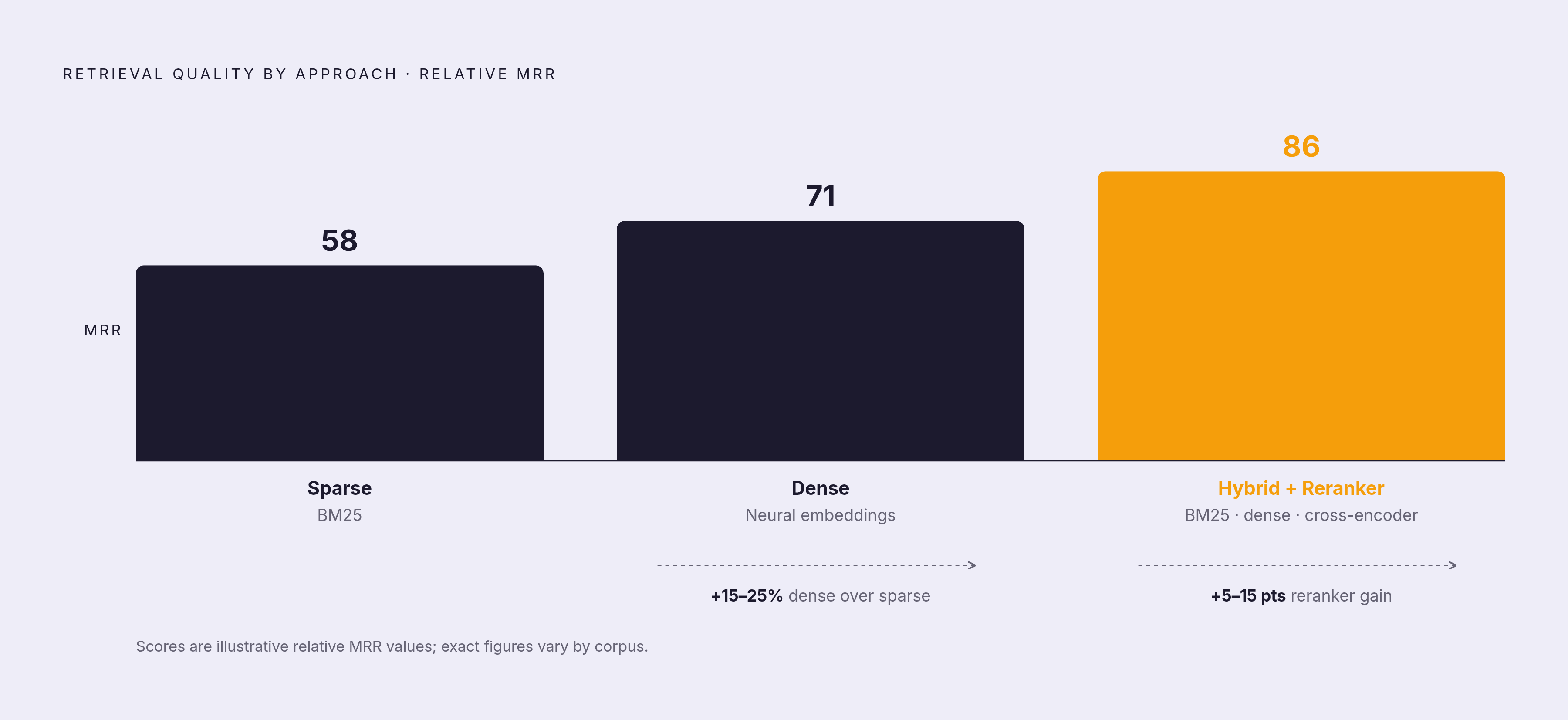
Sparse retrieval, methods like BM25, runs on keyword matching. It's dependable when the query has exact terms in it: error codes, product names, proper nouns, jargon that shows up verbatim in the notes. Dense retrieval runs on neural embedding similarity instead, so it catches meaning even when the query uses completely different words than the source note did. Dense beats sparse by 15 to 25% on general knowledge queries. Sparse still wins on highly technical content where exact wording carries the answer.
Treating this as an either-or choice is the actual mistake, and the benchmarks back that up plainly. Benchmark evaluations run across 2024 and 2025 converge on the same answer: hybrid search wins, and it's not close. Combining BM25 with dense embeddings, fused through a method called Reciprocal Rank Fusion, consistently beats either approach running alone. Most personal vaults need both running at once, because most people's notes are a mix: formal research writing that favors dense retrieval, sitting right next to quick references packed with exact codes, dates, and proper names that favor sparse.
Add a reranker on top and the gains keep stacking. A cross-encoder reranker, applied after the first retrieval pass, reads the query and each candidate chunk together instead of comparing vectors independently, and has been shown to add another 5 to 15 points of MRR (mean reciprocal rank) on hard evaluation sets.
The embedding model isn't a commodity choice either, whatever the marketing suggests. Leading embedding models have been shown to outperform OpenAI and Cohere embeddings by 9 to 20%, as measured in December 2025. That's not a rounding error. That's the gap between a system that finds the right note and one that just doesn't.
On storage, the vector database field has settled around a handful of names: Pinecone, Weaviate, Milvus, Qdrant. Each is workable at personal scale, differing mainly in hosting model and how much setup work they demand.
The tools people actually use to build personal RAG systems
Almost every decision downstream traces back to one fork: cloud-first or local-first.
Obsidian sits on the local-first side. It stores everything as plain Markdown files on your own machine, with bi-directional linking that builds a visual knowledge graph between notes. No AI comes built in, but the most popular community plugin adds RAG-based chat across an entire vault. Obsidian dropped its commercial license requirement in February 2025, so organizations now use the core app for free; optional add-ons include Sync at $4 a month and Publish at $8 a month, both billed annually. MCP integration lets tools like Claude Code read from and write to the vault directly, and local models through Ollama or LM Studio work natively, so data never has to leave the machine unless someone chooses to send it somewhere. Because it's all plain-text Markdown, there's no lock-in: any AI tool or editor can read the files straight away.
Notion AI takes the cloud-first, collaborative route instead. Its agents run multi-step tasks across a shared workspace, which suits teams well. Full AI access now needs the $20 Business tier, since Notion retired its standalone AI add-on in 2025; Free and Plus users get only a limited trial. This is a tool built for a shared surface, not a private vault, and treating it like one is where people get burned.
Mem goes cloud-first and AI-native from the ground up, with strong synthesis and cross-note question answering built in. The tradeoff: the data sits on Mem's servers, in exchange for a much lighter setup burden.
Google's NotebookLM and ChatGPT both run on a similar RAG-like retrieval pattern under the hood, but they're built for session-scoped work, answering questions about a document just uploaded, rather than serving as a persistent vault that grows over months and years.
If there's one setup worth copying, it's this: run Obsidian as the durable vault where the actual thinking and research live, and use Notion as the collaborative layer shared with a team. Treat them as complements, not competitors fighting over the same job.
There's also a workflow automation layer worth knowing about. Tools like n8n let builders wire together pipelines that pull in content automatically, say, AI-related emails from a Gmail inbox, push it through an API, and store the enriched result in a database. Once it's stored, querying that content works just like the semantic search covered earlier, just applied to live, incoming data instead of a static note pile.
Beyond retrieval, some builders want a reasoning layer sitting above all of this, something that doesn't just fetch facts but tracks patterns across notes over time and sharpens judgment instead of just answering lookups. That's a different kind of tool than a note-taking app, closer to an orchestration layer that decides what gets retrieved and how it gets stitched together.
Open-source frameworks that wire the pipeline together
The tools above each bake in one particular RAG recipe. Frameworks go a level deeper: they let a builder pick the chunking method, the retrieval paradigm, the reranker, and the language model independently, then wire them together by hand.
Dify, with over 154,000 GitHub stars, offers a visual workflow editor: build and test a RAG pipeline on a canvas without writing code, ingest documents from PDFs and slide decks, and orchestrate agents on top of it. It's the most approachable option for someone who isn't fluent in Python.
RAGFlow is self-hosted and open-source, built for production-grade RAG with strong document understanding, and it suits builders who want full control over where their data lives and how it gets processed.
LlamaIndex is purpose-built for indexing and querying personal and enterprise document stores, with solid support for structured data sitting alongside unstructured text, which matters if a vault mixes spreadsheets with essays.
Worth mentioning as a companion tool rather than a full framework: Firecrawl, which turns documentation sites and other web sources into clean Markdown, ready to chunk and embed. That fills a real gap when the existing notes don't cover something and fresh material needs to get pulled in from the open web.
Picking among these comes down to comfort level more than anything else. Non-coders tend to land on Dify's visual approach. Builders comfortable in Python often reach for LlamaIndex for the composability. People who care most about owning their data end to end gravitate toward RAGFlow. Whatever the marketing around any of these tools claims, none of them removes the need to actually test retrieval quality against real notes.
Advanced retrieval patterns that make a personal knowledge system reason rather than just retrieve
Standard vector RAG is excellent at one specific job: finding the note closest in meaning to a question. Ask something like "what are the recurring tensions across six months of project notes," though, and it starts to strain. That question doesn't point at one note. It requires synthesizing across dozens of them, and plain vector search was never built for that job.
GraphRAG, developed by Microsoft Research (Edge et al., 2024, released under an MIT license), takes a different approach. It builds a graph of entities and relationships out of the whole document corpus, then traverses that graph at retrieval time instead of just measuring vector distance. On broad, corpus-wide questions like "what are the main themes here," it beats vector-only RAG by a wide margin. For a personal vault full of cross-referencing ideas, that's the difference between a system that finds isolated matches and one that surfaces connections nobody drew on purpose. That matters most for researchers and writers whose notes constantly reference each other.
Agentic RAG breaks the old fixed sequence entirely. Instead of retrieve-then-generate as one pass, the system loops: plan, retrieve, reason, critique, rewrite, reflect, repeat until it's confident in the answer. A 2025 survey of the field pulled together these patterns (reflection, planning, tool use) and argued that autonomous agents handle multi-hop retrieval better than static pipelines do. Practically, this is what makes a question like "summarize how my thinking on this project has evolved since January" actually answerable: the agent issues several retrieval calls, compares what comes back, and only then synthesizes a response.
A few more patterns worth knowing by name. RAG-Fusion (Rackauckas, 2024) improves recall by rephrasing the same query several different ways and fusing the results together through reciprocal rank fusion, hedging against the risk that one particular phrasing misses the note actually needed. Self-RAG and Corrective RAG add a reflection step: the model checks whether what it retrieved actually answers the question, and re-retrieves if it doesn't, cutting down on confident-sounding answers that are simply wrong.
One more model worth flagging: the PersonalAI framework, from researchers at Skoltech and Sberbank (Menschikov et al., submitted June 2025, revised April 2026), proposes an external memory system built on a knowledge graph that the language model constructs and updates on its own. It's aimed specifically at long-term personal interactions, the kind of use where standard RAG tends to lose the thread across many sessions.
That points at a distinction worth sitting with: memory and RAG aren't the same thing, even though both run on retrieval underneath. Memory covers dynamic interaction history, what got discussed with the system yesterday. RAG covers static domain knowledge, the actual notes and documents. They're complementary, not interchangeable, and a personal system that leans on one while ignoring the other ends up feeling incomplete, even without an obvious name for what's missing.
Where most personal RAG systems degrade and what to do about it
RAG has a reputation for being easy to demo and hard to trust. That reputation is earned. RAGFlow's 2025 year-end review makes this point about enterprises too: even well-resourced teams committed to RAG report that getting stable, accurate answers on complex queries takes serious, ongoing tuning. Personal builders hit the same wall with far fewer resources to throw at it, which is exactly why skipping evaluation is the single most common mistake in this whole space.
Retrieval misses are the first failure mode. The right note exists somewhere in the vault, but the wrong chunks come back at query time. This is almost always a chunking problem or an embedding model problem, not a mysterious one. Fix it by auditing where the chunk boundaries actually fall, and testing whether hybrid retrieval catches what pure dense search misses.
Context flooding is the second. Too many chunks get crammed into the prompt, and instead of a sharp answer, the model produces something vague and hedgy, averaging across too much material at once. Tighter top-k limits, paired with a reranker that promotes only the highest-signal chunks, fixes this directly.
Stale index is the third, and it's the quietest one. New notes get added, but if the index doesn't refresh, the system keeps answering from an old snapshot of the vault. Set up automated re-indexing that triggers whenever a file changes. Don't rely on remembering to do it by hand.
Lost in the Middle is the fourth. Even when retrieval does its job and pulls the right content, that content can land in the middle of a long context block, and the model underweights it anyway. Per RAGFlow's review, that's a documented behavior of how these models process long context, not a bug in the retrieval step. The fix is ordering: put the most relevant chunks at the start and end of what gets sent to the model, not buried in the center.
None of this makes evaluation optional. Organizations running RAG in production report a 78% improvement in response accuracy on domain-specific queries compared to a vanilla language model with no retrieval at all. That number cuts both ways, though: it also means the vanilla model was wrong often enough for the gap to be measurable in the first place. Worth remembering the next time a personal system gives a fast, confident answer. Spot-check it against the actual source note now and then. The system that seems most trustworthy is often the one nobody bothered to check.