RAG vs Agentic AI for Personal Assistant Use Cases
RAG retrieves known information; agents decide and act on their own.
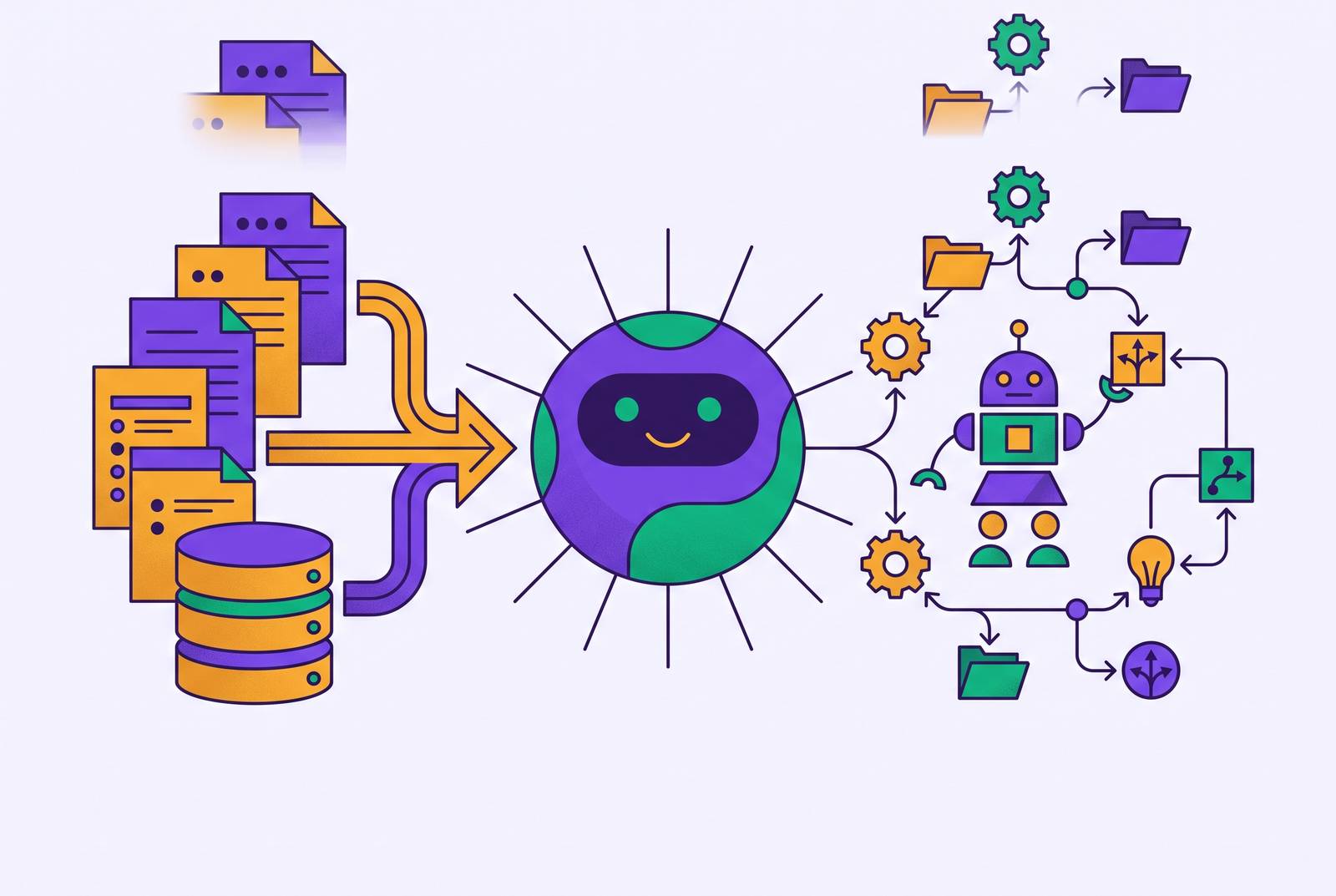
RAG and agentic AI solve two different problems inside a personal assistant, and the gap between them isn't a matter of degree. One retrieves and surfaces what's already known. The other plans, decides, and acts on its own. Most teams building these products still mix the two up, and the mistake shows up in a specific place: they monitor outputs, what a chatbot says, when what actually needed watching was actions, what an agent does.
Ask an assistant to "get me ready for my meetings today," and that's a retrieval task: pull the calendar, scan the relevant email threads, hand back a clean agenda. Ask the same assistant to "reschedule my 3pm and draft an apology to the client," and the job changes shape. Now the system has to decide what to do, touch a calendar with write access, and produce something that goes out under the user's name. That's a different category of work, not a harder version of the first one, and treating it like the first one is exactly how things break.
This split maps closely onto what happened in customer support over the last few years. Second-generation systems answered questions by retrieving from a knowledge base. Third-generation systems run a loop: observe, plan, act, reflect, pursue a goal instead of just answering a prompt. Personal assistants are going through that same shift now, and the teams getting tripped up are usually still applying old monitoring habits, built for systems that only generate text, onto systems that now take autonomous action. That gap is where coverage quietly disappears.
What RAG actually does inside a personal assistant, and what it does well
Strip away the jargon and RAG is a fairly plain mechanism. A user query triggers a retrieval step, pulling from an approved data store, a calendar, an email archive, a folder of documents, a vector index of past conversations. Whatever comes back gets injected into the model's context window, and the model generates an answer grounded in that retrieved content instead of whatever it happened to memorize during training.
That last part matters more than it sounds. The model's parameters never change. All the freshness comes from the retrieval layer, which is exactly why RAG works so well for the kind of data a personal assistant deals with constantly. An inbox that refills every hour, a calendar that shifts by the minute, a document folder that grows every week: retraining a model to keep pace with that would be absurd. Swapping out what gets retrieved isn't.
Take the earlier example: "get me ready for my meetings today." The system retrieves the day's calendar events, pulls related email threads, and generates a structured rundown, times, participants, topics, maybe a note on what was left unresolved from the last conversation with that person. No decisions made, nothing sent, nothing changed. Just information, organized and handed back.
That's the strength of RAG, and it's a real one.
- Answers stay grounded in sources the user actually controls, which cuts hallucination and keeps outputs auditable. Anyone can trace an answer back to the document it came from.
- Dynamic personal data (inbox, files, schedule) gets handled without a retraining cycle.
- Cost stays predictable: one retrieval call, one generation step, done.
- Deployment moves fast, since retrieval tooling is already standard practice across teams building AI products.
One limit shows up constantly in practice, though. If a document sits in the index, it's retrievable. The model doesn't enforce document-level permissions on its own. Access control has to get built into the retrieval layer itself, not assumed as a side effect of the architecture, and teams that skip this step tend to find out the hard way.
Where RAG stops, the ceiling every personal assistant builder hits
RAG treats every query as its own isolated event. No memory of a plan, no sense of a multi-step goal, just one lookup and one answer. Fine, as long as the task fits inside a single retrieval. It falls apart the moment it doesn't.
And retrieval itself isn't foolproof. Research from SenseTime in 2025 traced roughly 48% of traditional RAG failures back to the system simply failing to surface the right chunk in its top results at all. Not a reasoning failure. A retrieval failure: the system never even saw the piece of information it needed. Noise compounds the problem too. Irrelevant or misleading passages that make it into the context window can quietly corrupt an otherwise reasonable answer, especially when the real answer is split across multiple sections or depends on something mentioned earlier in a document.
The deeper issue, though, is structural. RAG retrieves once and stops. It can't visit a website to double-check something, can't update a calendar entry, can't send a message, can't even ask itself whether the first retrieval actually contained what it needed. Ask it to move a 3pm meeting, and there's nothing for it to retrieve. That's a write operation, and RAG was never built to write.
Bolting tool access onto RAG through layers of prompt engineering can paper over this for a while. It also gets unmanageable fast: most teams that try it end up with a tangle of conditional logic that breaks every time the underlying prompt shifts slightly. Wrong fix, wrong problem, and it tends to show up as a maintenance burden six months after launch rather than a clean failure on day one.
The customer support analogue makes the ceiling concrete. Answer-only RAG bots tend to flatten out around 30 to 40% containment, while agentic systems that can actually act on a request push toward roughly 70%. That gap is more than just a performance number. It's a trust gap, the difference between a system that can tell you the answer and one that can go do the thing.
What agentic AI adds, and why it transforms what a personal assistant can take on
An agent runs a loop: observe, orient, decide, act. Give it a high-level goal, and it breaks that goal into steps, then picks which tool fits each step as it goes, instead of following a fixed script written in advance.
The tools an agent can reach define its entire risk and value profile: APIs, calendars, email clients, file systems, databases, browsers, code interpreters. Widen that toolset, and the assistant gets more useful and, at the same time, more dangerous if something goes wrong. That tradeoff doesn't disappear because of a clever prompt. It has to get managed at the architecture level, full stop.
Where this actually shows up for a personal assistant is task management: helping someone plan out a week, prioritize a stack of competing deadlines, track progress on three projects that all need attention at once. Not answering questions about the calendar, working the calendar. And agentic assistants don't wait around for a prompt the way a chatbot does. They act on the user's behalf, proactively. One 2026 industry analysis put approval rates on autonomous actions at 85 to 92% for most agentic assistants, though only after a 2 to 4 week onboarding period. That tracks: these systems need time to calibrate to a specific person's preferences before they can act with real confidence.
That calibration period is part of the design, not a flaw in it. IBM's 2024 description of autonomous agents lays out the pattern: the agent learns what a user expects over time, stores that alongside explicit feedback, and adjusts future behavior accordingly. The assistant that's been running for two months should behave differently than the one just switched on, and if it doesn't, something in the memory layer isn't working.
Email is the case that makes this concrete. The average knowledge worker checks email 77 times a day, according to a computer-logging study out of UC Irvine and Microsoft Research, and spends about 28% of the work week, roughly 11 hours, managing messages, per McKinsey Global Institute's 2012 Social Economy report. Teams running agentic assistants against that workload report saving around 26 minutes a day. Microsoft Copilot is the visible enterprise version of this: drafting emails, recapping meetings someone missed, helping build out a presentation, wired into Office directly, per Microsoft's own 2024 description of the product.
That adoption curve isn't hypothetical anymore, either. A 2025 McKinsey survey found 23% of organizations actively scaling agentic AI across at least one business function, with another 39% running experimental deployments. Nearly two-thirds of organizations surveyed are somewhere on that path already.
Current agentic personal assistants and what each one is actually built to do
Products in this space aren't interchangeable, even when they all get called "agentic." Each one is built around a different bet about where the friction actually lives, and a fair number of them are agentic in name only, dressed up with a couple of extra API calls and nothing resembling a planning loop underneath.
Lindy sits at the top of Mastra's 2026 rankings, and the bet behind it is straightforward: a normal day of client-facing work is scattered across email, calendar, CRM, documents, meeting notes, and follow-ups, and no amount of clever retrieval fixes that fragmentation. Lindy's premise treats collapsing all of it into one assistant layer as the actual problem worth solving, not a nice-to-have bolted onto a chatbot.
Rahi launched in January 2026 with a narrower focus: email and communication management specifically. The philosophy underneath it treats the inbox as the task list itself, not just a source of information, and the assistant's job is to work that list directly. It's been one of the more talked-about entrants in the proactive assistant space this year, per analysis from aimagicx.com.
Microsoft Copilot plays at enterprise scale, threading through spreadsheet analysis, document prep, and meeting coordination, with the advantage of sitting natively inside Office and connecting into the broader business systems most large organizations already run on.
Here's the test worth actually applying, because the marketing language around "agentic" has gotten sloppy enough to be useless: does the product break a goal into steps, choose its own tools, catch its own mistakes, and adapt over time? Or does it retrieve some context, draft a response, and stop there? A real agent does the former. RAG with tool access stapled onto the side does neither, no matter what the landing page says.
Why agentic AI and RAG are converging, and what hybrid architectures mean for personal assistants
The two approaches aren't staying in separate lanes for long. Recent work has pushed RAG toward something more dynamic and decision-driven, where an autonomous agent orchestrates the retrieval process itself as part of its reasoning, instead of retrieval sitting as a fixed step at the start of the pipeline. The umbrella term for this is Agentic RAG, and a handful of variants are worth knowing by name.
- Corrective RAG (CRAG) adds an explicit step that checks retrieved document quality before generation even starts.
- Self-RAG lets the model decide, in real time, whether retrieval is even needed for a given query and whether what came back is actually relevant.
- GraphRAG represents documents as knowledge graphs, supporting reasoning across multiple linked entities instead of treating each chunk in isolation.
- Multi-agent RAG splits retrieval work across specialized agents, coordinated by a separate orchestrator agent.
The retrieval layer itself has gotten sharper too. Public benchmarks from 2024 and 2025, BEIR, MTEB, Anthropic's work on contextual retrieval, show that combining BM25 with dense embeddings through reciprocal rank fusion beats either method running alone, and stacking a cross-encoder reranker on top adds another 5 to 15 points of MRR on the harder benchmark sets, according to a 2025 RAG architecture analysis from futureagi.com.
A narrative that got popular in 2025 claims agents will simply replace RAG outright, and that deserves real pushback because it misses something structural. RAG's actual core competency, retrieving relevant information efficiently and accurately from a mountain of private data, is exactly what makes it the foundational data layer agents need to function at all, per a 2025 review from ragflow.io. An agent still has to retrieve before it can plan. Anyone predicting RAG's disappearance is describing agents planning in a vacuum, with no grounded information to plan against, and that's not a roadmap. That's a hallucination engine with extra steps.
Which raises the real question for anyone building on Agentic RAG specifically: what governs it? The answer needs a different security model built for agentic execution, because the system is still taking autonomous action even in the moments when retrieval looks like the main thing happening.
The real cost of choosing agentic (token overhead, latency, and what the math actually looks like)
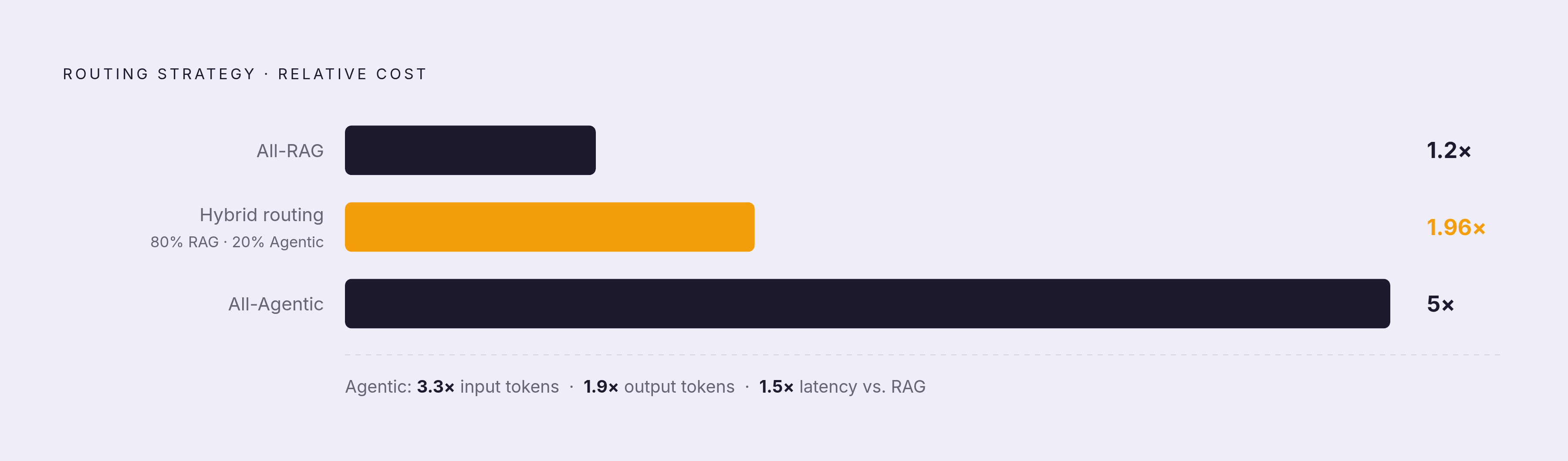
Agentic architectures cost more, and the gap isn't small. A comparison published on arxiv.org found agentic setups use 3.3 times more input tokens and 1.9 times more output tokens than enhanced RAG, while taking 1.5 times longer to run. Every reasoning loop the agent adds burns tokens and adds latency, and on complex queries that overhead can climb to 3 to 10 times the token cost and 2 to 5 times the latency of a standard RAG call.
The tail is worse than the average suggests, too. P99 latency in agentic systems can run 5 to 10 times the P50 for complex queries, so the worst-case responses land dramatically slower than the typical ones. That unpredictability is its own design problem, separate from the average cost question.
RAG cost is easy to forecast: one retrieval, one generation, done. Agentic AI multiplies cost across every step in a plan, and that compounding effect is much harder to model ahead of time than a single-shot pipeline.
So what's the actual fix here? Not an all-or-nothing choice between the two, but adaptive routing, and this is the part most teams get backward by defaulting to "just make it agentic" across the board. Route 80% of queries, the simple lookups, through traditional RAG at roughly 1.2 times baseline cost, and reserve the agentic path for the remaining 20% that actually need it, even at 5 times the cost. Blend those numbers and total cost is around 1.96 times baseline, according to analysis from sphereinc.com, less than half of what routing everything through the agent loop would run. Academic guidance backs this up directly: agentic RAG isn't meant as a universal replacement for traditional RAG. For simple fact retrieval or narrowly scoped queries, a modular RAG pipeline delivers plenty of performance at a fraction of the overhead, and the guidance from a 2025 arXiv paper (2501.09136) is to adopt agentic design selectively, based on how complex the task actually is.
The architecture decision hinges on risk tolerance as much as raw capability. In most cases, the answer that falls out of the cost model is a hybrid routing layer, not a single architecture applied uniformly across every query, and teams that skip the routing step and go all-in on agentic are usually paying for capability they don't need on 4 out of 5 requests.
Security risk is not symmetric (what personal assistant builders must understand before granting agents tool access)
Prompt injection behaves very differently depending on which architecture it hits, and that asymmetry is the whole ballgame from a security standpoint. Anyone treating RAG security and agentic security as the same checklist is already exposed.
In a RAG system, injected instructions hidden in retrieved content typically cause information disclosure: the model gets steered into returning data it shouldn't have surfaced. Bad, but contained. In an agentic system, that exact same injection can trigger autonomous action across tools, files, and APIs, with no human checking in at any step along the way. Same attack, wildly different blast radius.
The EchoLeak case (CVE-2025-32711), disclosed in mid-2025, showed exactly how this plays out. The vulnerability caused Microsoft Copilot to exfiltrate sensitive data automatically, with no user interaction required at any point. That's the injection risk converting from an information problem into an action problem, purely because the system had tool access to act on.
The non-human identity problem drives a lot of this. Most agents run on service accounts and API credentials, and those credentials often carry broad, long-lived permissions that stick around far longer than they should. As automation scales, these machine identities end up touching sensitive systems in ways that behavioral anomaly detection alone struggles to catch reliably.
An agent running a multi-step task can move data across system boundaries in a way that looks entirely normal at every individual step, and still be unauthorized in aggregate. Easy to miss, precisely because each action checks out on its own. The sequence is the problem, not any single step in it, which means there's no single bad output for a monitoring dashboard to flag.
So what does this mean for governance in practice? Agentic RAG needs agentic controls: role-based access control, explicit tool permissions, memory controls, policy checks at every step, not the output monitoring built for a RAG-era system that never took an action beyond generating text. The attack surface has moved from the output layer to the action layer, and the controls have to move with it. Anyone granting an agent write access to email, calendar, or file systems needs to scope those permissions explicitly at design time, not patch them in after something goes wrong.
A practical decision framework for matching architecture to personal assistant task type
One question cuts through nearly all of this: does the task require surfacing knowledge, or planning and executing action? Everything downstream follows from the answer, and skipping this question is how teams end up building agentic infrastructure for a lookup problem.
Reach for RAG when the task is answering a question grounded in personal data, calendar, email, documents, and when that underlying data shifts constantly but retraining a model isn't realistic. Reach for it too when predictable latency and cost matter more than multi-step capability, or when the assistant needs to operate inside strict, well-defined access boundaries.
Reach for agentic AI when the task involves actual multi-step execution: booking something, rescheduling something, drafting a message and sending it, updating a record. Reach for it when the goal spans multiple tools or data systems at once, when proactive behavior (acting before being asked) is part of the actual value being delivered, or when the assistant needs to keep adapting to a specific person's preferences rather than just retrieving whatever's static in front of it.
Consider a hybrid routing layer when the query mix includes both quick lookups and genuine action tasks side by side, when the cost math favors something closer to that 1.96 times blended figure over full agentic deployment across the board, or when security requirements demand tight control over which queries are even allowed to reach the action layer in the first place.
Before shipping anything, though, ask where the human approval point actually sits. RAG surfaces information for a person to act on themselves. Agentic systems act on that person's behalf directly, and that's the real design decision: how much autonomy to grant, and under what controls. It comes down to which tasks a user genuinely wants handed off entirely, and which ones they'd rather review before anything goes out the door.
Both architectures are mature at this point, both run in production at real scale. Reaching for agentic by default, because it sounds more advanced, is the mistake, since most of the query volume in a personal assistant is still simple retrieval that RAG handles cheaper, faster, and with a smaller blast radius if something goes wrong. Match the architecture to the task in front of you. Save the agent loop for the 20% of requests that actually need to act, not answer.