Vector Databases as Personal Memory Layers
Vector databases retrieve facts but don't actually understand what matters about a person.
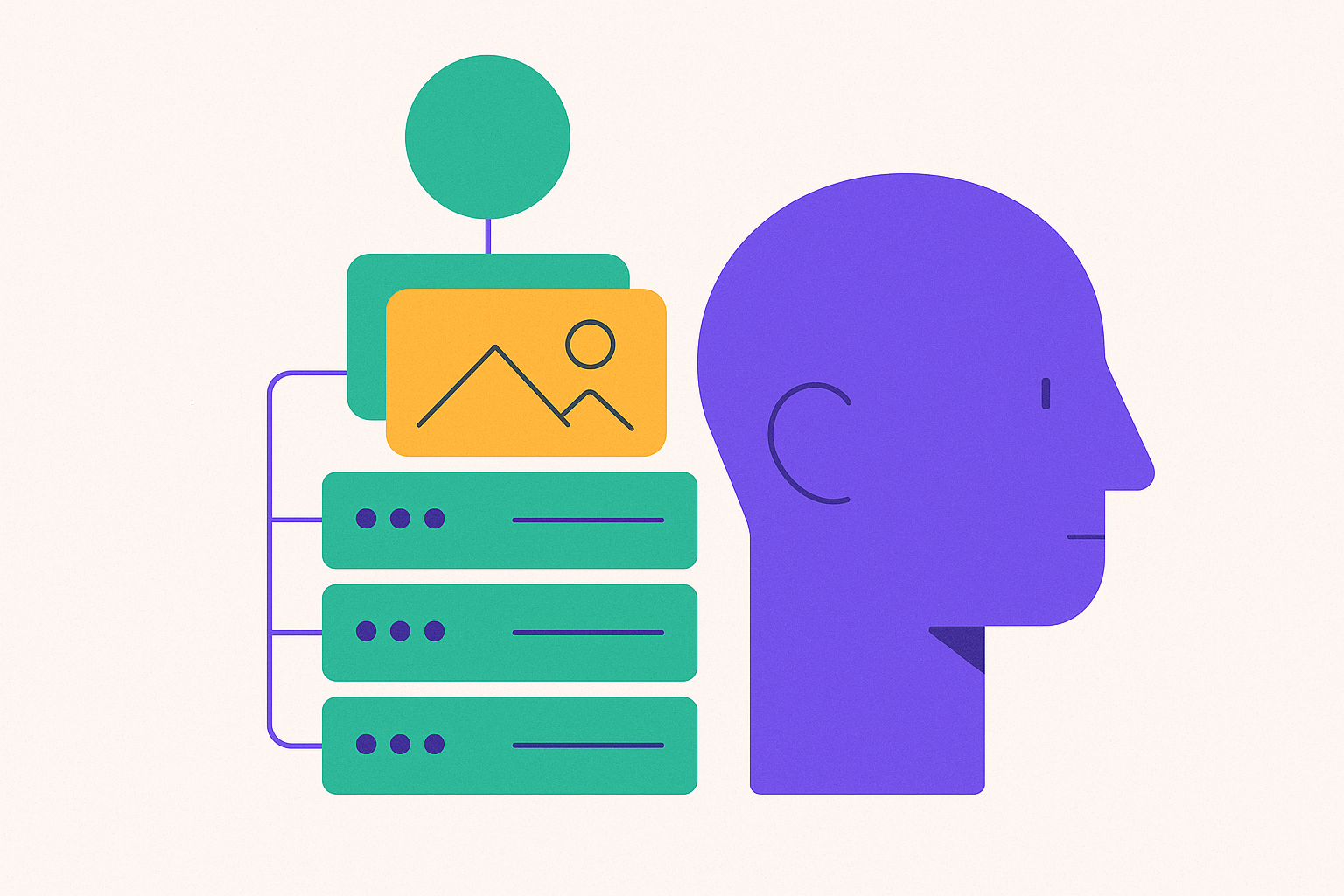
Traditional databases store rows and columns. You query them with exact matches: find the record where user_id equals this value, or where the date falls within this range. Precise, fast, and entirely literal. They cannot tell you that "format" and "template" mean roughly the same thing in context.
Vector databases work differently. They store embeddings: high-dimensional mathematical representations of meaning. Feed a sentence to an embedding model and it outputs a long array of numbers encoding the semantic content of that sentence, positioning it spatially relative to everything else in the database. Similar meanings cluster near each other in that space. When you query, you're not asking "does this exact phrase exist?" You're asking "what's stored near this meaning?"
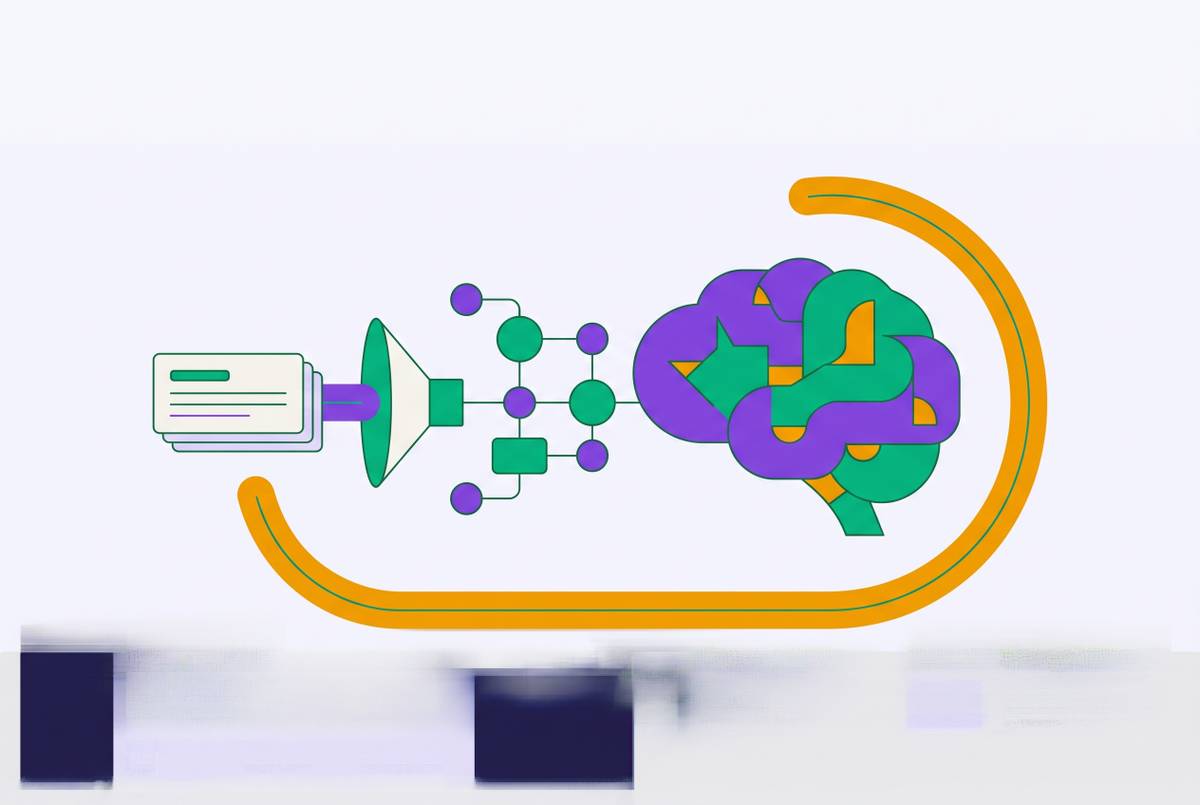
The basic pipeline for personal memory looks like this: new information, whether a stated preference, a completed task, or a key fact, gets passed through an embedding model and stored as a vector alongside the original text as metadata. At the next session, the user's query gets embedded, similar vectors get retrieved, and the original text gets injected into the context window before the model reasons. The model never actually "remembers" anything. Persistence lives outside the model, retrieved on demand.
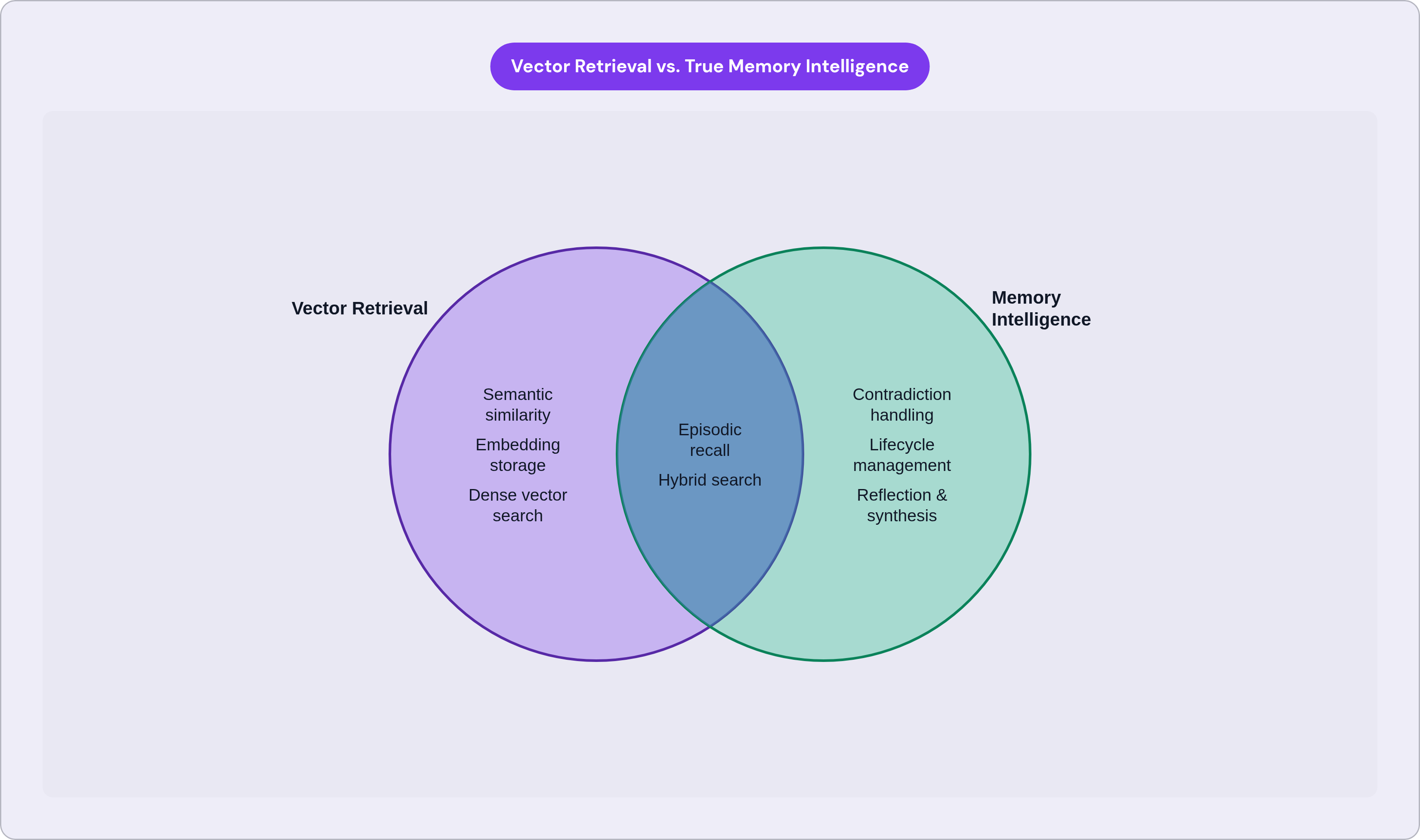
But here's the thing most architectural writeups skip past too quickly: retrieval and memory are not the same thing. Vector databases provide the retrieval layer. Extraction logic, curation, contradiction handling, and lifecycle management all have to be built on top of that. The database can find what's semantically close; it cannot decide what was worth storing in the first place, whether a stored fact is still true six months later, or how a dozen individual observations add up to something meaningful about a person. That gap, between "retrieves past facts" and "understands this person," is where the actual hard work lives.
The Three Kinds of Memory a Personal AI System Needs
The word "memory" is doing a lot of work in most discussions of personal AI, and the looseness causes real architectural confusion.
Short-term, or working, memory is the transient context held in the context window during a current session. It's the thing vector databases are meant to supplement, not replace.
Long-term memory is where it gets interesting, and where most implementations fall short. Episodic memory covers specific past events: what happened in a conversation, what was decided, what was tried. Semantic memory covers persistent facts and preferences: dietary restrictions, communication style, professional context, the things that are stably true about a person across time. Procedural memory covers reusable workflows: how a user structures their code reviews, which steps they habitually skip, what their typical research process looks like.
Storing chat logs in a vector database covers episodic memory only. That's a narrow slice. More capable architectures add a reflection step, where the agent periodically synthesizes raw observations into higher-level insights rather than just logging events. Instead of storing twenty individual instances of a user working in short bursts, the system synthesizes a durable semantic fact about that person's working style. That is a meaningfully different kind of knowledge, and it changes what the system can do.
The taxonomy matters practically because different memory types call for different retrieval strategies. A vector store handles episodic and some semantic memory reasonably well. Procedural memory, especially as it evolves, often benefits from graph structures that model relationships between entities and steps. No single tool handles all three with equal elegance, and understanding that forces cleaner decisions about what you're actually trying to build.
How the Major Memory Platforms Handle Persistence Differently
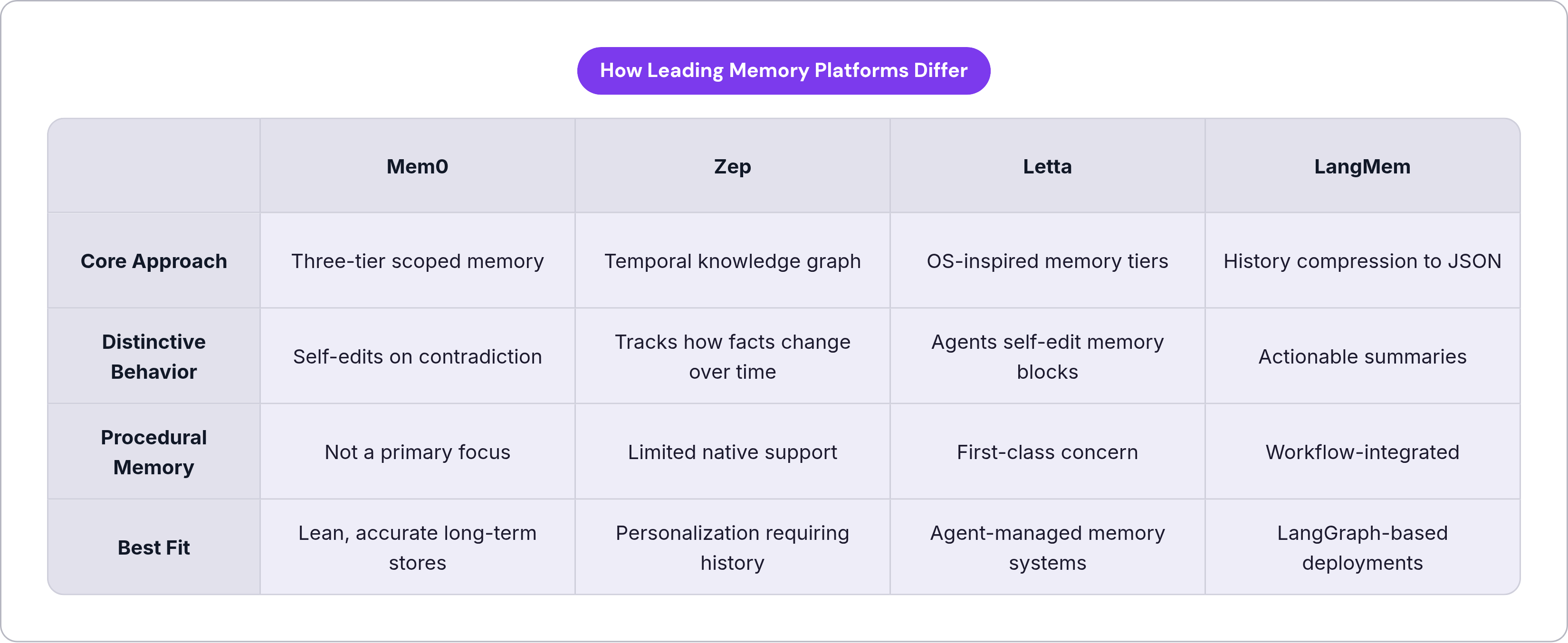
The ecosystem has matured quickly, and the leading platforms have landed on distinct architectural bets, not just variations on a theme.
Mem0 uses a three-tier memory structure scoped to the user, the session, and the agent. Its most distinctive behavior is self-editing on contradiction: when new information conflicts with stored memory, Mem0 updates rather than appends. This keeps the store lean over time, which matters more for retrieval quality than most people appreciate until they've watched a noisy store degrade.
Zep takes a temporal knowledge graph approach. Rather than storing what's currently true, it tracks how facts change over time. A user's job title, location, or stated preference can evolve, and Zep's architecture preserves that history rather than overwriting it. This gives the system the ability to reason about when something became true, not just whether it is, which turns out to matter for the kinds of personalization that require more than a snapshot.
Letta is explicitly OS-inspired. It models memory across three tiers: core memory resident in the context window, analogous to RAM; recall memory as searchable conversation history; and archival memory as long-term cold storage queried on demand. Agents in Letta self-edit their own memory blocks. Procedural memory is a first-class concern, not bolted on.
LangMem takes a different angle, compressing long histories into actionable summaries stored as structured JSON. It integrates tightly with LangGraph workflows, making it a natural fit for teams already operating in that ecosystem rather than a general-purpose solution.
Production reality leans toward combination. Most serious deployments pair a memory platform like Mem0 or Zep, handling extraction and curation, with a dedicated storage layer like Pinecone or Redis for retrieval at scale. One tool rarely covers both jobs well. And for applications where each user has a small personal store, giving each tenant their own isolated database instance outperforms forcing a shared vector database into multi-tenancy, both for performance and for data isolation.
Where Pure Vector Retrieval Breaks Down and What Fills the Gap
Here's a failure case worth sitting with. An agent stores the fact: "Vendor X requires PO format v3 for all orders over $10,000." A user later asks, "Which vendors need special purchase order templates?" The words "template" and "format" are conceptually equivalent. They are not reliably close enough in vector space to surface that match. Semantic similarity and relevance are not the same thing, and in operational contexts where precision matters, that gap is not a footnote.
Hybrid search, combining dense vectors with BM25 keyword retrieval, closes this gap significantly. Benchmark data shows it's only marginally slower than pure vector search while yielding substantially more relevant results. The tradeoff is clearly favorable in most production contexts. Entity-aware retrieval adds another path, connecting queries through shared named entities rather than relying on semantic distance alone. A multi-strategy approach finds answers through multiple independent paths, so when any single strategy fails, another compensates.
Memory also degrades without lifecycle management, and this is the part that doesn't get enough direct discussion. Contradictions accumulate. Stale facts persist. The store grows noisy. Retrieval quality falls over time not because the database is broken, but because the retrieval layer has no concept of a fact being outdated. Something has to know that. Something has to care.
Microsoft Research has published work on architectures that decouple what an agent remembers from how it retrieves that information at query time. The results suggest dramatic reductions in context token usage while maintaining accuracy comparable to full-context approaches. The direction this points is toward memory systems that are increasingly efficient not just in storage, but in the cost of accessing what's stored, which matters when you're paying per token at scale.
What Consumer AI Products Have Shipped as Personal Memory So Far
The consumer landscape shows what these abstractions look like when shipped to millions of users, and where the structural constraints become visible.
ChatGPT launched memory in limited testing in early 2024, with broad rollout following later that year. By April 2025, it had expanded beyond saved facts to pull context from any past conversation. Memory is on by default for most account tiers.
Claude's memory tool shipped in beta in mid-2025 and extended to free users in early 2026. It's scoped per Project: each project has its own isolated memory pool, no cross-project memory. This is an intentional design choice that prioritizes user control and prevents context from bleeding across unrelated domains. The tradeoff is that memory doesn't travel with the user across contexts, which limits how useful it is for people who work across multiple projects with similar needs.
Gemini's approach is architecturally distinct. It connects context across Google's ecosystem, including Gmail, Photos, and other apps, under a "Personal Intelligence" framing. The memory is account-bound and non-exportable; the context stays inside Google's graph. That's a real capability advantage for users who live inside Google's ecosystem and a hard constraint for anyone who doesn't, which is an architectural choice that also happens to be a retention strategy.
Microsoft Recall takes a different approach entirely, using optical character recognition, semantic indexing, and on-disk vector databases to let users query their own screen history in natural language. It's available on Copilot+ PCs and has faced persistent criticism from security researchers despite Microsoft's safety claims. The architectural bet is interesting regardless of those concerns: memory as a record of everything you've seen, not just what you've said to an AI.
The Rewind/Limitless trajectory is worth understanding as something other than just a cautionary tale. The company raised substantial funding to build a "search everything you've seen and heard" system, was acquired by Meta in late 2025, and wound down its screen and audio capture product within weeks of the acquisition. Users in the EU and UK had to export their data before deletion. The technical vision was compelling; the business and regulatory trajectory wasn't. Whether Meta absorbed the team for the product or the capability is worth asking.
Every one of these products shares the same structural property: memory is siloed to the platform. Gemini's context can't travel to Claude. ChatGPT's saved facts can't move to a personal agent you're building. This portability gap is not incidental. It is the structural opening for developer-built memory layers, and it's the actual reason the infrastructure market exists alongside the consumer product market.
The Real Cost and Complexity of Building Personal Memory Yourself
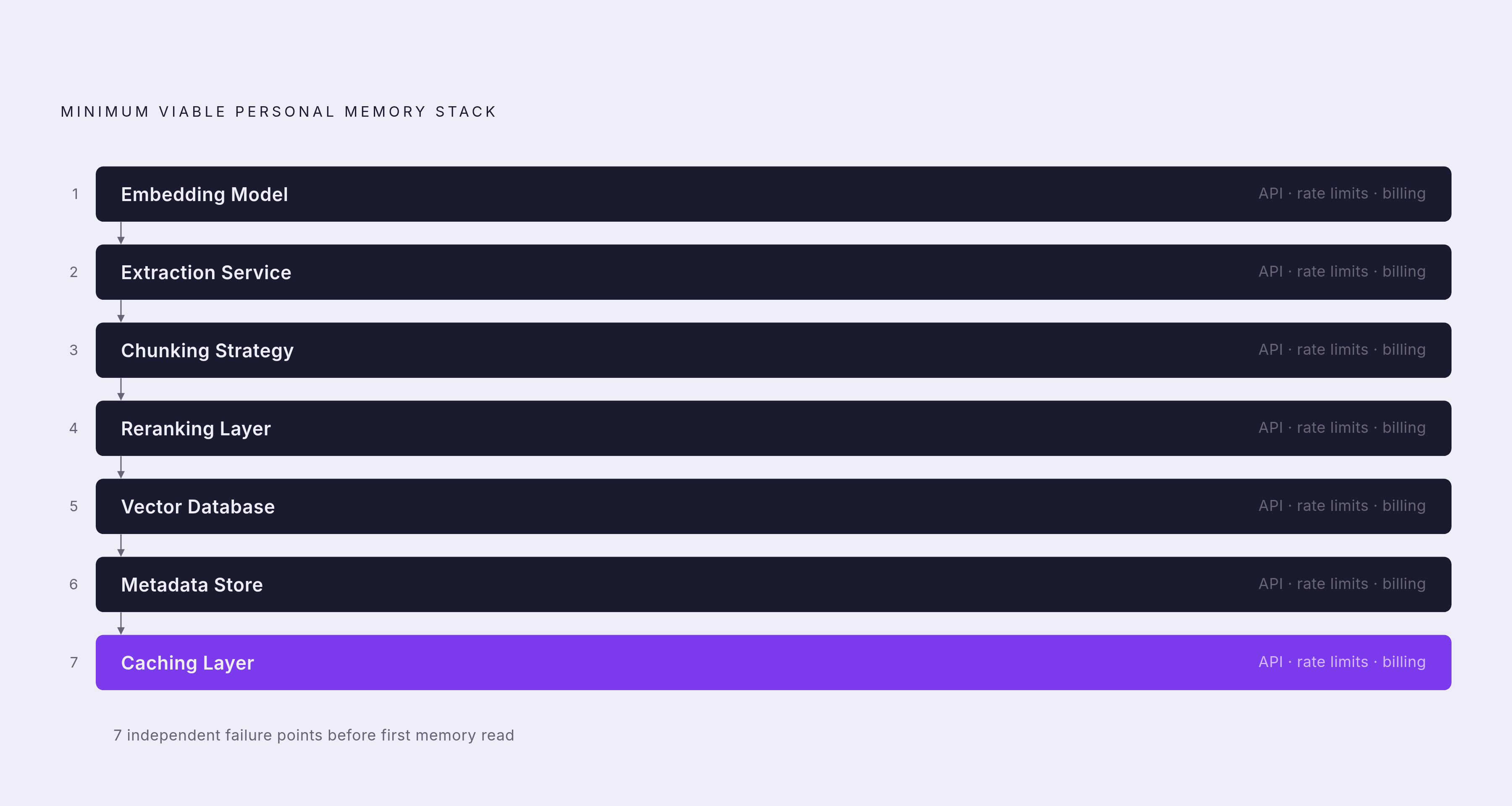
The minimum viable configuration requires an embedding model, an extraction service, a chunking strategy, a reranking layer, and a vector database. That's five services before any memory intelligence. Most production setups add a metadata store and a caching layer, bringing the count to seven, each with its own API, rate limits, failure modes, and billing surface. If you haven't built something like this before, the number seven doesn't fully convey what it means to debug a latency issue that originates at any of those points.
Embedding costs are not one-time. A corpus of ten million documents averaging five hundred tokens costs around $650 to embed once with OpenAI's large embedding model. When you upgrade the model, or refine your chunking strategy, you re-embed. One reported case describes re-embedding a one-terabyte corpus weekly at twelve thousand dollars a month. That's not a rounding error; it's a recurring line item that requires justification in any budget conversation.
Chunking strategy alone has no universal answer. Chunks that are too large dilute relevance scores; too small, and you lose the surrounding context that makes a fragment meaningful. The right answer depends on your content type, your retrieval use case, and your model's embedding behavior, and it will need to change as any of those evolve. This is the kind of decision that sounds like a configuration detail until you're three months into a deployment and your retrieval quality has mysteriously degraded.
Privacy and data residency add a layer that is legal, not just technical. Memory systems that persist user data across sessions are subject to data protection obligations in most jurisdictions. Where memory lives, who controls it, and how long it's retained are questions compliance functions will ask, and the answers constrain architectural choices in ways that are hard to retrofit.
The open-source ecosystem offers a counterpoint worth taking seriously. At least one browser extension project has built a local-first memory graph using WebAssembly and IndexedDB, capturing conversations from major AI interfaces into a private store with no server and no API key. The technical scope is more limited than a production memory platform. Its existence still reflects something real: people want memory that isn't owned by the platform they happen to be using today, and some of them are willing to build it themselves to get that.
What the Market's Rapid Growth Reflects About Demand for Persistent AI Context
The vector database market's trajectory is not primarily a story about databases. It's a story about what developers are trying to build and what they're willing to pay to build it.
The market is growing at a compound annual rate that puts it on track to more than triple in size from 2025 to 2030, per MarketsandMarkets research. The managed cloud segment is growing fastest. That detail matters: the primary constraint isn't the technology, it's the operational overhead of running it. Teams want the capability without the infrastructure burden, which is a different kind of demand signal than wanting the capability itself.
By 2024, vector search had already moved from a specialist category to a data type embedded in general-purpose systems. PostgreSQL via pgvector, MongoDB, Redis: the capabilities are now part of the infrastructure teams already operate. The question is no longer whether to add vector retrieval; it's how much memory intelligence to build on top of it, and which parts to own versus delegate.
North America accounts for the largest revenue share, reflecting where AI-native development is most concentrated. But the growth in managed services suggests the pattern is spreading to teams with less infrastructure sophistication. That's the dynamic that drives a market from specialist to general-purpose, and it's worth watching because it tends to precede commoditization of the underlying layer.
What a Personalized Intelligence Layer Requires Beyond Retrieval
Vector retrieval solves the statelessness problem at the storage level. That's necessary. It's also where most implementations stop, and stopping there leaves the harder problem untouched.
Getting from "retrieves past facts" to "understands this person" requires extraction logic that decides what's worth storing, because most of what happens in a conversation is signal-free. It requires contradiction resolution that updates stale or conflicting facts rather than accumulating noise over time. It requires reflection, the periodic synthesis of raw observations into higher-level patterns a model can actually reason from. And it requires lifecycle management, the capacity for memory to age, deprecate, or be confirmed as still true.
Mem0 leans into self-editing and contradiction handling. Zep leans into temporal evolution. Letta leans into agent self-management of memory blocks. The consumer products handle some of this invisibly, at the cost of portability and user control. None of them has fully solved the problem, and the problem is unlikely to be solved soon, because it is partially one of knowledge representation and partially one of epistemology: how do you know what you know about someone, and how do you know when that knowledge has expired?
For builders, the practical question is how much of this memory intelligence to delegate to a platform versus own. If memory is a feature, delegation is probably the right call. If memory is the product, if the value you're actually delivering is a system that gets better the more someone uses it, you need to understand and control the full stack. The vector database is where that work starts. The understanding of a person, if it's achievable at all, is somewhere further out.