Amygdala Hijacking in High-Stakes Executive Decisions
Threat-detection systems built for survival make poor boardroom judges.
There's a moment most senior leaders know, even if they've never named it. A question lands sideways in a board meeting. An investor goes hostile. A number comes in wrong in front of the wrong people. And somewhere between hearing the words and opening your mouth to respond, something shifts. The response that follows feels sharp, decisive, appropriate. It often isn't any of those things.
That gap, between what actually happened and how the brain experienced it as threat, is where the concept of the amygdala hijack lives. Daniel Goleman popularized the term in his 1995 book Emotional Intelligence, drawing on Joseph LeDoux's neuroscience research. It describes an emotional response that is immediate, overwhelming, and disproportionate to the actual stimulus, because the brain has registered a much larger threat than the situation warrants. But what if the very confidence that follows that response is itself the problem?
Worth saying plainly: the Society for Neuroscience would note that "amygdala hijack" is a neuroleadership term of art, not a clinical diagnosis. The underlying circuitry is more complex than the phrase suggests. But that honesty, rather than undermining the concept, is exactly what makes it useful for rigorous thinkers. It describes something real. It describes something leaders recognize. And for the purposes of understanding high-stakes decision-making, it earns its place.
What the Brain Is Doing When a Hijack Occurs
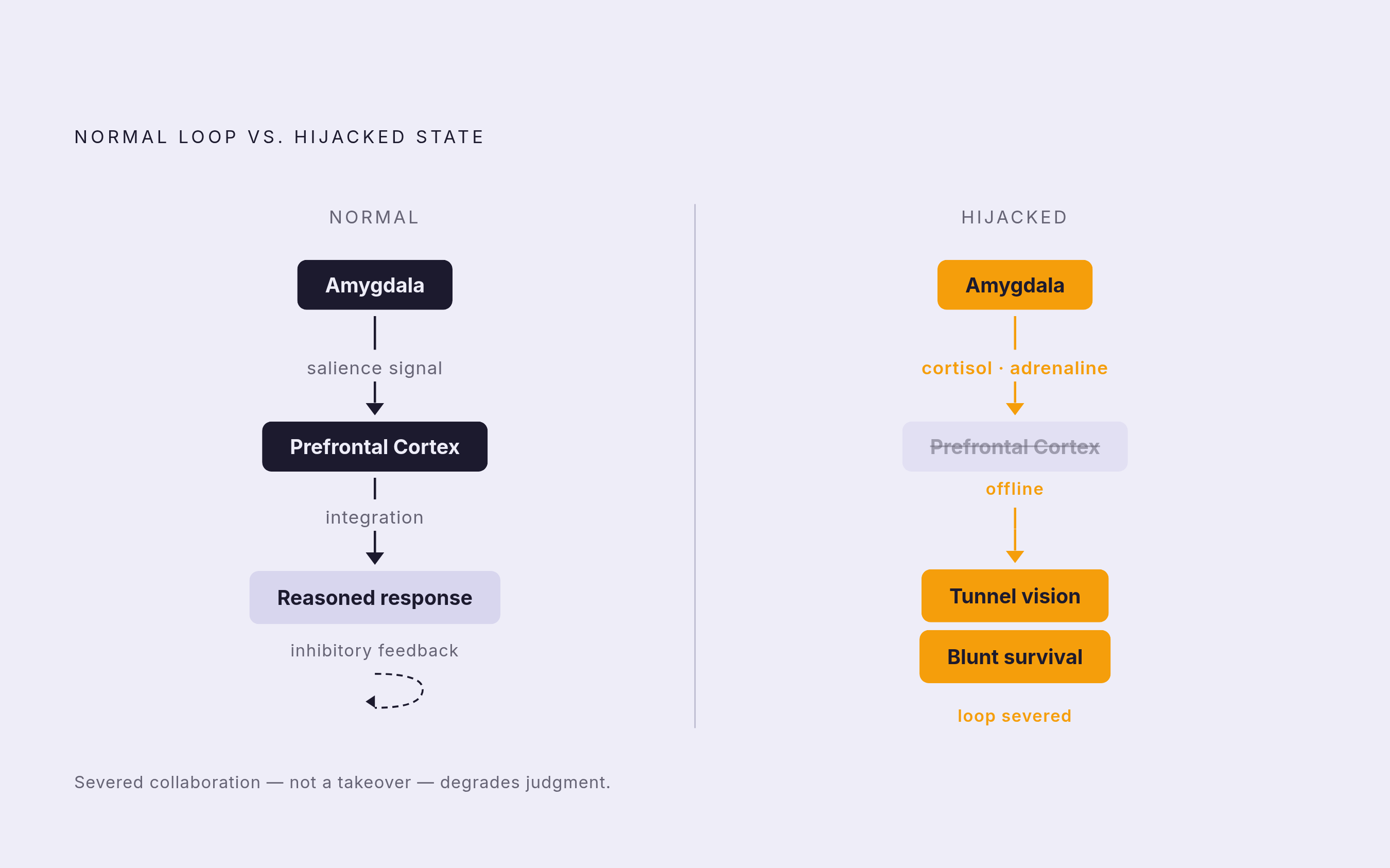
The amygdala functions as the brain's threat-detection center. When it perceives danger, it triggers the release of stress hormones, cortisol and adrenaline, and activates the fight-or-flight response. Critically, it does this before your conscious mind has had a chance to weigh in.
The prefrontal cortex, the region responsible for planning, nuanced judgment, impulse control, and long-term reasoning, normally exerts top-down inhibitory control over the amygdala. During a hijack, that regulatory loop degrades. Thinking becomes circular. Executive functions go effectively offline.
Contemporary neuroscience has refined the classical picture somewhat. The amygdala does not so much "override" the prefrontal cortex as fail to communicate properly with it. These two regions ordinarily work in collaboration, with the amygdala helping to flag what's emotionally salient and the prefrontal cortex integrating that signal into reasoned response. A hijack is a breakdown of that collaboration, not a simple takeover.
This distinction matters, because it reframes what we're trying to protect. The amygdala isn't the enemy. It encodes emotional memory, prioritizes what's relevant in complex environments, and helps identify which data points in a noisy room actually matter. The problem emerges when threat-state activation severs its useful integration with rational processing.
When that severance happens, peripheral vision narrows. Attention tunnels. The capacity for empathy and long-term thinking goes offline. What remains is a fast, blunt survival system built for escaping predators. It is a poor instrument for running a company.
Why the Boardroom Is a Reliable Hijack Trigger
To understand why this works, we must first look at what the amygdala fundamentally does not understand: the difference between a physical threat and a social one.
It responds to a hostile board challenge with the same neurochemical cascade it would deploy for a predator. An earnings miss in a public setting, a question that implies you don't know what you're doing, an activist investor making a move you didn't anticipate: to the threat-detection system, these register as danger. Survival-grade danger.
Certain boardroom conditions reliably activate this response. Problems that feel overwhelming in scale. Challenges to identity or status, particularly when they happen publicly. High-visibility decisions with no clearly right answer. And perhaps most consequentially, time pressure.
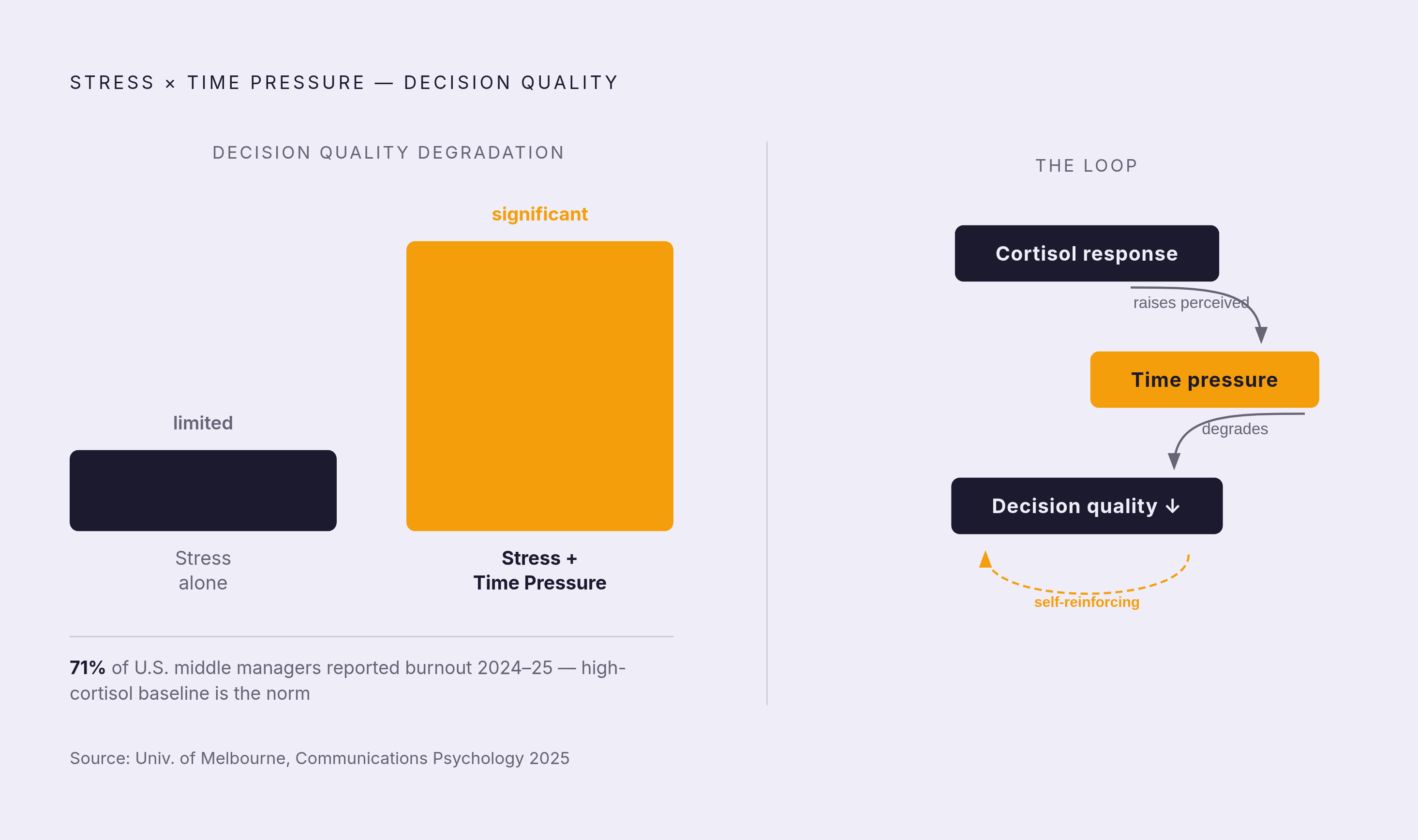
A 2025 study out of the University of Melbourne, published in Communications Psychology, found something worth sitting with: acute stress alone had surprisingly limited effects on decision quality. But when decisions were accompanied by experienced time pressure, decision quality dropped significantly among cortisol responders. Time pressure is the compounding variable. It is also among the most normalized features of executive life.
What makes a hijack particularly treacherous at the leadership level is what it feels like from the inside. The hijacked leader feels certain and decisive. The confidence is real, and that's the problem. It is threat-response confidence, not judgment. From the outside, it manifests as defensiveness, self-protective decisions that diverge from organizational priorities, and a narrowing of focus that misses critical information. And almost no one in the room will name it in real time, because the person who would need to say something is usually the most powerful person present.
How Chronic Stress Compounds the Acute Hijack Problem
The acute hijack is one problem. The chronic environment that precedes it is another, and the more important one to understand.
Sustained elevated cortisol physically impairs the prefrontal cortex. Over time, chronic stress is associated with volume reductions in both the prefrontal cortex and hippocampus, dendritic atrophy, and reduced neuroplasticity. The brain's capacity to recover from stress-induced impairment diminishes with continued exposure.
The same 2025 Melbourne study found that higher cortisol levels led not only to lower decision quality but to greater experienced time pressure, and that the deterioration in decision quality among cortisol responders was independent of how computationally complex the decision actually was. The difficulty isn't the problem. The cortisol is.
A separate study published in PNAS found that elevated cortisol shifts financial risk preferences inconsistently, sometimes increasing avoidance, other times increasing impulsivity depending on context. For executives making risk-weighted calls throughout a full day, this inconsistency is itself a liability. You can't build reliable judgment on an unstable platform.
Pattern recognition, one of the most valuable tools a seasoned leader develops over years, is among the first capabilities to degrade under sustained stress. This is not a theoretical concern. Burnout surveys from 2024 to 2025 found that roughly 71% of middle managers in the United States reported being burned out. The chronic stress picture isn't the exception. For a large share of leaders, it is the operational baseline.
What a Hijacked Decision Costs the Organization, Not Just the Leader
The effects of an emotional hijack don't end when the meeting does. Research from Forbes Coaches Council suggests the neurological and hormonal residue of a hijack can persist for up to four hours after the triggering event. Decisions made inside that window carry the imprint.
This matters at the individual level. It matters considerably more when you factor in what researchers Hatfield, Cacioppo, and Rapson identified as emotional contagion: the mechanism by which people absorb the emotional states of those around them, automatically and unconsciously. The leader is, neurologically speaking, the emotional climate of the room. A regulated leader entering a high-stakes meeting regulates the people in it. An activated leader activates them.
In the moments that matter most, M&A negotiations, crisis response, board presentations, this dynamic is most consequential and most often unexamined.
The organizational case for caring about this isn't abstract. A reactive decision made from a hijacked state can cost months of trust repair, derail strategic momentum, or accelerate talent attrition. The compounding cost runs well beyond the moment of the decision itself.
Consider Anne Mulcahy at Xerox in 2000. The company carried $17 billion in debt, the stock had fallen more than 90%, and the SEC was investigating. Investment bankers were recommending Chapter 11. The doomsday scenarios were real. What Mulcahy's leadership in those boardrooms demonstrated was the capacity to hold a non-hijacked state while everyone around her was being activated by legitimately alarming information. Her emotional regulation, not her technical financial expertise, became a structural condition of the eventual turnaround. That's not a soft skills story. That's an organizational survival story.
Recognizing the Hijack Before the Decision Lands
The central difficulty of self-recognition during a hijack is that it doesn't feel like impairment. It feels like clarity. Why exactly does this happen? Because the threat-response system is designed to produce confidence, not caution.
This is why the physical signals deserve attention first, because the body activates before the mind registers threat. Rapid heartbeat. Shallow breathing. Muscle tension. A narrowing of focus onto a single solution or a single threat. Speech speeding up or becoming unusually blunt. These are legible signals if you know what you're reading for.
Behavioral signals tend to show up first to the people around you. Defensiveness to new information or challenge. Decisions oriented toward protecting status or control rather than serving organizational interest. A pull toward fast, clean answers in situations that warrant complexity.
Pre-commitment is one of the more underutilized tools here. Naming in advance the conditions under which you are most likely to be triggered, challenges to your identity, high time pressure, public scrutiny, makes the signal recognizable when it arrives. You've already done the interpretive work before you needed it.
The structural counterpart to self-recognition is having someone in the room with standing to name what's happening. Because self-recognition during a hijack is unreliable, a trusted advisor or peer with the relational license to say "I want to slow this down" isn't a personal luxury. It's a practical safeguard against a known vulnerability in the decision architecture.
Interrupting the Cycle: What Actually Works and Why
The fastest route back to prefrontal cortex access runs through the body, not cognition. This surprises some leaders, who instinctively reach for more analysis when they sense something is off. But reasoning your way out of a hijacked state from inside the hijacked state is a circular problem. The instrument you're using to evaluate the situation is the instrument that needs recalibration.
Slow, controlled breathing directly activates the parasympathetic nervous system. It begins lowering cortisol. It buys the seconds needed to re-engage the prefrontal cortex. Physical movement, even briefly stepping out of the room, can interrupt the neurological loop in a way that changing your thoughts cannot.
Naming the emotional state also has demonstrated effect. Affect labeling, putting language to what you're experiencing, "I notice I'm feeling threatened by this," reduces amygdala activation. The mechanism is real. It's not a reframe or a reappraisal; it's a neural interrupt.
Building structural delay into high-stakes decisions is one of the most underrated organizational moves available. Not responding immediately. Requesting time. Scheduling the decision for the following morning. This isn't indecision. It's allowing the cortisol window to clear before the decision becomes final.
Pre-mortems and decision frameworks serve a related function. When you commit to a structured decision process before you enter a high-pressure context, you're offloading the judgment work to a calmer prior state. The executive in the hijacked moment isn't generating new judgment from a compromised platform. They're executing a framework their earlier self built when the prefrontal cortex was fully online.
Longer-term, the prefrontal cortex's capacity to regulate the amygdala is trainable. Practices that build emotional regulation, adequate sleep, recovery time, sustained attention practices, are not peripheral to cognitive performance. They are cognitive performance. Goleman's original argument, that emotional intelligence accounts for a disproportionate share of what separates high performers at senior levels, points to the scalable implication: this is a developable capability. It is not a fixed personality trait some people happen to have.
Building Organizational Conditions That Reduce Hijack Risk at the Leadership Level
The individual strategies are necessary. They are not sufficient if the organizational environment is systematically recreating the triggers. One might argue that teaching individual interruption techniques is enough — but that raises an important question: what happens when the organization itself is the trigger?
Chronic time pressure as the default operating mode, always-on availability expectations, and high-stakes decisions made in real-time public settings without structured preparation all raise the baseline cortisol load that makes hijacking more probable. You can teach a leader every interruption technique in the literature, and it will matter less if the organization continuously refills the tank.
Decision architecture is a practical lever here. Structuring the most consequential decisions to occur at low-stress times of day, with adequate preparation, and away from the compounding pressure of a live boardroom reduces the interaction effect that the Melbourne research identified between cortisol and time pressure. The goal is to decouple important decisions from the conditions that most reliably degrade them.
Psychological safety, the kind where team members can name when a leader appears activated without professional risk, functions as a distributed early-warning system. It compensates for exactly the limitation that makes individual self-recognition unreliable. Leaders who have pre-authorized that conversation, who have said explicitly "if I'm moving too fast and you see it, say something," are building organizational infrastructure, not inviting criticism.
The framing that lands best with skeptical leaders is augmentation, not subtraction. The goal is not to remove emotional response from executive decision-making. The amygdala's integration with the prefrontal cortex is a feature of a functioning system; it helps prioritize what matters in complex decisions. The goal is to preserve the conditions under which that collaboration works, so that the signal the amygdala sends is received and integrated, rather than overwhelming the system that was supposed to process it.
Practically, that means pressure-testing decision processes, not just decisions. It means coaching structures that build recognition and recovery as organizational capability, not personal development. And it means leadership cultures that treat emotional regulation as a professional competency with the same seriousness as financial acumen or strategic thinking, because the evidence increasingly suggests it predicts performance outcomes at a level that warrants that treatment.
The boardroom will keep generating hijack conditions. That's not a problem to be solved, it's the nature of the role. The question is whether the leader, and the organization around them, has built enough infrastructure to catch the moment before the decision does.