Personal Intelligence vs Emotional Intelligence
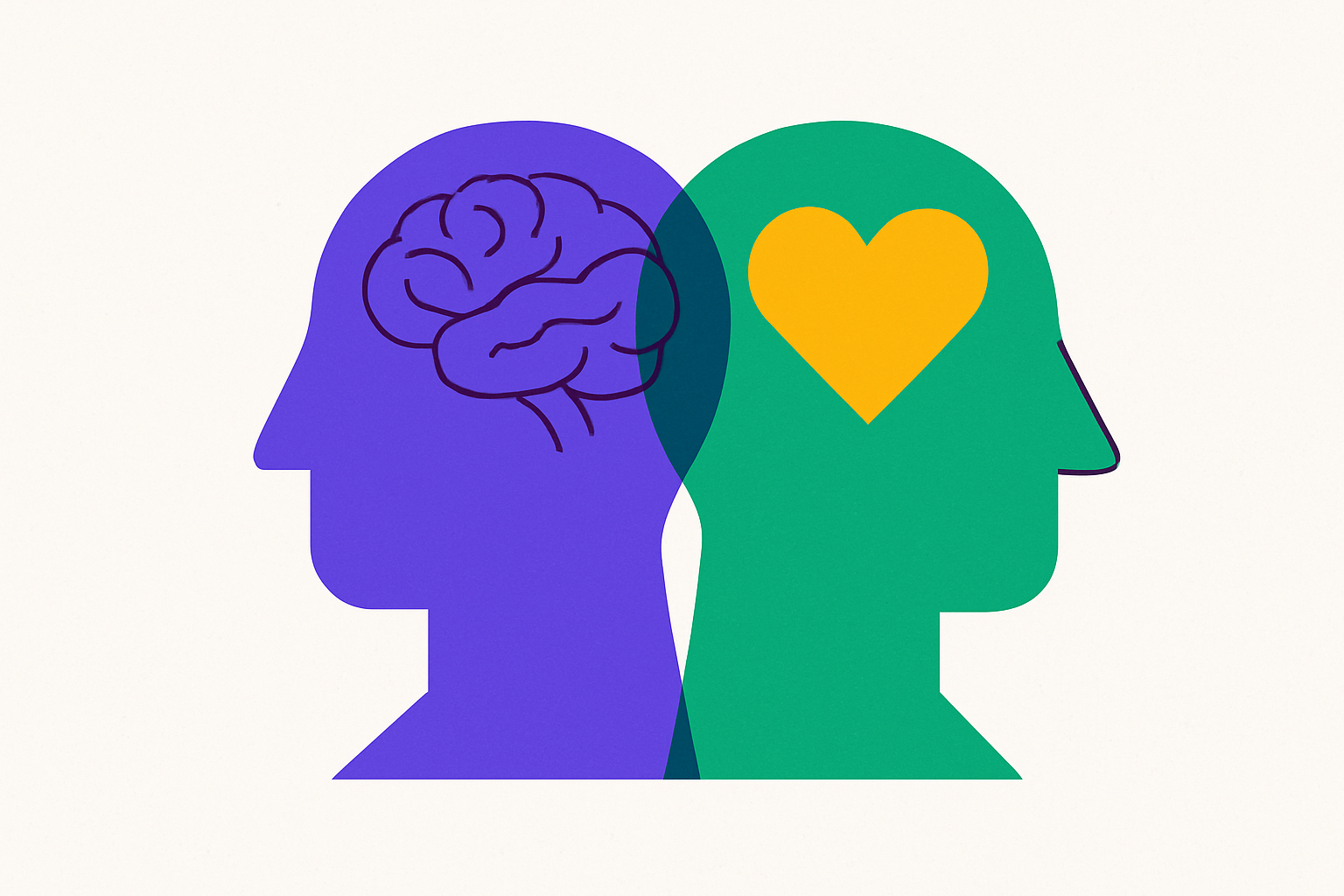
Emotional intelligence reads feelings; personal intelligence understands personality patterns.
What emotional intelligence actually measures, stripped of the popular version
Most people's working definition of emotional intelligence came from a 1995 bestseller, not a psychology lab. When Daniel Goleman published his book, EI became a cultural fixture. His model stretched the concept to include motivation, empathy, and social competencies broad enough to cover nearly any admirable human quality. That expansion made EI accessible and, frankly, sellable. It also made the original claim almost unrecognizable.
Mayer and Salovey's model is narrower and considerably less flattering to assume you already possess. They argued that emotional intelligence is a real cognitive ability, not a disposition or a personality style. The claim was specific: some people process emotional information more accurately than others, in roughly the same sense that some people reason more accurately about verbal or spatial problems. It's a capacity, not a character trait.
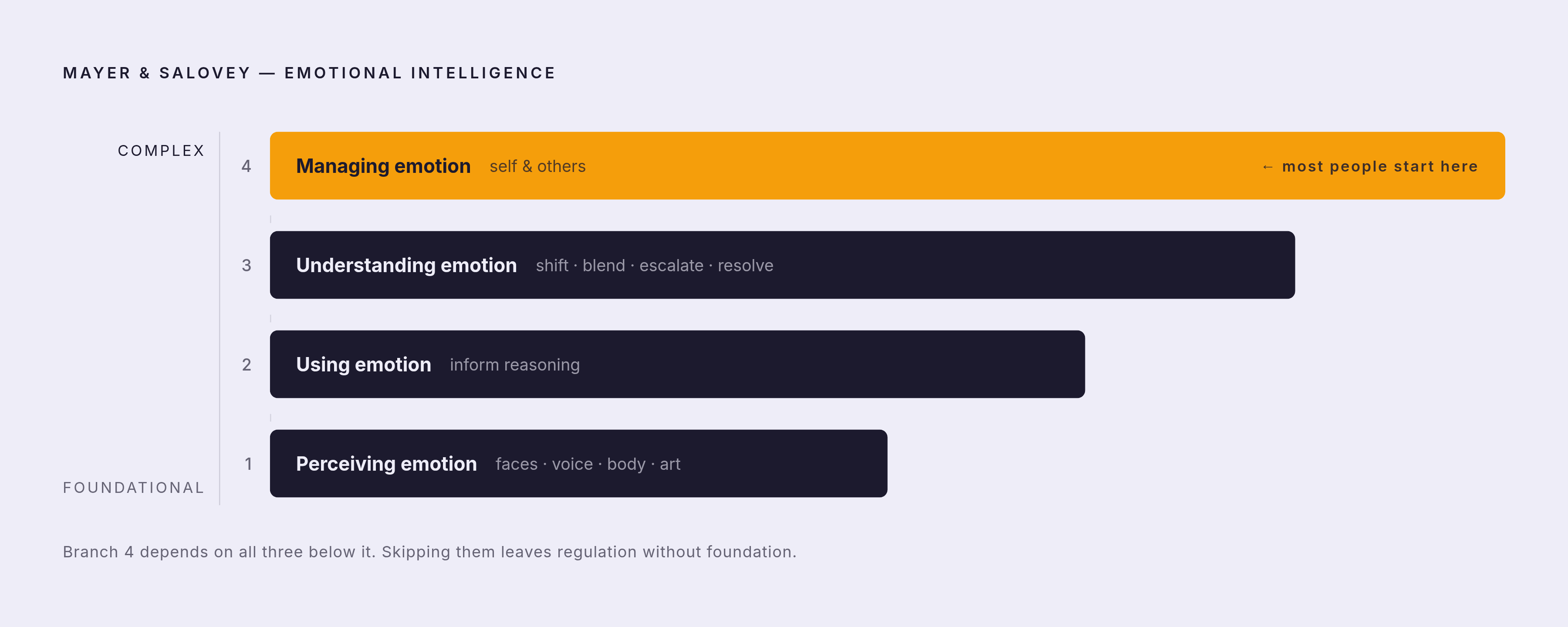
Their four-branch structure runs from simple to complex. At the base: perceiving emotion, reading faces, vocal tone, body language, and the emotional content in art or music. Above that, using emotion to facilitate thought, letting your current emotional state inform your reasoning appropriately rather than distorting it. Third, understanding emotion: how feelings shift over time, how they blend, what drives escalation or resolution. Fourth, and what most people jump to first, managing emotion in yourself and in others.
The test built to measure this, the MSCEIT, contains 141 items and scores accuracy. It is a performance test. Your result doesn't depend on how emotionally sophisticated you believe yourself to be; it depends on how accurately you actually respond. That distinction is not a minor methodological preference. It is the whole philosophical bet.
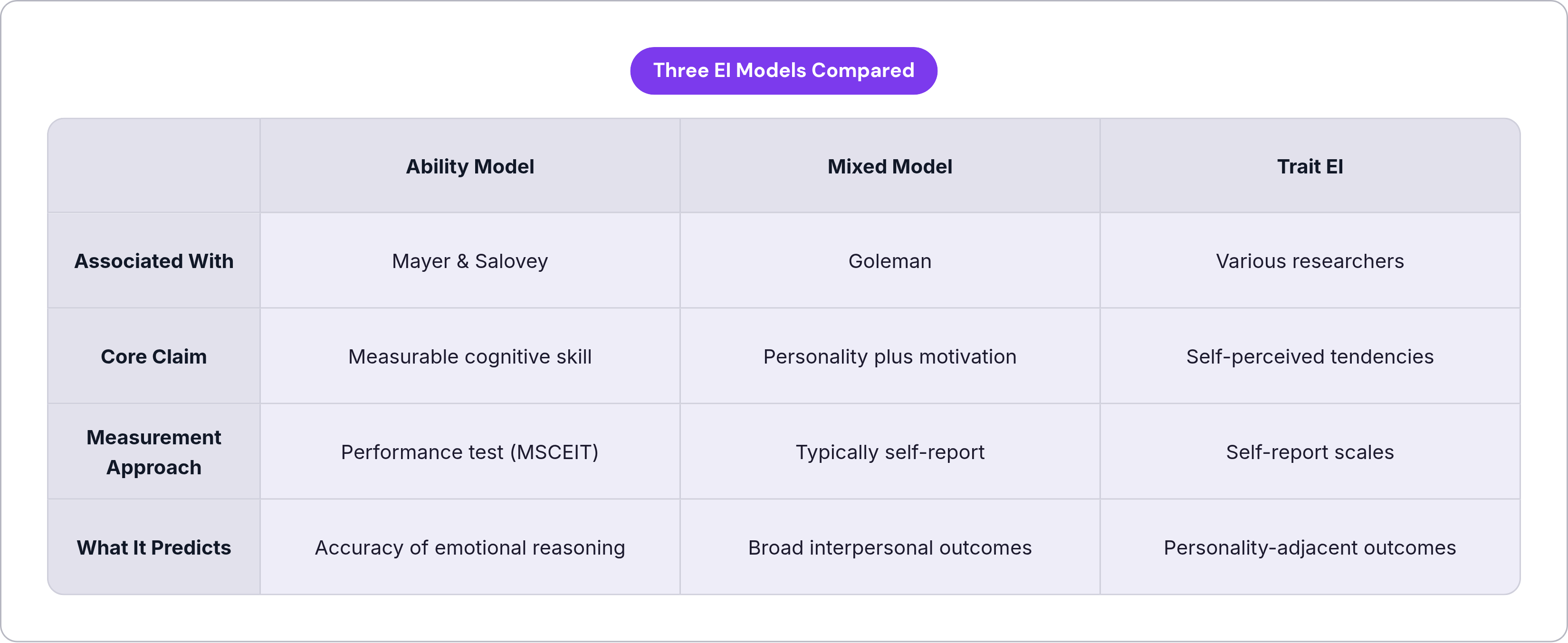
The field, unfortunately, has not stayed tidy. Three competing EI models now coexist in the literature. The ability model is what Mayer and colleagues built: EI as measurable cognitive skill. The mixed model, associated with Goleman, folds in personality traits and motivational attributes. A third, trait EI, treats the construct as a bundle of self-perceived tendencies, closer to a personality description than anything you'd call a performance measure. These are not three names for the same idea. They predict different outcomes, require different research methods, and have generated findings that are difficult to reconcile. Researchers within the field acknowledge this openly.
What's relevant for comparing EI to personal intelligence is the narrow definition. Emotional intelligence, properly framed, is about processing emotional information accurately. Keep that boundary in mind, because the moment you blur it, the distinction with personal intelligence disappears.
What personal intelligence covers that emotional intelligence does not reach
Mayer defines personal intelligence as the capacity to reason about personality and to use personality information to enhance thoughts, plans, and life experience. The subject matter difference is the entire argument.
EI processes emotional data: feelings, affect, the signals emotional states generate. Personal intelligence processes personality data: motives, characteristic patterns of thought and behavior, values, identity, the stable organizational features of how a person actually operates across time and context. Not how someone feels right now. How they are put together.
That distinction depends on accepting Mayer's model of what personality is. In his framework, personality is the organized system of a person's major mental systems: motives, emotions, cognition, knowledge, plans, action styles, self-awareness. Emotions are one component of that larger system, not its entirety or its defining feature. This is why the two frameworks aren't simply redundant. EI addresses one part of the system. PI addresses the system.
Personal intelligence operates through four capacities. First, recognizing personally relevant information, through introspection about yourself and observation of others. Second, forming accurate models of personality from that raw material, moving from noticing to actually understanding how someone is organized. Third, guiding choices using those models when personality fit is what's actually at stake. Fourth, systematizing goals, plans, and life narratives in ways that produce better outcomes over time.
That fourth capacity is where EI runs out of jurisdiction. It has nothing to do with reading someone's emotional state in a conversation or regulating your own reactivity in the moment. It is about whether the arc of your decisions across years reflects an accurate understanding of who you are. Whether your goals cohere with your actual motives. Whether the roles you keep choosing fit your character, not just your ambitions. That is a different kind of reasoning, operating on a longer time scale and drawing on different information entirely.
How closely related these constructs are, and why that closeness can mislead
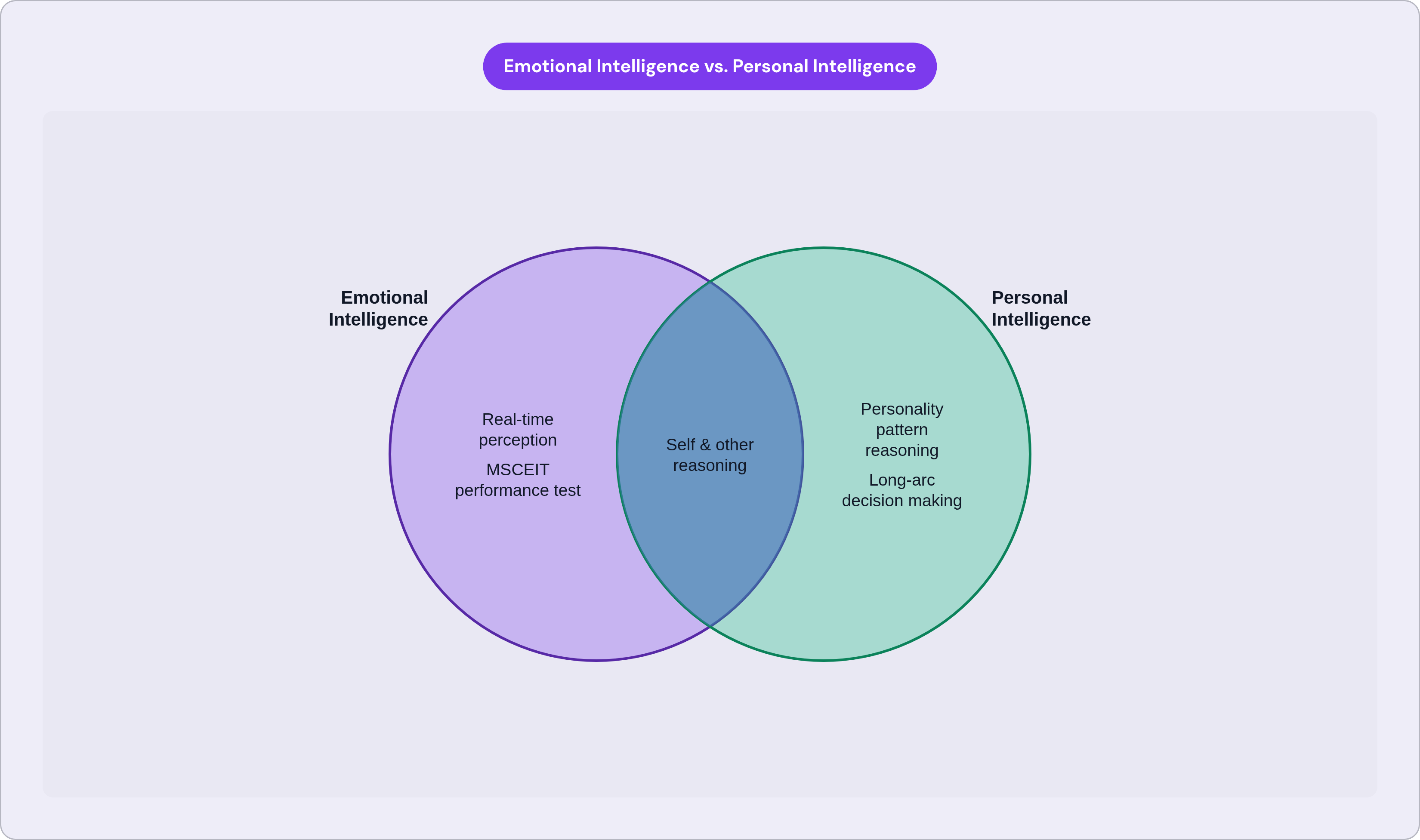
At least one published study found that personal intelligence and aspects of emotional intelligence correlated at r =.69. By psychological measurement standards, that's a strong relationship. It confirms what you'd expect: people who reason well about emotions tend to reason better about personality. The overlap is real and worth taking seriously.
Both constructs belong to what researchers call "hot intelligences," forms of reasoning that engage information to which the person is personally reactive, as opposed to the cooler abstraction of mathematical or verbal problems. Both involve reasoning about self and other. You would be suspicious of a framework that claimed otherwise.
But r =.69 also means roughly half the variance in one construct is not explained by the other. That is not a trivial remainder. It represents a substantial independent domain.
The number is easier to understand through cases than through statistics. Someone can be highly accurate at reading emotional states in real time, tracking the subtle shift in a colleague's affect during a meeting, calibrating their own responses with real precision, and still carry a badly inaccurate model of their own stable personality. They don't understand why they reliably gravitate toward a particular kind of conflict, or why a specific type of relationship keeps failing, because those are questions about personality configuration and motive, not about what's happening emotionally in any given moment. High EI, low PI.
The reverse is equally possible. Someone who understands personality structures deeply, who accurately models what drives the people around them, still finds their own emotional reactions taking over when a conversation turns charged. Understanding the architecture of a situation doesn't mean you can manage your reactivity inside it.
The practical risk of conflating the two is this: someone who builds real EI skills can reasonably feel more self-aware afterward and assume the larger project of self-understanding is complete. Personal intelligence suggests it isn't. A different domain of reasoning remains, one that EI development was never designed to reach.
Where EI applies well and where PI's broader frame becomes relevant
Emotional intelligence fits situations where emotional tone is the primary variable. Navigating interpersonal conflict as it unfolds. Reading a group's collective state in a high-stakes meeting. Managing your own reactivity when pressure spikes. Research consistently finds that higher EI is associated with greater leadership effectiveness, contributing variance that neither general cognitive ability nor personality traits alone fully explain. When you need to perceive and respond to emotional information quickly, EI is the right tool.
Personal intelligence fits a different category of question. Career direction. Whether a long-term relationship suits who you actually are, not just who you feel drawn to at a given moment. Whether the goals you've stated align with the motives that actually drive your behavior. Why a particular pattern keeps recurring in your professional or personal life despite your best intentions. These are questions about stable personality configurations, about the fit between character and circumstance, not about the emotional texture of a specific encounter.
Mayer's own framing is worth quoting closely: people who are more attuned to reading others, and more accurate in understanding themselves, make decisions better suited to their own authentic happiness. That is a PI claim. It isn't about emotional regulation. It's about whether your choices reflect an accurate model of who you are.
The cleanest separator between the two is time scale. EI largely operates in the present moment, in the conversation, in the meeting, in the charged exchange. PI operates across longer arcs: plans, commitments, the accumulated pattern of a life and what it reveals about the person living it. The same person sitting across a difficult conversation needs EI. The same person deciding whether to stay in a career that no longer fits needs PI. Different problems, different reasoning.
The measurement problem each framework faces
The MSCEIT's design reflects a deliberate bet. By building a performance test that scores accuracy, Mayer and his colleagues tried to insulate EI measurement from self-report distortions, where participants rate how emotionally skilled they perceive themselves to be rather than demonstrating what they can actually do. That matters because self-reported EI correlates strongly with existing personality traits, which raises an uncomfortable question: are you measuring a distinct intelligence, or repackaging agreeableness and extraversion with a more appealing label?
The field's practical problem is that most commercially deployed EI tools use self-report anyway. This makes findings difficult to compare across studies and has fueled persistent debate about what EI actually predicts when you adequately control for personality and general cognitive ability. Different measures are, in a meaningful sense, measuring different things. Calling all of them "emotional intelligence" produces an illusion of convergence that the data doesn't support.
Personal intelligence faces a related but distinct challenge. Mayer and colleagues developed the Test of Personal Intelligence using an analogous philosophy: objective items, scored for accuracy across the four PI capacities. The intent mirrors the MSCEIT. But PI is a younger construct with a smaller accumulated body of empirical work, and the TOPI is still building its research foundation. There is less to point to, which makes the framework harder to defend in applied settings where people want established evidence.
There is also a conceptual fork worth noting. At least one subsequent researcher has reconceptualized personal intelligence as a bundle of emotional, social, and motivational competencies rather than Mayer's personality-reasoning model. That is not a minor definitional adjustment. It changes what you'd train and what you'd measure. The field is not settled on what PI even is yet.
The practical implication is one I've watched people miss repeatedly: what you measure shapes what you build. A self-report EI tool develops confidence in how emotionally capable you perceive yourself to be. Whether it's developing accurate emotional reasoning is a separate question. If you are unaware of the difference between those two outcomes, you can't evaluate whether the work you're doing is actually working.
What the global EI data reveals about where these capacities stand right now
The Six Seconds State of the Heart report, described as the world's largest EI study, found that emotional intelligence and wellbeing scores declined for four consecutive years as of 2024. Gallup's 2025 research estimated that declining engagement cost the global economy $438 billion in lost productivity in the same year. At the population level, something is moving the wrong direction.
Meanwhile, published EI research is growing. In 2024, 316 articles were indexed in Scopus on EI, up from 251 the prior year. The scholarly conversation is expanding while real-world scores fall. If EI interventions and trainings were reliably building the capacity they claim to build, you'd expect that gap to close. It isn't closing.
The post-2021 literature is increasingly organized around "artificial intelligence," "assessment," and "performance" as keywords, suggesting the field is actively interrogating its own measurement practices at the exact moment population scores are declining. That is not a coincidence. It looks like a field that has started to suspect its prior tools are insufficient.
Personal intelligence has no comparable longitudinal data. It doesn't yet appear in large-scale survey research that generates population-level trend lines. That absence reflects where PI sits in its development cycle: closer to foundational theory than applied practice. Whether that's a liability or a form of protection from the commercialization pressures that have diluted EI's precision is unclear. I think about that question more than I'd expect to.
How to identify which capacity you're actually working on
The most useful diagnostic is also the most blunt: is the gap you're experiencing located in reading emotional states in the moment, or in reasoning about personality patterns across time?
If you struggle to perceive how someone actually feels in a conversation, if your emotional reactions take over your reasoning under pressure, if real-time regulation is where you consistently fall short, those point toward EI. The research is reasonably clear that EI can be developed through deliberate practice, not just conceptually understood. Knowing the four-branch model doesn't move your scores. Accuracy-building practice does.
If your gaps look different, if you keep landing in situations that obviously conflicted with your actual values once you were past them, if your stated goals and your chronic behavior are misaligned, if you read moment-to-moment emotional states reasonably well but consistently misjudge people's stable character over time, those point toward PI. The developmental targets differ accordingly: building more accurate models of your own stable motives rather than your situational feelings, improving your recognition of consistent personality patterns in others, testing whether your longer-range plans actually cohere with who you are rather than who you intend to become.
Here's where conflating the two becomes concrete and costly. Someone who completes a serious EI development program and emerges feeling more self-aware is not necessarily operating with a more accurate model of their own personality. The EI work reached emotional processing. It was not designed to reach what PI addresses. Feeling more present in conversations is a real gain. It is not the same gain as understanding why you keep making the same class of mistake.
Both frameworks are tools for reasoning more accurately within a specific domain. Neither asks you to defer to it. The question worth sitting with is simply whether the capacity you think you're developing is actually the one you're working on, because that's a harder question to answer than it appears.