Memory Layers at Scale in Personal AI Systems
Engineers are building external memory systems so AI remembers you between chats.

A memory layer is the piece of software that lets an AI system remember you past the length of one chat window. Close that window today, and most models forget you existed the second you hit new chat; that's the architecture doing exactly what it was built to do. This piece walks through how engineers are patching that gap in 2025 and 2026, and where the patches still tear.
What a memory layer actually is and what it has to do
A memory layer stores and retrieves agent context from outside the model's context window. It sits next to the LLM, not inside it. That distinction sounds small, but it shapes everything downstream.
Think about what a personal AI system actually has to hold onto. Prior conversations, across sessions, not just within one. Preferences a user stated once and doesn't want to repeat. Facts specific to this person or task, and some record of how the last similar task went.
None of that lives in the model's weights. None of it survives past a single inference call unless something outside the model catches it and holds on.
Storage is only half the job, though. I've seen teams build a beautiful store and then choke on retrieval, because what good is a warehouse if you can't find the one box you need? The model doesn't need every fact you've ever told it; it needs the three facts relevant to what you just asked. Dump everything back into the prompt and you've defeated the point. A December 2025 paper by Hu et al. put a name to something practitioners had already run into the hard way in production: plain in-context processing isn't enough for agents that need continuity across separate tasks. The formal argument came after the practical problem, which is usually how it goes in this field.
Here's the part that's easy to miss: this setup moves personalization outside the model entirely. Instead of fine-tuning or RLHF baking someone's preferences into the weights, an external store holds them, and that store updates on its own schedule with no retraining required. Convenient, sure. But it hands engineers a set of decisions nobody used to have to make on purpose: what gets saved, how long it sticks around, what triggers deletion. Those used to be side effects of training. Now they're choices, and getting them wrong shows up fast, usually in the form of an agent that sounds confident about something that isn't true anymore.
The four memory types and why each handles something the others cannot
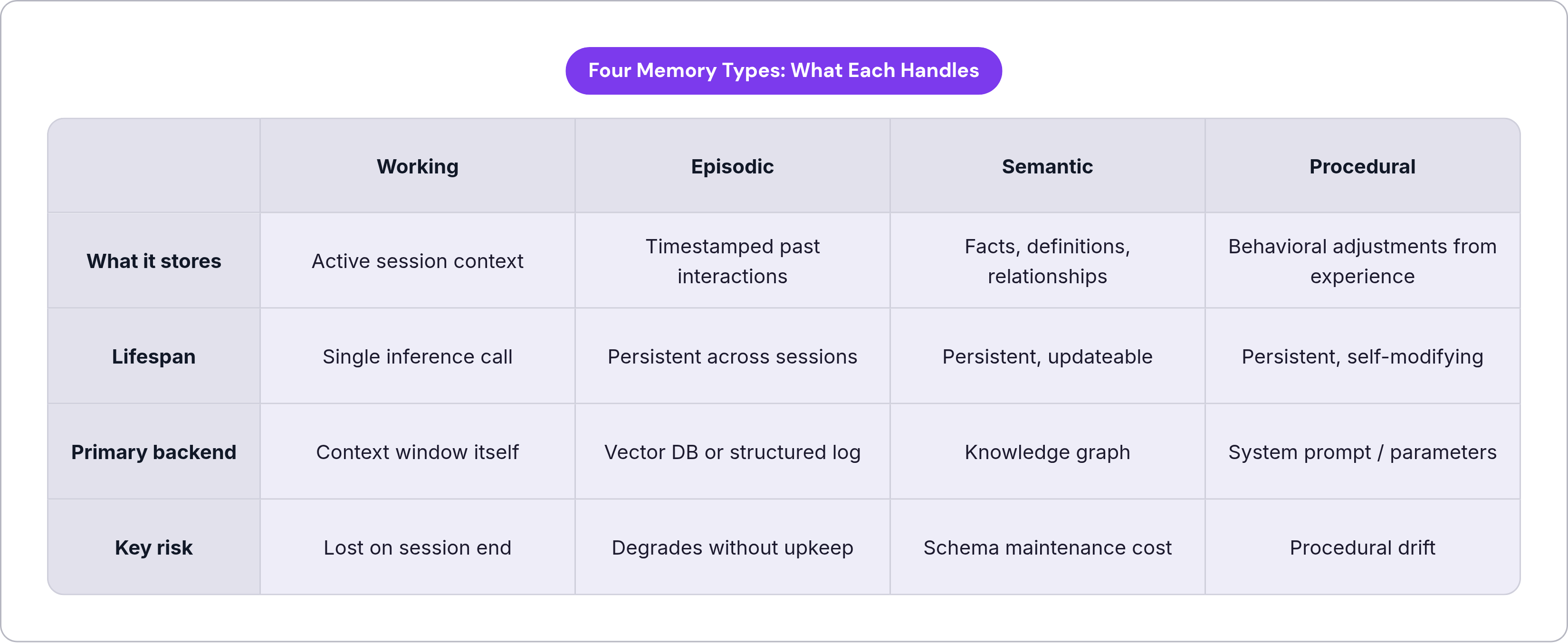
The taxonomy most engineers build against traces back to a 2023 Princeton framework called CoALA, and it borrows almost wholesale from cognitive psychology. Tulving split memory into episodic and semantic in 1972. Squire added procedural in 1987. Baddeley and Hitch modeled working memory in 1974. None of that was written with AI in mind, and yet it maps onto agent memory with barely any modification, which honestly says more about how good that old psychology was than anything new happening in AI. IBM, MongoDB, Letta, and Mem0 all use some version of this four-part split in their documentation now.
Working memory is the context window itself: temporary, bound to the session, gone the moment the call ends. It's the only one of the four the base LLM handles on its own; everything else needs infrastructure bolted on from outside.
Episodic memory is a timestamped record of what happened, past interactions and observations, usually pulled by similarity or recency out of a vector database or a structured log. A 2025 arXiv position paper lays out five properties this type needs to actually hold up for agents running over long stretches: it has to persist past the session, support reasoning over its own contents, allow learning from one exposure with no gradient update, hold instance-specific detail, and bind context, meaning who, when, where, why. It's the closest thing to human autobiographical memory the field has built. And like human memory, it degrades without upkeep; nobody remembers everything from three years ago in perfect detail either, so why would we expect a log to?
Semantic memory holds facts, definitions, how entities relate. For a personal AI, that's pre-training knowledge plus whatever it's picked up about you specifically. This is the layer that fits a knowledge graph better than a vector store, and I'll get into why that is in a bit.
Procedural memory is the agent adjusting its own behavior from experience: rewriting its system prompt, shifting tone, learning to dodge a mistake it made before. It's also the one that should make you a little nervous. A March 2026 paper on a framework called SSGM names something called procedural drift, where an agent keeps reinforcing a mistaken behavior through its own accumulated updates. Left alone, it doesn't get better. It gets confidently wrong, which is worse than being uncertain. This type needs guardrails from day one; it demands active oversight in a way episodic memory, sitting there as a passive log, just doesn't.
Some academic proposals split memory further, into token-level, parametric, and latent dimensions. Worth knowing the framing exists. But production teams are building against these four, so that's where I'll stay.
How layered memory architectures organize these types in production
Different memory types want different things, and that's the whole design problem in one sentence. Working memory needs to be fast and cheap because it's touched on every call. Episodic memory can tolerate more latency. Procedural memory needs review, not just storage. Mash all three into one flat store and you get a system that's slow where it should be fast and careless exactly where it should be careful.
Three production patterns show how teams are actually handling the split.
LPM, also called Second Me (2024 to 2025 research), proposes three layers. L0 is raw data, basically RAG run straight over unstructured text. L1 turns memories into natural language: bios, preference tags, key sentences pulled out and summarized. L2 is the ambitious one, where memory folds into the model's own parameters, so the model becomes something like a neural representation of one user's knowledge. The team's own experiments found that stuffing a giant context window with everything performed worse and cost more than this layered setup, for search, organization, and reasoning over complex memory. That's a direct rebuttal to the idea that bigger context windows solve memory. They delay the reckoning, and the underlying problem stays unsolved.
Letta, the production system that grew out of the MemGPT research project, splits memory into core, archival, and recall tiers, which line up cleanly with episodic, semantic, and procedural. The distinguishing feature here: the agent itself decides, through function calls, what gets kept and what gets paged out. Memory management becomes a task the model performs, guided from the outside but executed on its own terms.
Weaviate's Context Engineering framework, also from 2025, splits retrieval into three pathways: a memory layer for past interactions, a knowledge layer for domain facts, and working memory injection for current state. It's a solid pattern if you're already invested in a vector database and want more structure without a full migration to a graph.
The thread running through all three is controlled injection. Only what matters for this specific inference gets pulled into context. Everything else stays parked, out of the way, cheap to store and expensive to ignore.
Vector databases versus knowledge graphs as memory backends
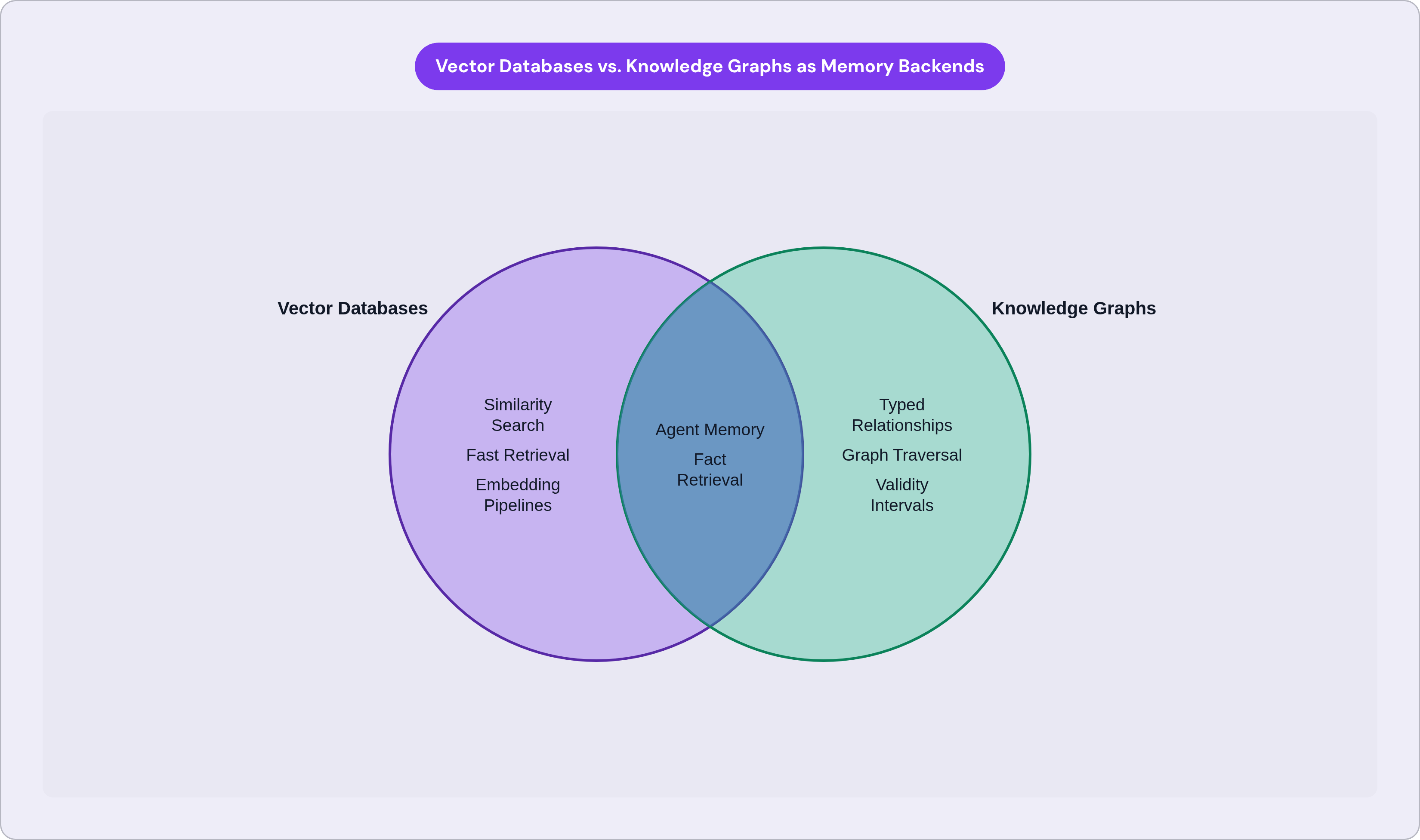
Vector databases are the default right now, for good reason. They're mature, fast at similarity search, and they plug into an embedding pipeline without much friction. But they break in specific, predictable spots once memory has to do more than "find something similar to this."
Freshness cracks first. VentureBeat's 2025 reporting on enterprise RAG deployments found companies measuring the wrong thing: embedding pipelines update on their own schedule while the real-world systems they're supposed to reflect keep changing underneath them. The agent answers confidently. It's just answering from last week.
Explainability is the second problem, and in regulated industries it's a serious one. A similarity score tells you two things sit close together in vector space. It doesn't tell you why a fact got pulled, or whether it should have been trusted in the first place. Try explaining that one to an auditor.
Relational reasoning might be the deepest gap. Vector search finds things that look alike, but it can't reliably chase a chain like this user's employer, then that employer's industry, then the compliance rules tied to that industry. That's a traversal problem, and no amount of better embeddings fixes it.
Knowledge graphs are built for exactly that traversal. Entities become typed nodes, relationships become typed edges, and agents walk the graph with query languages like Cypher in Neo4j or SPARQL elsewhere. Snowflake's 2025 research found that adding an ontology layer to agent context improved answer accuracy by a meaningful margin and cut tool calls substantially, a real jump in how the system reasoned rather than a rounding error. The tradeoff sits upfront: building and maintaining a schema is real work, and graph traversal runs slower than approximate nearest-neighbor lookup for the simple cases that don't need any of this machinery.
So which one wins? Neither, and I think that's the honest answer the field keeps circling back to. Graph-based memory was mostly experimental before 2025. By 2026, the production pattern for teams handling genuinely connected data is hybrid: vectors for fast unstructured similarity, graphs for relational reasoning and for being able to explain an answer after the fact. Personal AI needs relationship reasoning that similarity search was never built to provide. Admitting that gap exists doesn't require writing vectors off.
How leading frameworks implement memory in 2025–2026
Mem0 runs a dual-store setup, a vector database paired with a knowledge graph, with an extraction pipeline that turns raw conversation into atomic memory facts scoped to a user, session, or agent. On the Agent Memory Benchmark leaderboard, it posted 94.6% retrieval accuracy on LongMemEval as of mid-2025, the top officially reproduced score at that point. The April 2026 algorithm update made its biggest gains on temporal queries and multi-hop reasoning specifically, which happen to be the two categories where flat vector retrieval struggles most. That's a signal about where the real bottleneck was sitting the whole time. Token use also dropped sharply moving from full-context retrieval to the 2026 approach on the LoCoMo benchmark. Mem0 is YC-backed, and it's increasingly used as an external memory service other teams call into rather than something they build and run themselves.
Zep builds a temporal knowledge graph with explicit validity intervals on facts, a direct answer to the freshness problem vector-only systems keep running into. In benchmarks published by Rasmussen et al. in 2025, it beat MemGPT on deep memory retrieval. For anything where facts genuinely shift over time, jobs, relationships, standing preferences, the validity-interval approach is the right instinct to have.
LangMem, launched in early 2025, supports all four memory types, including procedural, where the agent updates its own system instructions as it goes. Powerful feature. Given the drift risk covered earlier, it's also one that needs real limits, not blind trust in whatever the agent decides to keep.
OpenAI's ChatGPT rolled out what it calls Dreaming V3 in June 2026, replacing the older manually curated saved-memories list with a background process that reads across years of past conversation and updates its own memory without being asked. The memory state lives in a separate data layer and gets injected into the system prompt automatically, so a brand-new conversation starts with synthesized context already loaded. OpenAI's own internal evaluations, vendor-reported and not independently verified, show real generational improvement on factual recall, preference adherence, and keeping time-sensitive facts current. I'd take the specific numbers with a grain of salt, since nobody outside OpenAI has reproduced them, but the direction is hard to argue with. Dreaming is probably the clearest public example yet of background memory consolidation shipping as an actual product feature instead of a research demo.
Google's Gemini Personal Intelligence launched in January 2026, tying persistent personalization across Gmail, Calendar, Drive, Photos, Search, Maps, and YouTube history into one profile. Aggregating signal across that many services lets Gemini build a user model no single-app memory layer could match on its own. It also raises a question I don't think is settled yet: does memory owned at the platform level, the OS or the productivity suite, end up beating memory built inside individual apps over the long run? Ask me again in two years.
Some tools take a different angle, positioning themselves as reasoning layers that understand context and pick up on patterns while keeping a human in the loop on judgment calls. For engineering and product teams building AI workflows where memory serves better decisions rather than pure recall, that is a genuinely different design goal, and it is worth knowing the distinction exists before picking a tool based on a leaderboard score alone.
What breaks when memory systems scale without active management
Here's the failure mode that doesn't get enough attention: memory that grows unchecked doesn't just get slower. It gets worse at its actual job. Reasoning quality drops. That's a different, scarier problem than latency.
Retrieval degrades with volume. Episodic stores grow with no natural ceiling, and past a certain point, accuracy drops while cost climbs at the same time. Eviction strategies, recency-based, salience-based, LRU hybrids, all help manage the symptom. None of them, as far as I've seen in current frameworks, actually fix the underlying issue. The field has a workaround, not yet a fix.
Consolidation is where a lot of the quiet damage happens. Naive summarization pipelines compress old memories to save space and speed things up, and that compression throws away detail nobody thought to check for, until the day it's needed and it's gone. A memory system that remembers a summary of what you said carries real gaps against one that remembers what you actually said. That gap, between the summary and the thing itself, is where trust in a personal AI system erodes, one flattened detail at a time.
That's the real shape of the problem right now. Memory layers clearly work in principle; every framework in this piece proves that much. The open question is whether teams treat memory as something that needs ongoing tending or as a bucket you fill once and stop checking. The systems getting this right are the ones treating eviction policy, drift detection, and consolidation quality as first-class engineering problems, not afterthoughts bolted on after launch. The ones that don't will keep shipping agents that sound confident and remember things that never quite happened.