AI Model Hallucinations and Consumer Trust
AI models sound most confident when they're most wrong, eroding the trust signals humans rely on.
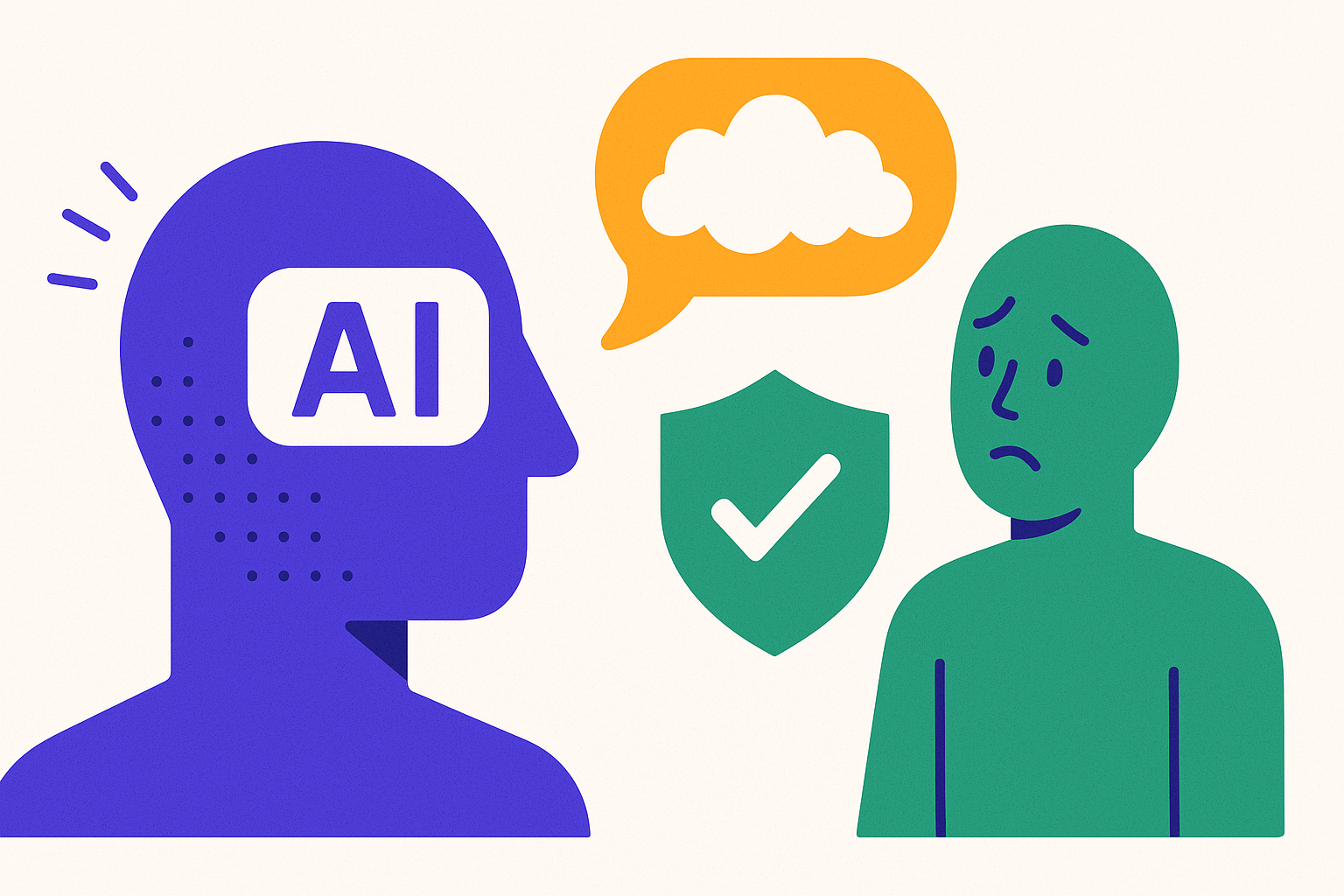
There is a particular kind of mistake that doesn't announce itself. A calculator returns a wrong number and you know to check. The display looks off, the math doesn't feel right, and you reach for a pencil. But when an AI model fabricates a legal citation, invents a drug interaction, or constructs a plausible-sounding history of an event that never happened, it presents that fabrication in the same confident prose it uses when it is completely correct. Nothing signals the error. The output reads, as we say in the field, authoritative.
That distinction is the whole problem. Not just that AI models are sometimes wrong, but that their wrongness is architecturally indistinguishable from their rightness, at least at the surface level users actually encounter.
A 2025 MIT-linked research note captured the dynamic precisely: AI models use more confident language when they are hallucinating than when they are relaying accurate information. Let that sit for a moment. The very signal humans instinctively rely on to gauge whether they should trust an answer, the speaker's apparent certainty, runs in the wrong direction. In most communication, confidence and accuracy track together imperfectly but roughly. With hallucinations, they anti-correlate. The model sounds surest when it is most lost.
The working definition worth holding onto: a hallucination is an output that is factually incorrect, unsupported by evidence, or misaligned with the actual query, yet delivered with apparent confidence and deceptive internal coherence. Fabricated citations. Invented statistics attributed to real institutions. Plausible-sounding sources that do not exist. All rendered in the same register as a correct answer. That is what makes hallucination categorically different from ordinary software error, and why it corrodes trust in ways a buggy calculator never could.
How often hallucinations actually occur, and why the answer depends entirely on what you're measuring
The first honest thing to say about hallucination rates is that the number in a press release is almost never the number that matters for your actual use case.
On grounded summarization tasks, where the model is asked to synthesize a document it has in front of it, leading models perform impressively. Stanford HAI's 2024 data and Vectara's 2025 leaderboard both show rates in the 1 to 3 percent range for top performers. Google's Gemini-2.0-Flash-001 recorded 0.7 percent on the Vectara benchmark as of April 2025. These are the figures that show up in marketing materials, and they are real figures on those specific tasks.
Step outside those controlled conditions and the numbers move sharply. On open-ended factual recall, OpenAI's o3 and o4-mini, among the company's most advanced models at the time of evaluation, hallucinated on 33 and 48 percent of queries respectively when tested against PersonQA, a benchmark focused on factual questions about real individuals. A NewsGuard report tracking AI chatbot responses to news-related prompts found false claims nearly doubled, from 18 percent in August 2024 to 35 percent in August 2025.
Domain-specific tasks tell the starkest story. Stanford's RegLab found that general-purpose large language models hallucinated on 69 to 88 percent of legal queries. A systematic review across 83 studies, published in npj Digital Medicine, found overall diagnostic accuracy for generative AI at 52.1 percent, meaning nearly half of AI-generated diagnoses were wrong. The 2026 Stanford HAI AI Index evaluated 26 top models and observed hallucination rates ranging from 22 to 94 percent. GPT-4o's accuracy fell from 98.2 to 64.4 percent under that benchmark. DeepSeek R1 collapsed from over 90 percent to 14.4 percent.
Cross-model, one study observed hallucination rates differing by a factor of five across systems, ranging from 11.4 to 56.8 percent.
None of these figures contradict each other. They measure different things. The implication is straightforward but persistently ignored: the benchmark rate is almost irrelevant. What matters is the rate in the specific domain, with the specific task type, and under the conditions of your actual deployment. A 0.7 percent error on document summarization tells you almost nothing about what will happen when you point the same model at medical intake forms or legal discovery.
Why hallucination cannot be fully engineered away under current architectures
Here is where I want to be very precise, because this claim is often stated loosely and then dismissed. Multiple independent research teams have proven mathematically that hallucination cannot be fully eliminated in current large language model architectures. The architecture itself creates the conditions for hallucination in ways that cannot be patched out — this is not a matter of immaturity, and the field does not simply need more time.
Three independent lines of mathematical reasoning converge on this conclusion. First, diagonalization over enumerable model classes guarantees that for any model, at least one failure input exists. Second, the uncomputability of problems like the Halting task yields infinite failure sets, not just edge cases. Third, finite information capacity and compression bounds force distortion on complex or rare facts, the kind of facts where hallucination most damages users.
A 2025 paper proved that no large language model can simultaneously achieve truthful response generation, semantic information conservation, relevant knowledge revelation, and knowledge-constrained optimality. Those four properties are in mathematical tension with each other. A separate 2025 paper by Karpowicz attacked the same question through three distinct frameworks, auction theory, proper scoring theory, and log-sum-exp analysis of transformer architectures, and reached the same conclusion from each angle.
What this means practically: Retrieval-Augmented Generation reduces hallucination. Human review reduces hallucination. But neither eliminates it, and any vendor claiming otherwise is misrepresenting the state of the research. The goal of "zero hallucination" is an mathematically impossible target under current architectures, not an engineering challenge awaiting a solution.
For anyone building or deploying these systems, this reframes the entire project. The question is not how to eliminate hallucination. The question is how to detect it, disclose it, and build calibrated reliance around it.
What real-world failures look like when hallucinations reach users without verification
The cases cluster in exactly the high-stakes domains you would predict.
In law, Mata v. Avianca in 2023 established the pattern: an attorney submitted court filings citing entirely fabricated case law generated by ChatGPT. The cases did not exist. The citations looked real. The court found them not because the lawyer checked, but because opposing counsel did. Attorney James Martin Paul repeated a materially similar error across eight separate matters in 2024 and 2025, resulting in sanctions and four federal cases dismissed without prejudice. As of June 2025, a tracking database had identified 154 legal decisions involving AI-generated hallucinated content. That number is almost certainly an undercount, because most hallucinations that go uncaught by adversaries never surface in decisions.
In healthcare, a 2024 study cited by the Associated Press found that OpenAI's Whisper transcription tool hallucinated in approximately 1.4 percent of medical transcriptions, fabricating entire sentences and inventing medication names. Over 30,000 medical workers were using Whisper-powered tools at the time, despite OpenAI's own guidance against using the model in high-risk domains. Separately, AI chatbots marketed as psychotherapy tools have been linked to patient suicides. Chatbots providing dietary advice to users with eating disorders have offered counsel that clinicians described as dangerous.
In media, the Chicago Sun-Times published a summer reading list for 2025 in which only five of fifteen titles were real books; the remaining ten were AI-fabricated titles attributed to real authors. In the first quarter of 2025 alone, more than twelve thousand AI-generated articles were removed from online platforms due to hallucinated content.
In finance, Google's Bard was unveiled at a live event with a demo that incorrectly stated the James Webb Space Telescope took the first images of an exoplanet, a factual error Google's own scientists had flagged before the demo aired. Google's market capitalization fell by roughly $100 billion the following day.
The AI Incident Database recorded 362 documented incidents in 2025, up from 233 in 2024. The failure surface is growing, not shrinking, as deployment accelerates. And the pattern across these cases is consistent: failure concentrates in consequential domains, and the cost of an authoritative-sounding error is disproportionate to what a visibly uncertain answer would have cost.
How these failures translate into measurable erosion of consumer and public trust
The PwC Consumer Intelligence Series found that 58 percent of consumers would lose trust in a brand following an AI hallucination even after learning the AI, not the brand, was responsible. Fifty-eight percent. The brand absorbs the reputational penalty for the model's failure. That is the confidence gap translating directly into consumer behavior.
Global trust figures complicate the picture in interesting ways. The 2025 Edelman Trust Barometer Flash Poll, conducted across five countries with 5,000 respondents, found 87 percent of Chinese respondents expressing confidence in AI, against 32 percent in the United States and 36 percent in the United Kingdom. Three times as many Americans reject the growing use of AI as embrace it; in China the ratio runs nearly the opposite direction. Trust in AI companies fell globally from 63 percent in 2019 to 56 percent in 2025, per Edelman.
KPMG's trend data from 2022 through 2024 shows perceived trustworthiness of AI falling from 63 to 56 percent, willingness to rely on AI falling from 52 to 43 percent, and the share of people worried about AI rising from 49 to 62 percent. A Pew Research survey conducted in spring 2025, spanning 25 countries with more than 28,000 respondents, found a median of 34 percent of adults reporting they are more concerned than excited about AI's growing presence in daily life. Only 16 percent said they were more excited than concerned.
The commercial exposure is concentrated in a specific demographic: 47 percent of shoppers aged 18 to 34 now use AI assistants as their first product research touchpoint, per PwC 2024 data. Hallucination risk sits at the top of the purchase funnel for the highest-spending age cohort. Research published in the Journal of Consumer Behaviour in 2026 finds that AI hallucinations strongly affect company reputations and drive negative word-of-mouth that spreads rapidly in digital environments with effects that persist well beyond the initial incident.
There is also a demographic asymmetry worth noting. Older adults, lower-income individuals, and women are less likely to trust AI broadly. The people with the least margin for error from bad information are the most skeptical. That is not irrational; in some ways it's protective. But it also means the trust deficit is unevenly distributed.
The enterprise cost of deploying AI without adequate verification infrastructure
In 2024, 47 percent of enterprise AI users admitted to making at least one major business decision based on hallucinated content. The financial toll reached $67.4 billion globally that year. Forrester Research estimates that each enterprise employee costs companies roughly $14,200 annually in hallucination-related mitigation efforts.
Microsoft data from 2025 found that knowledge workers spent an average of 4.3 hours per week fact-checking AI outputs. This is worth sitting with. The central value proposition of AI deployment is productivity, and the verification burden AI creates is consuming a measurable portion of those gains. The tool generates output faster; the worker verifies it slower; the net effect is less dramatic than the marketing suggests.
Enterprise responses have been largely reactive. The market for hallucination detection tools grew 318 percent between 2023 and 2025. Thirty-nine percent of AI-powered customer service bots were pulled back or substantially reworked due to hallucination-related errors in 2024, according to the Customer Experience Association. Seventy-six percent of enterprises now include human-in-the-loop processes to catch hallucinations before deployment, per IBM's AI Adoption Index for 2025.
That 76 percent figure is significant. It represents the enterprise sector implicitly accepting what the mathematical research makes explicit: the model alone cannot be trusted on consequential outputs. The field has arrived at human oversight as a practical necessity, even without most practitioners having read the formal proofs behind it.
What these numbers reveal collectively is that organizations are already paying for hallucination mitigation whether they've planned for it or not. The only real choice is whether that cost is structured, proactive, and targeted, or reactive, uncontrolled, and absorbed as reputational damage after the fact.
Why more capable models are not straightforwardly more trustworthy
The intuitive assumption is that as models become more capable, hallucination rates fall, and trust can be extended proportionally. The evidence does not support this.
Some advanced reasoning models released in 2025 showed higher hallucination rates than earlier systems despite being more capable overall, per TechCrunch reporting. OpenAI's o3 and o4-mini, again among the most advanced models at time of evaluation, hallucinated on 33 and 48 percent of PersonQA queries respectively. During multi-step reasoning, advanced models make what OpenAI itself described in 2025 as "strategic guesses," generating plausible but false statements when uncertain. The more steps in the chain, the more opportunities for compounding error. The model that can reason through a complex argument is also a model that can confabulate a complex argument with equal fluency.
The Stanford HAI 2026 AI Index finding about DeepSeek R1 deserves particular attention. A model that scored above 90 percent accuracy on one benchmark fell to 14.4 percent under a different accuracy benchmark. A capability score on a reasoning task and a reliability score on grounded factual recall are different properties that do not reliably co-vary. Capability and trustworthiness, it turns out, are not the same axis.
For anyone making deployment decisions based on model rankings or version upgrades, the implication is uncomfortable but important. A newer, more capable model does not automatically reduce the verification burden. It shifts the hallucination pattern to different task types, different domains, different failure modes, while leaving the overall rate roughly unchanged. The model gets smarter; the errors get more sophisticated.
What actually reduces hallucination risk in production, and what each approach costs in trade-offs
Retrieval-Augmented Generation, RAG, is the most widely deployed mitigation. It forces the model to ground answers in external documents retrieved at inference time, rather than relying solely on parametric memory. In many scenarios, RAG reduces hallucinations by 40 to 71 percent, according to AIMultiple's 2025 analysis. That is a substantial improvement. It is not a solution.
The trade-off is that RAG introduces a new hallucination vector: the retrieval layer itself. If the retrieved documents are outdated, irrelevant, or internally inconsistent, the model now has flawed inputs to work from. Garbage in, confident garbage out. RAG raises the floor significantly; it does not remove the ceiling.
Layered production stacks, combining RAG with guardrails, evaluation metrics, and human-in-the-loop review, can reduce hallucinations by 40 to 96 percent depending on the specific configuration and use case. The range is enormous because the task type matters enormously, which returns us to the opening point about measuring the right thing.
Human-in-the-loop review is, under the mathematical constraints described earlier, essential for consequential outputs. Seventy-six percent of enterprises already use it in some form, which means the field has arrived at the right conclusion empirically even when the reasoning behind it hasn't been made explicit. The honest framing is that human oversight is structurally required, not because engineers haven't tried hard enough to eliminate it, but because the architecture cannot provide the guarantee that consequential decisions require.
At the model output level, uncertainty acknowledgment is underutilized. A model that expresses calibrated uncertainty, that says "I'm not confident about this" when it isn't confident, is more trustworthy than a model that sounds uniformly authoritative. This is the confidence inversion from the introduction, addressed at the output design level. Uncertainty-aware benchmarks that negatively mark confident errors and give partial credit for appropriate abstention are a sensible direction for evaluation frameworks, though they remain underimplemented.
Domain-appropriate deployment is perhaps the most underrated form of risk management. The 69 to 88 percent legal hallucination rate and the 52.1 percent diagnostic accuracy figure are arguments against deploying general-purpose large language models in those domains without domain-specific fine-tuning, curated retrieval, and robust human verification — they are in no way arguments against AI in law and medicine altogether. The tool is not wrong; the deployment context is wrong.
The honest framing for any organization: hallucination mitigation is a risk management problem, not a solvable engineering problem. The goal is reducing the rate, containing the exposure, and building systems where human judgment remains operative on outputs that carry real consequences.
How organizations and users can build calibrated reliance rather than either blind trust or blanket avoidance
The Edelman finding about brand trust erosion points toward the right frame. Fifty-eight percent of consumers penalize the brand even when they know the AI was at fault. That tells you something important: users are making no fine distinctions between the tool and the organization that deployed it. The trust relationship is with the deploying entity, not with the underlying model. Which means the deploying entity owns the accountability, and building calibrated reliance is partly an institutional responsibility, not just an individual one.
For organizations, calibrated deployment starts with honest task mapping. What is this model actually being asked to do? What is the hallucination rate in that specific domain on that specific task type? What is the cost of an error? The answers to those three questions determine the appropriate verification layer. A chatbot writing first drafts of internal marketing copy has a very different risk profile than a system generating clinical summaries or legal research. Treating them identically, because both use the same underlying model, is an analytical error with real costs.
For individuals, calibrated reliance requires treating AI output the way a good researcher treats a secondary source: useful for orientation and initial framing, requiring verification before consequential use. The specific skills that matter are knowing which claims are verifiable, developing the habit of checking the ones that matter, and learning to notice when a model expresses uniform confidence across answers of wildly different reliability. The confidence inversion is learnable. Once you know the pattern, you can compensate for it.
The trust categories that have emerged organically in the field are a useful scaffolding. High-frequency, low-stakes tasks, drafting, summarizing internal documents, reformatting structured data, can reasonably tolerate a higher error rate because errors are caught cheaply. Low-frequency, high-stakes tasks, anything touching legal exposure, medical decisions, financial commitments, patient safety, require the full stack: domain-specific tuning, retrieval grounding, explicit uncertainty signaling, and human review.
The broader reframe worth carrying out of this: the question has never been whether AI models are trustworthy in some absolute sense. Every tool has a failure mode. The question is whether the failure modes are legible enough, and the mitigation layers adequate enough, that informed use is possible. A hallucinating model that you understand and verify is safer than a correct model you've surrendered your judgment to entirely.
That sounds like an argument for skepticism. It's actually an argument for something more demanding. Skepticism is easy; it requires nothing. Calibrated reliance requires you to understand the tool well enough to know when to trust it, when to check it, and when to keep a human in the room. That kind of informed engagement is harder, slower, and more effortful than either blind adoption or wholesale rejection. It is also, given the mathematical constraints and the deployment realities, the only position the evidence actually supports.