Best Local LLM Models for Privacy-Conscious Users
Run open-source AI models locally to keep your sensitive data off cloud servers forever.
There is a version of this conversation that starts with "which AI model scores best on benchmarks?" That is the wrong starting point if you care about privacy. Benchmarks don't tell you whether your data stays on your machine. They also won't tell you whether the vendor's terms shift in six months. They don't tell you whether your contract language, your source code, or your client's financial details quietly become training material for someone else's product.
Let's start from the actual problem instead.
According to the LayerX Enterprise AI & SaaS Data Security Report 2025, 77% of employees report pasting company information into AI services, and 82% of those did so from a personal account, bypassing any corporate controls whatsoever. That number should arrest you. It means the sensitive information flowing into cloud AI systems isn't primarily coming from sanctioned enterprise deployments with negotiated data agreements. It's coming from individuals, at scale, on personal accounts, under consumer terms of service most people have never read.
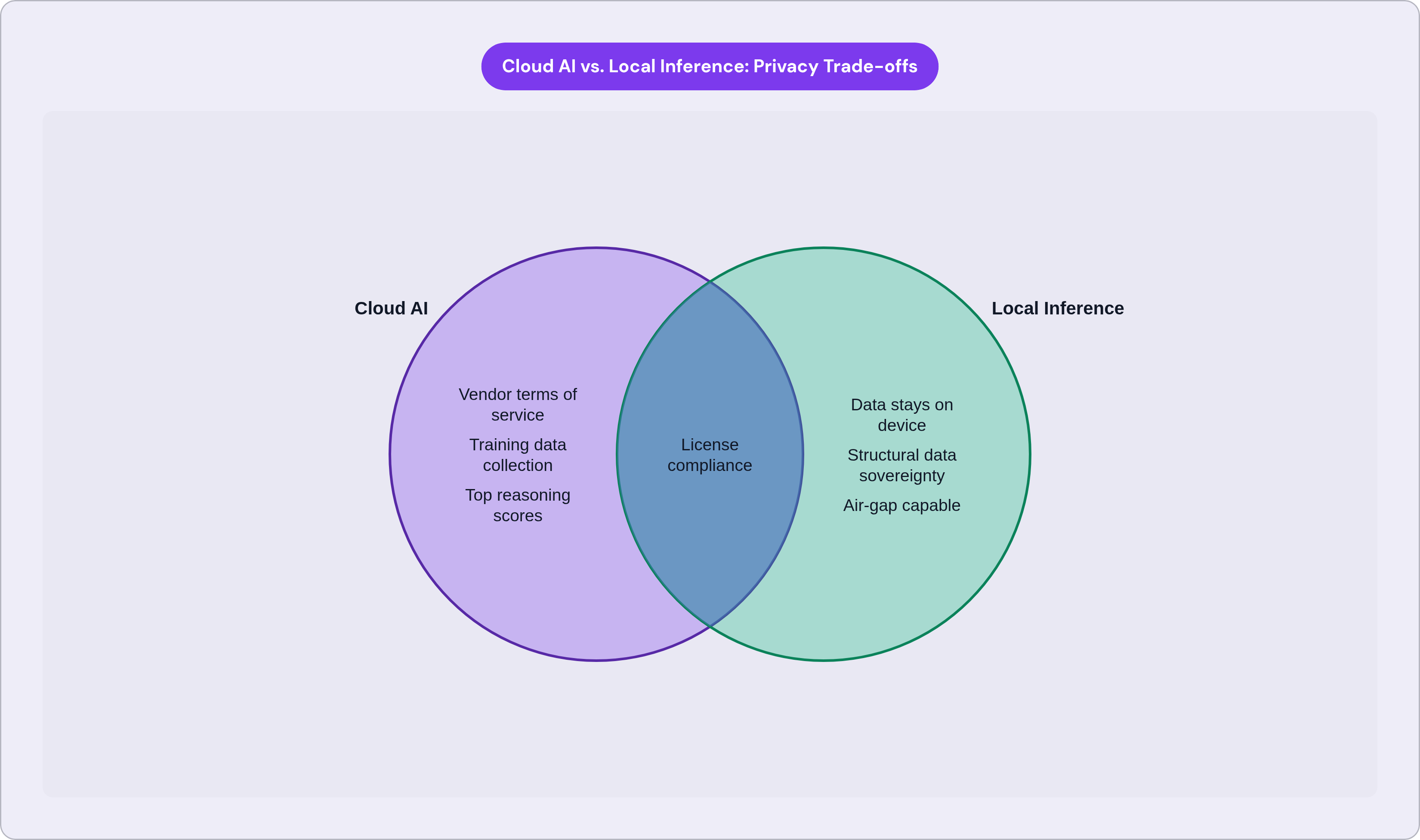
What do those terms actually say? Microsoft's privacy policy implies prompts are shared with third-party advertising partners. DeepSeek and Meta indicate prompts can be shared within their respective corporate groups. Gemini, DeepSeek, Pi AI, and Meta AI offer no opt-out from training use at all. Anthropic's Claude Pro defaults to training data collection; users must manually opt out, or their data is retained for up to five years.
These aren't hypothetical risks. They're documented policy positions. And policy positions change. Starting August 17, 2026, Atlassian began using data from Jira, Confluence, and Jira Service Management to train its AI, affecting approximately 300,000 customers with no meaningful prior consent mechanism. Acceptable-today policies can become problematic overnight, and there is no structural protection against that trajectory, only contractual promises from companies with incentives to monetize the data they hold.
There's also a regulatory wrinkle that doesn't get discussed enough. GDPR's "right to be forgotten" doesn't map cleanly onto model weights. EU data protection authorities clarified in 2025 that information embedded in model weights cannot simply be deleted; full retraining is required. A database row can be erased. A model trained on your data cannot be selectively unwound. That's not a policy failure; it's a technical reality, and it matters enormously if your organization operates under European law.
Local inference is the structural answer to all of this. Not a policy promise. Not an opt-out checkbox. Architecture.
What Local Inference Actually Guarantees, and Where It Still Requires Care
Running a model locally means all processing stays on your hardware. Zero data traverses third-party servers. For industries where that distinction carries legal weight, this is significant: HIPAA for healthcare, attorney-client privilege for legal work, SEC and FINRA compliance for financial services. Data sovereignty becomes structural rather than contractual. You are not trusting a vendor's terms of service; you are trusting physics.
The cost economics are worth understanding, particularly for organizations considering scale. Cloud inference on an eight-GPU H100 cluster runs roughly dozens of dollars per hour. Equivalent on-premise power and cooling, at standard electricity rates, runs under a dollar per hour. The breakeven arrives at thousands of hours of continuous use, approximately twelve months of sustained deployment. Over five years, the savings projection is substantial. For intermittent or lighter workloads, hardware amortization changes the calculus, so it's not a universal argument. But for teams running inference continuously, the financial case is clear.
Now for the honest caveat, because local inference is not automatically private.
In January 2026, a security incident documented 175,000 exposed Ollama server instances accessible on the public internet. Individual victims lost between $46,000 and $100,000 per day from unauthorized use of their compute. The model was local. The endpoint was public. That distinction is the whole ballgame. Proper firewall configuration and network isolation are non-negotiable. Running a model on your machine and exposing its API endpoint to the open internet is not a privacy architecture; it's an attack surface.
Two other limitations to carry forward: frontier cloud models still lead on multi-step reasoning and complex coding at the very top of the capability range. And local models hit context and memory limits faster than their cloud counterparts, meaning large queries sometimes require chunking. These are hardware constraints, not permanent capability gaps, but they affect which model is right for which task.
How to Frame the Selection Decision Before Looking at Any Specific Model
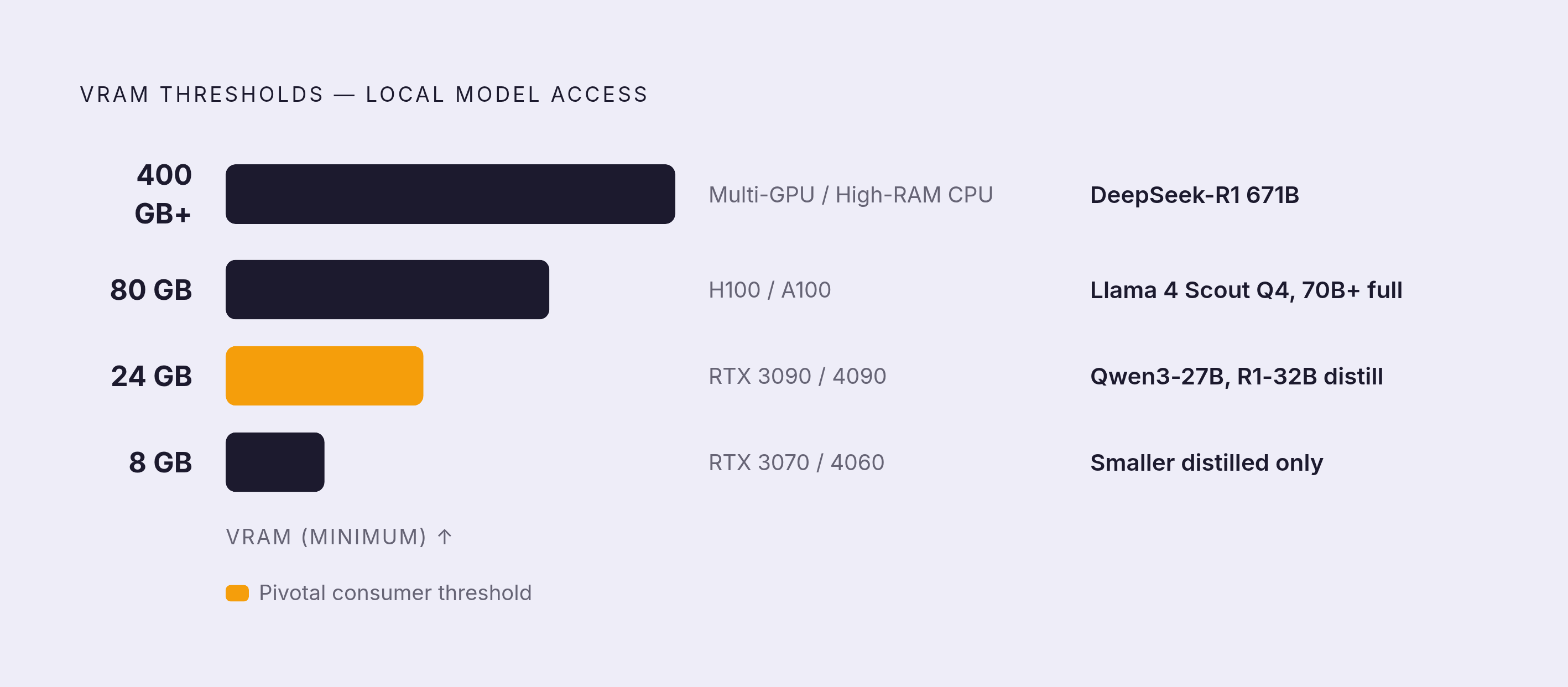
The instinct is to start with benchmark scores. Resist it. A model you cannot fit in your GPU's VRAM is not a viable option regardless of where it ranks on any leaderboard. The correct selection order for privacy work is: VRAM ceiling first, task fit second, license third.
Here's the practical VRAM map. Eight gigabytes is entry-level consumer GPU territory, the RTX 3070 or 4060 class, which limits you to smaller distilled models. Twenty-four gigabytes, a single high-end consumer card like an RTX 3090 or 4090, opens the 27B to 35B range depending on quantization. Eighty gigabytes, a single H100 or A100, is required for full 70B-plus models without quantization. Above that, you're looking at multi-GPU setups or high-RAM CPU inference for the largest models.
Quantization deserves a direct word. Running a model at 4-bit or 3-bit precision trades a small accuracy margin for dramatically reduced memory requirements. This is normal, accepted practice in serious ML deployments, not a compromise you should feel apologetic about. For most conversational, summarization, and coding tasks, the quality difference is minimal.
Task categories matter as much as hardware. Visible step-by-step reasoning and mathematical logic favor one model. Long-document work, including retrieval-augmented generation, multi-file code review, and contract analysis, favors another. General coding assistance and tool use is a third axis. Personal or conversational use on constrained hardware is a fourth. Matching model to task gets you more usable performance than chasing benchmark rankings.
License is the last checkpoint, and it matters especially if you're building a product. Apache 2.0 and MIT licenses are clean for commercial use without meaningful restrictions. Some open-weight models carry deployment thresholds above which the license becomes more restrictive. Verify before building on top of a model at scale.
Qwen 3 and Qwen 3.5: The Best All-Around Local Model for Most Privacy-Focused Users in 2026
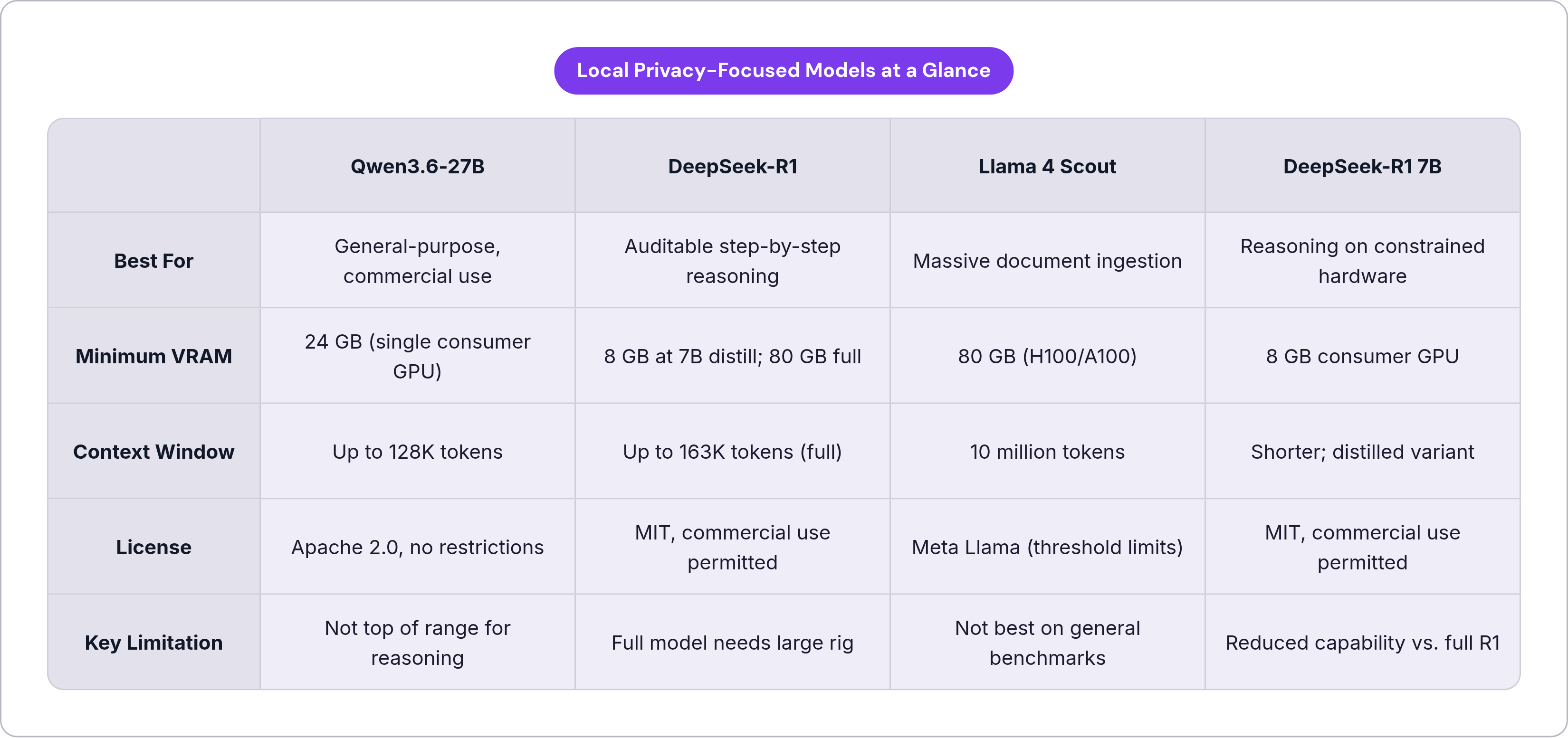
If you have a single 24-gigabyte consumer GPU and you need a capable, commercially usable, fully self-hostable model, Qwen3.6-27B is probably where you land. It's a dense 27-billion-parameter model that fits comfortably on one card, scores 77.2% on SWE-bench Verified per the Qwen team's published 2026 benchmarks, and carries an Apache 2.0 license. That last detail matters: no usage thresholds, no commercial restrictions, no legal ambiguity.
The broader Qwen family spans 0.6 billion to 235 billion parameters, including mixture-of-experts variants. The pretraining corpus covers approximately 36 trillion tokens across 119 languages. Dense models support up to 128,000 context tokens, which handles most enterprise document tasks without chunking at lower parameter counts. For users with 32 gigabytes of VRAM, Qwen3.6-35B-A3B is the logical step up.
What stands out about this family is the efficiency gains at smaller sizes. Qwen3-4B rivals Qwen2.5-72B on several benchmarks, which is a meaningful finding for anyone running on constrained hardware. You don't have to accept a dramatic capability cliff when you step down in size.
At the top of the family, Qwen 3 235B-A22B leads the open-source leaderboard for all-around reasoning and coding as of mid-2026, and Qwen3.5 extends the range to hundreds of billions of parameters at the high end and under a billion parameters at the low end. The 70-billion variant fits in 70 gigabytes at 4-bit quantization, dropping to 60 gigabytes at 3-bit. If you're prototyping for a range of deployment environments, the ability to start small and scale within a single model family without retraining or switching frameworks is a practical advantage.
No cloud component required. The weights are yours to run, on your hardware, air-gapped if necessary.
DeepSeek-R1: The Right Choice When the Reasoning Process Matters as Much as the Answer
Most models give you an output. DeepSeek-R1 gives you the derivation. Its defining feature is visible chain-of-thought via <think> tokens: you can watch the model reason step by step, catch the exact point where it went wrong, and calibrate your trust in the conclusion based on the quality of the work shown. For legal analysis, financial modeling, or complex debugging, that transparency is not a nice-to-have. It's the whole point.
The license is MIT as of its January 2025 release, explicitly permitting commercial use and derivative works. The May 2025 R1-0528 update pushed AIME 2025 accuracy from 70% to 87.5% and added JSON output and function calling, which reopened R1 for agentic workflows it couldn't reliably handle at launch. That's a substantial capability jump in a single update, and it's worth factoring into any comparison that predates it.
The distilled family covers nearly every hardware tier. The 1.5-billion-parameter version runs on essentially any laptop. The 7-billion version fits an 8-gigabyte VRAM GPU. The 32-billion distill lands at 18 to 20 gigabytes at Q4 quantization, fitting an RTX 4090 with headroom. A 70-billion distill is available for larger rigs. The full 671-billion-parameter model requires a minimum of 80 gigabytes of VRAM for reasonable inference speed, with a context length of 163,840 tokens.
Here is the privacy caveat that gets mishandled in most conversations about DeepSeek: the company is Chinese, and its cloud API is subject to Chinese data law. This is a legitimate concern. It applies to the cloud service, not to the self-hosted weights. Running R1 weights locally means data never leaves the machine, and the geopolitical consideration disappears completely. The confusion arises when people conflate the product's origin with its local deployment characteristics. They are separate questions. Users who have dismissed R1 on privacy grounds because of the company's jurisdiction should revisit that conclusion if they're considering local deployment.
Llama 4 Scout: The Only Local Model with a 10-Million-Token Context Window
Context window size is usually a footnote in model comparisons. For certain task categories, it is the entire selection criterion.
Llama 4, released April 5, 2025, is Meta's first LLM family built on mixture-of-experts architecture. Scout activates 17 billion parameters from a 109-billion-parameter total; Maverick draws from a 400-billion-parameter pool. Scout's context window is 10 million tokens. Nothing else locally runnable comes close. If your work involves ingesting entire codebases, lengthy legal documents, multi-session conversation histories, or large-scale contract review without chunking, Scout's context advantage effectively ends the conversation before it starts.
The MoE architecture keeps inference latency reasonable despite the enormous total parameter count, because only a fraction of parameters activate on any given token. At Q4 quantization, Scout fits on a single 80-gigabyte H100, which puts it within reach of serious workstation and small server setups, though consumer GPUs remain out of scope.
One license note: Meta's Llama license is not Apache 2.0. Usage restrictions apply above certain deployment thresholds. For individual researchers and small teams, this is unlikely to be a concern. For anyone building a product intended to reach a significant user base, verify the specific thresholds before committing to this architecture.
The benchmark comparison to Qwen or R1 is a fair question, and Scout is not the top performer on general reasoning tasks. That's the straightforward answer. But benchmarks measure performance on standard tasks, not on ingesting your entire legal document archive in one pass. For the tasks Scout was designed for, the 10-million-token window is a structural advantage that no benchmark score for a shorter-context model can offset.
Smaller Models That Run on Consumer Hardware Without a Dedicated GPU
Not every privacy use case requires a large model. Personal journaling, sensitive correspondence, local document Q&A, and note summarization all run effectively on 7-billion to 14-billion-parameter models, and several options at this tier are notable given their size.
DeepSeek-R1's 7-billion distill runs on an 8-gigabyte VRAM GPU, preserves the reasoning traces that make the full model distinctive, and carries the MIT license. For users who need auditable reasoning on constrained hardware, this is probably the first thing to try.
Qwen3-4B, as noted earlier, rivals much larger models on several benchmarks. It's an outlier for its parameter count and handles CPU-only inference reasonably well on a modern laptop with sufficient RAM. If you want to run something capable on hardware that has no discrete GPU, this is a serious option.
Mistral 7B and Mistral Nemo are widely cited for strong performance per parameter in the 7-billion to 12-billion range. Both carry Apache 2.0 licenses and cover general-purpose use cases competently for users without a dedicated GPU.
Microsoft's Phi-4 is worth naming for laptop-class deployments where capability density is the priority. It's a compact model with strong reasoning benchmarks relative to its size, which matters when you're working within tight memory constraints.
The important quantization note at this tier: 4-bit quantization makes 7-billion-parameter models run on hardware that couldn't otherwise fit them, and quality degradation for conversational and summarization tasks is minimal at this scale. It's not a reluctant concession; it's the standard approach.
All of these models run entirely on-device, including on air-gapped machines with no network connection. For maximum privacy guarantees, that's the architecture.
The Tooling Layer: What You Actually Run These Models Through
A model weight file is an inert artifact. Running it productively requires an inference server, and usually an interface on top of that.
Ollama is the most widely adopted local inference server. One-line installation, automatic model pulling, an OpenAI-compatible API, and broad community support make it the default starting point for most users. The caveat is the January 2026 exposure incident, where 175,000 Ollama instances were found publicly accessible. This is not a reason to avoid Ollama; it's a reason to harden the default configuration before exposing any endpoint to a network. Firewall rules, binding to localhost only, and disabling remote access unless you have a specific reason for it are all basic hygiene steps that prevent the incident profile documented that month.
LM Studio is the GUI-first option for non-developer users. It includes a model browser, a chat interface, and a local API server, making it a reasonable entry point for individuals who want local inference without touching a command line. It does the same core job as Ollama with less configuration surface area, which reduces the misconfiguration risk for users who aren't comfortable with network settings.
The choice between them is largely a question of workflow. Developers integrating local inference into existing applications will gravitate toward Ollama's API compatibility. Individuals who want a self-contained chat experience closer to a desktop application will find LM Studio more approachable. Both get you to the same place: model weights running on your hardware, no data leaving your machine, inference you control entirely.
That's the whole architecture. Model selection is the interesting intellectual question, but the guarantee it provides, your data staying where you put it, doesn't depend on which model you pick. It depends on understanding what local inference actually does, and making sure you haven't accidentally punched a hole in it.