On-Device AI Models vs Cloud AI Models
Neural Processing Units make on-device AI fast enough for real-time tasks cloud can't handle.
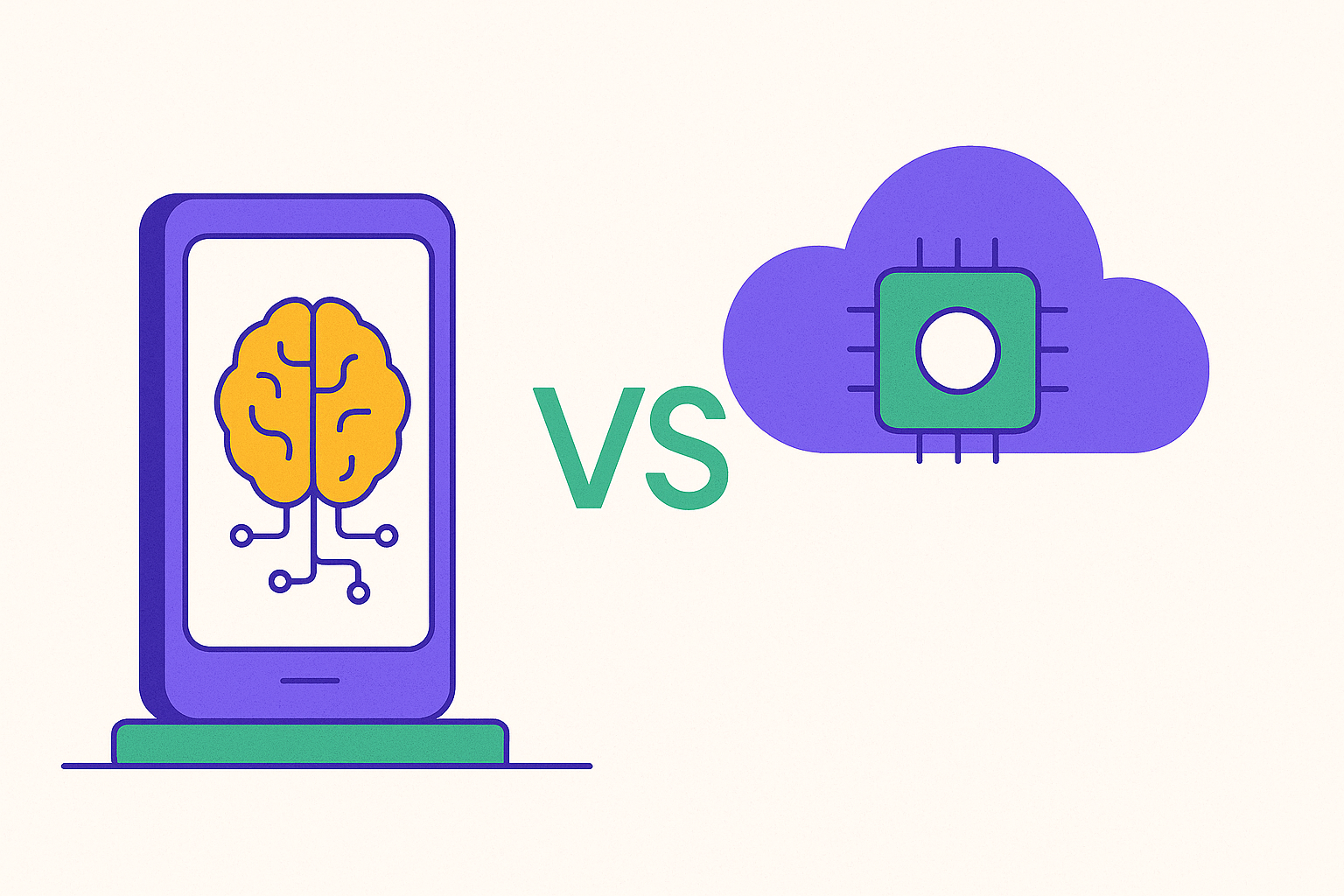
The enabling component is the Neural Processing Unit, the NPU. A dedicated chip built to run AI inference without draining a battery in twenty minutes. What matters is that NPUs are no longer confined to research hardware. Apple, Qualcomm, Google, MediaTek, Intel, and AMD are all shipping them across mainstream consumer devices. Apple's A18 Pro Neural Engine runs 35 trillion operations per second, sitting in millions of pockets right now. Qualcomm's Snapdragon 8 Elite runs large language models locally at over 70 tokens per second, a material jump from its predecessor.
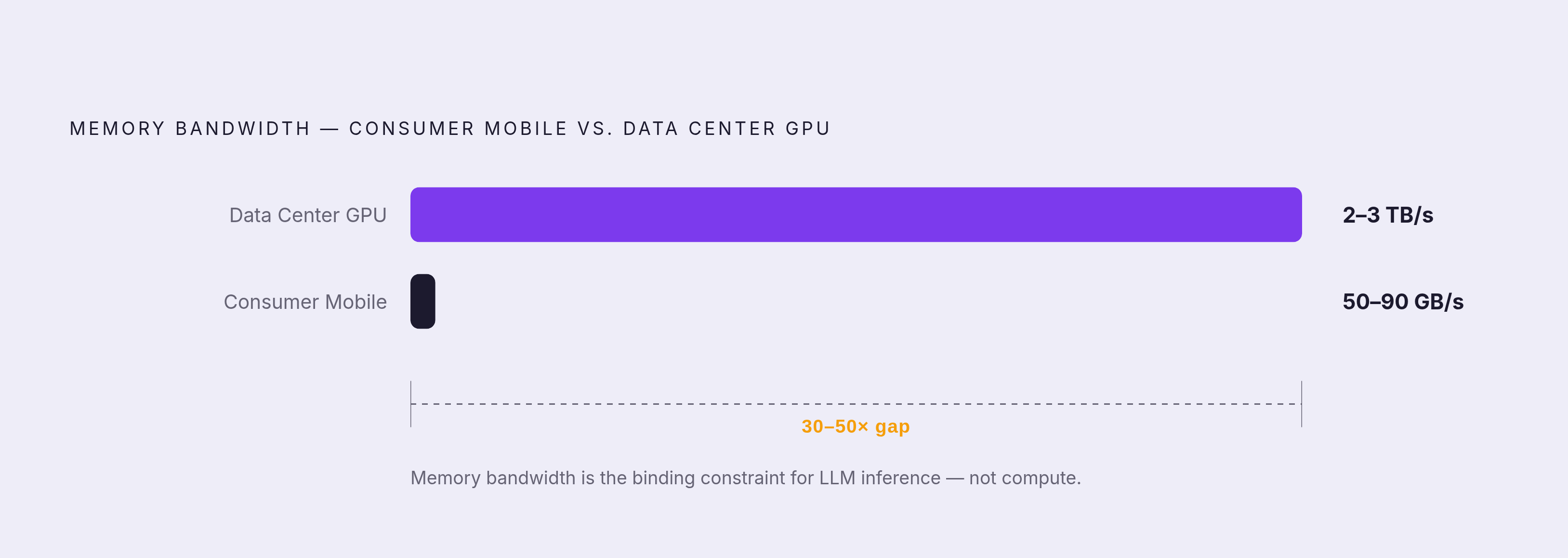
Impressive numbers. But the constraint that gets glossed over in those benchmark announcements is memory bandwidth, and this is where the conversation usually goes sideways.
Consumer mobile devices deliver roughly 50 to 90 gigabytes per second. Data center GPUs deliver two to three terabytes per second. That gap, 30 to 50 times, matters because LLM inference is memory-bound, not compute-bound. For every token a model generates, the full set of model weights must be read from memory. The compute units are often sitting idle, waiting for data. Thermal throttling compounds this further: battery-powered devices will reduce performance under sustained load to manage heat. Peak benchmark and sustained real-world performance are two entirely different numbers, and the industry's habit of leading with the former has caused more than a few engineering teams to build on assumptions that collapsed under actual use.
On-device AI is also not exclusively a mobile story. NVIDIA's DGX Spark, announced in early 2025, brings data center-level inference capability to a desktop form factor. The category is broader than a smartphone-centric view would suggest.
IDC forecasts over 900 million GenAI smartphone shipments by 2028. The installed base is scaling fast enough that these architecture questions are no longer theoretical exercises.
Where the capability gap between on-device and cloud models actually falls
A frontier cloud LLM carries hundreds of billions of parameters. An on-device model typically carries a few billion. That is not a rounding error; it is the difference between a model that can follow complex, multi-step instructions across a long context and one that handles short, bounded requests competently.
On-device handles autocomplete, intent classification, voice transcription, image tagging, local document summarization, simple Q&A. A well-quantized small model running locally covers these tasks, and often wins on latency alone compared to a cloud call for the same request. What still requires cloud: complex code generation, long-form analysis, multi-step reasoning chains, tasks that require broad world knowledge with recent updates.
The practical on-device model class right now is what the industry calls Small Language Models, SLMs. Microsoft's Phi-4, Google's Gemma 4 with two and four billion parameter variants, Meta's LLaMA 3.2 explicitly targeting edge and mobile, Mistral's Ministral 3, Hugging Face's SmolLM3. These are real models shipping on real devices. Google's Gemma 4 uses a per-layer embedding technique that lets it run in as little as five gigabytes of RAM with four-bit quantization. The engineering investment in on-device efficiency is serious and accelerating.
SLMs sacrifice some generality relative to frontier models. They win on speed, cost, privacy exposure, and deployability. The productive question is never whether on-device is good enough in the abstract. It is whether a specific task actually requires frontier-model reasoning, or whether that is overhead the use case never needed in the first place.
Latency and availability as functional requirements, not just performance metrics
Cloud round-trip latency under good network conditions runs between 50 and 200 milliseconds, and on congested networks it spikes well beyond that. On-device latency runs under 10 milliseconds. Human perception registers that gap clearly in real-time interactions, which means the choice often makes itself before you get to cost or privacy.
For live translation inside a conversation, for AR overlays tracking physical motion, for voice commands in time-sensitive environments, cloud latency does not degrade the experience. It breaks the product. There is no graceful degradation when the fundamental loop of perception and response requires near-instantaneous processing. These use cases are effectively resolved by latency alone.
Offline availability belongs in the same category. Medical devices in low-connectivity clinical or field settings cannot depend on a network call completing. Industrial tools where network access is unreliable need to function when connectivity fails. Consumer applications where a dropped connection should not cause a feature to silently disappear need local fallback, at minimum. These are hard requirements, and hard requirements have a way of clarifying architecture decisions that might otherwise drift.
There is also a structural risk category that on-device inference is simply immune to: service outages, rate limits, provider deprecations. A feature built entirely on a cloud API can be disabled by events entirely outside the developer's control. This is not a theoretical concern. It surfaces in production, reliably, at the worst possible moment.
How privacy protection differs structurally between the two approaches
Three things follow structurally from cloud processing that do not follow from on-device processing. The provider reads your content; it had to, in order to process it. So does its staff, under certain circumstances, and so does anyone with legal compulsion. Content can become training data, because once data is on a server, whether it is used for model improvement is a policy decision by the provider, and policies change. A breach exposes readable text, because encryption protects data in transit and at rest but comes off during processing.
On-device means the data never leaves the device. Those three structural exposures simply do not exist.
The regulatory environment around this is not academic. The EU's General Data Protection Regulation has levied over 4.5 billion euros in total fines since enforcement began. The EU AI Act came into force in August 2024, adding transparency and risk assessment obligations on top of existing data protection requirements. GDPR, HIPAA, CCPA, and China's PIPL each carry data localization or processing restrictions that on-device inference reduces the surface area for considerably. Compliance teams at large enterprises have started treating on-device processing not as a technical preference but as a procurement criterion.
The complication worth sitting with: on-device is not without security risk. Model compression techniques required to fit models onto consumer hardware, specifically pruning and quantization, can introduce new attack surfaces and increase susceptibility to adversarial inputs or model inversion attacks. Local storage still requires proper security controls. And if an application collects results or interactions centrally, the processing is local but the data still flows outward. On-device AI reduces structural privacy exposure. It does not dissolve the obligation to handle what remains.
The economics of cloud inference at scale, and when on-device flips the math
The current pricing landscape for cloud AI deserves candor. Several major providers are charging less than inference costs. This is a land-grab strategy, not a sustainable unit economics model. The price you see today is not the price you will see once the market consolidates, and anyone building long-term cost projections on current API rates is making an assumption that should at least be stated explicitly.
A single frontier query costs a fraction of a cent, manageable in isolation. But agentic workflows, where a single user task chains ten to thirty model calls, compound that cost rapidly. Multiply across millions of daily active users and the bill becomes a material business problem. I have watched teams ship something that looked financially reasonable in staging and then spend the next quarter in uncomfortable conversations with their finance department, not because the engineering was wrong but because nobody stress-tested the economics against realistic usage patterns before launch.
On-device inference, once integration costs are absorbed, carries zero marginal cost per query. A 90-plus percent cost reduction is achievable for workloads that can shift from cloud APIs to on-device or edge-hosted SLMs, with break-even timelines under 18 months for high-volume applications. There is also the API dependency risk: a single-provider build is exposed to pricing changes, model deprecations, and outages simultaneously. The middleware layer that looked like infrastructure during development can quietly become both a variable cost and a strategic vulnerability at scale.
Cloud remains the right answer when frontier capability is genuinely required and query volume is low enough that per-call costs do not compound. The on-device economics argument is specific: it applies when volume is high, tasks are bounded enough for SLMs, and long-term cost predictability matters to the business.
How Apple, Google, and Samsung are handling the hybrid middle ground in practice
The clearest case study in hybrid architecture is Apple Intelligence. A roughly three billion parameter on-device model handles the majority of requests locally. Private Cloud Compute routes requests that exceed local capability to Apple silicon servers, with an explicit architectural commitment that user data is not accessible to Apple or any third party. As of mid-2026, Apple is extending those same privacy guarantees to Google Cloud infrastructure for new workloads, the first time that standard has been applied to a third-party data center. The Foundation Models framework gives developers access to the on-device model at zero API cost, which means an education app can generate a quiz from local notes, or an outdoors app can run natural language search, entirely offline.
Google's approach on Android centers Gemini 2.0 Flash for on-device multimodal inference, integrated directly into the operating system. Its federated learning implementation on the Android keyboard trains model updates locally on individual devices and aggregates them centrally, achieving cloud-side learning without central data collection. Samsung Galaxy AI positions its on-device suite explicitly around privacy, with data staying on the device by default. Qualcomm frames cloud and edge as complementary compute architectures: foundational models trained in the cloud, inference split by task complexity at runtime.
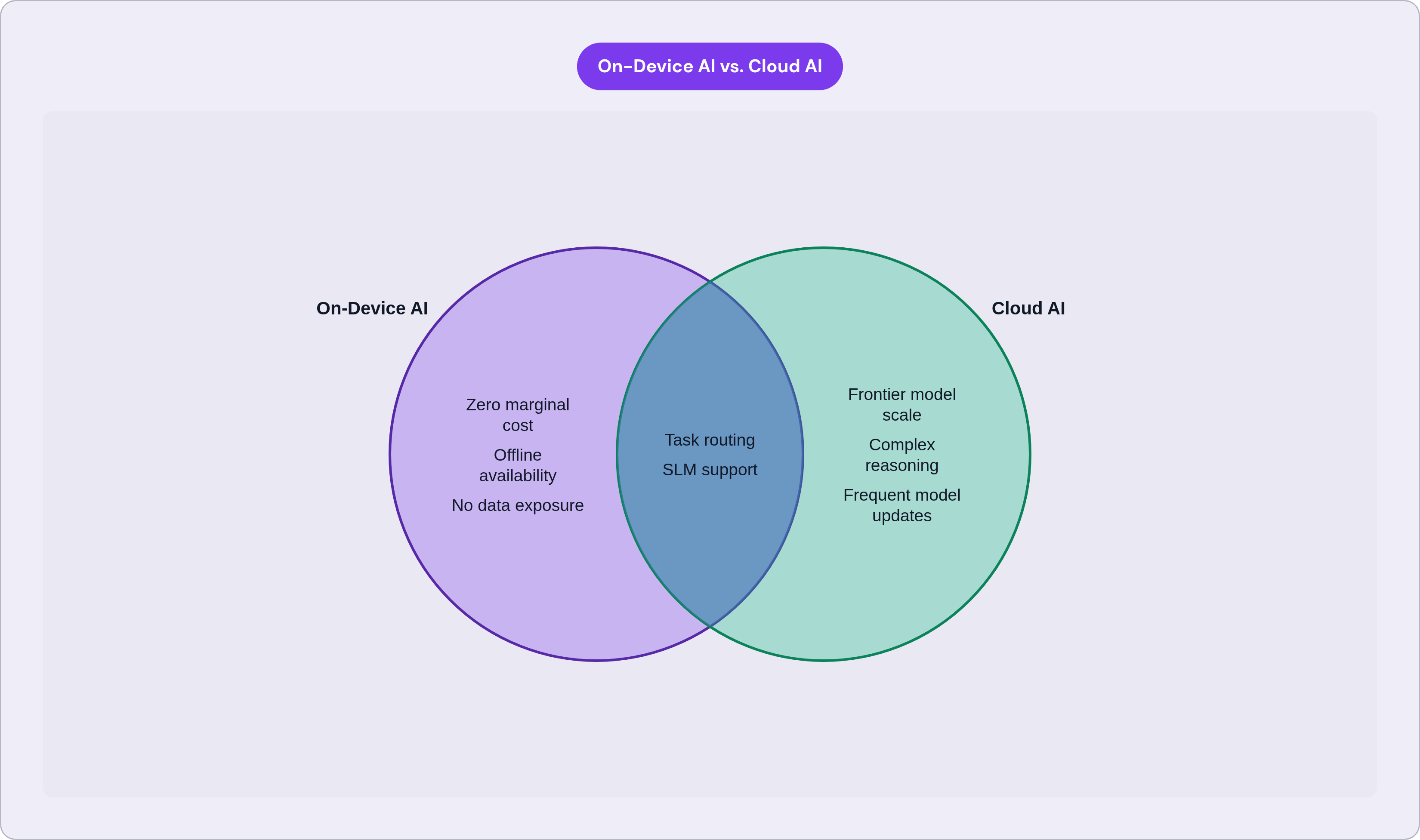
The pattern across all four is consistent, and it is worth pausing on what that consistency actually signals. Route simple, latency-sensitive, or privacy-sensitive tasks on-device. Send tasks that exceed local capability to cloud with explicit controls on what leaves the device and why. The routing architecture is the product. None of these companies made a binary choice; they engineered their way out of having to make one.
Matching deployment choice to the constraints a use case actually carries
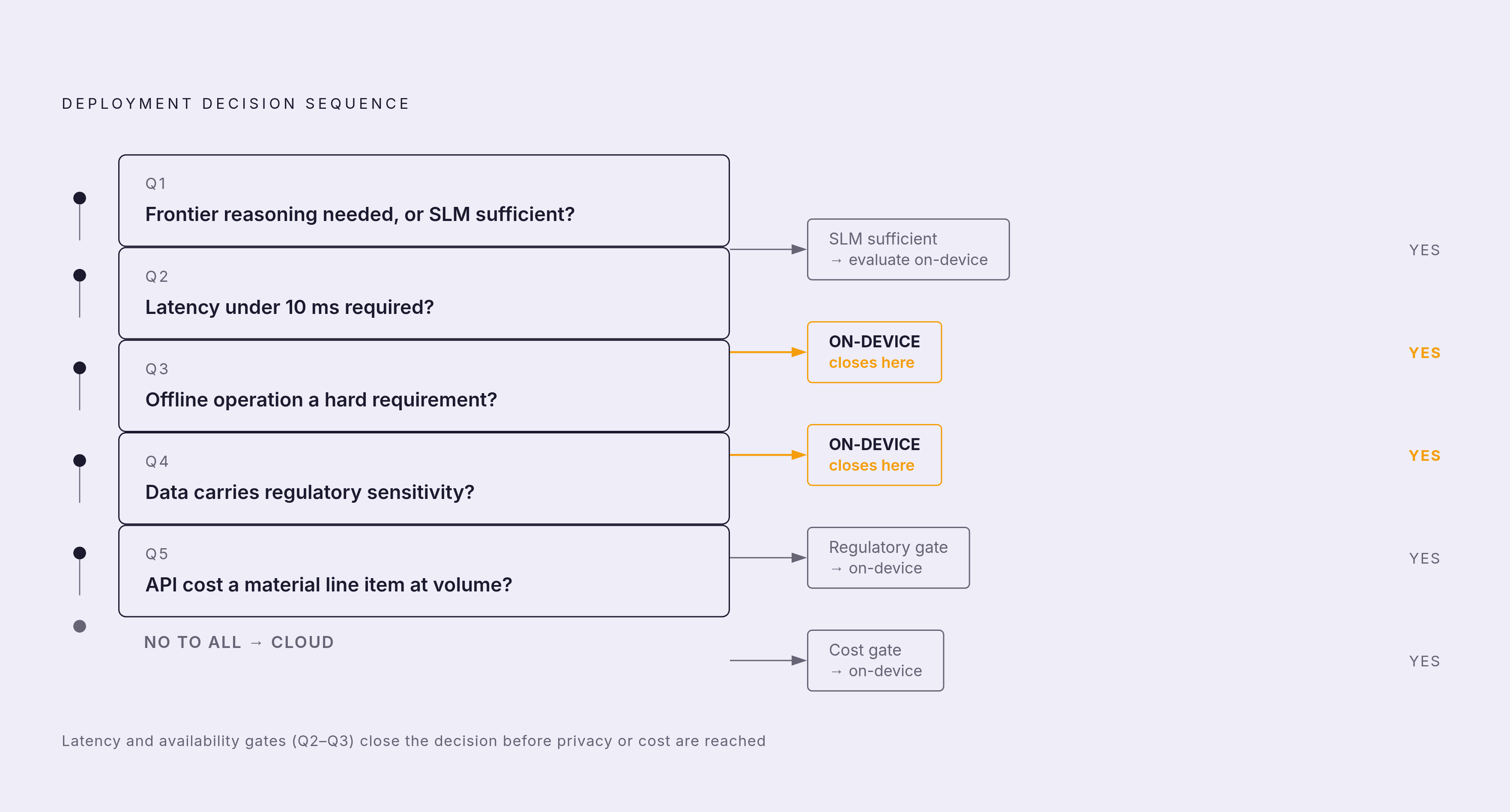
The practical decision is a set of questions worth asking in sequence rather than in parallel. Does the task require frontier-model reasoning, or does a well-quantized SLM handle it adequately? Does latency need to be under 10 milliseconds? Does the application need to function offline as a hard requirement? Does the data carry regulatory sensitivity that changes the compliance calculus? Is query volume high enough that per-call API cost compounds into a material line item?
Some use cases answer these questions before you finish asking them. Real-time voice, translation, and AR point toward on-device; latency decides it before cost or privacy enter the room. Healthcare and legal tools processing sensitive documents point toward on-device; structural privacy exposure decides it. High-volume consumer apps with bounded, repeatable AI tasks point toward on-device; cost compounding decides it. Field and industrial tools in low-connectivity environments have no real choice; availability is non-negotiable.
Other use cases point clearly toward cloud. Complex reasoning, long-form generation, multi-step analysis: the capability ceiling decides it. Low-volume, high-complexity tasks where per-call cost is trivial and frontier performance justifies the call. Rapid prototyping where model flexibility and update cadence matter more than marginal cost.
The straightforward answer for most production systems is that they will route by task. The Apple, Google, and Samsung pattern is not a compromise; it is the architecturally mature answer for complex applications. What I have noticed, working through these decisions across different contexts, is that teams who pick a side permanently and stick with it usually made that choice early, under different conditions, before the use case fully revealed itself. Latency gaps, compliance exposure, and surprise API bills tend to be symptoms of the same underlying problem: the deployment choice was made by default, not by design.