Choosing the Right AI Model for Personal Use
Benchmark rankings misguide you; your actual workflow determines the right model.
What the Current Leaderboard Actually Measures, and What It Misses
Leaderboards are real. The problem is treating them like shopping guides.
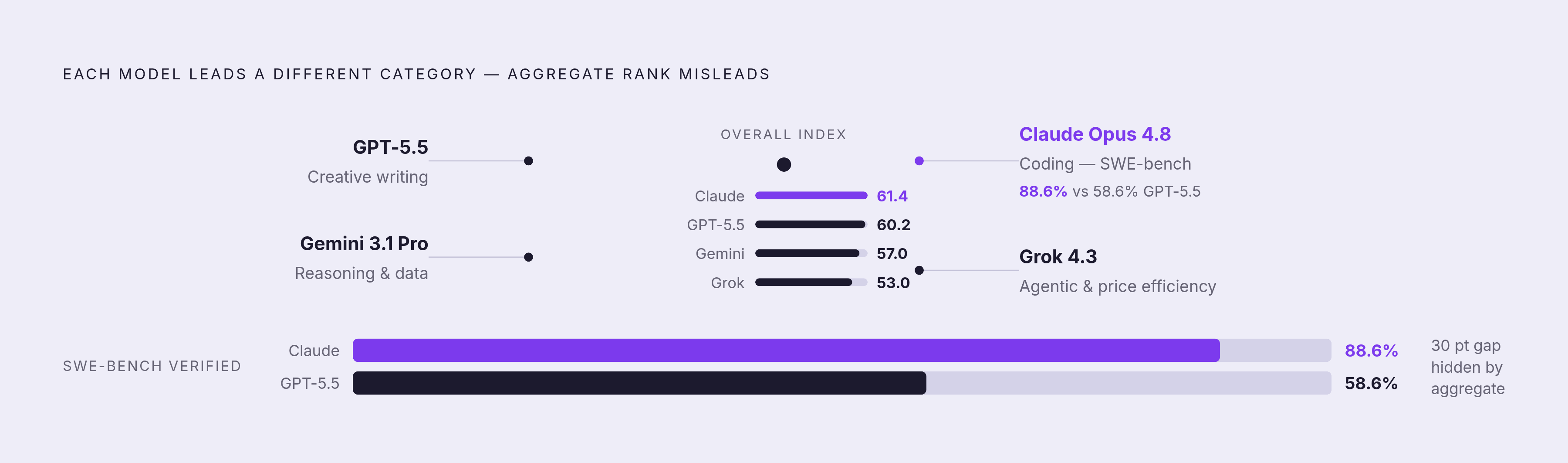
As of June 2026, the Artificial Analysis Intelligence Index puts Claude Opus 4.8 at 61.4, GPT-5.5 at 60.2, Gemini 3.1 Pro at 57, and Grok 4.3 at 53. Less than ten points separating first from fourth. At that level of compression, aggregate rank tells you almost nothing about how any of these models will perform on your actual work. The margin between first and fourth place is smaller than the margin between using a model skillfully and using it carelessly.
What benchmarks measure is performance across a fixed test suite designed to approximate general intelligence on academic and professional tasks. Useful for comparing research labs. Less useful for comparing tools, because your workflow is not a fixed test suite.
Even within that narrow cluster, task-level leadership diverges sharply. GPT-5.5 leads on creative writing. Claude Opus 4.8 leads on coding benchmarks by a margin that isn't close. Gemini 3.1 Pro leads on reasoning and data analysis. Grok 4.3 leads on agentic tool use and price efficiency. Four models, four different leaders, depending on what you're actually trying to do.
What leaderboards don't capture at all: daily usage limits, how context windows actually behave when you push them near their ceiling, whether the model integrates natively with tools you're already using, and what the pricing looks like relative to your real consumption patterns. Any one of those dimensions can override a benchmark ranking entirely. That raises an important question: if the leaderboard isn't the right starting point, what is? Which is why the next step isn't model selection. It's a clear look at yourself.
Identifying Your Actual Use Pattern Before Picking a Model
Before any of this becomes actionable, you need a rough map of your own tasks. Not hypothetical tasks. What did you actually use AI for in the last two weeks?
The common categories shake out like this: writing and editing (creative, professional, or both); research and fact-finding; coding or technical problem-solving; reading and synthesizing long documents; open-ended brainstorming; real-time information like news and current events; and integrations with software you're already running, whether that's Google Workspace, Microsoft 365, or social platforms.
Most people have one or two dominant tasks and a handful of occasional ones. The dominant tasks should drive the primary choice. Everything else is a tiebreaker.
There's a secondary variable most people underestimate: usage volume. Are you running a few thoughtful queries per day, or are you the kind of person who tabs over to AI constantly, reflexively, for everything from drafting a Slack message to debugging a function? That distinction surfaces as a real decision point when we get to Claude, and I'd flag it now so it doesn't catch you off guard.
GPT-5.5 and ChatGPT: The Generalist Default and the Creative Writing Leader
I've watched GPT's lead in creative writing hold across multiple model generations, and GPT-5.5 extends it further. Released in April 2026, it generates prose that reads as warm and rhythmically alive rather than assembled from parts. That quality is hard to describe in benchmark terms, and yet it's often the first thing people notice when they're working on something where voice matters.
If writing is your dominant task, whether that's fiction, marketing copy, essays, or anything that benefits from cadence and personality, GPT-5.5 is the current standard. That's not a hedged opinion. It's the clearest performance lead any model holds in any category right now. But what if writing is only part of what you need — does that lead still hold? For purely generative tasks, yes. For everything else, the picture gets more complicated.
Beyond creative work, it handles everyday productivity, general Q&A, and multimodal tasks across text, image, and audio without friction. Its context window runs to 128K tokens, sufficient for most document work. And its daily usage allowance is the highest among the flagships, which is a real differentiator if you've ever hit Claude's limits mid-project and felt the interruption knock you out of your rhythm.
Where it falls short: that 128K window is smaller than what Gemini and Grok offer, and GPT-5.5 is less reliable than Claude when prompts involve nuanced multi-step instructions where adherence and precision matter more than fluency. The model occasionally prioritizes sounding right over being precisely right, which, depending on your work, is either irrelevant or disqualifying.
Pricing runs from free to $20 per month for Plus to $200 per month for Pro.
Claude Opus 4.8: Where Instruction-Following and Long-Context Work Actually Hold Up
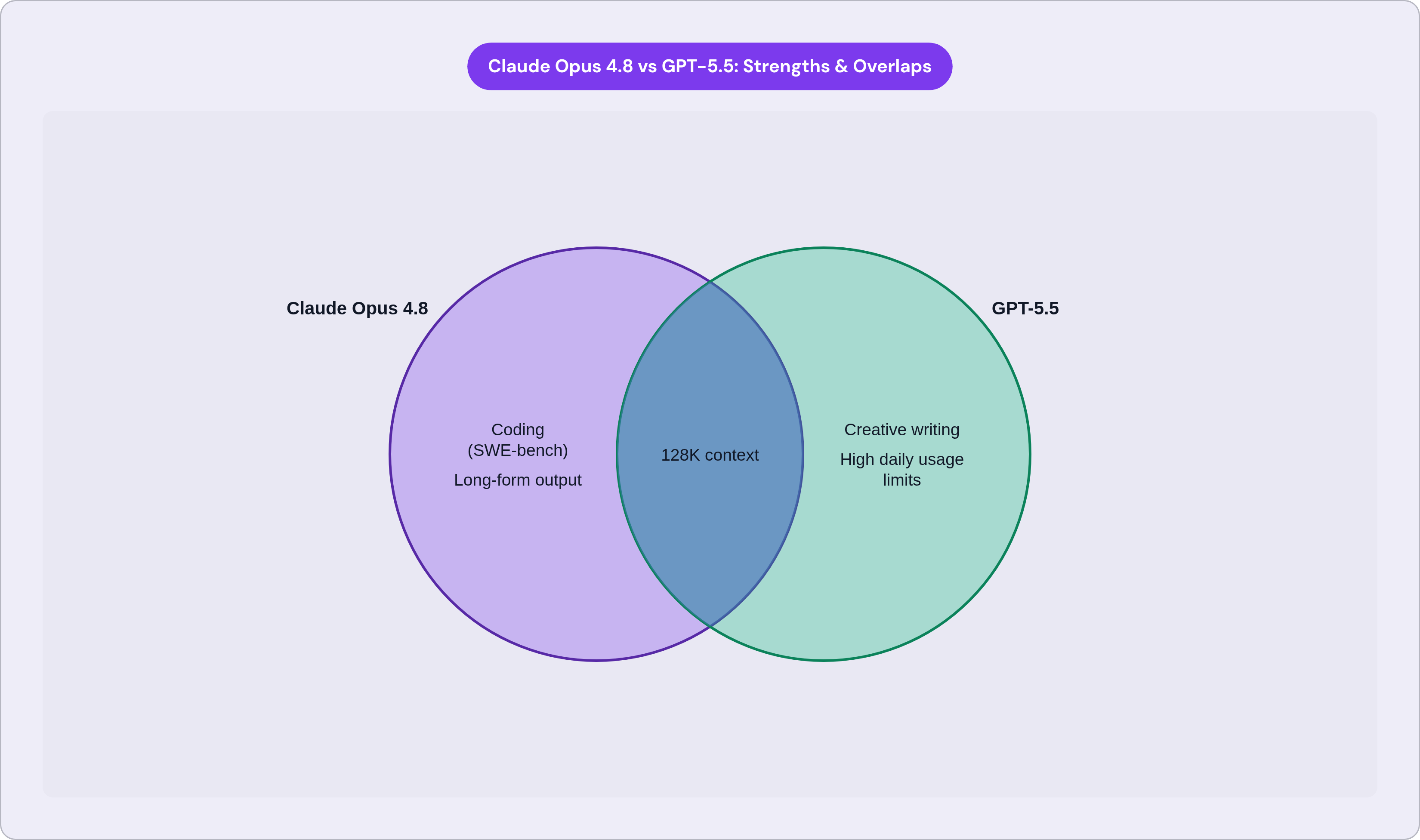
Claude Opus 4.8 sits at the top of the Artificial Analysis overall index, and the headline number is less interesting than what it's actually built on.
Two capabilities stand out, and they compound each other. The first is instruction-following in complex, layered prompts. When a prompt carries multiple nested conditions, specific formatting constraints, and requirements that need to hold coherently over a long output, Claude is where other models start to drift. I've tested this repeatedly. GPT-5.5 will often produce something that sounds better but quietly drops a condition three sections in. Claude doesn't do that with the same frequency, and for technical or legal or research work, that reliability is worth more than stylistic polish.
The second is coding. Claude leads SWE-bench Verified at 88.6% and SWE-bench Pro at 69.2%, compared to GPT-5.5 at 58.6% and Gemini 3.1 Pro at 54.2%. Those are not marginal gaps. For coding-heavy workflows, the choice among flagships is effectively made for you.
Claude also outputs up to 128K tokens in a single pass and produces the most coherent long-form prose among these models when the task calls for sustained argumentation rather than creative voice.
Here's the friction point, and it deserves more than a footnote: heavy users hit Claude's daily limits regularly. If your workflow involves dozens of queries per day, you will find yourself cut off in ways that don't happen with ChatGPT or Gemini. That's a real operational constraint, and no benchmark captures it. The fix is a Max plan starting at $100 per month, which is a meaningful jump from the $20 Pro tier. Know that going in.
Pricing: free and Pro at $20 per month, Max from $100, Team plans from $25 per seat.
Gemini 3.1 Pro: The Long-Context and Multimodal Case, With a Google Ecosystem Condition
Gemini's one million token context window is not a modest upgrade from 128K. It's a categorically different capability. We're talking about ingesting an entire codebase, a full season of television scripts, or twenty-plus research papers in a single session, without chunking, without losing thread, without asking the model to reconstruct context it previously held. But what if that number overpromises what the model actually delivers in practice?
Two things to know before you build a workflow around that number. First, recall accuracy in practice degrades past roughly 500K tokens. Second, accessing the full window requires Gemini Advanced at $19.99 per month, and it runs more slowly than the default experience. The capability is real; the conditions around it require careful calibration.
On reasoning and data analysis, Gemini 3.1 Pro leads among the four flagships on the Artificial Analysis index. Its sparse Mixture-of-Experts architecture dynamically allocates compute toward harder problems, which in practice translates to stronger sustained performance on tasks requiring logical structure rather than fluent generation. Whether that architecture advantage matters to you depends entirely on the kind of reasoning you're asking it to do.
Its audio and video multimodal capabilities are best-in-class at the flagship tier. Integration with video generation tools gives it a meaningful edge for multimedia workflows that neither Claude nor GPT-5.5 currently matches.
The ecosystem condition in this section's heading is the most operationally important variable for most people considering Gemini: it is built into Gmail, Docs, Drive, and Meet in a way that feels native rather than bolted on. For someone whose working day already runs through Google Workspace, that ambient integration compounds into real time savings. For someone who doesn't, it's a neutral feature that doesn't offset what other models do better.
Grok 4.3: Real-Time Information and Agentic Tasks at the Lowest Flagship Price
Grok 4.3 launched in April 2026 with continuous reasoning and a one million token context window, matching Gemini on that dimension. Its aggregate index score is the lowest of the four flagships, and its task-level performance tells a more interesting story than that ranking suggests.
On Artificial Analysis's CaseLaw benchmark, Grok currently ranks first among flagships. On complex agentic workflows and multi-step instruction-following, it punches above its overall index position. These are narrow specialties, but they illustrate a pattern: when the task involves structured procedural reasoning or specialized factual accuracy, Grok's ceiling is higher than its overall ranking implies.
The real-time information advantage is difficult to replicate through other means. Grok has live access to X's data, which makes it the clearest choice for anything trend-sensitive, news-dependent, or requiring awareness of what happened this morning. Other flagships can browse the web with varying consistency; Grok does this natively and continuously.
It is also worth considering a less quantifiable element: Grok scores highly on emotional intelligence metrics, and extended brainstorming sessions feel more conversational with it than with other models. I'm skeptical of that category of benchmark in general, but the subjective experience tracks. Whether it matters to you depends on how you work.
The pricing argument is simple and worth stating plainly: for users who want frontier-class reasoning without paying $100 or $200 per month, Grok 4.3 is the most defensible choice at the upper subscription tier.
When Perplexity, Copilot, or Meta AI Fits Better Than Any of the Four Flagships
There are three scenarios where reaching for a flagship is the wrong move, and recognizing them early is worth something.
The first is research that requires traceable sourcing. Perplexity is search-native; it delivers real-time citations alongside its responses, and that citation architecture is what it's optimized for. When accuracy with verifiable sources matters more than generative capability, Perplexity wins that comparison decisively over any of the four flagships. It's a different tool for a different job, and treating it as a lesser ChatGPT misunderstands what it actually does well.
The second is working inside Microsoft 365 for most of your day. Copilot summarizes Teams meetings, drafts in Word and Outlook, builds PowerPoint decks from structured notes, and analyzes Excel tables, all without context-switching out of the software you're already in. For organizations already on Microsoft 365, that embedded workflow provides more practical daily value than paying for a separate flagship subscription and toggling between environments. The convenience of staying inside one suite, for a knowledge worker spending eight hours a day in that suite, is undervalued.
The third is social content creation where cost is a constraint. Meta AI is free across Facebook, Instagram, WhatsApp, and Messenger, and it generates images and captions natively inside the platforms where that content will actually be published. For someone whose primary AI need is generating social content efficiently, the convenience calculus clearly favors a free embedded tool over a paid standalone.
The pattern connecting all three: these tools win when integration architecture or citation structure is the primary requirement, not raw model capability.
Open-Weight Models: When Privacy, Cost, or Control Outweigh Convenience
By mid-2026, the open-weight conversation has shifted. These models are no longer the budget compromise; several now match or exceed earlier flagship generations on reasoning benchmarks. The case for going open-weight is a specialization argument with three distinct scenarios.
The first is privacy and data sovereignty. Running a model locally means nothing leaves your machine. For sensitive documents, regulated data, or anyone uncomfortable with third-party data retention, this consideration outweighs any benchmark score. Gemma 4 runs on a laptop across its smaller parameter ranges under a permissive Apache 2.0 license. Qwen 3 is a comparable option for the same use case.
The second is cost at scale. Self-hosting Llama 4 or DeepSeek V3.2, or accessing them via API, costs a fraction of proprietary pricing. DeepSeek's architecture in particular has achieved frontier-comparable performance at dramatically lower compute costs, which has reoriented how the industry thinks about the economics of reasoning. For teams running high-volume workloads, the math becomes compelling quickly.
The third is specialized reasoning performance at the open-weight tier. Qwen 3 at its largest scale leads open-weight models on both graduate-level science benchmarks and competitive mathematics. For scientific or mathematical work where you want open-weight control without sacrificing reasoning quality, it's the strongest current option.
One thing about DeepSeek that requires direct attention: per its privacy policy, user data is stored on servers in China. For regulated workloads or anyone for whom data jurisdiction is a hard requirement, the correct path is self-hosting the MIT-licensed weights in your own environment rather than using the hosted product.
Licensing is not uniform across open-weight models, and it matters for commercial use. DeepSeek V3.2 and GLM-5 carry MIT licenses; Gemma 4 and Qwen 3.5 carry Apache 2.0. Others carry usage caps or geographic restrictions. Check before you build anything commercial on them.
A Task-First Decision Framework for Making the Actual Choice
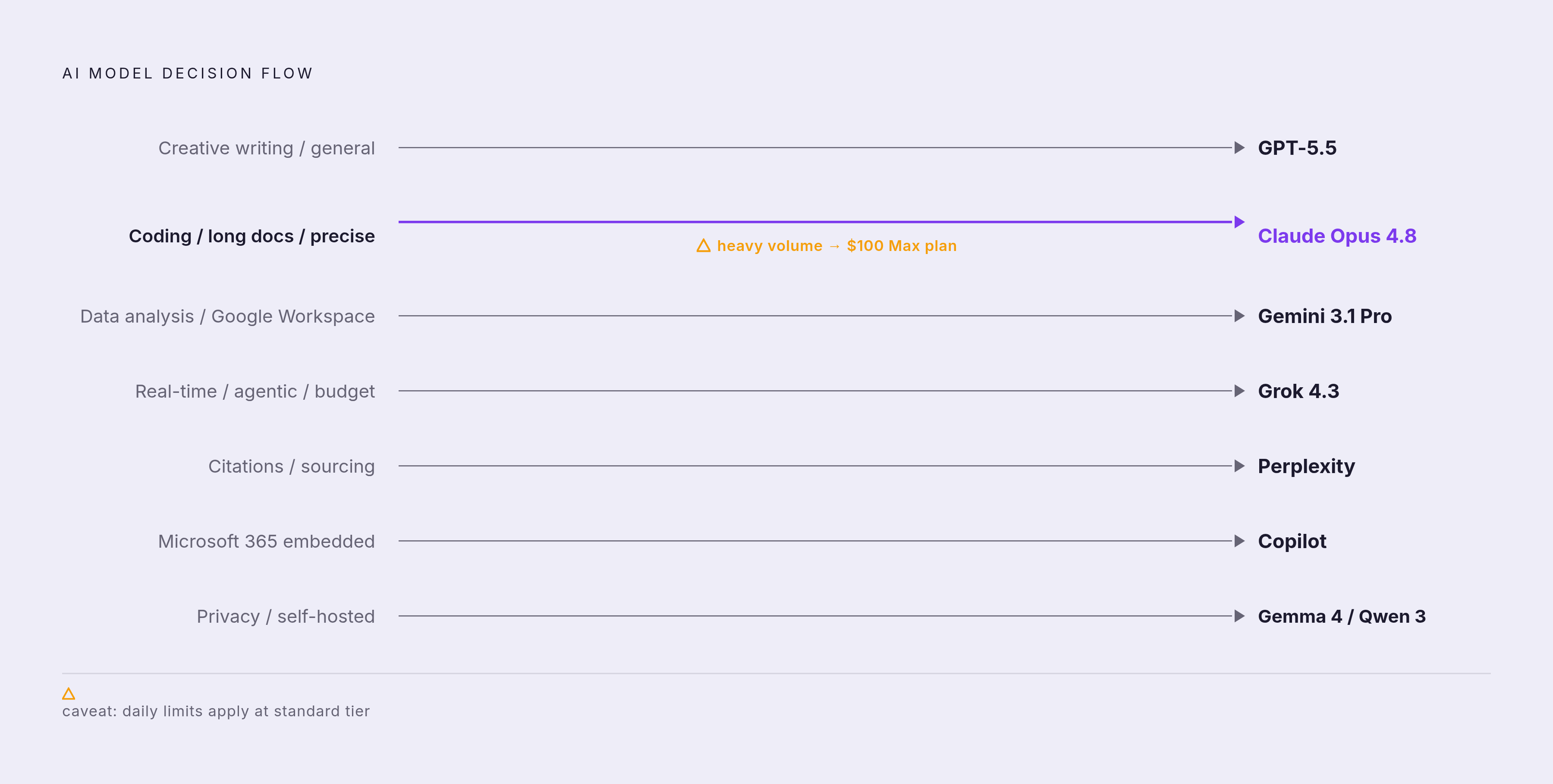
The framework runs in one direction: start with your dominant task, let the task point to the tool, treat everything else as a secondary filter.
Creative writing and general daily use points to GPT-5.5. Complex coding, long documents, and precise instruction-following points to Claude Opus 4.8, with the explicit caveat that high daily volume will push you toward the $100 Max plan or toward a different model. Data analysis, sustained reasoning, large-file ingestion, and Google Workspace integration points to Gemini 3.1 Pro. Real-time information, agentic workflows, and price sensitivity at the premium tier points to Grok 4.3.
Outside the flagship tier: research requiring citations goes to Perplexity. Microsoft 365 integration goes to Copilot. Privacy-first or self-hosted requirements go to Gemma 4, Qwen 3, or self-hosted DeepSeek V3.2, with a licensing check before any commercial deployment.
What this framework doesn't do is declare a winner. The field has matured past the point where a single ranking is useful advice. These models are close enough in aggregate performance that the differentiating variable is nearly always the specific demands of your work: your tasks, your volume, your existing software environment, your tolerance for cost and constraint.
I've spent enough time with all of these to believe that the right model for you is rarely the one with the highest overall index score. It's the one whose particular strengths happen to map onto what you actually spend your day doing. Figure that out first, and the rest of the decision tends to resolve itself.