Consumer AI Models Landscape Overview
Three AI leaders dominate the market, but their dominance looks different than it did a year ago.
Where attention and money concentrate: the top three own the field
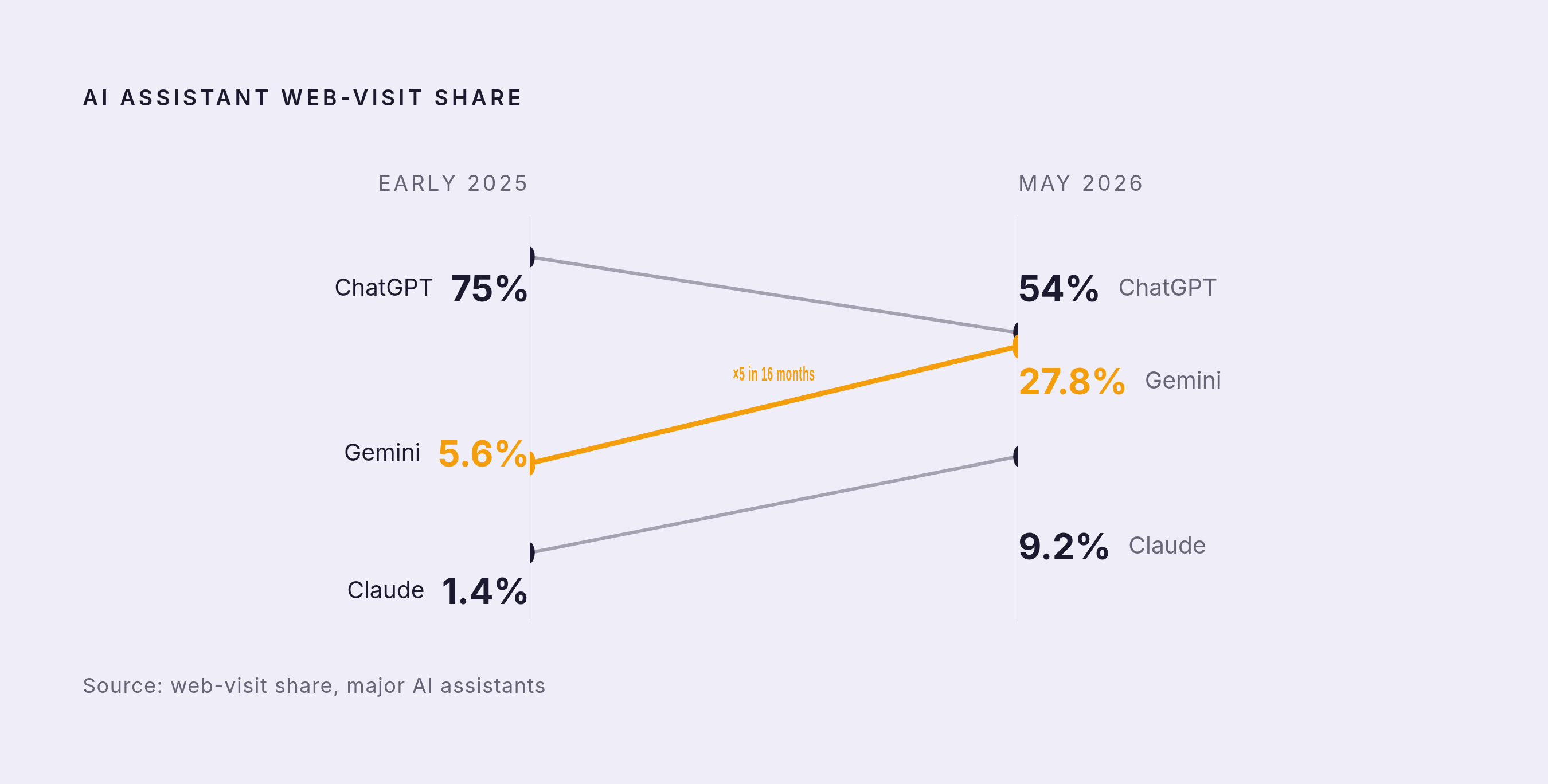
When you look at web-visit share across the major AI assistants in May 2026, the picture is startlingly concentrated. ChatGPT, Gemini, and Claude together capture nearly 90% of time spent on AI assistant apps. General AI assistants as a category take 81% of consumer AI spend, per Menlo Ventures' 2026 data. Three products, effectively three companies, define what most people mean when they say they "use AI."
But the internal dynamics of that top three are shifting faster than the headline number suggests. ChatGPT held roughly three-quarters of combined web visits across the major assistants in early 2025. By May 2026, that share had compressed to about 54%, per Similarweb data via Momentic. Gemini went from 5.6% to nearly 28% of that same combined pool. Claude climbed from 1.4% to 9.2%.
ChatGPT's absolute user base keeps growing. What these numbers actually show is that Gemini and Claude are growing faster, which means users entering the market, and some who were already there, are distributing themselves differently than early adopters did. The category is no longer winner-take-most in the way it briefly looked like it would be.
The remaining field, DeepSeek, Grok, Perplexity, and Copilot, each hold under 5% of global visits. Their stories are worth telling, but their competitive relevance is about positioning and niche utility, not scale rivalry with the top three.
ChatGPT: what first-mover advantage looks like at a billion users
Over 1.1 billion monthly active users. Roughly 900 million weekly actives. Eighteen billion messages per week as of mid-2025. I've watched a lot of software products scale, and these numbers have no meaningful comparisons at this speed of accumulation.
First-mover advantage, in practice, looks like this: when someone who doesn't follow tech closely thinks "AI chatbot," they think ChatGPT. That kind of default mental-share is extraordinarily difficult to dislodge, and it translates directly into engagement depth the other players haven't matched. ChatGPT's ratio of daily to monthly active users sits at 36%, nearly double Gemini's equivalent figure. Its month-12 desktop retention, the share of users still around a year after first use, runs at about 50%, again roughly double its nearest competitor, per Yipit data via a16z.
The use cases where ChatGPT leads are telling: rewriting, learning new skills, content creation, casual conversation, helping with homework. Open-ended, iterative, generative tasks. They reward a user who brings a question, pushes back, asks follow-ups, builds on the response. ChatGPT built the deepest habit loop around that kind of exchange, and that's not accidental.
The revenue story is striking: $13.1 billion in 2025, ahead of OpenAI's own internal targets, with projections toward $24 billion annualized by mid-2026. Search usage nearly tripled in a year. An ads pilot reached over $100 million in annualized revenue in under six weeks.
Here's the tension that rarely gets named, though. OpenAI was reportedly spending $1.22 for every dollar of revenue it brought in as of Q1 2026, per analysis from Where's Your Ed At. Revenue is accelerating; losses are also accelerating. But what does that mean for the product decisions users actually experience? The move into ads, the platform broadening, the enterprise push: these aren't purely strategic choices made from a position of comfort. They're responses to a cost structure that requires massive scale to justify, and that pressure shapes product decisions whether or not OpenAI discusses it openly.
Enterprise adoption looks deep on the surface: 92% of Fortune 500 companies use ChatGPT in some capacity. But its share of enterprise LLM spend fell from 50% in 2023 to 27% in 2025, per Menlo Ventures. That's not collapse. It's the enterprise market fragmenting toward more specialized choices, which is exactly what enterprise markets do once they mature past the "let's try the famous one" phase.
Google Gemini: distribution as a competitive moat
Gemini is not competing for the same user behavior that ChatGPT is. It's competing for a different moment in a different workflow, and it is winning that moment through distribution, not through conversational product superiority. That distinction is worth sitting with carefully, because the growth numbers can obscure it.
Monthly active users confirmed at Google I/O in 2026 reached 900 million, up from 750 million just a few months earlier. Monthly web visits grew nearly 650% over roughly a year. Pro subscription growth is outpacing ChatGPT's by a significant margin.
The source of that growth isn't a better chatbot. It's Android. It's Search. It's Workspace. Google already sits inside the daily digital life of more people than any other tech company on earth, and Gemini is the AI layer being stitched into all of it. The "Personal Intelligence" feature launched in early 2026 connects Gemini directly to a user's Gmail, Google Photos, YouTube activity, and Search history. That's not a product feature in the traditional sense; that's a structural integration that converts ordinary Google usage into AI interaction without the user necessarily opening a dedicated AI app.
The use-case data reflects this lane. Gemini leads on quick answers, health information lookups, translation, and general topic research. About 53% of users surveyed by Morning Consult turned to Gemini for quick answers; around half went there for health information. That is the search reflex being redirected, and Google knows exactly how to capture a reflex.
The engagement gap complicates this growth narrative, and complicates it significantly. A daily-to-monthly active user ratio of 21%, versus ChatGPT's 36%, suggests that a meaningful portion of Gemini's reach is ambient: users who encountered AI through a Google surface they were already using rather than users who deliberately opened Gemini because they wanted Gemini. Month-12 desktop retention around 25% reinforces this reading.
That raises an important question: is there a meaningful difference between a user who encounters Gemini passively and one who seeks it out deliberately? The distinction between ambient reach and deliberate adoption matters enormously for how you interpret the trajectory. Passive touch doesn't build the same kind of habit that intentional use does. Gemini is reaching a staggering number of people; the open question is how many of them it is actually winning.
Claude: the smaller player that enterprise and developers treat differently
Claude's consumer numbers, 245 million monthly active users, 9.2% of global web visits, 13.4% in the U.S., are clearly smaller than the top two. But reading Claude through consumer share alone produces a badly distorted picture, and it's a mistake I've seen analysts make repeatedly.
The enterprise story is the real story. Anthropic reached 40% of enterprise LLM spend in 2025, up from a much smaller share two years prior, sitting ahead of OpenAI by that measure, per Menlo Ventures. That is a remarkable inversion of the consumer narrative. The company with the smallest consumer footprint of the three is leading on the metric that represents the most durable, highest-margin revenue in the industry.
Several things converge to explain it. Claude's context window, its ability to work with long, dense documents rather than just short prompts, makes it the practical choice for research-heavy, legal, compliance, and code-review workflows. Anthropic's emphasis on safety and interpretability, manifested in what it calls Constitutional AI, speaks directly to enterprise risk management. Companies buying AI for internal use carry different concerns than consumers experimenting with a chatbot: regulatory exposure, data handling, auditability, reliability under edge cases. Claude's positioning addresses those concerns in ways that ChatGPT's consumer-first framing doesn't often match.
The developer story compounds this. Claude is frequently chosen as the underlying model for products built on top of AI, not as the end product itself. That creates a multiplier effect: enterprise and developer adoption shapes how other products are built, which shapes how end users encounter AI even without knowing which model powers the experience.
Claude's 13.4% U.S. web-visit share also carries a qualitative signal. That proportion reflects deliberate, task-oriented users, people who sought it out specifically. The ambient-versus-deliberate distinction that complicates Gemini's story runs differently here. Claude's users know exactly why they're there.
The rest of the field: what DeepSeek, Grok, Perplexity, and Copilot are actually competing on
Combined, DeepSeek, Grok, Perplexity, and Copilot hold under 10% of global web visits. The competitive dynamics here are about lane ownership, not market leadership, and understanding what lane each occupies is more useful than tracking share numbers.
DeepSeek generated significant attention in early 2025 for its cost-efficiency claims and benchmark performance relative to its compute costs. Its 4.1% global visit share versus 1.2% in the U.S. reflects real adoption in markets where Chinese-origin models face fewer reputational headwinds. It also surfaces the open-weight model question and the geopolitical dimension of the AI landscape, two threads I expect will become considerably louder over the next few years. Whether DeepSeek's architectural approach will influence Western model development, or whether regulatory pressure will constrain its reach, remains unresolved.
Grok lives on X's data stream. Its differentiation is real-time access to public discourse, trending topics, the churning news cycle. It performs best for users who spend significant time on X and want AI that understands the current conversation rather than the settled record. Its U.S. share slightly exceeds its global share, consistent with X's U.S.-centric user base.
Perplexity is perhaps the most intellectually honest product in the field about what it is: an answer engine, not a chatbot. Query in, sourced answer out, no pretense of relationship or conversation. For users doing research where knowing the provenance of information matters, Perplexity's paradigm is distinct from both ChatGPT's open dialogue and Gemini's search integration. It competes for the same information-utility lane Gemini occupies, but with a starkly different interface philosophy and a user who cares about citation in a way that Gemini's typical user probably doesn't.
Microsoft Copilot is the most difficult to read from visit data alone. Its standalone web-visit share is modest, but most of its actual usage is embedded across Office 365. Measuring Copilot by direct visits is like measuring how often people consciously think about the electrical wiring in their walls: it misses most of what's actually happening. It's likely undercounting meaningful enterprise usage by a significant margin.
How the interaction paradigms actually differ across these products
The model quality gap between the top products has narrowed substantially. Multimodality, image generation, voice, document analysis, code assistance: these are effectively table stakes for the leaders now. Arguing that one is categorically better than another at core tasks is increasingly difficult to sustain in practice, and I've stopped finding those arguments convincing when I encounter them.
What actually differs is the paradigm of interaction.
The conversational model, ChatGPT's home terrain, asks the user to bring a question and build toward something through dialogue. It rewards iteration and benefits from a user who pushes back, refines, develops. The experience is generative in the literal sense: something is being created in the exchange, not just retrieved.
The search-replacement model, Gemini's primary lane and Perplexity's explicit architecture, is optimized for retrieval. Query in, structured answer out. The friction is lower for users who want information rather than dialogue, but the ceiling is also lower. You're looking something up, not building something.
The context-layer model is the paradigm shift that gets the least attention but will matter most over the next few years. Gemini Personal Intelligence, Copilot inside Office, Claude embedded in enterprise workflows: these aren't products you deliberately open so much as surfaces that appear within your existing environment. The AI is reading your email, your documents, your calendar, surfacing where it's relevant. Ambient and proactive rather than deliberate and reactive.
Voice deserves a separate note. Advanced voice modes from both ChatGPT and Gemini are opening a spoken-assistant category that is still early. The shift there isn't just convenience; it's a fundamentally different cognitive mode for interacting with AI, one that doesn't require sitting down to type. I think this will eventually redefine what "using AI" means in the same way smartphones redefined what "using the internet" meant, though that's a claim worth holding loosely until we see retention data on voice-first users.
For anyone building a product on top of AI, these paradigm distinctions are architectural decisions, not aesthetic ones. Choosing to embed a context-layer model is a different engineering and user-experience commitment than surfacing a conversational interface.
What the use-case data reveals about which tools users actually trust for which jobs
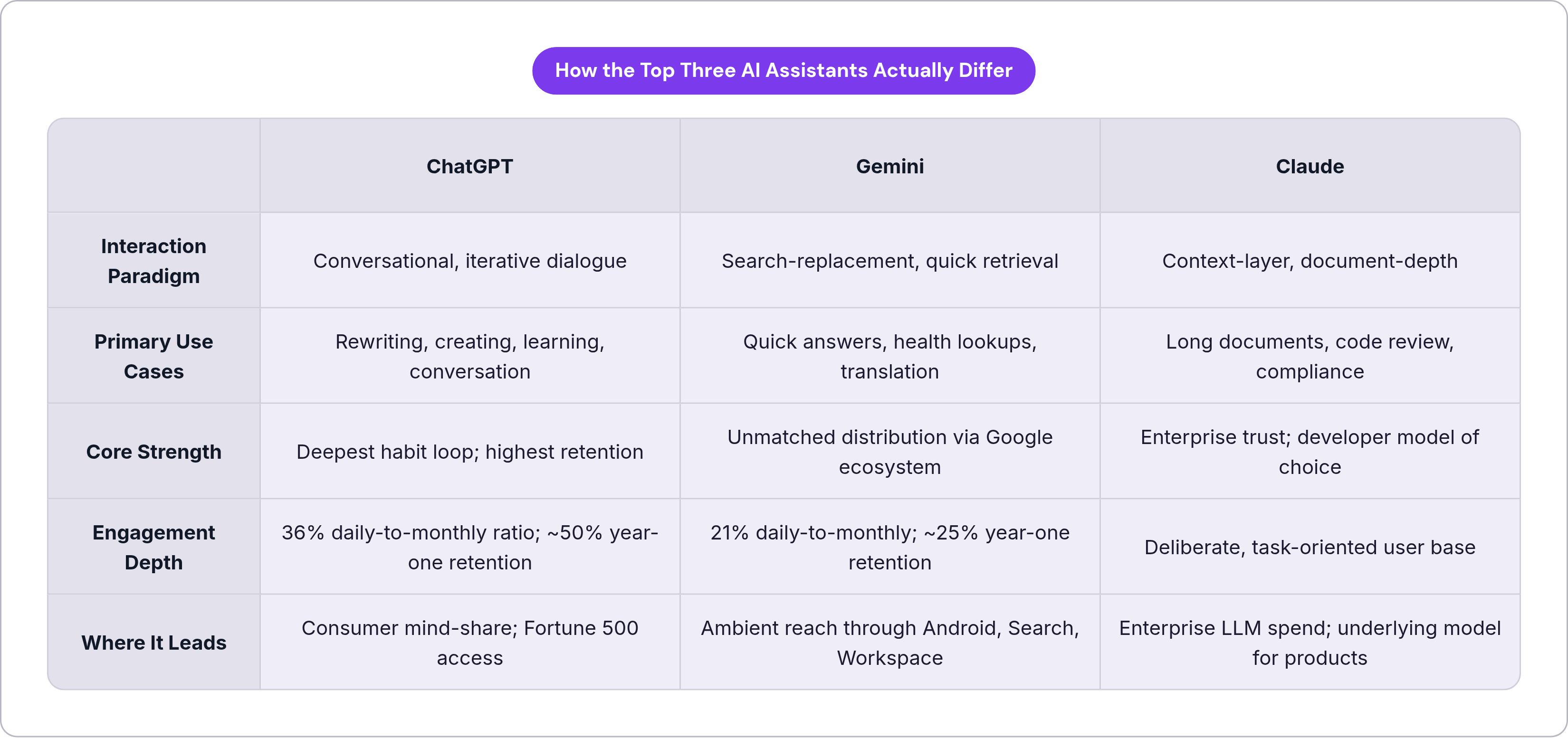
Use-case data is where the abstract competitive narrative becomes tactile. Morning Consult's May 2026 survey produces the clearest signal of functional differentiation in the current landscape.
Gemini's strongest numbers cluster around lookup and information utility: quick answers, health information, translation, topic research. These are moments where the user has a specific informational need and wants a fast, reliable response. The search-replacement thesis isn't just positioning; users are routing those tasks to Gemini at higher rates than to alternatives.
ChatGPT's use-case leadership concentrates on the generative and relational: rewriting content, learning new things, creating things, sustained exchanges where the AI serves as a thinking partner. These are longer, more open-ended sessions. The engagement depth numbers, that 36% daily-to-monthly ratio and 50% year-one retention, are directly consistent with use cases that pull people back repeatedly rather than resolving a single query and closing the tab.
Claude doesn't feature heavily in consumer use-case surveys, which is itself a data point worth noting. Its comparative strength surfaces in professional and developer contexts: long-document work, code review, research-intensive tasks where context persistence and accuracy under complexity matter more than conversational fluency or response speed.
One might argue that one of these products is simply better than the others — but what does "better" actually mean when users are routing different jobs to different tools? The "best AI" question is the wrong question. The products are not interchangeable, and the answer is relative to the job. A user choosing tools based on which AI is generically superior is operating with a framework that the market has already moved past. Gemini for a faster factual answer, ChatGPT to work through a creative problem iteratively, Claude to process the fifty-page contract: these aren't arbitrary preferences. They reflect something users have learned through accumulated experience, even if most of them couldn't articulate the logic explicitly.
The market is reflecting this whether users know it or not. ChatGPT's share is consolidating even as absolute usage grows; Gemini and Claude are each expanding into their respective lanes. Users are, gradually and without fanfare, figuring out where each tool earns their trust. The process is driven by accumulation — which interactions felt useful and which didn't — rather than by conscious comparison shopping.
That's how mature markets behave. The novelty phase selects for curiosity. The habit phase selects for fitness to task. Consumer AI has arrived at the habit phase, and the differentiation that matters is becoming legible in the data for anyone paying close enough attention to look.