Free vs Paid AI Subscriptions for Individuals
Most people still use free AI, but the $20 tier gap is widening faster than you'd expect.

The timing matters more than most people realize. ChatGPT Plus launched at $20 a month in February 2023, and that felt like a clear, simple decision: pay for the better version or don't. Three years later, the same question involves seven pricing tiers from OpenAI alone, a market that runs from free to $300 a month, and a confusing array of tradeoffs that most comparison guides flatten into a chart and call it a day.
Here's what I keep coming back to: despite over a billion monthly users across the major platforms, only around 2% of U.S. households are actually paying for generative AI, according to PNC Bank data. Compare that to streaming subscriptions at 25% of households, and you start to see the real story. This technology has extraordinary reach and almost no monetization depth. Which means the free tiers are still quite good, the paid tiers are getting more capable, and the gap between them is widening faster than most casual observers notice.
Whether paying is worth it for you specifically depends on one thing more than anything else: how deeply AI is already woven into your actual work.
What the pricing landscape actually looks like across the main providers
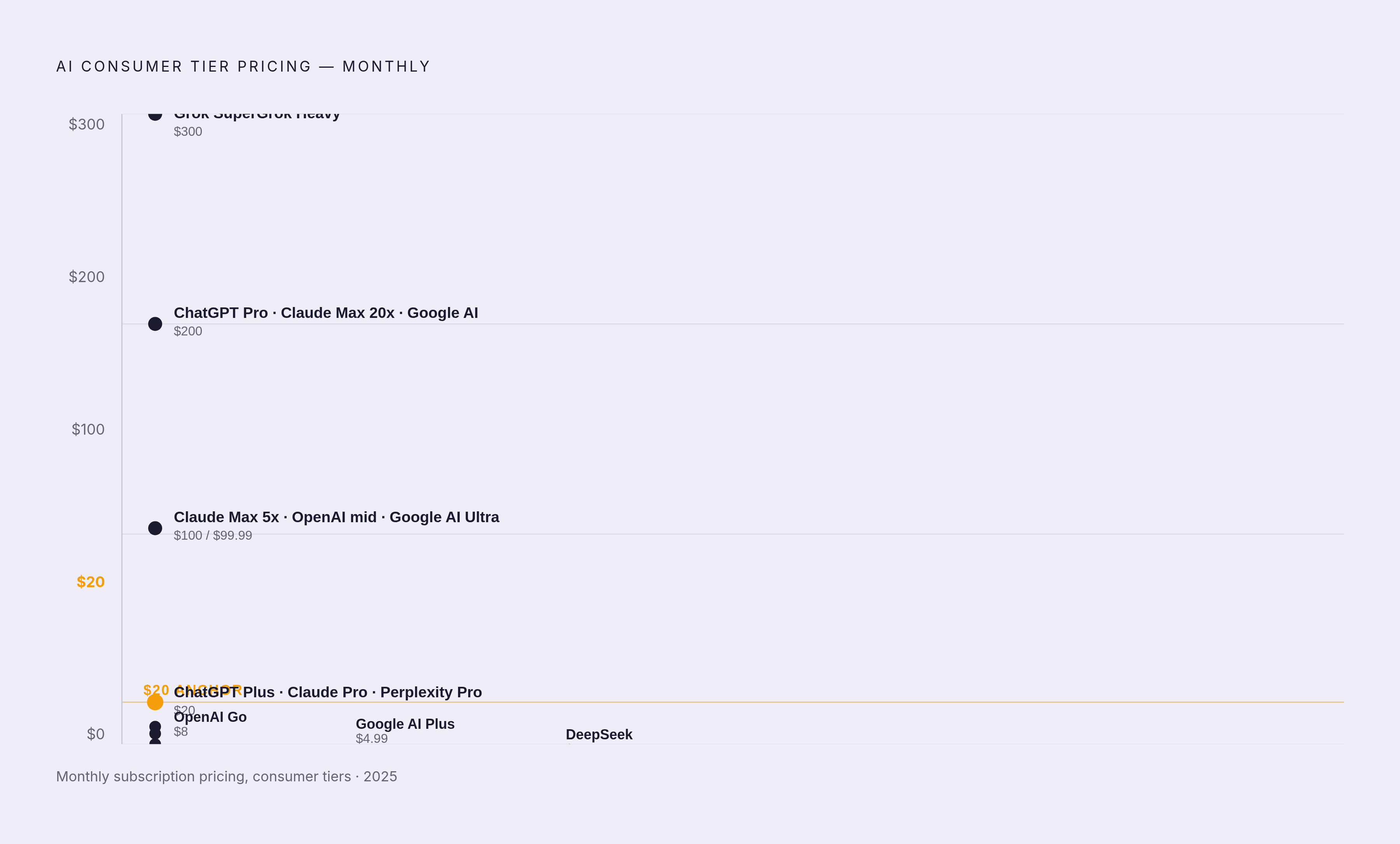
The $20-a-month tier is the market's psychological anchor. ChatGPT Plus, Claude Pro, and Perplexity Pro all sit there, which is not a coincidence. It's the price point that feels like Spotify or Netflix, familiar enough not to require justification.
But the landscape around that anchor has gotten complicated in ways that now rival telecom pricing structures.
OpenAI has seven tiers as of mid-2026, including a new $8 ad-supported entry point and a $100 mid-tier sitting between Plus and the $200 Pro plan. Anthropic's Claude runs free, then $20 Pro, then $100 Max at five times the usage limits, then $200 Max at twenty times. Google dropped the price on its entry-level AI Plus plan to $4.99 after a June 2026 price cut, then climbs through AI Pro and AI Ultra at $99.99 to a top tier at $199.99. Grok's SuperGrok Heavy sits at $300 a month, the highest self-serve price in the market. Microsoft retired Copilot Pro entirely and replaced it with a Microsoft 365 bundle. Perplexity Pro stays at $20 (or $17 annually) but covers a narrower scope: it's built for research-heavy workflows, not general assistance.
The first practical implication of all this: before you can evaluate whether to pay, you have to figure out which pricing structure even applies to your use case. A casual user comparing OpenAI's seven tiers to Anthropic's four-tier structure is a different decision than a developer trying to decide between Claude Max and ChatGPT Pro. The complexity itself is the first thing worth naming.
What free tiers deliver and where they hit walls
There's a meaningful distinction that gets lost in most free-versus-paid arguments. A free plan that gives you three outputs before a paywall is a demo. A free plan that gives you thousands of code completions per month, or unlimited search with citations, is a workable professional tool. Not every free tier is the same thing.
DeepSeek is the clearest outlier here: no subscription required at all, which reduced the barrier to entry significantly, particularly in price-sensitive markets. That kind of pressure from below matters.
ChatGPT's free tier gives you unlimited access to GPT-5 mini and limited access to GPT-5, the flagship model, with usage caps that reset periodically. Gemini's free tier provides access to Flash-class models with varying access to the Pro model. These are real tools for the right tasks.
The walls appear in predictable places. Daily or weekly message limits reset, which sounds fine until you hit the cap mid-project and have to wait. Free users are deprioritized during peak traffic, and I've seen sessions slow to the point of uselessness during periods of high demand. During particularly intense global traffic spikes, OpenAI has restricted free-tier access entirely, temporarily. And the best models, GPT-5.6, Claude Opus 5, Gemini 3.1 Pro at full capacity, sit behind paywalls across every major platform. File upload capability is minimal or absent on most free tiers.
Who does free actually serve well? Casual users. Students in early experimentation. Professionals with one-off questions or occasional drafts. Anyone whose AI use is intermittent rather than woven into daily rhythm.
The case for staying free: if you're using these tools lightly and irregularly, the occasional frustration of hitting a cap costs you far less than $240 a year. That math is straightforward. The mistake is staying free because you're used to it, not because the value calculation supports it.
The real capability gaps that paid tiers open up
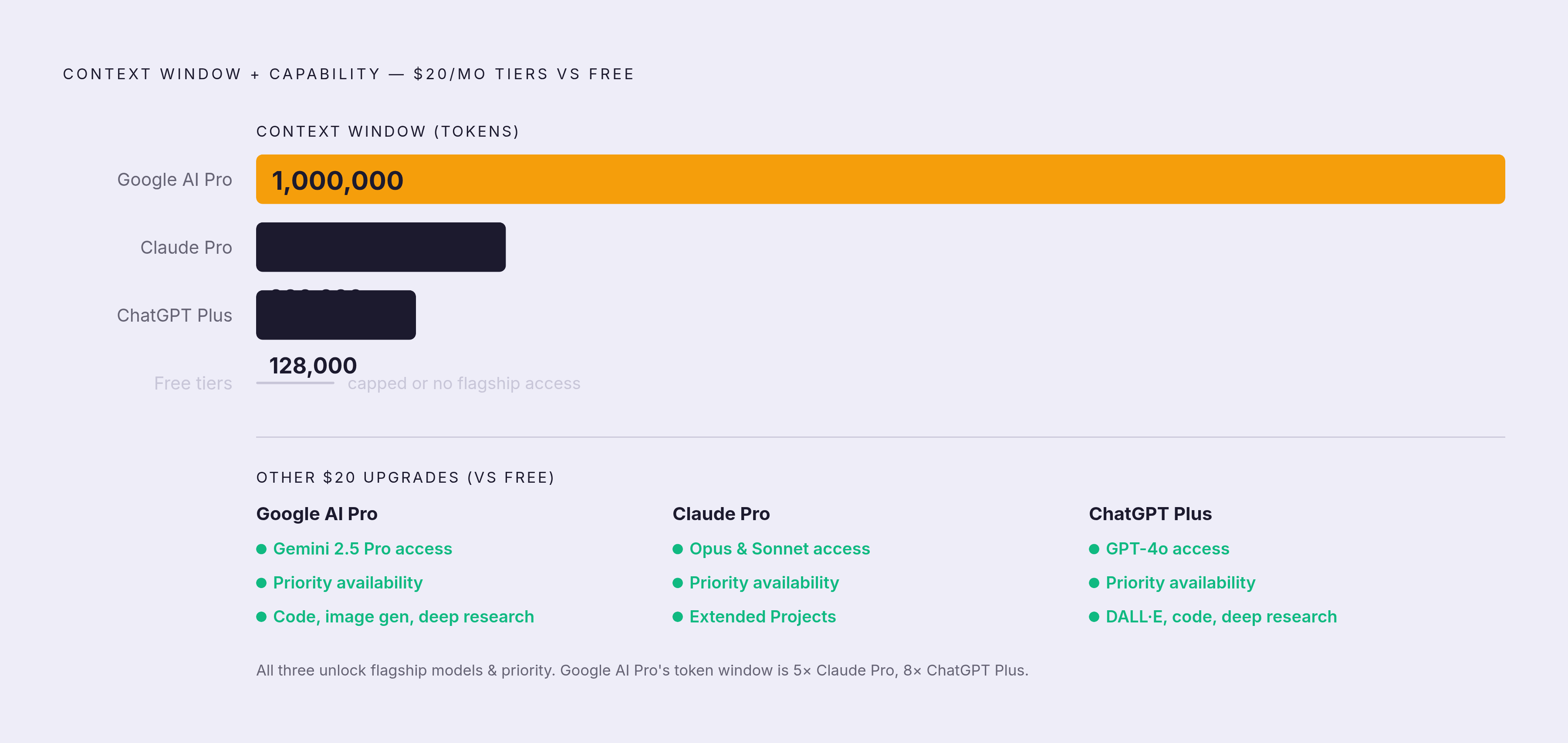
Four things actually change when you pay at the $20 level: you get access to the highest-quality models, a larger context window, priority availability, and advanced features like code execution, image generation, and deep research tools. Let me be specific about each, because the differences are not uniform across providers.
The context window comparison is the starkest differentiator at the $20 tier. Google AI Pro gives you a one-million-token context window, the largest available at standard-tier pricing. Claude Pro offers 200,000 tokens. ChatGPT Plus offers 128,000. In practical terms, a one-million-token window means you can load an entire codebase or a book-length document into a single session without truncation. The others cannot do that. If your work involves large files, lengthy documents, or long iterative coding sessions, that spec sheet number translates directly into a functional difference.
Model quality at the $20 level is meaningfully better than the free tier, not marginally so. The reasoning, the nuance in long-form output, the handling of ambiguous instructions; these improve meaningfully with flagship model access.
The satisfaction data is worth citing here. Paid users score significantly higher on net promoter measures than free users across the ecosystem, with ChatGPT specifically showing a dramatic swing from negative free-tier scores to strongly positive paid-tier scores, according to a Recon Analytics survey of over 120,000 respondents. That's not a small effect. It suggests that the capability gap is large enough that people who pay notice a qualitative difference in their experience.
At the $20 tier, each provider has a comparative strength worth knowing. ChatGPT Plus offers versatility, strong image generation, and the broadest integration ecosystem. Claude Pro offers the most feature-dense $20 subscription in 2026: complex reasoning, superior code quality, long document handling, and access to Claude Code and a collaborative workspace feature. Google AI Pro earns its place for anyone embedded in the Google ecosystem, with Workspace integration, video generation via Veo 3, five terabytes of storage, and that one-million-token window.
None of this is to say one is universally better. The right $20 subscription depends on what you're actually doing.
How to match your usage pattern to the right tier
The governing logic here is simple but easy to skip: tier value is a function of frequency times task complexity times reliance on specific features. It has nothing to do with how sophisticated you are as a user in general; it's about what you're asking the tool to do, and how often.
Walk through the usage profiles carefully.
If you're doing occasional, low-stakes tasks, drafting a quick email, asking a one-off question, getting a recipe suggestion, the free tier on any major platform covers you completely. There's no case for paying.
If AI has become a regular work tool, one or two sessions daily for writing, summarizing, or research, and you're hitting free-tier caps regularly, that's your signal. Move to $20 a month. Choose the provider based on what you're doing: versatility and breadth point toward ChatGPT Plus; complex reasoning and code quality point toward Claude Pro; deep integration with Google's productivity suite points toward Gemini.
If your work involves large documents or substantial codebases, context window size becomes the deciding variable. Claude Pro or Google AI Pro outperform ChatGPT Plus in this specific scenario, and the one-million-token window is a real functional advantage, not a marketing claim.
If you're a heavy Google Workspace user, the storage (five terabytes) and Workspace integration in Google AI Pro carry independent value beyond pure AI capability; you're effectively getting a different product, not just a better chatbot.
If your primary use case is sourced, cited research rather than open-ended generation, Perplexity Pro at $20 a month is more efficient than a general-purpose assistant. It's a narrower tool built for that workflow.
The practical triggers for upgrading are worth being explicit about: hitting message limits during active work sessions, needing to process files larger than free tiers allow, experiencing slowdowns at peak hours that interrupt actual work, and needing a specific model capability (image generation, video, code execution) that only exists on paid tiers.
One counterintuitive note: about half of paid AI subscribers cancel and restart subscriptions as needed, according to survey data. That churn isn't failure; it's a rational management strategy. If your need for heavy AI use is seasonal or project-specific, subscribing for three months and canceling is a legitimate approach.
When the $100–$300/month tiers are actually worth considering
These tiers exist for a narrow but real use case: agentic, multi-step workflows, particularly code generation with iterative debugging, file editing, and long autonomous sessions that run without constant human intervention.
The reason the compute cost is so different is straightforward. Agentic tools like Claude Code or ChatGPT's code interpreter consume tokens at a rate ten to fifty times higher per session than standard chat. The economics of $20 a month break quickly at that usage level, not because the provider is being arbitrary, but because the underlying compute is more expensive.
Claude Max at $200 a month is explicitly designed for all-day professional use, with twenty times the usage limits of Claude Pro. ChatGPT Pro and Google AI Ultra sit at comparable price points and serve maximum-capability users. Grok's SuperGrok Heavy at $300 a month is the highest self-serve tier on the market.
The framing that makes the most sense for evaluating these tiers is professional ROI, not consumer subscription logic. A software developer earning a competitive salary who uses a $200 tool to deliver a meaningful productivity improvement is not making the same calculation as someone comparing it to Netflix. The relevant comparison is professional software: JetBrains licenses, GitHub Copilot, Figma, tools whose cost is evaluated against billable output or career value.
Who should not be at this tier: anyone for whom the $20 cap is not the actual bottleneck. If you're not regularly hitting usage limits at $20 a month, the $200 tier gives you almost nothing extra for your specific use case. The step from $20 to $200 is only rational when the cap itself is what's slowing your work.
The subscription stacking problem most guides ignore
Here's the situation that sneaks up on people. A general assistant at $20 a month, a search tool at $20, an image generation tool at a similar price: you've crossed $50 to $100 before you've made any deliberate decision about it. According to Bango's survey of 2,000 U.S. AI users conducted in late 2025, Americans are paying for an average of four premium AI tools at roughly $66 a month in aggregate. About a quarter spend over $100 a month. Fourteen percent are paying for eight or more AI services.
The cost structure creates a real tradeoff: subscribe to multiple tools for full capability coverage, or pick one and accept the gaps. Most guides don't force that choice explicitly enough.
A few things the research supports. Identify which single tool covers 80% of your actual use cases before adding a second subscription. If a specific gap in your primary tool appears less than weekly, the free tier of a second tool likely fills it adequately. Treat the cancel-and-restart behavior as a feature, not a sign of indecision: it's a rational response to high costs and seasonal variation in need.
The $20-a-month threshold functions as a psychological anchor, comparable to streaming services, the price point where a subscription starts to feel normal rather than like a significant expense. Google's $4.99 AI Plus entry point after the June 2026 price cut changes the math for light users who want some paid benefits without crossing that anchor.
What paying actually does and doesn't change about data privacy
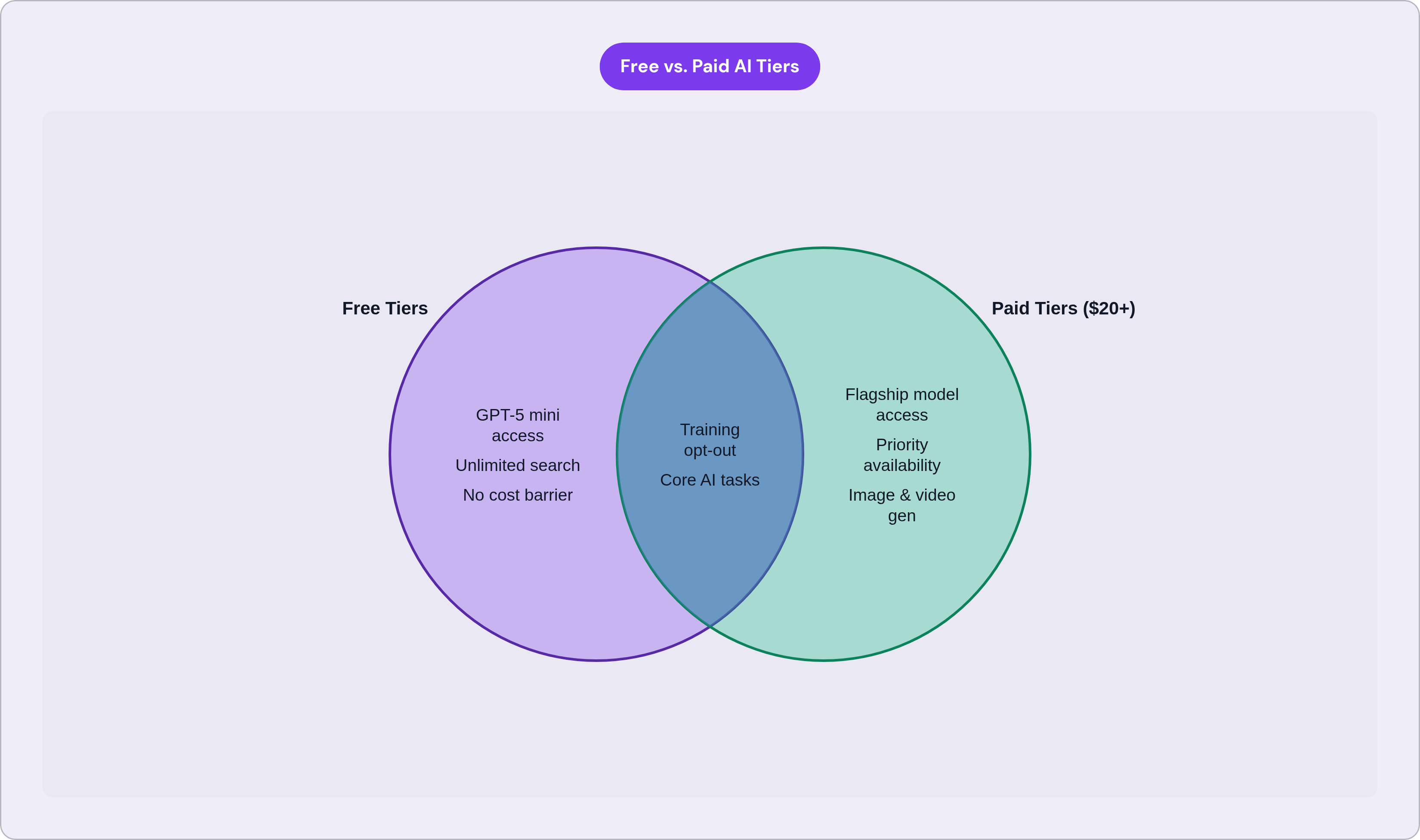
Let me be direct about the central misconception here, because it comes up constantly: paying $20 a month does not automatically remove your conversations from model training.
On ChatGPT's Free, Go, Plus, and Pro plans, conversations are used for model training by default. The opt-out is available in Settings under Data Controls, and it's available to both free and paid users equally. Paying for Plus does not change your default data treatment.
The real privacy divide is not free versus paid. It's consumer tiers versus contracted tiers. Enterprise and Team tiers, with admin controls and negotiated data agreements, are where default-off training protection actually lives. The API with Zero Data Retention is another legitimate path for users with serious requirements.
ChatGPT Pro at $200 a month is the notable exception at the consumer level: it is excluded from model training by default. That's one meaningful privacy benefit of the highest consumer tier.
Anthropic's approach is worth noting: in late 2025, they required every existing Claude user to actively choose whether to allow conversations for model training or opt out, with different data retention periods attached to each choice. That's a more explicit consent structure than most providers use.
Privacy scores the lowest of any attribute across the AI ecosystem in user satisfaction research, by a substantial margin, according to the Recon Analytics survey data. Users care. But most don't know what paying actually changes, which creates a gap between concern and informed action.
What paid tiers at $20 buy: performance, model access, higher limits. Not a business-grade privacy environment. If data sensitivity is a real requirement for your work, the right path is an Enterprise or Team tier with documented data controls, or the API with Zero Data Retention. Assuming Plus solves it is a meaningful mistake.
Making the call: a practical decision sequence for individuals
Start with an honest audit. How many times a week does AI appear in your workflow, and for what type of task? Not how often you open the app; how often you rely on an output to do something you couldn't have done as well or as fast otherwise.
From there, the sequence is fairly clean.
Infrequent, low-complexity use: stay free. Revisit if you're hitting caps more than twice a week.
Regular daily use for general tasks: move to $20 a month. Choose the provider based on task fit. Versatility points toward ChatGPT Plus. Complex reasoning and code quality point toward Claude Pro. Google ecosystem integration points toward Gemini.
Regular daily use with large documents or codebases: let context window be your deciding variable. Claude Pro or Google AI Pro serve that need better than ChatGPT Plus at the same price.
Agentic workflows, all-day professional use, or frequently hitting the cap at $20: evaluate the $100 to $200 tier. Calculate whether the productivity case holds at your income level. Be honest about whether the cap is actually the bottleneck or whether you're rationalizing an upgrade.
On stacking: before adding a second subscription, name the specific gap your primary tool doesn't cover. If that gap appears less than weekly, the free tier of a second tool likely fills it.
On privacy: opt out of training in Settings on whatever tier you use. Understand that only contracted tiers give you default-off protection. Don't assume paying more at the consumer level solves a data sensitivity problem.
One last thing worth holding onto: this market is still early and moving fast. OpenAI's revenue grew from a $10 billion annualized run rate in mid-2025 to more than $25 billion by early 2026, per Reuters reporting. Providers have strong incentive to keep improving free tiers to grow the user base, which means the floor keeps rising. A decision you make today will look different in twelve months. The practical approach is to make the call that fits your current usage, stay attentive to what the free tier actually delivers, and let the cap, not the marketing, tell you when it's time to move.