LLM Reasoning Quality Differences Across GPT-4o, Claude 3.5, and Gemini 1.5
Claude and Gemini dominate different reasoning tasks while GPT-4o trails on science and code.
GPT-4o, Claude 3.5, and Gemini 1.5 each turn out to be better at different jobs, and the differences appear once you stop asking which one wins overall. That timing matters. This isn't a case of comparing a 2024 model to a 2026 one and pretending the gap is about design philosophy instead of just age. These three shipped as actual peers, built to compete against each other directly.
The natural move is to grab a leaderboard, find the highest number, and call it a day. But that instinct breaks down fast once you look at where these scores actually cluster. Take MMLU, long treated as the go-to yardstick for general capability: GPT-4o hit 88.7%, and Claude 3 Opus landed at 86.8%, both according to a medRxiv study on Japanese medical licensing exams. Stanford HAI's AI Index backs this up from another angle, finding that close to half of the 60 most-cited benchmarks in the field now show measurable saturation. When frontier models bunch up within two points of each other on a test, that test has stopped telling you anything useful about which model is actually smarter.
The better question is which model's reasoning strengths line up with the task sitting in front of you. It's which model's reasoning strengths line up with the task sitting in front of you. One quick note before diving in: this comparison doubles as a historical snapshot. Both Claude 3.5 Sonnet API snapshots were retired October 28, 2025, GPT-4o came off ChatGPT on February 13, 2026 (with its chatgpt-4o-latest API snapshot pulled February 17, 2026, though other GPT-4o snapshots remain in the API), and Gemini 1.5 Pro has been retired as of September 24, 2025. Plenty of teams are still running workloads on these models, or picking their successors based on what these three got right and wrong. The sections ahead test logical and scientific reasoning, coding, long-context synthesis, multimodal inference, and hallucination behavior.
Where the three models separate on hard logical and scientific reasoning
GPQA Diamond is the benchmark to trust here. It's a set of 198 biology, physics, and chemistry questions built specifically to resist lookup, meaning you can't just search your way to the answer. That design choice is what makes the results meaningful. When a benchmark is that hard to game, the scores that come out of it actually mean something.
Here's where it gets interesting: Claude 3.5 Sonnet scored 59.4% at launch, Gemini 1.5 Pro came in close behind at 58.9%, and GPT-4o trailed at 53.6% sentisight.ai benchmarklist.com. That's not noise. Claude and Gemini are essentially tied, and GPT-4o is sitting five to six points back, a real and consistent gap sentisight.ai benchmarklist.com. What does that mean in practice?
Part of what drives Claude's number seems to come down to how it reasons out loud. Practitioners who've worked with it closely tend to note that it lays out its assumptions before it commits to a conclusion, which makes the whole chain of thought easier to check line by line. If a user needs to audit the logic rather than just accept whatever answer lands, having a visible reasoning trail beats having a slightly higher score with no way to verify how it got there.
One caveat carries into the next few sections: GPQA tests isolated reasoning steps. It doesn't test whether a model can hold a long chain of logic together over pages of text, or make a sound judgment when the input is a mix of images and text and numbers. Those are different skills, and they're what the rest of this piece digs into. The human non-expert baseline stands at just 34% even with unlimited web access (only marginally above chance on a four-option test), which makes all three models' scores meaningful datacamp.com. What this gap means practically is that for tasks requiring structured scientific inference (research summarization, hypothesis evaluation, technical QA), Claude 3.5 and Gemini 1.5 have a measurable edge over GPT-4o in this cohort.
What drives Claude 3.5's lead in code reasoning
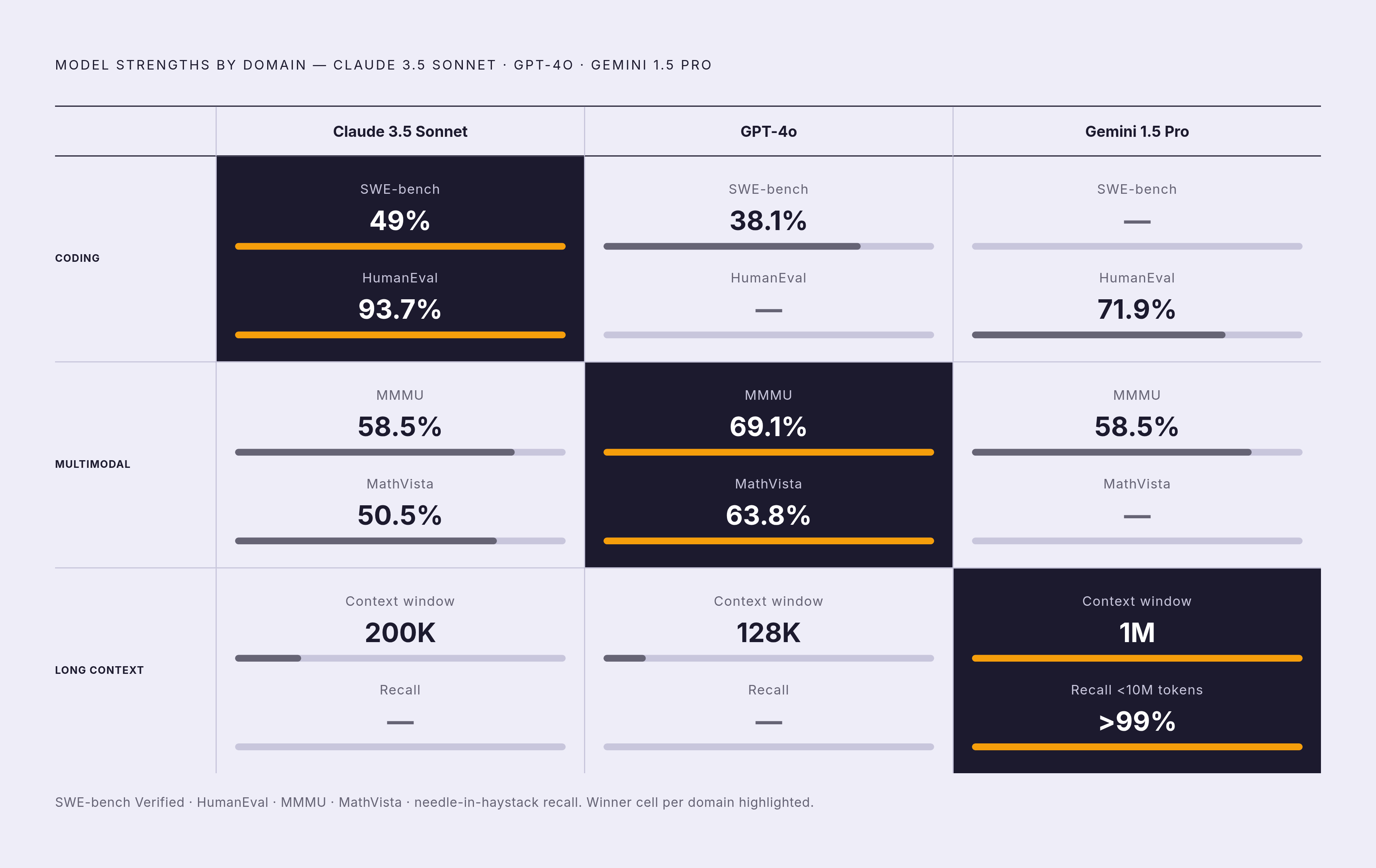
Coding is where Claude 3.5 Sonnet pulls furthest ahead, and the numbers back it up from more than one direction. On SWE-bench Verified, which tests models against real GitHub bug reports rather than tidy synthetic exercises, Claude 3.5 Sonnet scored 49% against GPT-4o's 38.1% is4.ai. Eleven points is a lot of ground in a benchmark built from actual production bugs, and it's large enough to change outcomes in any pipeline where an agent is fixing code with minimal human review is4.ai.
HumanEval tells the same story from a different angle. Claude 3.5 Sonnet scored 93.7%, GPT-4o came in at 90.2%, and Gemini 1.5 Pro dropped to 71.9% arxiv.org tech-insider.org evolution.ai. That's not a small gap for Gemini, that's a different tier entirely on pure Python generation arxiv.org tech-insider.org evolution.ai. And it's not a fluke tied to one test: across a broader coding suite, Claude 3.5 Sonnet posted 81.7% on EvalPlus, 61.65% on CodeMMLU, and 51.6% on Aider Polyglot, alongside that 49.0% SWE-bench figure arxiv.org.
Gemini 1.5's architectural strengths lie in context length and multimodal processing rather than code generation, and its HumanEval score of 71.9% is well behind its peers, signaling it is not the right primary choice for code-heavy workflows in this cohort evolution.ai. A 71.9% HumanEval score, well behind both peers, is a clear signal that Gemini 1.5 isn't the right default for code-heavy work in this particular lineup arxiv.org tech-insider.org evolution.ai.
What does this mean for a team actually shipping software? If the job is automated bug fixing, code review at scale, or running agentic coding pipelines where the model works somewhat independently, Claude 3.5's SWE-bench number is probably the single most decision-relevant figure in this whole comparison. But coding reasoning happens within a bounded context window. The next question is what happens when a task demands holding onto and synthesizing enormous volumes of text: context window architecture then shapes performance more than raw reasoning skill.
Gemini 1.5's long-context retrieval advantage and its real ceiling
Gemini 1.5 Pro got to a million-token context window before either competitor came close. It started as an experimental private preview in February 2024 and reached general availability by May that year. At launch, nothing else in this group was in the same range.
No peer in this cohort matched that at launch. That's a genuinely rare capability: finding one specific fact buried in a document the size of several novels stacked together.
On VideoAds tasks that require tracking temporal sequence and narrative structure, Gemini 1.5 Pro trails open-source models like Qwen2.5-VL-72B, which scored 73.35% overall, partly due to its low frame-rate processing (1 fps) and limited narrative context aggregation emergentmind.com. Part of that gap traces back to how Gemini processes video, at a low frame rate of about 1 frame per second, and to weaker aggregation of narrative context across a long clip. So the model can find a needle, but following a story as it unfolds across the haystack is a different, harder task.
What that split means in practice: pick Gemini 1.5 when the job is "locate this one fact somewhere inside a million-token pile of documents." Be more careful reaching for it when the job requires stitching together narrative threads, tracking events in temporal order, or following causal chains across that same volume of material. Claude 3.5, with its 200,000-token window, sits in a different spot: smaller in raw capacity, but positioned for long-document work where the priority is synthesis and analysis rather than pure retrieval depth. GPT-4o's 128,000-token window is the smallest of the three, and that's a real structural limit for teams handling very large documents, regardless of how good GPT-4o's per-token reasoning happens to be. On simple retrieval ("needle in a haystack"), the Gemini 1.5 technical paper reports that Gemini 1.5 Pro achieves greater than 99% recall for text, video, and audio up to at least 10 million tokens, a genuine capability no peer in this cohort matched at launch emergentmind.com promptingguide.ai.
Multimodal inference versus multimodal ingestion across the three models
All three models can take in text, images, and more. That part's table stakes at this point. The real question is what happens after the input goes in: how good is the reasoning once the model has to actually think about what it's looking at?
On MMMU, a benchmark for multimodal understanding, GPT-4o leads clearly at 69.1%, with Gemini 1.5 Pro and Claude Opus tied at 58.5%, and GPT-4 Turbo at 63.1% encord.com. MathVista, which tests math reasoning grounded in visual input like charts and diagrams, tells a similar story: GPT-4o again comes out highest at 63.8%, while Claude Opus lands lowest at 50.5%, a gap of more than thirteen points encord.com.
This is what matters. Design intent and measured performance aren't always the same thing.
So what's the actual takeaway for someone choosing between them? For work involving charts, technical drawings, or math problems presented visually, GPT-4o is the stronger pick in this cohort. The multimodal picture splits cleanly along that line: volume favors Gemini, reasoning quality over visual content favors GPT-4o.
Hallucination patterns across the three models and their implications for reliability-sensitive tasks
Start with the finding nobody in the industry likes to advertise: a 2024 study covered by a tech news outlet found that models aren't hallucinating meaningfully less, despite what the major labs have claimed publicly. That's a baseline problem, and it applies across all three models here, not just one.
Within this specific group, though, some real separation appears in the results. Claude 3.5 and o1 consistently posted the lowest hallucination rates across a medical hallucination evaluation, landing as the top two performers across both tasks and risk categories, per a study cataloged under arXiv:2503.05777. Gemini 1.5 Flash, the lighter model in that family, showed somewhat elevated hallucination rates, notably 12.3% on lab data understanding and 5.0% on chronological ordering. That second number sounds small until you consider what it means in a clinical or legal setting: getting the order of events wrong in a compliance workflow isn't a minor slip, it changes outcomes.
A separate emergency medicine exam study, run on 60 questions from a December 2024 Turkish fellowship exam, adds a useful wrinkle. GPT-4o posted the highest raw accuracy at 90.0%. Claude 3.5 came in at 83.3%, but with the highest response consistency of the group, a Fleiss' Kappa of 0.68. Gemini 2.0 scored 80.0% with the lowest consistency, a Kappa of 0.49. Consistency and peak accuracy aren't the same measurement, and for anything running in production at scale, consistency might matter just as much as the headline number.
Claude 3.5's methodical chain-of-thought style makes it less likely to confidently assert a wrong answer, and better at sticking to source material in document-based tasks, which explains its consistency advantage in structured evaluation settings. That's a specific, mechanical reason the pattern appears in structured evaluations, not just a vague reputation for being careful. For any domain where a confidently wrong answer does more damage than a correct one delivered with appropriate hedging, Claude 3.5's reliability profile is the number that matters, not its position on a benchmark leaderboard.
A domain-by-domain guide to choosing between the three models
None of this adds up to a single ranking. What it adds up to is a set of conditions: which model wins depends entirely on what you're asking it to do.
When the reasoning process itself needs to be reviewed, Claude's auditable chain of thought gives it an edge.
For coding and software engineering, Claude 3.5 Sonnet is the clear choice (49% SWE-bench versus GPT-4o's 38.1%), while Gemini 1.5's 71.9% on HumanEval puts it out of contention for serious engineering workloads is4.ai evolution.ai. Developer tools that track context across sessions, remembering prior patterns and workflow history, only widen that gap further once a team leans into it.
For retrieval over very large document sets, Gemini 1.5 Pro is the default choice, with its greater-than-99% recall and million-token window emergentmind.com promptingguide.ai. Test first whether the actual task is retrieval (Gemini's strength) or multi-hop synthesis across that same volume (where the advantage gets murkier).
For visual and multimodal reasoning, GPT-4o leads on quality, 69.1% on MMMU and 63.8% on MathVista, while Gemini 1.5 leads on sheer processing volume thanks to its native multimodal design encord.com. The choice comes down to whether the bottleneck is how much you need to process or how accurately the model needs to reason about what's in front of it.
For high-stakes professional work, medicine, law, compliance, where getting it wrong carries real cost, Claude 3.5's consistency scores and lower hallucination rates in medical evaluation make it the safer bet, even though GPT-4o posted the highest raw accuracy (90.0%) in the emergency medicine exam study. Consistency under repeated testing is worth more than a single high score when the system is actually deployed.
Cost is part of the calculation too. As of mid-2026, GPT-4o runs $2.50 per million input tokens and $10.00 per million output tokens, while Gemini 1.5 Pro is $1.25 and $5.00.
Put it all together and none of these three models wins across the board. Locking into one model for every use case means leaving real reasoning quality on the table somewhere. The smarter approach is matching the model to the task, and doing it deliberately rather than by habit. SOURCE PAGES, what the pages behind the outline's links say.