Gemini Memory and Context Features Compared to Rivals
Gemini's 2 million token window and Google ecosystem integration outpace rivals.

Picture the physical surface you work on when you're deep in a project. Not a filing cabinet, not a hard drive, the actual desk in front of you, covered in the documents you're actively using. That's a context window. Everything the model can see simultaneously when it generates a response. When the desk fills up, something slides off the edge, and the model can no longer reference it.
For casual back-and-forth, this is a non-issue. You're not feeding a year of email into a single prompt. But for certain categories of work, the desk size is the entire question.
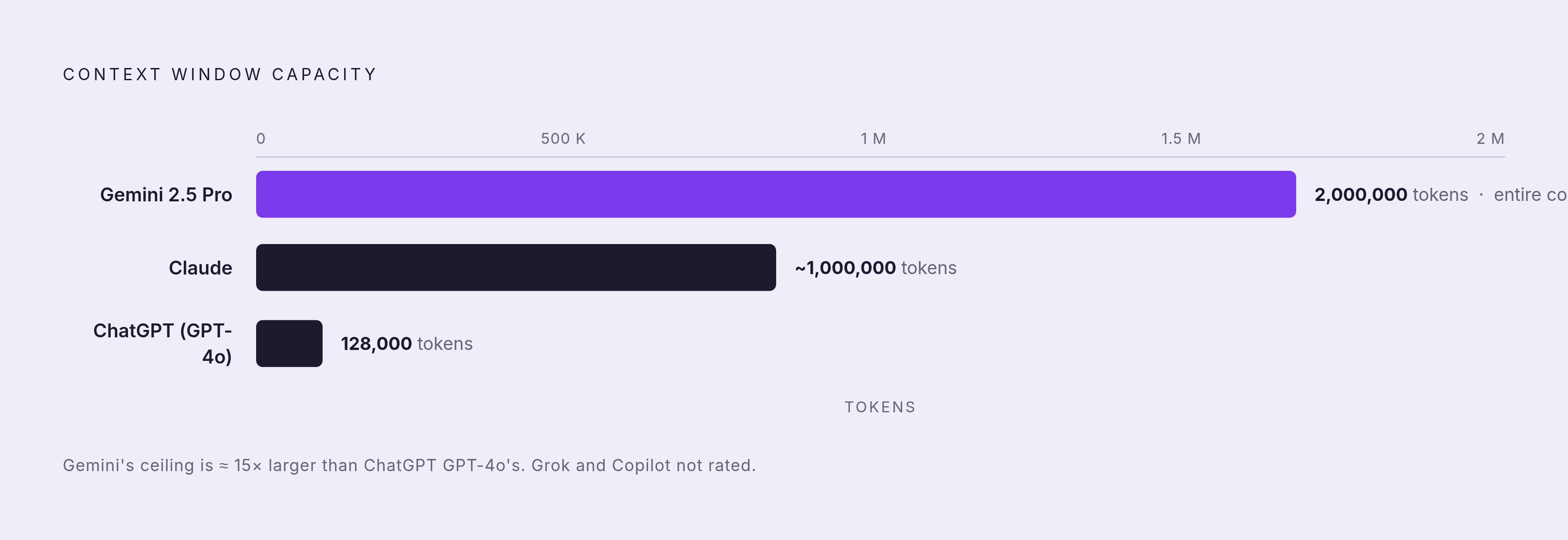
Gemini 2.5 Pro holds 2 million tokens. That's the largest publicly available context window of the five systems here, and the practical implications are concrete rather than theoretical: dropping an entire codebase, a multi-year legal record, or a manuscript into a single session is something practitioners are actually doing. Claude's standard window sits in the 1-million-token range, with some deployment configurations lower. ChatGPT on GPT-4o runs around 128,000 tokens. That gap matters specifically when the work involves large document sets or multi-file code.
The failure mode practitioners see with smaller windows is sometimes called "reasoning drift." You set detailed instructions at the top of a long session; twenty minutes and several thousand tokens later, the model is behaving as if it never read them, because it effectively hasn't. A larger window addresses this. You've probably experienced it without knowing what to call it.
The counterargument, and Anthropic has been unusually direct about this, is what researchers call "context rot." Accuracy degrades as the token count grows, even within a window technically large enough to hold everything. What fills the context matters as much as how much fits. So 2 million tokens is a real advantage for specific high-volume workflows, and largely irrelevant for everything else. If you're doing neither multi-file engineering nor bulk document analysis, you're buying desk space you'll rarely fill.
Gemini's Layered Memory Architecture: What Personal Context and Thought Signatures Actually Do
Gemini's cross-session memory isn't a single feature; it's several distinct mechanisms stacked on top of each other, and you have to understand what each one actually does to evaluate it clearly.
The first layer is explicit memory: you tell it to remember something, it does. Available on the free tier. Works exactly how most people initially imagine memory working, which is to say it's deliberate, user-directed, and bounded by what you remember to ask it to save.
The second layer is where the architecture gets interesting. "Personal Context" is Gemini's background memory system. It periodically generates interpretive summaries of patterns, preferences, and recurring themes across your conversations, without requiring prompts. The model is reading your conversation history and deciding what to abstract and preserve. These summaries are LLM-generated, not verbatim transcripts, and the refresh isn't real-time. Something you express today won't immediately alter the profile.
That compression is doing two things simultaneously. It reduces raw data volume retained, which is better for privacy than storing everything verbatim. But it introduces a specific failure mode: if the model misreads a pattern, the misread becomes the memory, and you won't know it happened until you notice Gemini responding on a false premise. There's no alert. No diff log exists. You'd have to catch it yourself.
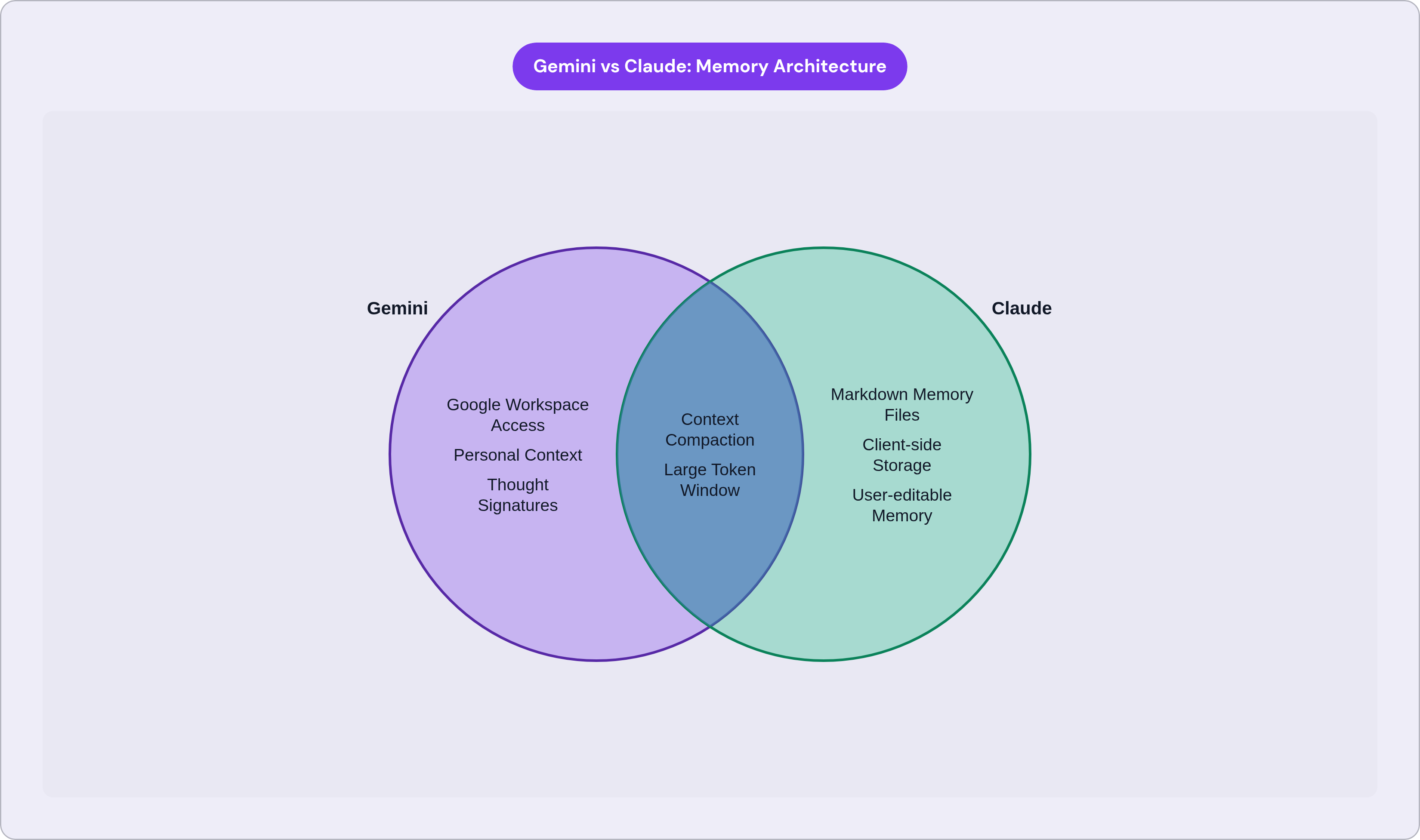
The third layer, Thought Signatures, is primarily relevant for agentic workflows. These are encrypted notes Gemini takes about its own reasoning before acting, passed back into conversation history so an automated agent can reconstruct its exact prior logic across multi-step tasks. For anyone building workflows on top of Gemini, that's architecturally significant. For conversational use, it rarely surfaces.
There's also Temporary Chats: sessions that aren't saved, aren't referenced in future sessions, aren't used for model training, and are deleted after 72 hours. For users who want capability without continuity, this is the relevant option.
A few availability constraints that are easy to miss: automatic memory is unavailable to users under 18, or on work and school Google accounts by default. Geographic rollout excluded several regions initially. These aren't footnotes; they determine whether the architecture is even accessible to a specific user.
The design bet Personal Context is making is to reduce the cognitive burden on users managing their own context. The cost is interpretive opacity. You're trusting the model to summarize you accurately, with limited visibility into what it decided was worth keeping.
How Gemini's Google Ecosystem Integration Separates It from Every Other System in This Comparison
Every other system in this comparison primarily works from what you say to it directly. Gemini can reach into Gmail, Google Drive, Google Calendar, and other Workspace services tied to your account, without you uploading anything. Context is pulled rather than pushed. You don't have to think about what to include; Gemini can reference Tuesday's client email thread or Thursday's calendar block because those already exist in your Google account.
This is a structural advantage, not a marginal one, and it's the feature that ChatGPT and Claude cannot replicate without equivalent ecosystem depth.
For enterprise deployments, Gemini extends further: Gemini Enterprise can connect to Microsoft Outlook and OneDrive, crossing the Google-Microsoft boundary. The integration isn't purely defensive; it's designed to reach users regardless of which productivity stack they're on. On the developer side, Gemini Code Assist builds a team-level memory of coding standards derived from pull request interactions, stored in a Google-managed project, retrieved when relevant to code being reviewed, with no manual tagging.
The privacy trade-off enabling all of this deserves to be stated plainly. Google uses conversations for model training by default. Opting out, specifically by disabling Gemini Apps Activity, also disables the Gmail, Drive, and Maps integrations. The advanced contextual features are conditional on data sharing. That's the explicit bargain. Ecosystem depth requires data openness, and users who want the full integration have to accept that exchange knowingly, rather than by missing a setting buried in an account dashboard.
For users who find that acceptable, the integration represents a real architectural lead over every other system here. For users who find it untenable, the transparency-first approach Claude offers is a better fit, though it means giving up those data connections entirely.
ChatGPT's Memory Evolution from Explicit Saves to the "Dreaming" Background Curation System
OpenAI shipped the first widely deployed persistent memory in a consumer AI product in February 2024. The mechanism was explicit saves: users instructed the model to remember specific facts. It was useful and also fragile, dependent on user initiative, and prone to going stale as circumstances changed while saved memories didn't.
The second phase introduced background curation drawing on chat history automatically. The full version of what OpenAI calls "Dreaming" arrived in 2026. The model now curates and updates memories over time; a concrete example they've cited is "going to Singapore" becoming "went to Singapore" after the trip. There's a reviewable summary page showing what ChatGPT knows and where that knowledge came from.
That transparency layer is worth dwelling on. A book icon below each response lets users see which sources, including custom instructions, past chats, files, and stored memories, influenced that specific answer. No equivalent is currently available in Gemini's consumer interface. For users who want to understand why the assistant responded the way it did, this is an advantage that's easy to undervalue until you need it.
OpenAI has published internal performance data on memory quality across roughly a year of development: factual recall improved from 67.9% to 82.8%, preference adherence from 55.3% to 71.3%, accuracy over time from 52.2% to 75.1%. These are internal figures, not third-party audited, and that matters. But they're also the most granular memory performance data any of the five vendors has made public. The trajectory is meaningful even with appropriate skepticism about self-reported metrics.
One legal footnote belongs here, less as a privacy warning and more as an illustration of how "delete" doesn't mean what users expect. In May 2025, a federal court ordered OpenAI to preserve all ChatGPT conversation logs as part of a copyright lawsuit, including conversations users had already deleted. The order was later modified, but the episode clarifies something: the legal and technical definitions of deletion are identical in name only, and they can diverge at inconvenient moments.
On context window: ChatGPT operates at approximately 128,000 tokens. Sufficient for most tasks, but a real gap relative to Gemini's ceiling when the work involves large document sets.
Claude's Approach: a Large Context Window, Human-Readable Memory Files, and a Deliberate Transparency Bet
Anthropic took longer to ship cross-session memory than either OpenAI or Google, and that wasn't an accident. The original design was no persistent memory by default; when a session closed, everything went with it. That choice reflected a values hierarchy Anthropic has been consistent about: when uncertain, protect user control over what the system retains.
Persistent memory rolled out to enterprise and team accounts first, then paid consumer tiers, then free users in early 2026. The architecture it landed on is different from what Gemini or ChatGPT built.
Where OpenAI and Google store memory in opaque vector-backed systems, Anthropic stores Claude's memory as human-readable markdown files. You can open them. You can read them. You can directly edit what Claude knows about you. This isn't a minor implementation detail; it reflects a deliberate prioritization of auditability over frictionless automation.
For agentic workflows, Claude writes to a memory folder that's read at the start of each session. An auto-mode lets Claude decide what to store, or users can manage it explicitly. For developers building on the API, Claude requests file operations but the application executes them; the memory lives in the developer's own infrastructure, rather than on Anthropic's servers. That client-side design is a meaningful architectural difference for anyone building AI-native products and thinking seriously about where sensitive user context should live.
Context compaction, released in late 2025, addresses context rot mechanically: as a conversation nears its token limit, earlier messages are summarized automatically, enabling very long sessions without hard cutoffs. It's a practical solution, even if it introduces some of the same interpretive compression risks as Gemini's Personal Context.
The real cost of Claude's approach is the absence of ecosystem integration comparable to Gemini's Workspace connections. Claude's memory is bounded by what users and developers explicitly provide. For controlled agentic workflows, that's a feature. For casual personal use, it's friction that Gemini's pulled-context architecture doesn't create.
Grok and Copilot: What Each System Adds to the Competitive Picture
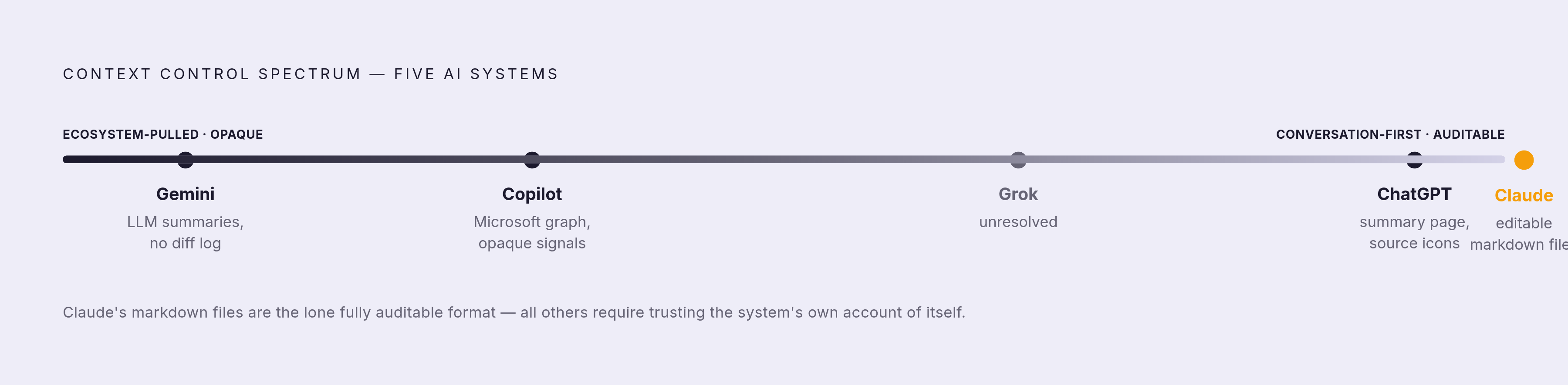
Grok launched cross-conversation memory in mid-2026, alongside a feature called Skills: structured capabilities the model learns and applies across sessions. It arrived later to persistent memory than the other four systems. The Skills framing suggests something more structured than simple preference tracking, but independent performance data wasn't available for this piece, so the picture here is necessarily qualitative. Grok is still early in establishing what its memory architecture is, specifically.
Microsoft Copilot finished rolling out its M365 memory system around the same time. The most instructive thing about Copilot is the parallel to Gemini: both systems derive most of their memory value from ecosystem integration rather than conversation history alone. For Copilot, that ecosystem is Outlook, Teams, SharePoint, and OneDrive. For organizations already standardized on Microsoft 365, the contextual reach within that environment is a real competitive advantage, directly analogous to Gemini's advantage for Google Workspace users.
The pattern across all five systems is worth naming. Gemini and Copilot are ecosystem-integrated assistants; their memory is most valuable because of the external data connections it unlocks. ChatGPT and Claude are conversation-history-first; their memory is built from what you say directly. Grok is still finding its position. And none of these systems share memory across platforms. A user's context in one assistant is invisible to all others, by design. That design serves the vendors as much as it serves the users.
Memory Portability as the Next Architectural Battleground
Both Anthropic and Google have shipped import tools that pull context from competitor exports. That's a meaningful development because the persistent memory each system has built over time has also functioned as retention infrastructure. The more you invest in one assistant's understanding of you, the more expensive switching becomes.
Gemini's import tool is among the most comprehensive currently available: a guided prompt flow or direct upload of exported conversation history from other platforms, designed to carry over interests, preferences, relationships, and personal context. Claude's import tool, as of early 2026, pulls context from ChatGPT and Gemini exports. ChatGPT has not yet reciprocated with an equivalent inbound import capability; users can export from ChatGPT but cannot easily bring a competitor's context into it.
The deeper structural problem with portability is one that rarely gets the attention it deserves. Every system generates its own interpretive summaries of your conversations. When you export from one system and import into another, what actually transfers isn't raw truth. It's one model's interpretation, filtered through a second model's interpretation. The receiving system inherits another system's reading of you, rather than the underlying record. Switching costs are falling; fidelity is lost in translation, and that loss compounds with each migration.
For developers building applications on top of these systems, portability isn't just about user convenience. It's an architectural decision about how tightly a product is coupled to a single vendor's context layer. Import tools loosen that coupling, but they don't solve the interpretive fidelity problem. They just make it easier to move the problem around.
Security Risks That Only Exist Because Memory Persists Across Sessions
There is a category of vulnerability that didn't meaningfully exist before cross-session memory became standard. If an adversary can write something into a model's memory, that influence survives the conversation. The attack surface isn't the session; it's everything the session touches going forward.
The threat category is prompt injection: hidden instructions embedded in a document, email, or webpage the AI processes, designed to alter the model's behavior. Prompt injection has existed as long as language models have processed external content. What persistent memory adds is duration. An injection that previously expired with the session can now persist indefinitely.
Security researchers documented this category systematically through 2025 and 2026, specifically as a response to persistent memory becoming standard across the industry. Gemini's Google Workspace integration represents the sharpest version of the problem. If a malicious email causes Gemini to write something to memory while processing the inbox, that injected context carries forward into future sessions, shaping responses to questions the user asks days later about entirely unrelated topics. There's no reason for the user to connect the two events.
This isn't an argument against persistent memory. It's an observation that the architectural choice to persist context across sessions is also, inherently, a security posture, and it deserves to be treated as one. Vendors are aware of this; mitigations exist. But they're imperfect, because the same interpretive flexibility that makes memory useful is exactly what makes injection possible.
Anyone using an AI assistant with ecosystem access, Gemini or Copilot especially, should think about the documents, emails, and pages they ask the assistant to process with the same care they'd apply to any system that has write access to their personal data. That's proportionate caution, not excessive caution. It's calibrated to the actual access level involved.
The broader picture that emerges from placing these five systems side by side is that "memory" was a proxy for a more consequential question: what kind of relationship do you want with this assistant, and what are you willing to give up to get it? Gemini pulls from your ecosystem and asks you to accept a meaningful data trade-off. ChatGPT builds gradually from conversation history and shows its work more visibly than any competitor. Claude prioritizes auditability and user control over frictionless reach. Copilot mirrors Gemini's logic inside the Microsoft stack. Grok is still writing its answer.
The right choice depends on which dimension of memory matters most for how you actually work, not on which system is winning a feature count.