hosted personal AI assistants with persistent memory: comparing Jenova, Lindy, Vellum, and similar platforms
Three memory philosophies shape how AI assistants learn who you are.

Persistent memory in AI assistants sounds like a solved problem. It isn't, and the reason has less to do with whether a platform remembers things and more to do with what kind of remembering it's built to do.
The difficulty of persistent memory in AI assistants
By 2026, nearly every hosted AI assistant worth using ships some form of persistent memory, so you can no longer tell much from the feature by itself. A year ago, a platform could market "remembers your preferences" as a real differentiator. Now it's closer to a checkbox, the same way "has a search bar" would be.
The problem these platforms are all trying to solve is consistent: general-purpose chatbots forget everything between sessions, or they keep a thin slice of memory, a few isolated facts, without ever building a real picture of how a person actually thinks and works. ChatGPT's memory toggle and Claude's equivalent setting both do something in this direction. They save a preference here, a name there. That's useful, but it's a narrow kind of useful.
An assistant can know you prefer short answers, but the real gap is that this isn't the same as one that knows why you chose a particular system design last Tuesday, which trade-offs you weighed, and which options you ruled out and why. The first is a setting. The second requires the assistant to have tracked reasoning across time rather than just data points. That distance is the actual subject of this piece: not whether a platform has memory, but what kind of memory it has, and what that memory is built to do for the person using it. The gap between "knows you prefer concise answers" and "knows why you made a specific architectural choice last Tuesday, what trade-offs you weighed, and what you ruled out" is what separates platforms like Vellum, which turns multi-session context into something closer to a reasoning layer, from memory toggles added onto general-purpose models.
Three distinct architectural philosophies that separate today's platforms
If a platform's memory feels shallow or deep, that comes down to a design choice made early, not a setting you can toggle later. You can find three distinct philosophies across the market, and they tell you how a platform behaves in practice far better than any list of features on a pricing page.
The first philosophy treats memory as an add-on to a model interface. Facts and preferences get captured as a convenience layer, but the model itself and the memory system sit apart from each other architecturally. ChatGPT and Claude's memory toggles are the clearest examples of this approach.
The second philosophy treats memory as automation infrastructure. Here, memory is selective and governed by rules, tuned to make repeat workflows run more smoothly. The assistant's core job is execution, and it remembers operational details so it can act reliably, not so it can build a rounded picture of the user.
The third philosophy treats memory as foundational architecture. Memory is built into every agent and every session from the start, on the assumption that context should accumulate and compound rather than get refreshed on demand.
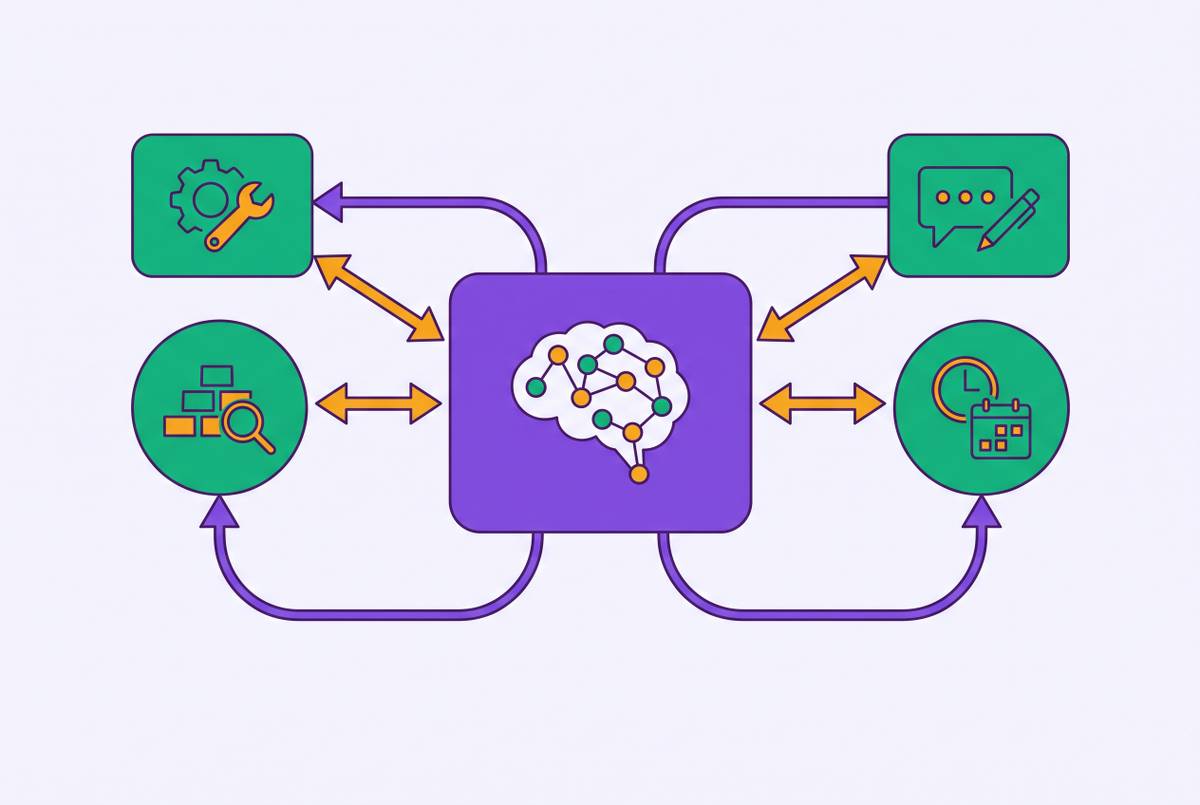
What does each philosophy actually get you? Philosophy 1 gets you a better chatbot, one with a longer attention span. With Philosophy 2 you get a better automation worker, one that executes recurring tasks without forgetting the operational details each time. Philosophy 3 aims for something else: an assistant whose usefulness builds over weeks instead of resetting every time a new session opens. Vellum takes this approach. Its three-layer memory system, workspace files, a curated knowledge base, and auto-extracted long-term memory, treats the accumulation of context as the core design principle rather than a bonus feature, so the assistant's value compounds over time instead of flattening out session to session.
How modern memory pipelines work under the hood
Any memory claim rests on a pipeline: extract, store, retrieve. The assistant pulls key facts, preferences, and context out of conversations, stores them in a persistent database, and retrieves whatever is relevant when a new session starts. Selective extraction and smart retrieval exist because the system doesn't have to cram an entire conversation history into the context window every time, which would be slow, expensive, and often beside the point.
Measuring how well any of this actually works used to be guesswork. Before a benchmark called LoCoMo (Long-term Conversational Memory) came along, you mostly had self-reported memory quality claims or one-off tasks that nobody else could reproduce. LoCoMo tests recall across multi-session data using five question categories of varying difficulty: single-hop, multi-hop, open-domain, temporal, and adversarial, though most reported results cover only the four non-adversarial categories. It gave the industry something like a shared yardstick, even if that yardstick still has gaps.
Two failure modes recur in any platform, regardless of what its marketing promises. The first is context rot: preferences that go stale quietly start corrupting outputs, because the assistant keeps treating an old fact as current. The second is entity contradiction: the assistant ends up holding two conflicting facts about the same person or project, with no built-in way to resolve which one is right. Neither failure announces itself. Both just make you trust the assistant a little less with each interaction, until you notice the pattern.
What should a reader actually check when a platform claims "deep memory"? Ask how it handles retrieval (keyword matching alone is weaker than a system that also understands meaning) and ask what mechanism, if any, catches outdated facts before they get used.
Vellum: memory as a three-layer reasoning infrastructure for teams that want to own their context
Vellum was founded in 2023 by Akash Sharma, Sidd Seethepalli, and Noa Flaherty, originally as an enterprise LLMOps platform, before the company introduced its Personal Intelligence product in 2026. The assistant grew out of infrastructure built for teams running serious AI operations rather than a consumer chat product adding memory as an afterthought, which shapes how deeply it tracks context across sessions.
The memory system has three layers. Workspace files hold documents and data a user hands over directly. You maintain a curated personal knowledge base on purpose, and it holds structured context. Auto-extracted long-term memory fills in the rest: it pulls automatically from interactions, and attaches confidence scoring and reinforcement tracking so the system can flag what's reliable and what might have gone stale. That last part addresses the staleness and contradiction problem raised earlier: confidence scoring and reinforcement tracking on auto-extracted memories give the assistant a way to surface context it trusts while flagging what may no longer be accurate, a structural attempt at a detection mechanism that no platform in this comparison has fully solved as of 2026.
Retrieval runs on a knowledge graph that combines lexical and vector search, so you can find exact keyword matches as well as context that means the same thing but is phrased differently. In day-to-day use, that architecture supports things like managing calendars, summarizing Slack messages, working across files, and controlling a browser on the user's behalf. The assistant runs on Vellum's managed platform, or it can be self-hosted, with access available through desktop, mobile, web, and messaging channels.
Self-hosting is a real option here. You pay no platform fee, and the assistant's code is available under the MIT license, which matters if you have serious privacy requirements and don't want your context sitting on someone else's servers.
None of this comes free of friction. An independent review found that cost, capability, and ease of use don't always line up, especially if you aren't already technical. The depth that makes Vellum powerful is the same depth that raises the barrier to entry for a casual user who just wants something that works out of the box.
The case for sticking with it anyway comes down to patience. Vellum builds more slowly but compounds more: after two to four weeks of regular use, the memory architecture starts to feel distinctly different from a stateless chatbot, because confidence scoring and reinforcement tracking make the assistant more reliable over time rather than more cluttered. That timeline matters for setting expectations. If you expect an immediate payoff in the first few days, you'll likely be underwhelmed. Anyone willing to use it steadily for a month is testing the actual thesis of the product.
Vellum fits engineers, product teams, and technical knowledge workers who want an assistant that understands their context in real depth and who don't mind configuring or self-hosting it. But if you want a ready-to-use personal assistant with minimal setup, it's a weaker fit.
Jenova: memory bundled into specialist agents for users who want domain depth across multiple models
Jenova takes a different bet. Instead of building one memory layer that serves a general-purpose assistant, it bundles persistent memory into specialized agents, each built for a particular domain. The platform is aimed at individual knowledge workers who'd rather consolidate several AI subscriptions into one interface than juggle them separately.
Memory here works at two levels. You get full conversation history preserved with complete fidelity, unlimited, persistent, and searchable across sessions. Above that sits a Global Memory layer, and it automatically pulls out important facts, preferences, and context, then carries them across sessions. Mention a role, a project, or a preference once, and Jenova applies that knowledge to future interactions so you don't get asked again.
What sets Jenova apart from a single-model assistant is the range of models it gives access to. Users can work across GPT-5.4, Claude Opus 4.6, Gemini 3.1 Pro Preview, and models from xAI and DeepSeek, with persistent context traveling along regardless of which model handles a given task. If you want the right model for the right job without rebuilding context each time you switch, that's a meaningful convenience.
The agent library itself spans real professional range: a Business Co-Pilot, an Academic Research Assistant, a Fundamental Stock Analyst, an LSAT Tutor, and others, each pre-configured with domain expertise, custom instructions, and its own knowledge base. Specialized mentor personalities cover career strategy, exam prep, languages, creative work, and personal development. Integrations through MCP tools reach into Gmail, Google Calendar, Google Drive, Notion, Google Search, Google Scholar, YouTube, and Reddit, all accessible directly inside an agent conversation.
On privacy, Jenova encrypts data in transit and at rest, doesn't use it to train its own models, and doesn't sell it to advertisers, though third-party model providers the platform routes through may have their own data policies. Users keep control over their memory. Pricing runs on a tiered structure: a free tier with core features and limited daily use, Plus at $20 a month for 20 times the usage, Pro at $100 a month, and Max at $200 a month.
The trade-off built into this design is scope. Memory lives inside each agent, so if your work spans multiple domains, you have to lean on the Global Memory layer to bridge context between them. That works fine for carrying over preferences, but it may not hold the same nuanced project reasoning a single unified knowledge graph would. That's not a flaw so much as a direct consequence of designing around specialist agents instead of one general memory system.
Jenova fits knowledge workers who already know which domains they spend most of their time in and want a specialized, memory-equipped agent for each one. It also suits anyone who wants access to multiple models but doesn't want the hassle of choosing between them manually.
Lindy: memory as selective operational context for an assistant built to act, not just recall
Lindy starts from a different question altogether: not "how do I build a full model of this user," but "what does this agent need to remember to get the job done reliably." Lindy positions its agents more like employees than like automations, holding context across sessions, making judgment calls based on instructions and memory, communicating proactively, and coordinating with other agents on the user's behalf.
Memory here is selective and governed by rules. Agents manage their own memory rather than saving everything that comes through, and the system prioritizes operationally useful facts, something like "User always schedules standups on Monday at 10 AM", over building a broad general picture of who the user is. That's a deliberate choice, and it's the right one for the job Lindy is built to do.
The assistant can manage calendars, summarize Slack messages, work with files, and control a browser once it's holding the right context, with access through desktop, mobile, web, and messaging channels, running on Vellum's managed platform or self-hosted. In practice, it behaves less like a platform someone logs into and more like a personal assistant someone messages directly.
For regulated industries, Lindy carries SOC 2 Type II certification and HIPAA compliance at the Enterprise tier, and the platform has more than 400,000 paying users, a scale signal that points to strong product-market fit for personal productivity use cases.
The architecture's trade-off is visible in what it leaves out. When learning happens at the session level and never gets written to persistent memory, it resets as soon as agents restart or get redeployed. Preferences built up over weeks of use can disappear, and contextual intelligence formed through feedback can dissolve between deployments. You're optimizing for selective, operational memory instead of a comprehensive model of the user, so you should know that going in rather than discovering it later.
The free plan was removed sometime between January and March of 2026. Pricing now runs on usage, which makes costs harder to predict in advance, and because memory is selective rather than comprehensive, users may occasionally find themselves re-establishing context that, ideally, Lindy should have already retained.
Lindy fits people whose main need is reliable execution across communication and business tools, drafting email, scheduling, coordinating across apps, especially where the workflows are consistent and recurring. It's a weaker fit for someone looking for an assistant that builds a general, evolving model of how they think over time.
The staleness problem that none of these platforms has fully solved
Every pitch examined here rests on one assumption: that memory gets more valuable the longer it accumulates. That assumption only holds if the memory stays accurate as circumstances change, and right now, none of these platforms can guarantee that reliably.
The failure mode is simple to describe and hard to fix. A fact gets recorded, a preference, a relationship detail, a project status, and then the underlying situation changes while the memory doesn't. No framework currently available detects this drift automatically or corrects it on its own. The assistant goes on treating an outdated fact as current truth, sometimes for a long stretch, because nothing in the pipeline is built to ask whether the fact is still true.
Vellum's confidence scoring and reinforcement tracking represent one structural attempt at narrowing this gap, surfacing what the system trusts and flagging what might be stale rather than treating every stored fact as equally reliable. That's a step toward detection. Anyone evaluating a platform's memory claims should ask the same question of all of them: not just how much it remembers, but how, if at all, it figures out when what it remembers has stopped being true.
Sources
- vellum.ai
- AI Assistant with Memory: How Persistent Context Transforms Your AI Experience
- AI Mentor Character: Personalized Guidance With Real Continuity
- How to Fix AI Character Forgetting Context: Stop Context Rot
- Lindy AI Builds Agents in 48 Hours Without Code — But Agents That Learn From Feedback Forget When Sessions Restart (Earlier Version) - MemU Blog