AI Agent Architecture Diagrams and What They Actually Show
How AI agent architecture diagrams map to what actually runs in production.
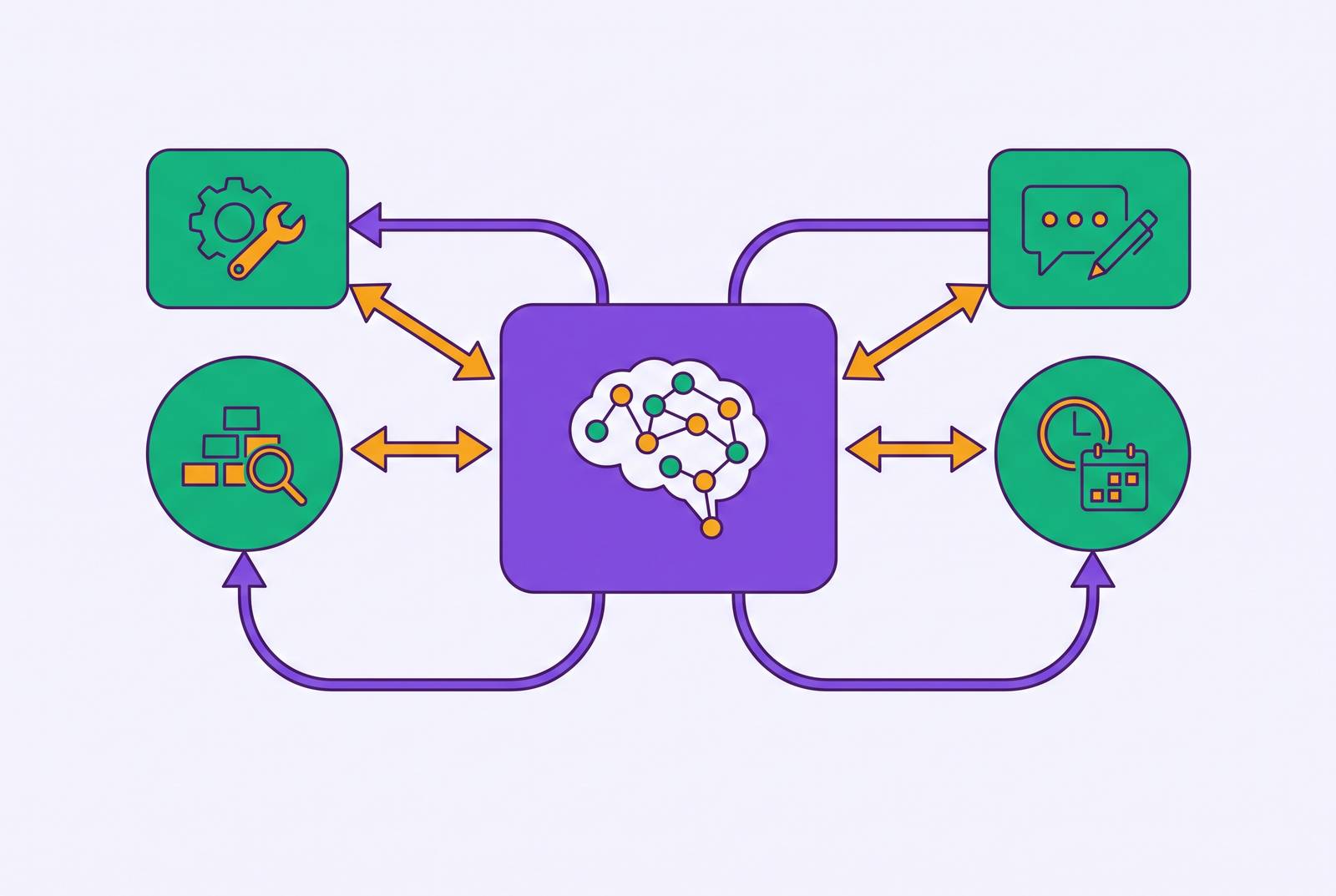
Open ten different AI agent architecture diagrams and the shapes repeat before the labels do. The standard AI agent architecture diagram has settled into a small, stable set of components, and practitioners across the field keep drawing them the same way. Most diagrams show four layers doing the actual work: an LLM as the reasoning engine, orchestration logic that manages tasks, data infrastructure that handles memory and state, and a tool integration layer that lets the system reach outside itself. Production documentation guides push that list further, naming an orchestrator or planner, a tool registry, a memory layer, sub-agents or specialists, human-in-the-loop gates, a state or checkpoint store, and a guardrails and eval layer as the building blocks any serious diagram ought to make visible.
None of this is an accident of habit. The repetition reflects something true about how these systems have to be built: reasoning, orchestration, memory, and action are genuinely different jobs, and keeping them separate is what makes an agent maintainable and debuggable once it stops being a demo. A diagram that draws these pieces apart is making a real claim about the system's design, not just following a template. This convergence happened for good reason. What the convergence leaves out is where the rest of this piece is headed.
What each canonical component does at runtime
Knowing the names of the boxes is not the same as knowing what they do once the system is live. The reasoning layer is often drawn as a single block, but in motion it is doing more than generating text: it runs chain-of-thought reasoning, weighs more than one possible action, and produces structured output that other parts of the system consume downstream. It never works alone. It pulls context from memory and from whatever tool definitions are currently available to it.
The orchestration layer decides how tasks actually move through the agent, chaining reasoning steps together and handing off to a tool or to another sub-agent when continuing on its own won't do. This is where a system built for a demo and a system built to survive production really start to diverge. Common orchestration patterns include sequential flows where tasks chain one after another, concurrent flows where independent tasks run in parallel, group chat setups where several specialist agents work the same problem together, handoff patterns that route work based on expertise, and magentic setups where a manager agent coordinates a set of specialized agents on the fly.
Memory is rarely one thing even when the diagram draws it as one box. Short-term memory holds the context of a single session. Long-term memory carries information across sessions. Episodic memory logs what the agent did and what happened as a result. For any workflow that spans minutes or hours rather than seconds, state management has to hold intermediate results, survive interruptions, and pick back up without losing its place, and that job gets harder the longer the task runs.
The tool integration layer lets an agent carry out actions in the world. Function calling gives the model a structured way to say which tool it wants and with what parameters, and that structure is what connects the agent to search, to code execution, to databases, and to outside APIs.
Five architectures put these same pieces together in different orders, and the order changes what you pay for and what you get. ReAct has the agent think, act, observe the result, and repeat, which makes it the easiest architecture to trace and the most common starting point in production. Plan-Execute splits planning from execution into two separate phases, and because the plan works like a contract, it cuts down on the agent drifting mid-task. Reflexion adds a round of self-critique after each attempt, which slows the system down but improves accuracy on tasks where correctness matters more than speed. Tree-of-Thoughts treats reasoning as a search problem, branching out several candidate paths and pruning the weak ones, which costs the most but tends to win on the hardest problems. Multi-Agent splits the task across specialists managed by a supervisor, built for jobs too long or too complex for one agent's context window to hold.
The eight workflow and agent patterns that account for most of what ships
Most of what actually reaches production is a workflow rather than the fully autonomous agent the diagram implies, and the gap between those two words shapes nearly every design decision that follows. The dividing line is control: in a workflow, code decides the path and the model fills in the steps along that fixed path, which makes the system predictable and easy to test. In an agent, the model decides its own path and its own tool use, which makes the system flexible but a lot harder to pin down.
Eight patterns cover most of what practitioners actually build, running from fully code-controlled to fully model-controlled. Prompt chaining runs a fixed sequence of calls, each one feeding the next, and fits any task that breaks down into known steps in a known order. Routing classifies the input first and then sends it down a specialist path, built for cases where different kinds of input genuinely need different handling. Parallelization fans a task out across several calls at once and then aggregates or votes on the results, useful when subtasks don't depend on each other or when a problem benefits from several independent takes. Orchestrator-workers puts a planner model in charge of breaking a task down while separate workers carry out the pieces, which fits jobs where the subtasks are real but can't be mapped out ahead of time. Evaluator-optimizer runs a bounded loop of generating, critiquing, and revising, and earns its cost only where clear criteria exist and iteration measurably improves the result. The tool-using agent pattern is the reason-act-observe loop from ReAct, suited to tasks where the next step depends on what the model finds along the way. Agents as tools wraps specialist agents as callable functions for a higher-level orchestrating agent, which is what you reach for once a single agent's list of tools has grown too large to manage well. A human-in-the-loop gate pauses execution on any flagged action until a person signs off, and belongs wherever an action is hard to undo, costly to get wrong, or sensitive enough to need a second opinion.
This list runs along a spectrum, from code-controlled on one end to model-controlled on the other, meant to be walked left to right. Most problems that show up in practice get solved somewhere in the workflow half of that spectrum, before they need the full autonomy of an open-ended agent loop. The agent loop is the most exciting pattern on the list and also the most expensive one to run, and the discipline that separates teams that ship reliable systems from teams that don't is using the simplest pattern the problem actually requires, adding complexity only once a measured failure proves the simpler version isn't enough.
Decision Loops, Memory Timing, and Trust Boundaries
The components in a canonical diagram each do real work in the system. Whether those components actually work together once the system is live is what a boxes-and-arrows picture is bad at showing.
Start with the happy path. Traditional architecture diagrams are built to show static data flow, one thing leading to the next in a straight line. Agent diagrams need to show decision loops, tool registries, memory stores, and the handoffs between agents as explicit, visible parts of the picture. Production documentation practice calls out the feedback cycle specifically, the loop where an agent calls a tool, reads the result, and decides what happens next, as something that needs its own place in the diagram, separate from being folded into a single line.
Conditional routing is one of the clearest casualties. A diagram will show a routing node sitting in the flow, but it almost never shows the conditions that decide which branch fires, what the system does when none of the conditions match, or what happens downstream when the classifier guesses wrong. A box labeled "memory" has the same problem in a different shape: it says nothing about when the agent reads from that memory, when it writes to it, whether those writes happen immediately or get deferred, or what the system does when the memory it's relying on is already stale.
Trust boundaries get left out of the diagram almost completely. Agents that execute code, query databases, and hit external APIs open up real security surface area, and a systematic gap analysis of production agent infrastructure names security as one of eight categories of missing infrastructure capability, with the absence of trust boundary representation called out as a specific structural gap. One more layer rarely makes it onto the page at all: the organizational context the agent is actually reasoning over, distinct from the mechanics of how it operates. In enterprise settings, that missing layer is a leading cause of production failures, not a footnote to them.
None of this makes the standard diagram useless. It makes it incomplete in specific, nameable ways, and each of those ways has a cost attached once the system runs at real scale.
The memory gap between prototype and production
Memory is the component most likely to look finished on the page and fail first once the system goes live, and the distance between how it's drawn and how it actually behaves is wider here than anywhere else in the architecture.
What the diagram compresses into one box is really four different jobs. Working memory is limited by the context window. Semantic memory lives in vector databases and supports retrieval-augmented generation. Episodic memory logs past actions and their outcomes. State management covers multi-step workflows that run for minutes or hours at a stretch. Each of these behaves differently, costs differently, and fails differently, and treating them as one undifferentiated box is where a lot of production trouble starts.
State management turns into a hard requirement the moment a workflow runs long. The system has to persist intermediate results, track where it is in the process, and recover cleanly from an interruption or a failure. A checkpoint store belongs in the architecture as its own component, not as a detail buried inside the memory box.
This is not a solved problem even at the infrastructure layer. The Agentverse platform's own gap analysis names the move from ephemeral key-value storage to a full Agent Memory Cloud as one of five critical paths agent platforms still have to travel, which confirms that memory architecture is an open infrastructure problem at the platform level, not something individual application teams can patch around on their own.
The obvious objection is to ask why any of this matters when context windows keep getting bigger. The window could simply be made large enough to hold everything, skipping the architecture. A bigger window doesn't answer the question of what to surface at the moment it's needed, it doesn't say when state should actually get committed, and it says nothing about what survives when the system restarts. Those are three separate problems, and expanding the context window addresses none of them directly.
The documentation gap: why most production agentic systems are governed by informal sketches
Production agentic systems build up dependencies and constraints that a standard diagram was never built to hold, and the space between what gets drawn and what actually gets governed is where maintenance costs pile up and safety failures start.
Research by Rausch and Wittek (arXiv:2603.15021) found that industrial agentic systems accumulate real dependencies and constraints around agent responsibilities, interaction protocols, the artifacts agents exchange, tool interfaces, and operational governance, and that most of this, in practice, lives in informal pipeline sketches or in the code itself. That makes change-impact analysis harder than it needs to be, slows down maintenance, and makes the whole system harder to evolve over time.
Two failure modes keep appearing in production, and neither one appears anywhere in a canonical agent diagram. One is "Governance as Afterthought": a team ships without documentation, without human-control pathways, without escalation routes, without monitoring, and only builds those in after something goes wrong. The other is "Vibe-Checking as Testing": a team ships based on a subjective sense that the outputs look right, with no eval framework backing that judgment up. The AI Agent Index found that only 19.4% of indexed agentic systems disclose a formal safety policy, a number that confirms both of these failure modes sit at the architecture level, not at the level of process discipline.
This gap is most visible in security documentation. A 2026 paper on security-auditable LLM agents (arXiv:2605.06812) argues for unified graph representations specifically because the tools already in use, static software bills of materials and runtime logs among them, can't capture how an agent's cognitive state evolves, how its capabilities bind together, or how risk cascades from one part of the system to another. The Coalition for Secure AI published its guide, Securing the AI Agent Revolution: A Practical Guide to Model Context Protocol Security, in January 2026, and the fact that a document like that needed to exist says something on its own: the threat model now matters as much as the capability model, and almost none of it is visible in the stakeholder-facing diagram a team actually presents.
The MLflow architecture guide makes a related point about structure rather than security: effective agents need perception, reasoning, planning, memory, tool use, and oversight pulled apart into distinct architectural layers, and that separation is what tells a maintainable production agent apart from a prototype that happens to work in a demo. Tangle those layers together and a change to the memory module can quietly break the reasoning layer, turning debugging into guesswork. Even the academic literature admits the field hasn't fully solved this. Framing from arXiv:2601.19752 (January 2026) points out that most efforts to characterize agentic design patterns still lack a rigorous systems-theoretic foundation, which leaves the field with taxonomies that sound right at a high level but are hard to actually implement.
How "context engineering" redefined the diagram's system-prompt box
The system-prompt box used to be the simplest thing in the whole diagram: one static block of instructions, written once and left alone. That box now has to hold something closer to a live assembly process, pulling together instructions, retrieved memory, tool definitions, and conversation history fresh for every single call. The discipline practitioners have started calling context engineering treats that assembly as the central design problem, not a side detail.
That shift matters because it means the box in the diagram labeled "system prompt" no longer describes a fixed artifact. It describes a pipeline: a set of decisions, made at every turn, about what information the model actually needs to see in order to reason well, and what information would only crowd the context window and make the system worse. Get that pipeline wrong and the failure looks exactly like a reasoning failure, even when the reasoning layer itself did nothing wrong. Everything this piece has traced, from the memory layer's hidden timing to the orchestration layer's hidden routing conditions, eventually has to funnel through that one box before the model ever produces a token. A diagram that still draws it as a static square is describing how these systems used to work, not how they work now.