Semantic Memory Examples Across Everyday and Professional Contexts
How your brain's fact system enables expertise, creativity, and everyday thinking.
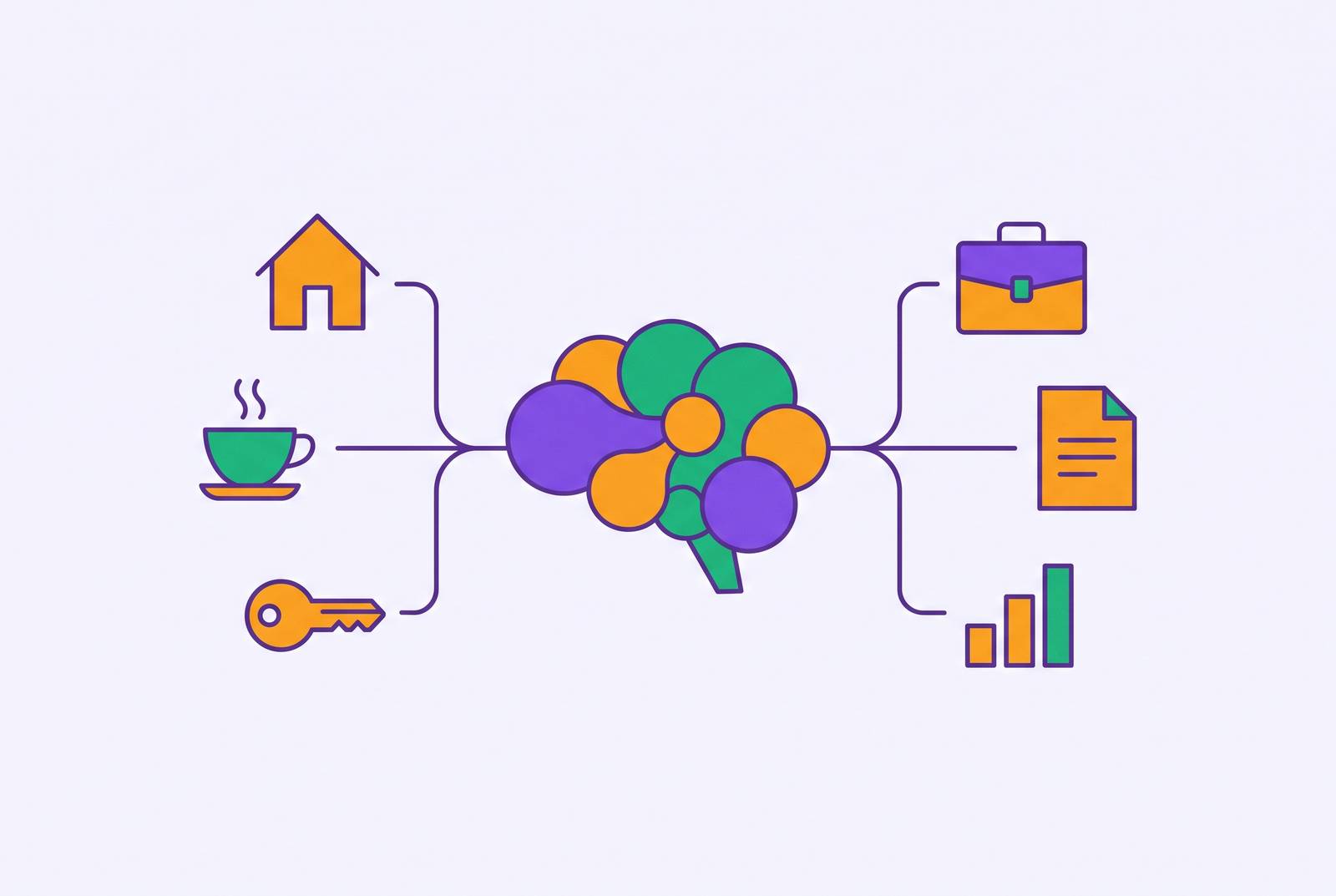
Semantic memory is the system that stores general knowledge about the world: facts, concepts, word meanings, and rules, held independently of when or where a person first picked them up. You know that a particular city is the capital of a particular country. You probably can't say exactly where you learned it. That gap, between knowing a thing and remembering the moment you learned it, is the clue to how this system works.
Psychologist Endel Tulving drew the line in the early 1970s, separating semantic memory from episodic memory. Both are forms of declarative memory, the kind of memory you can state out loud, and the two work closely together. But they run on at least partly different principles. Episodic memory holds your personal timeline: what happened, where, when. Semantic memory holds the facts left over after the timeline fades.
Structurally, semantic memory organizes itself into networks of connected concepts, sometimes called schemata. A concept like "bird" links to "feathers," "flight," "nest," and a hundred other nodes, and the strength of those links determines how fast you can retrieve them. Someone confirming that a robin is a bird answers faster than someone confirming that a robin is an animal, because the first link is shorter and more direct. Retrieval follows the shape of the network as much as the amount of information packed into it.
The neural story backs this up. Episodic memory leans heavily on the hippocampus. Semantic memory is supported mainly by the neocortex, built up gradually as the brain extracts stable patterns from repeated, similar experiences. If you learn enough individual instances of something, the specific episodes fade, but the general rule survives. That's why semantic memory tends to hold up better than episodic memory against distortion: you can lose the memory of learning a fact entirely and still keep the fact, stable and intact. Its capacity isn't fixed in any meaningful sense, though it decays over time and competes with interference like any memory system does.
How semantic memory operates in ordinary daily tasks
Semantic memory is behind nearly everything routine you do during a normal day, usually with no sense that you're recalling anything. When you pour a glass of milk, three memory systems fire at once. Recognizing the carton and knowing what milk is: that's semantic. Remembering the last time you poured a glass, maybe spilling it on the counter: that's episodic. Actually gripping the carton and tilting it at the right angle: that's procedural. One simple action, three separate systems, and only one of them, the semantic one, is pure knowledge about the world rather than knowledge about an event or a motion.
When you dial a phone number from memory, you're often drawing on the same thing. You know the number. You likely couldn't say when or where you first learned it. That absence of a source tag is itself a sign that the knowledge has been fully absorbed into the semantic system.
Language works the same way. Knowing what a word means, recognizing an object by its name, following a spoken instruction: all of it runs on semantic memory, and it runs automatically enough that most people never notice the retrieval happening. The same goes for the general knowledge that lets someone function as an informed adult: knowing roughly when a major historical conflict ended, knowing the capital of a neighboring country, placing a handful of historical events in the right order relative to each other. None of that requires remembering the classroom where it was taught.
When you learn a foreign language, the process becomes visible in a way daily life usually hides. Every new vocabulary word is a fresh entry into the semantic network, a word and its meaning stored without any specific memory of the moment it was learned. Within a few weeks, the word just means what it means. What looks, on the surface, like knowing how to do things, pouring milk, following directions, holding a conversation, often rests on a deeper layer of simply knowing facts about the world.
Professional expertise as semantic memory
Scaling this up from pouring milk to practicing medicine, the same system is still doing the heavy lifting. Professional expertise is, in large part, a dense and well-organized semantic network, built over years and activated in seconds.
Take a physician diagnosing a patient. Their semantic memory holds diagnostic criteria, pharmaceutical data, medical terminology, anatomic and pathological descriptions, and the typical course a disease takes. If you describe a clinical picture with the right set of semantic qualifiers, the precise descriptive terms medical training drills into every student, the correct diagnosis often follows almost on its own. The qualifiers act as a kind of shortcut key: label the features correctly, and the network supplies the rest. It's a trained retrieval path, not instinct in any mystical sense, built from thousands of hours of exposure to cases and categories.
Law, engineering, and architecture follow the same pattern. A structural engineer keeps a huge body of codes, load calculations, and material behaviors in long-term storage, and can call on them without ever rehearsing the lecture where the rule was first taught. A lawyer cites precedent the same way. During debate preparation, hours of research have to be converted into something retrievable mid-argument, key terms, structured claims, factual backing, so that during the debate itself, retrieval is fast enough to keep pace with a live opponent.
What separates a novice from an expert in any of these fields is mainly a difference in how those facts are connected: more nodes, denser links, faster paths between related ideas. Two people can know the same list of facts and differ enormously in how quickly and reliably they can use them, because one network is organized for retrieval and the other isn't. That distinction, organization over volume, turns out to matter well beyond the professions.
How semantic memory structure shapes creativity and verbal intelligence
Better organization improves expert judgment, and the same should hold for creativity. The research backs that up directly. Creativity isn't a separate talent bolted onto semantic memory. It emerges from how flexibly a person's existing knowledge is connected.
Across two studies, researchers found that people with high crystallized intelligence, the kind built from accumulated knowledge rather than raw processing speed, had semantic networks that were more flexible: less rigidly structured, more clustered, more interconnected. Those same groups outperformed lower-knowledge groups on tasks that measured creative output. The knowledge itself wasn't the advantage. The shape it was stored in was.
A 2026 study by Skurnik and Kenett at the Technion pushed this further. Across two separate tasks, ideation fluency and semantic network integration consistently predicted originality. People who generated more original ideas weren't simply the ones who knew more. They were the ones whose knowledge network was more tightly integrated, with shorter paths between distant concepts. Usefulness, as a separate dimension of creative output, tied to associations that were more specific to the task at hand, while originality tracked network integration more consistently across both tasks.
One finding complicates how people judge their own creativity. Self-ratings often diverged from actual task performance. People lean on quick, surface-level cues to judge how creative they are, rather than any accurate read on the quality of their own semantic network, so a person's confidence in their own originality isn't a reliable guide to how original their output actually is.
There's intervention evidence too. A program called SCIP, tested on 176 chemistry students between the ages of 10 and 18, raised scientific creativity scores and increased the interconnectedness of students' memory networks, with chemistry showing the clearest gains. The program didn't load students with more facts. It changed how the facts they already had were connected to each other. That suggests something practical for anyone who teaches or trains others: building connections between concepts may generate more creative capacity than covering more material ever could.
What early semantic memory decline reveals about Alzheimer's disease
A system this central to daily function and professional judgment should leave a visible mark when it starts to fail, and it does. Because semantic memory underpins language, judgment, and everyday competence all at once, Alzheimer's disease damages it early, often well before a formal diagnosis is possible.
Language impairment can appear at the prodromal stage of Alzheimer's, the period before the disease is fully declared, and the disease causes the sharpest damage at the lexical-semantic level. That could mean the semantic network itself is degrading, or it could mean the network is intact but retrieval from it is failing. Either way, the breakdown is visible in language well before other symptoms force a diagnosis.
A long-running study following a large group of people without dementia found that semantic fluency, the ability to rattle off words in a category, declined fastest in those already at elevated risk: carriers of a gene variant linked to the disease, people with amnestic mild cognitive impairment, those scoring at a midpoint level on a standard dementia-severity scale, and those who went on to develop dementia. Letter fluency, a related but distinct task, didn't decline early the same way; it only dropped in those who had already progressed to dementia. Semantic fluency was the more sensitive signal, by a wide margin.
How early? Semantic memory can decline as much as 12 years before a dementia diagnosis is made. A meta-analysis of multiple studies confirms the pattern: both phonemic and semantic fluency drop in mild cognitive impairment and Alzheimer's disease, but semantic fluency tends to show the steeper decline, because it depends on a network that's deteriorating from within, while phonemic fluency relies more on retrieval strategies that stay comparatively intact in the earlier stages. That makes a simple test, naming as many animals or foods as possible in a minute, a low-cost, non-invasive way to flag risk years before episodic memory symptoms, the forgetting most people associate with Alzheimer's, become obvious.
Revisions to the standard model of semantic memory
Everything described so far treats semantic memory as a stable archive: facts go in, facts come out largely unchanged. That picture is now being challenged from several directions at once, and the challenges matter for how confidently any of the claims above should be held.
Philosopher and cognitive scientist Gentry argued in a 2025 paper in Cognitive Science that episodic and semantic memory likely share causal mechanisms. Episodic memory is well established as reconstructive: it's rebuilt each time it's recalled rather than played back like a recording. If the two systems share mechanisms, semantic memory is probably reconstructive too, which would mean the old "storage and retrieval" metaphor, facts filed away and pulled back out intact, may not accurately describe what's happening when someone recalls a fact.
A study in Nature Human Behaviour, led by Tibon with Greve, Humphreys, Quent, and Henson, tested this directly with fMRI. The researchers carefully matched semantic and episodic conditions, so participants had to recall pairings between logos and brand names that reflected real-world knowledge against newly learned pairings created for the experiment. The statistical evidence came down against any neural difference between the two memory types during retrieval. The researchers themselves described being "very surprised" by the result, given decades of doctrine treating semantic and episodic memory as running on distinguishable neural systems.
A separate 2026 computational model from Imperial College and UCL, built by Albesa-González and Clopath, proposes that memory consolidation builds a shared vocabulary between episodic and semantic systems. Structure extracted from past experience feeds forward to organize how future memories get represented, a bidirectional relationship that conflicts with the standard model, where consolidation only runs one way, from episodic memory into semantic memory, never back.
A further complication involves aging and vocabulary. Older adults tend to have semantic networks that are less efficient, less interconnected, and more segregated than those of younger adults. Counterintuitively, increases in vocabulary size among older adults were associated with networks that were less robust and more segregated, not more. More words known didn't translate into a better-organized network. That finding alone should make you question any simple story where more knowledge always leads to a better-connected mind.
Taken together, these findings don't overturn the examples described earlier in this piece. A physician's diagnostic shortcuts still work. Semantic fluency testing still flags Alzheimer's risk early. But if semantic facts are assembled fresh at the moment of retrieval rather than fetched whole from storage, then the reliability of expert judgment, and the validity of fluency testing as a diagnostic tool, may depend more on context than current clinical and educational frameworks assume.
AI agents designed to replicate semantic memory's functions
Semantic memory carries this much cognitive weight in humans because it solves a specific engineering problem: how to hold general knowledge in a form that can be retrieved quickly and connected flexibly. Engineers now face the same problem, and they're solving it deliberately in AI systems built to be useful over long stretches of work rather than single exchanges.
A survey of AI agent memory frameworks sorts memory by function in a way that maps closely onto human cognitive architecture. Factual memory holds knowledge about the world, the direct analog to semantic memory. Experiential memory holds insights and skills built up from past interactions, closer to what episodic memory contributes in humans. Working memory manages active context in the moment. The parallel to human memory is a structural choice, made because the same functional problems, what to store, what to retrieve, what to forget, show up in both systems.
A 2025 survey on agent memory notes that the field remains highly fragmented, with loosely defined terms and inconsistent use of core concepts across different research groups. That mirrors the state of human memory research itself, where terms like "semantic" and "episodic" are still being renegotiated in light of findings like the Tibon study. Neither field has settled vocabulary, and both are working out the same underlying questions from different directions.
The constructivist turn in human memory research, the idea that facts are assembled at the moment of recall rather than pulled whole from storage, has a direct counterpart in how modern AI systems retrieve information: knowledge gets composed at the moment of a query, drawn from distributed sources, rather than pulled from one static store. And the lesson from the creativity research carries over cleanly too: a knowledge base organized around well-structured relational connections retrieves more usefully than one that simply indexes a large pile of facts. Volume alone was never the advantage, in brains or in machines.
That has a direct bearing on how these tools get used in professional settings. If AI systems help a physician surface a diagnostic association, or help an analyst connect evidence across separate domains, they work best when they extend a person's existing semantic network rather than substitute for the judgment that network supports. A tool that hands over an answer without showing the connections behind it asks for blind trust. A tool that strengthens the web of connections a professional already relies on earns a different kind of trust, the kind built on augmentation rather than replacement. That distinction, whether a system is built to extend human judgment or stand in for it, will likely decide which of these tools professionals actually keep using.
Sources
- 15 Semantic Memory Examples (2026)
- Semantic Memory Structure and Self-Evaluation of Creativity: Evidence Across Tasks and Dimensions - PMC
- GitHub - Shichun-Liu/Agent-Memory-Paper-List: The paper list of "Memory in the Age of AI Agents: A Survey" · GitHub
- Constructing Memories, Episodic and Semantic - Gentry - 2025 - Cognitive Science - Wiley Online Library
- The role of semantic memory networks in crystallized intelligence and creative thinking ability
- Semantic memory and language dysfunction in early Alzheimer's disease: A review
- Cross-sectional associations of amyloid burden with semantic cognition in older adults without dementia: A systematic review and meta-analysis
- Semantic Memory in the Clinical Progression of Alzheimer Disease - PMC