Multitasking Myth and Single-Tasking Productivity Evidence
Your brain is a serial processor that pays a steep cost for switching between tasks.
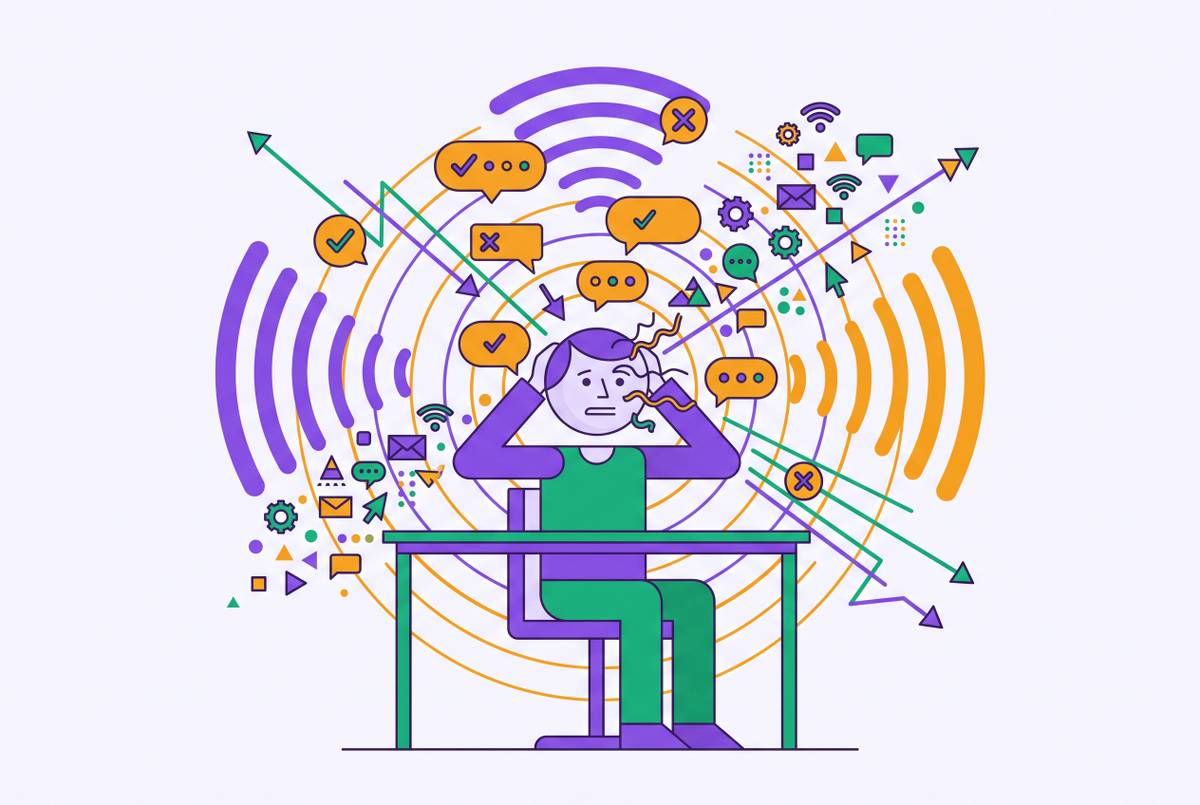
Six browser tabs open, Slack pinging in the corner, a half-written email next to a spreadsheet that still needs three more formulas. That setup feels like multitasking, but the brain is doing something else entirely: it is a serial processor, not a parallel one, and what looks like juggling is actually fast, repeated switching between one task and the next.
Why the Brain Cannot Multitask
The science behind this has a name and decades of testing behind it. Cognitive psychologists call it the central bottleneck theory, first proposed by Harold Pashler in the mid-1980s and backed up by hundreds of experiments since. The theory holds that response-selection, the moment the brain decides what to do given some input, happens one step at a time, with almost no known exceptions. Pashler's original dual-task experiments showed this clearly: when two signals arrived close together, the second response always lagged, even in people who had practiced the task extensively. That delay is called the psychological refractory period, and while enough single-task training can shrink it, it rarely disappears.
Wake Forest University psychology associate professor Anthony Sali, who worked with neuroscience experts on research published in 2025, frames the finding simply: "We're serial processors, not parallel processors". What does that cost in practice? The switching happens below conscious awareness, so a person never sees the toll it takes. They only feel the sensation of moving between tasks, and that sensation gets mistaken for productivity. The next section puts a number on what that switching actually costs.
The two-stage switch cost
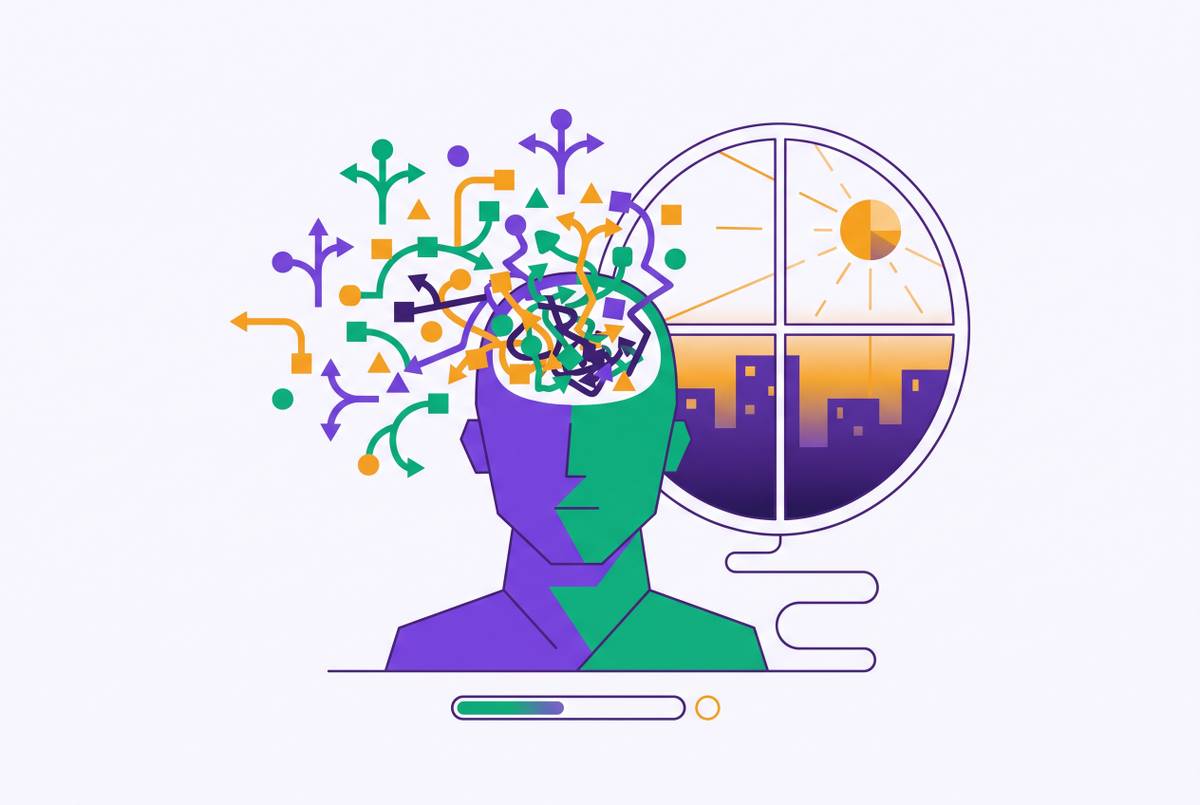
Every switch between tasks runs through two separate operations in the brain, and each one costs time and working memory that never appears on anyone's to-do list. The first stage, goal shifting, is the brain deciding to move on: "I want to do this now instead of that." The second stage, rule activation, turns off the mental rules that governed the last task and turns on the rules for the new one, clearing out variables like syntax, structure, or argument logic to make space for whatever comes next.
Research by Joshua Rubinstein, David Meyer, and Jeffrey Evans found that switching between tasks eats up a real share of a person's productive time, and none of that lost time comes from the actual work. It comes from the invisible cost of reconfiguring the brain's rule set over and over. That cost is not flat across all tasks, either. Switching between two complex, demanding tasks costs far more than switching between tasks that are automatic or well-practiced, which explains why walking and talking works fine while writing an email and analyzing a spreadsheet at the same time does not. Brain imaging backs this up: fMRI studies show heavier activation in the frontoparietal and dorsal attention networks during task-switching, so the brain is working harder, not smarter, every time it toggles. A conjunction analysis found that regions including the superior parietal lobule, the dorsal lateral prefrontal cortex, and the pre-supplementary motor area activate during both task-switching and working memory tasks, and a separate representational similarity analysis found shared activity patterns across these same regions. The two costs, switching and memory load, are not separate problems. They run through the same circuitry. Paying one tax usually means paying the other.
What switch costs compound into
Losing productive time is just the first bill. The same switching mechanism also drives up error rates, slows recovery after interruptions, and weakens working memory, three separate harms that stack on top of each other and explain why multitasking makes work worse, not just slower.
Start with errors. Multitasking raises error rates while also making tasks take longer, a double penalty that leaves someone worse off than if they had just done one thing at a time. And the damage doesn't require a long distraction. A study published in the Journal of Experimental Psychology found that interruptions lasting only a few seconds could double or triple sequence-error rates on the trial that followed. A quick glance at a Slack notification is a measurable quality risk.
Then there's recovery time. Workers who get interrupted tend to compensate by speeding up afterward, but that speed comes with a cost: higher stress, more frustration, and heavier mental effort, which adds up to a stress spiral rather than a productivity gain. How often does this actually happen in a normal workday? Microsoft's 2025 Work Trend Index found employees get interrupted every two minutes during core work hours by emails, chats, and meetings. At that frequency, the recovery cost from each interruption never fully resolves before the next one starts.
Finally, there's memory. Fragmented attention stops the brain from encoding information deeply, which leaves memories less durable and recall weaker, because forming a strong memory requires sustained, uninterrupted focus. Professor Sali described students who study while checking their phones this way: "If you're trying to study while also checking social media or responding to texts, you're not forming strong, durable memories of the study material". The attention is split, so the storage never happens cleanly.
The illusion of competence: why heavy multitaskers believe they are good at it
If the costs are this measurable, why does the myth survive? Mostly because the people who multitask the most are also the worst judges of their own performance. They feel busy and engaged while actually underperforming, and that feeling is persistent precisely because the switching that causes it happens outside conscious awareness.
Workplace culture reinforces the illusion at every level. Multitasking still appears as a desired skill in job postings and gets worn like a badge of honor. The Resilience Institute observes that the "dozen open browser tabs" is treated as proof of capability rather than a warning sign. The slowed response times and the doubled error rates caused by that switching stay invisible underneath that image of busyness.
One might argue this is really about who chooses to multitask in the first place, not what multitasking does to them. That's a fair challenge, and it deserves a straight answer: some research suggests people with weaker baseline attention may simply gravitate toward multitasking environments rather than being degraded by the multitasking itself, and the direction of cause and effect still needs more study. But that caveat doesn't change the practical picture. Across the literature, frequent multitasking correlates consistently with weaker attention, weaker memory, and weaker inhibitory control, regardless of which direction the arrow points. Whether multitasking causes the damage or simply attracts people already prone to it, the outcome for anyone trying to do careful work is the same.
Long-term and structural harms from chronic task-switching
The costs so far are acute: a slower task here, a sloppier output there. Chronic task-switching raises the stakes further, because the damage may not stop at a single bad afternoon.
A University of Sussex study found that people who multitask regularly show less brain density in the anterior cingulate cortex, the region responsible for cognitive and emotional control. That finding points to habitual multitasking possibly reshaping brain structure over time, though it describes an association rather than proof of permanent damage. It's a serious signal: habitual multitasking may reshape brain structure over time.
A 2024 review published in Frontiers in Psychiatry pulled together neuroscience and behavioral research and found that chronic digital multitasking tracks with more hyperactivity symptoms, weaker executive function, worse working memory, and higher mental fatigue. The review also describes a feedback loop: shrinking attention spans push people toward more multitasking, and more multitasking further wears down the capacity for sustained focus. That loop tightens as digital environments pile on more notifications, more tabs, more pings, giving the cycle more fuel with each passing year.
Workplace design bakes this into how a lot of workplaces are physically built, not just into individual habits. A systematic review covering 46 empirical articles found that open-plan offices, designed around constant interruption and ambient multitasking, hurt both performance and employee satisfaction. The same review found that for most knowledge workers, a single private office is the setting where individual and organizational performance comes out best. The floor plan itself can work against the brain's actual architecture.
The supertasker exception and the automatic-task caveat
Any argument this strong needs to survive its best objections, and there are two genuine ones here, not just rhetorical ones. A small group of people really can multitask without penalty, and a category of low-stakes tasks really can run in parallel.
University of Utah psychologists Jason Watson and David Strayer ran participants through a high-fidelity driving simulator while also assigning a demanding auditory memory task, and found that about 2.5% of participants, which they called supertaskers, showed zero performance drop while doing both at once. Out of roughly 700 people tested, researchers identified 19 who met the supertasker bar, a real, peer-reviewed finding: people who already ranked in the top quarter on single tasks and still showed no decline when doing two tasks together. With no reliable way to self-identify as one of them, it tells most readers very little about their own capacity. Almost nobody reading this is a supertasker, and assuming otherwise is exactly the kind of overconfidence the earlier section warned about.
The second exception is more useful day to day: tasks that have become automatic. Walking while talking, listening to familiar music during repetitive data entry, these pairings don't compete for the same prefrontal resources, so they can genuinely run side by side. The myth specifically breaks down when both tasks demand conscious cognitive control at the same time, like writing while analyzing, reading while listening, or driving while holding a phone conversation. Those pairings all draw on the same prefrontal circuitry, and that's where the bottleneck bites hardest.
Some people simply prefer juggling several things at once and report feeling more satisfied doing it that way. Preference isn't the same as performance, though. Even among people who enjoy switching between tasks, the underlying serial bottleneck doesn't disappear. The honest version of this section's conclusion is this: even its exceptions prove the rule. A tiny sliver of supertaskers and a narrow band of automatic tasks are the edge cases. Serial processing is still the default setting for almost everyone, almost all the time.
Why evidence-backed single-tasking strategies work
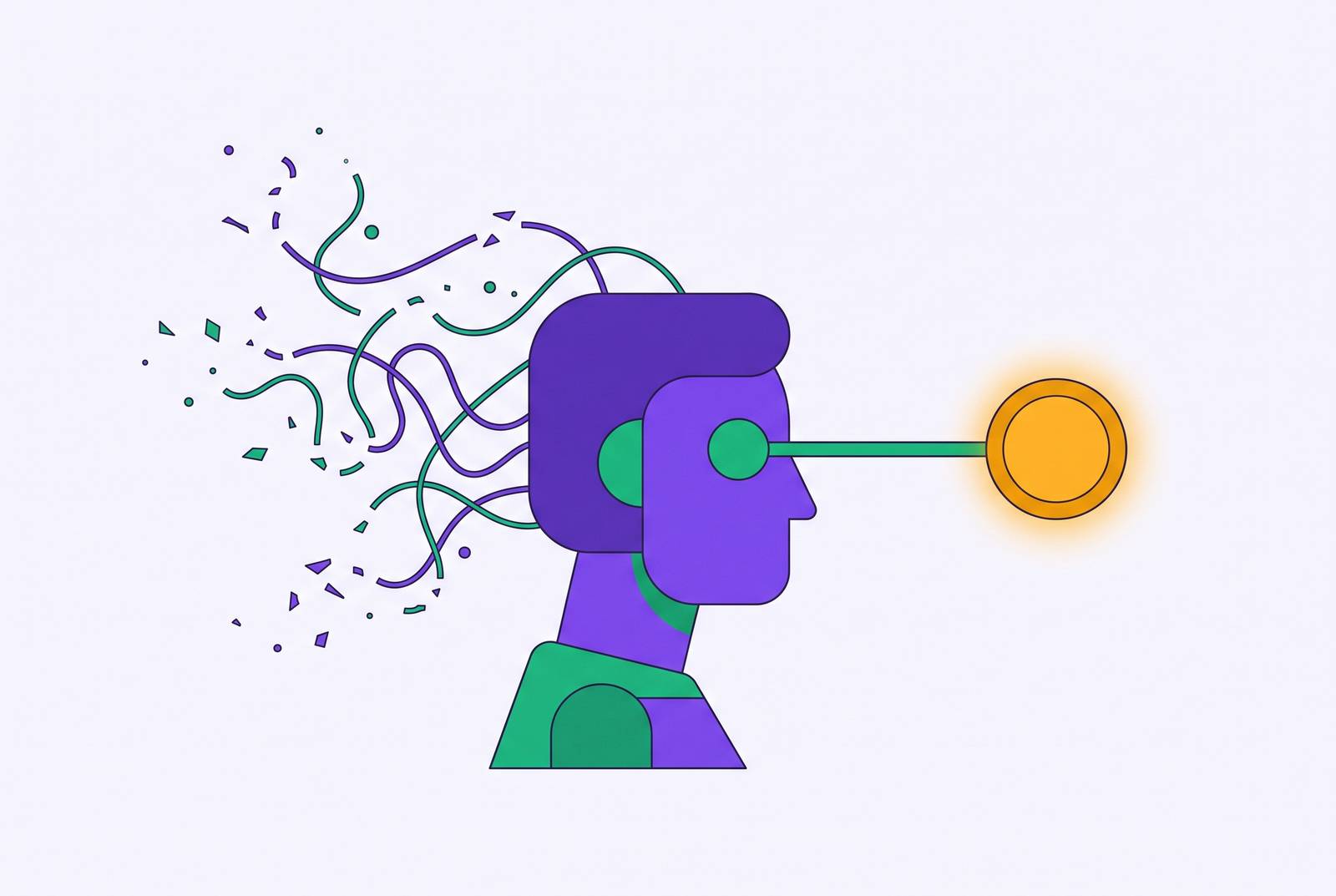
None of this points toward multitasking as a trick to learn or unlearn. It points toward single-tasking as the format that actually matches how the brain is built. Single-tasking strategies work because they remove the exact conditions that trigger switch costs, interruption debt, and working memory overload.
Professor Sali's prescription is straightforward: close unnecessary browser tabs, put the phone away or on silent, and commit to one task for a fixed stretch of time. The strategy works for a specific mechanical reason: it removes the stimuli that would otherwise trigger an involuntary switch before the switch cost even has a chance to build up. No open tab means no temptation to glance over. No buzzing phone means no reflexive goal shift. Each removed trigger is one less moment where the brain has to pay the two-stage tax of goal shifting and rule activation.
Where this breaks down is rarely the strategy itself. It's the environment around it. An open-plan office interrupts people by design, Slack and email run on notification schedules built for immediacy, and workplace culture still treats a crowded inbox as a sign of being in demand rather than a sign of fragmented attention. A person can close every tab and silence every phone, and still get interrupted every two minutes by the structure of the workplace itself. That gap between personal discipline and organizational design is the honest limit of any single-tasking advice. The evidence for single-tasking is strong. Whether it holds up in practice depends less on willpower and more on whether the workplace around a person is built to protect attention or built to fracture it.
Sources
- The Myth of Multitasking: How Focus Unlocks Your Full Potential - Resilience Institute
- Multitasking? Maybe not.
- Cognition and Multitasking: The Science Behind the Struggle
- The Myth of Multitasking: What Neuroscience Actually Says
- Multitasking: Switching costs
- Digital multitasking and hyperactivity: unveiling the hidden costs to brain health - PMC
- (PDF) Supertaskers: Profiles in extraordinary multitasking ability
- The True Cost of Multi-Tasking