Managing Attention in a Distraction-Heavy Environment
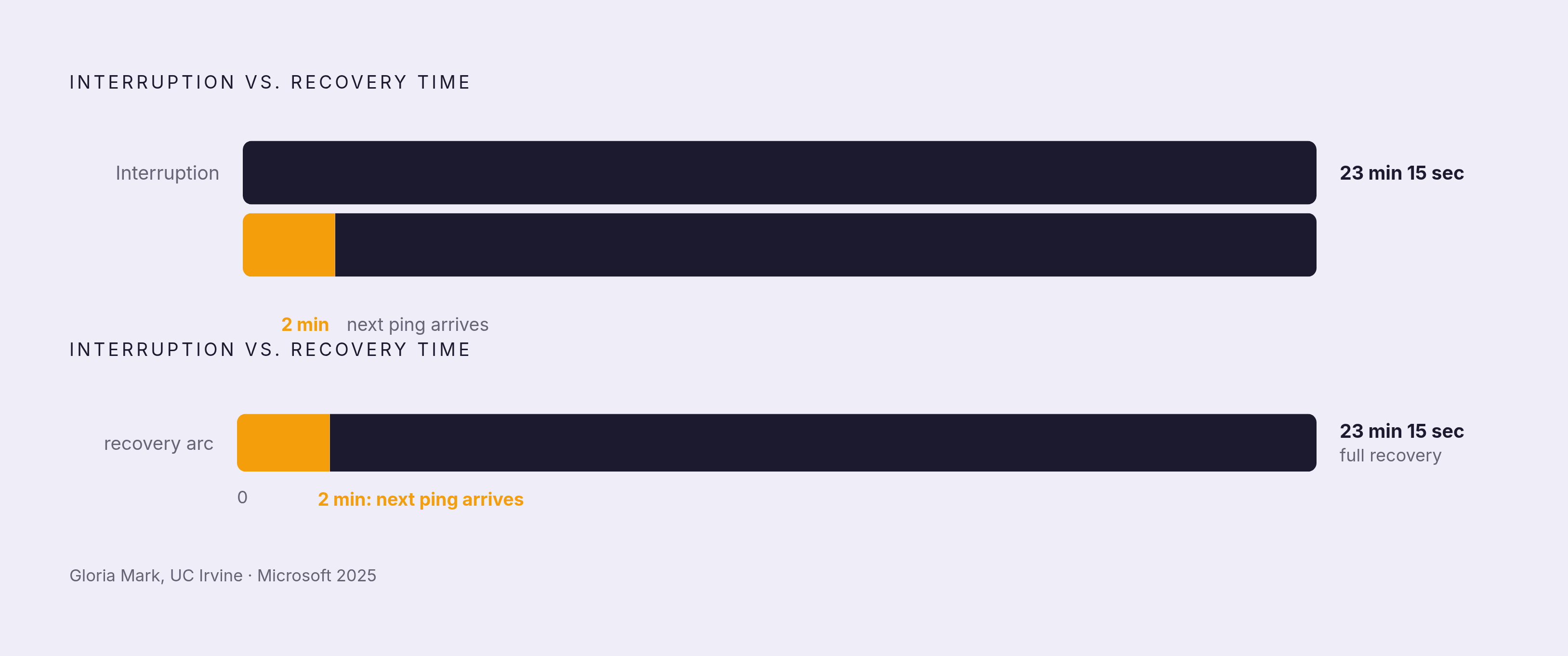
Interruptions arrive every two minutes, but recovery takes twenty-three.
Attention management means treating focus as something you actively direct, not something that just happens while you sit at a desk long enough. Author Maura Thomas made this distinction the center of her 2019 book Attention Management: time moves at the same rate no matter what you do, so you can't actually manage it. What you manage is attention, and attention isn't fixed the way minutes are. Two hours can produce a finished draft or produce nothing, depending on how much of your mind was actually in the room.
The World Economic Forum's Future of Jobs 2025 report lists "Attention Control and Focus Management" among the top ten skills workers will need in the coming decade. That ranking only makes sense once you see how much of the workday currently gets lost to the opposite of it.
How much focus the average workday actually destroys
Start with the total: workers lose roughly two hours of focus per day to distractions. Add that up and it's about 10 hours a week, 520 hours a year — a staggering share of working time spent not doing the work in front of you.
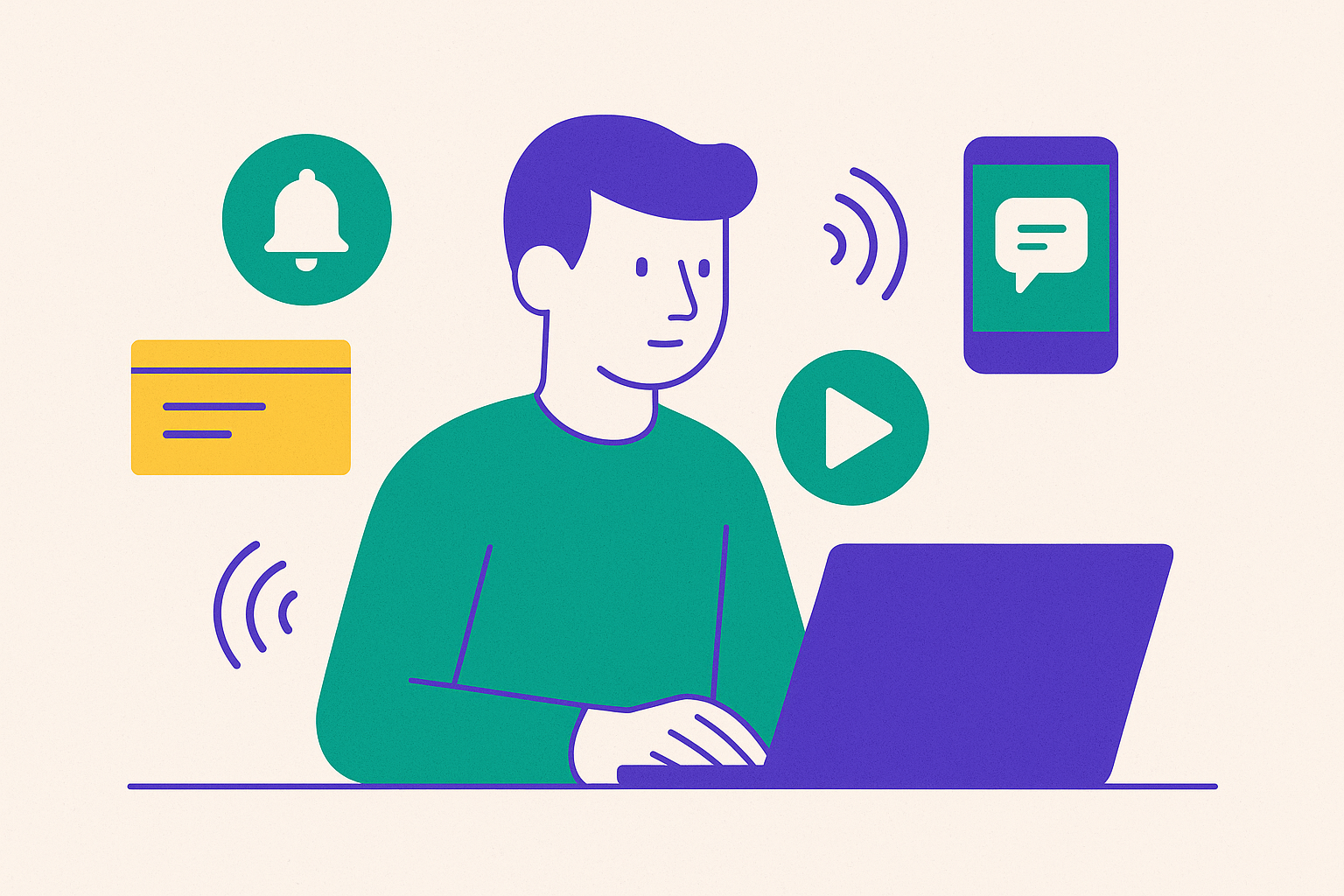
Microsoft's June 2025 workplace data gets at the mechanism behind that number. The most heavily interrupted employees received an average of 275 notifications across an eight-hour workday, roughly one every two minutes.
Most people read a number like that and reach for the same fix: more discipline, try harder to ignore the ping. That diagnosis is wrong, and it's worth saying plainly, because it blames the person instead of the system generating the pings. A stream of interruptions arriving every two minutes isn't testing willpower. It's testing something willpower was never built to handle. So what does an interruption actually do to the brain once it lands, and why does getting back on track take as long as it does?
What an interruption actually does to the brain, and why 23 minutes is not an exaggeration
Gloria Mark's landmark study at UC Irvine tracked workers through entire days, logging every interruption and every task switch. The number that's been quoted ever since: after a single interruption, it took an average of 23 minutes and 15 seconds to return to the original task at the same depth of focus.
Even that figure undersells the mess. Workers didn't go straight back to what they'd been doing. Research tracking task-switching behavior found they drifted through an average of 2.26 other tasks first before circling back. Run that against Microsoft's interruption rate: if pings arrive every couple of minutes and each one costs 23 minutes of recovery, nobody finishes a single recovery cycle before the next interruption lands. Sustained focus isn't a discipline problem in that kind of environment, it's an arithmetic problem, and no amount of trying harder changes the math.
Performance doesn't snap back to where it was, either, once the return happens. Mark calls this attention residue: the interrupted task keeps competing for mental bandwidth even once you're nominally back on the original one. Workers compensate by speeding up, but that speed buys nothing for free. It comes with more stress, more frustration, a persistent sense of being chased by the clock. Output volume might hold. Quality of thought doesn't.
Mark's 2023 book Attention Span tracks how this got worse over time. Average time spent on a single screen before switching away fell from 2.5 minutes in 2004 to about 47 seconds now. That's not a difference of degree from 2004, it's a different mode of working entirely.
Two separate brain systems explain why. The dorsal attention network handles sustained, goal-directed focus, the kind needed to write a report or debug code. A second attention system is built to notice novelty and scan for anything new or unexpected. Every notification pings that system directly, tapping circuits that reward the discovery of new information. Distraction feels rewarding in the moment, which is exactly what makes the next distraction easier to fall into.
None of this happens in a vacuum. Long before anyone opens a browser tab, the physical space someone works in has already started shaping how often their attention gets pulled.
How the physical workspace engineers distraction before anyone opens a browser
The open-plan office was sold as a collaboration tool. Whatever else it delivered, it did not deliver that. A systematic review that screened more than 10,000 papers and synthesized 31 studies on the topic found not one showing a productivity benefit from open-plan layouts. Not one. An entire architectural trend, adopted across the corporate world, was built on a premise the research never actually supported. If collaboration was the real goal, tearing down the walls was the wrong tool from the start, and the data says so plainly.
Jabra's 2024 "Sound Better" study, covering 2,000 workers across the US, UK, Germany, and France, found 63% of knowledge workers struggle to concentrate because of office noise, and one in ten said they regularly hide in the bathroom just to get some quiet. That's not a comfort complaint. That's people physically relocating to a bathroom stall because the floor plan gives them nowhere else to think.
The cost is measurable, too. A conservative model built from more than 30 lab studies puts the cognitive hit from intelligible background speech at around 7%, and that's the cautious estimate, given some underlying studies reported drops as steep as 41%. Interventions that reduce noise only produced an average gain of about 1.7% in productivity, a thin return given how much money gets thrown at fixing it after the fact.
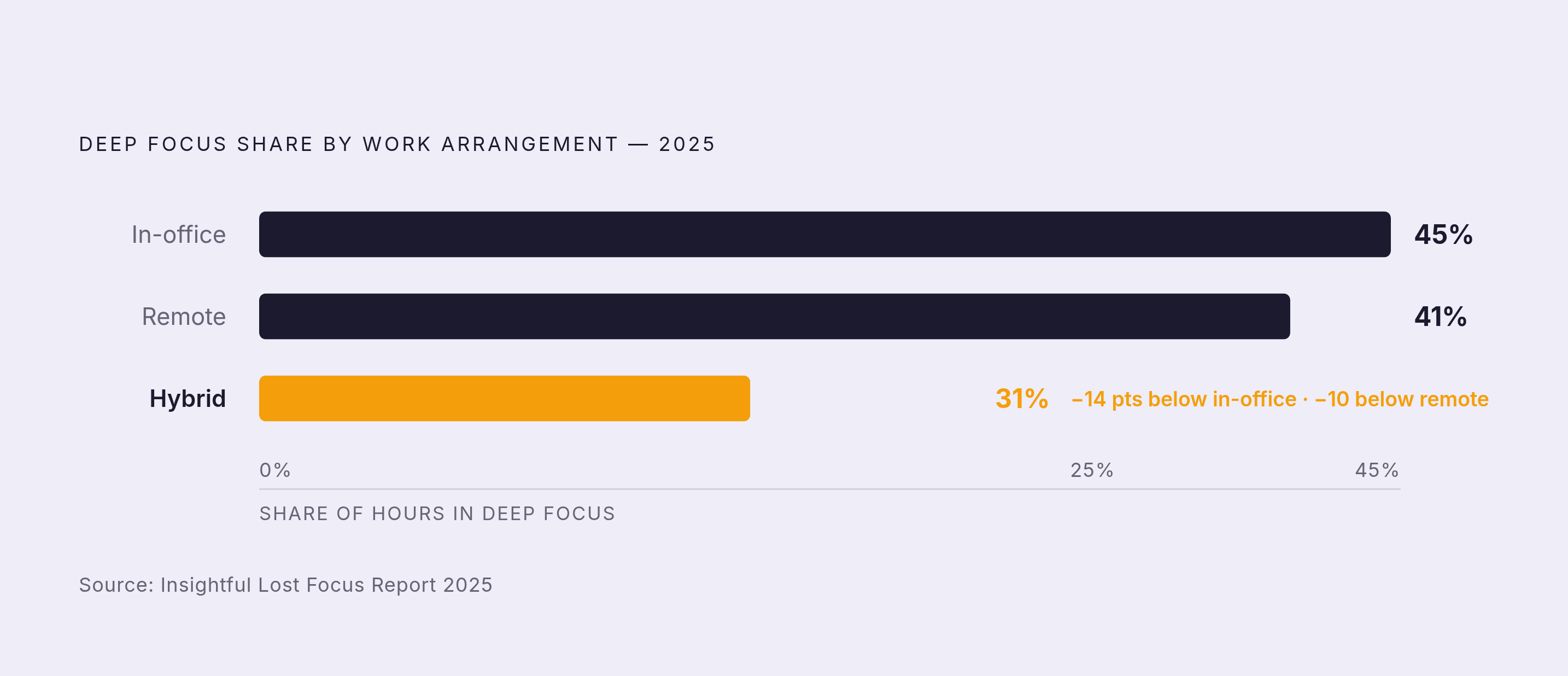
Where people work shapes how much deep focus they get, and the pattern isn't what you'd expect. Insightful's Lost Focus Report 2025 found fully remote teams spend 41% of their hours in deep focus, hybrid teams 31%, and in-office teams 45%. In-office edging out remote is a little counterintuitive given everything above, but the real story is the hybrid dip. Splitting time between environments seems to erode focus more than committing fully to either one, and if that holds, the "flexible" middle ground companies keep defaulting to is probably the worst structural choice on the table, not the safest.
Companies are responding, just not by rethinking the open floor plan itself. The office partition and panel wall market is projected to grow from $8.78 billion in 2025 to $12.53 billion by 2031. Organizations are spending heavily to wall off the very openness they built a few years back, which tells you something about how that original bet turned out.
Nobody gets to fully control their office layout, though. What people can control is what's sitting on their desk, and that turns out to matter more than most assume.
The device in the room: how phone presence drains attention even when unused
A phone doesn't need to buzz to cost you focus. A May 2025 experimental study out of the National and Kapodistrian University of Athens, running participants aged 18 to 25 through the Attention Network Test, found measurable attentional deficits just from having a smartphone present in the room, whether anyone touched it or not.
Most advice around phones aims at the wrong target. Half of employees name their phone as the primary source of distraction at work, and the instinctive fix is to mute notifications. But researcher Heitmayer's work shows only 11% of smartphone interactions are actually triggered by a notification. The rest are self-initiated, people reach for the phone on their own, unprompted, which means muting notifications solves a small slice of the actual problem and leaves the rest completely untouched.
Proximity does the rest of the damage on its own. When a phone sits within arm's reach, people engage with it nearly twice as often and check it about three times more frequently than when it's out of reach. That pull operates below conscious decision-making, which is exactly why willpower alone loses to it.
Restriction doesn't fix it either. Research suggests that blocking one source of distraction often just shifts wandering attention elsewhere rather than eliminating it. Swap the device, keep the pattern intact, which should tell you the phone itself was never really the problem.
So the real lever isn't removing the phone from the room. It's understanding your own distraction triggers well enough to build habits around them, instead of hoping a rule does the work for you. That shift, from diagnosing the problem to practicing something different, is where the structural fixes actually start to matter.
Deep work and time-blocking as the structural fix for fragmented attention
Cal Newport's 2016 book Deep Work named the state this whole piece has been circling: distraction-free concentration on cognitively demanding work, pushed to the edge of what your mind can handle, producing results fragmented attention simply cannot replicate. He contrasts it with shallow work, things like email or routine scheduling, which get done fine with a divided mind.
There's a practical reason deep work feels different from busywork. Real focus takes time to build and any interruption tears it back down. Which is what makes Research findings sting here: half of all meetings happened during the two windows shown to be prime for deep work, 9 to 11 a.m. and 1 to 3 p.m. Most organizations are scheduling their collaboration exactly when focused work was most available, and that's not an innocent coincidence. That's a calendar problem, and it belongs to the organization, not to the individual sitting in the meeting wishing they were somewhere else.
Time-blocking is the practical fix for that mismatch: designate specific chunks of the calendar as protected focus time and treat them the way you'd treat a meeting, as a commitment you don't casually cancel. The point isn't trying harder to focus. It's removing the conditions that make interruption possible in the first place.
The Pomodoro Technique, 25 minutes of focused work followed by a 5-minute break, lines up with research suggesting the brain can hold intense focus for around 25 minutes before fatigue sets in. Treat it as a rhythm, not an endurance test. Research draws a useful line between planned attention shifts, taken at natural stopping points, and involuntary fragmentation. The planned kind lets the brain's default-mode network consolidate what it just processed. The involuntary kind just tears it down again.
Research has found that 90-second micro-breaks — stretching, grabbing water, brief movement — sustained attention better across a session than one long traditional break in the middle. Frequent, deliberate pauses beat occasional long ones. This is also where certain AI tools earn their keep: surfacing relevant context right when it's needed and handling low-depth coordination in the background cuts the mental overhead of re-orienting after a break, which is what actually lets protected focus time stay protected.
Mindfulness as attention training, with realistic expectations about what it delivers
Set aside the idea that mindfulness is about relaxation or stress relief. In this context, it's attention training, plain and simple: noticing where focus has drifted and pulling it back, over and over, which is exactly the skill attention management asks for.
Research has found that a single short mindfulness session can produce measurable cognitive shifts, with participants showing quicker reaction times and fewer task-unrelated thoughts on attention tests than a control group. That's a measurable cognitive shift from one short session, not a vague feeling of calm.
Be honest about the ceiling here, though, because the wellness industry usually isn't. A broader 2025 systematic review and meta-analysis (PROSPERO registration #191756, spanning thousands of participants across 22 studies) found mindfulness-based programs improved task performance compared to passive controls, with an effect size of 0.25. Real, but modest. And when mindfulness got compared against active control groups instead of passive ones, that advantage disappeared entirely. Mindfulness isn't uniquely powerful, and it isn't the singular fix some of its marketing implies. It's reliably better than doing nothing, which is a smaller and more useful claim to make of it.
Experienced long-term meditators did outperform beginners, with an effect size of 0.32. But short, well-structured programs delivered comparable benefits in the same research, and what seemed to matter most wasn't session length. It was consistency of practice. Ten minutes a day, done regularly, is a realistic way to build attentional capacity over time. Not a transformation, a marginal gain that compounds, which over a year adds up to something worth having.
Notification management that actually works, and why banning devices misses the point
The instinct is to treat the tool as the enemy: turn off notifications, restrict the phone, block distracting sites. That instinct is the wrong one, and it's the most common mistake in how people try to fix their own attention. Heitmayer's research already showed that cutting off smartphone access just pushes the same wandering behavior onto a computer instead. Different device, same pattern, nothing solved.
And since only 11% of phone interactions are notification-triggered, muting notifications alone leaves most of the underlying habit completely untouched. The distraction was never really about the buzz. It was about the hand reaching for the phone with nothing prompting it, a habit problem, not a settings problem, and settings-level fixes will keep failing against it.
A November 2025 meta-analysis in Frontiers in Psychology, synthesizing 32 studies on digital reading, found a meaningful negative effect of attentional distraction on reading comprehension in networked environments, effect size -0.6411. Researchers checked whether the type of distraction or the mental effort it demanded changed that effect, and it didn't, not at a statistically significant level. That points toward a narrower target: the goal isn't total silence, it's cutting the high-effort, high-interruption stimuli specifically during the hours that need deep cognitive work.
What actually holds up against the evidence:
- Batching notification checks at set times instead of reacting to each one, protecting the recovery cycles interruptions would otherwise wreck
- Physically moving the phone to another room rather than turning it face-down, given the Athens 2025 finding that mere presence causes attentional deficits
- Building attention literacy: knowing your own triggers, your peak focus windows, and how long recovery actually takes for you
- Changing team norms, not just individual habits, since Microsoft's data on meetings saturating peak focus hours shows no amount of personal discipline fixes a calendar that was never built to protect anyone's attention
AI tools that quietly handle low-depth coordination work, routing messages, summarizing updates, keeping context organized across tasks, cut the number of reactive interruptions pulling people out of focus, without asking anyone to make a fresh willpower decision every time a message lands.
Treating attention as a skill to build, not a problem to solve once
Put the whole picture together and a pattern emerges. The idea starts with a simple distinction, you manage attention, not time, scales into a measurable daily loss, gets explained at the level of brain mechanics, gets shaped further by office layout and phone proximity, and finally gets addressed through structured practice: deep work blocks, mindfulness, smarter notification habits.
None of these are fixes you apply once and walk away from. Attention doesn't behave like a switch you flip to "focused" and leave there. It behaves more like a muscle, responding to consistent, deliberate practice and wasting under constant interruption. The workday will keep generating pings, the open office isn't disappearing overnight, and the phone will keep sitting there, tempting, whether it buzzes or not.
The skill lives in the ongoing practice of noticing where attention has gone and redirecting it, again and again, not in finding the one rule that makes the problem vanish for good. Judged against that standard, the strictest phone ban or the quietest office isn't what separates the workers and organizations making real headway. What separates them is training focus deliberately, the same way anyone trains a skill that pays off over years rather than days.