Productivity System Failure Patterns and Fixes
Most productivity systems fail at one broken link, not because people lack discipline.
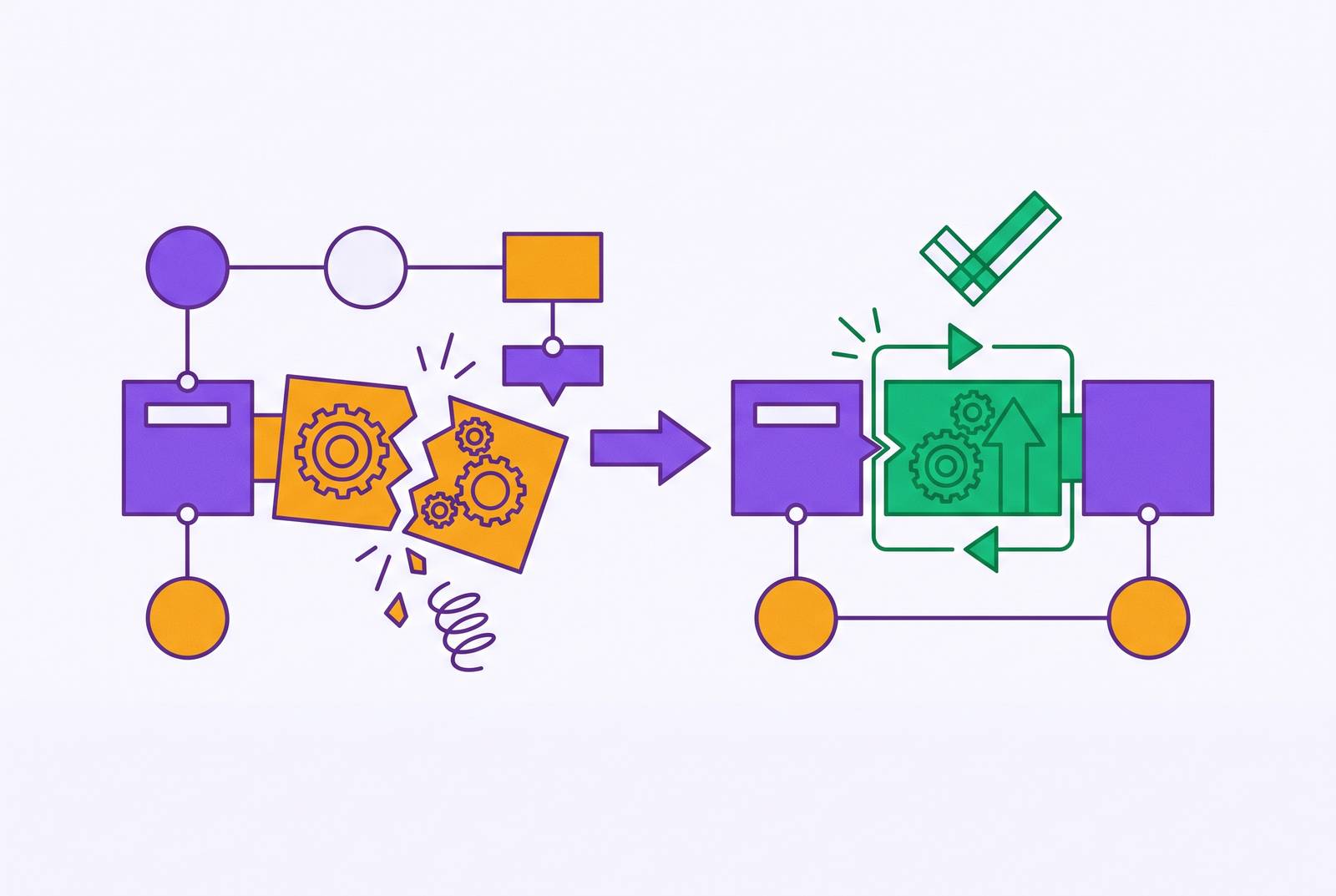
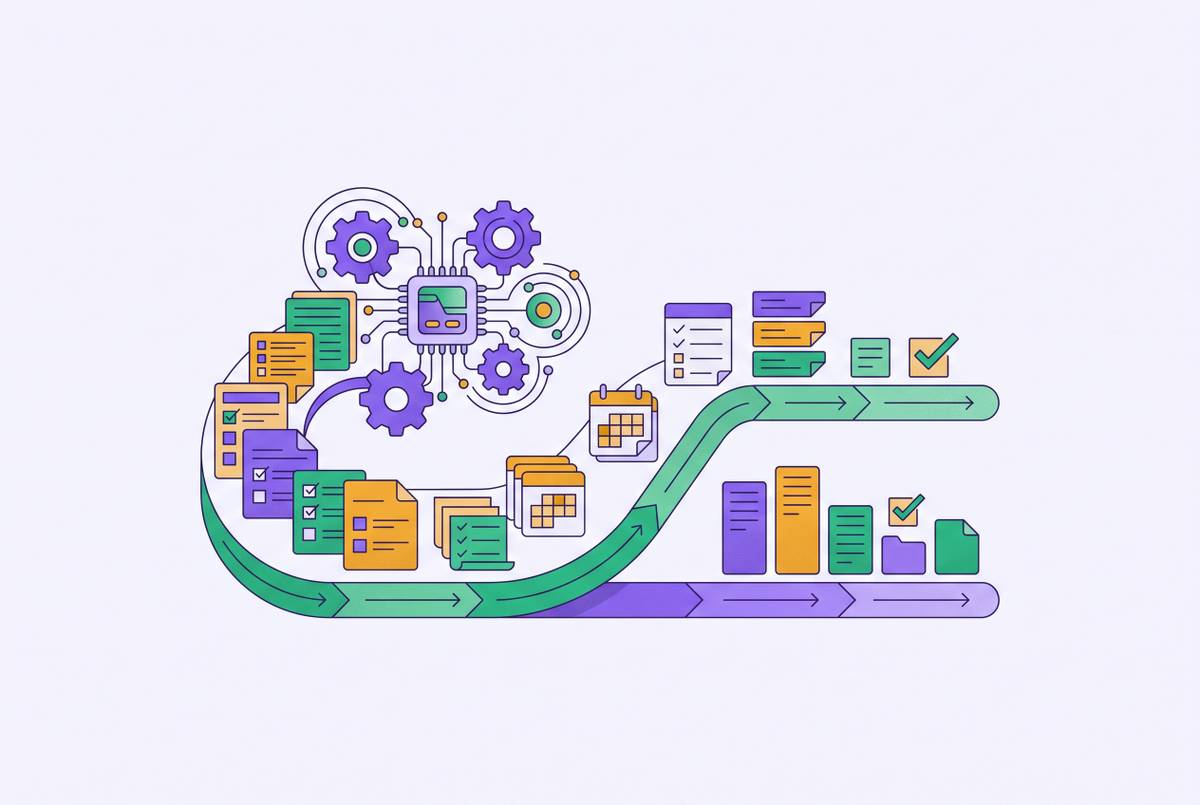
Slack's own research puts a number on something most people suspect but can't quite prove about their own jobs: 73% of workers say they don't have the right systems to get real work done. That number matters because it rules out the laziness explanation before anyone reaches for it. Most people chasing a better planner aren't undisciplined. They're running a system with one broken part, and they usually can't name which part it is.
Masicampo and Baumeister's 2011 research found something worth sitting with: making a specific plan for an unfinished task quiets the intrusive thoughts about it almost as much as finishing the task does. So the brain doesn't need completion. It needs proof the task landed somewhere it won't get lost. That single finding explains why so much of productivity design is really just architecture for trust: building a place the brain believes it can stop guarding.
Five failure patterns account for nearly every broken system worth diagnosing: over-engineering, productivity theater, the planning fallacy, energy mismatch, and context switching. Each has a specific, minimum-viable fix, and none of them require torching the whole setup and starting over. That instinct, the full rebuild, is the wrong move almost every time, and it's worth saying plainly up front: rebuilding from scratch is almost never correct. Fixing the one broken link almost always is.
What a productivity system can and cannot fix
Skip this question, and a person ends up rebuilding the same calendar app for the third time this year. No system fixes a workload that's genuinely too big. No app schedules its way out of a role that's structurally broken, or out of burnout that needs rest instead of a better task list.
Research finds that 41% of the workday goes to tasks employees themselves admit add no value. When that number reflects how a team or a role got structured in the first place, no capture method or prioritization framework moves it an inch. That's an environment problem, not a system problem, and the two get solved in completely different rooms: one with a notebook, the other in a conversation with a manager. Confusing the two is how months disappear.
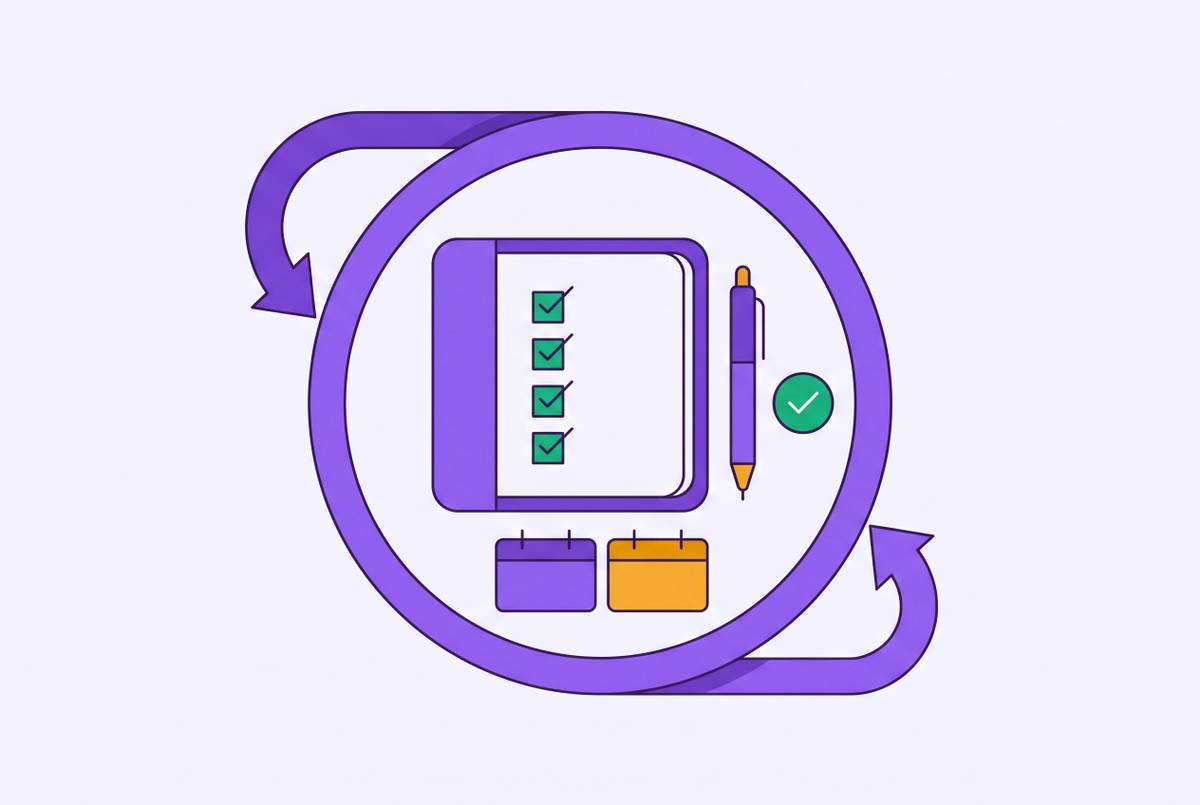
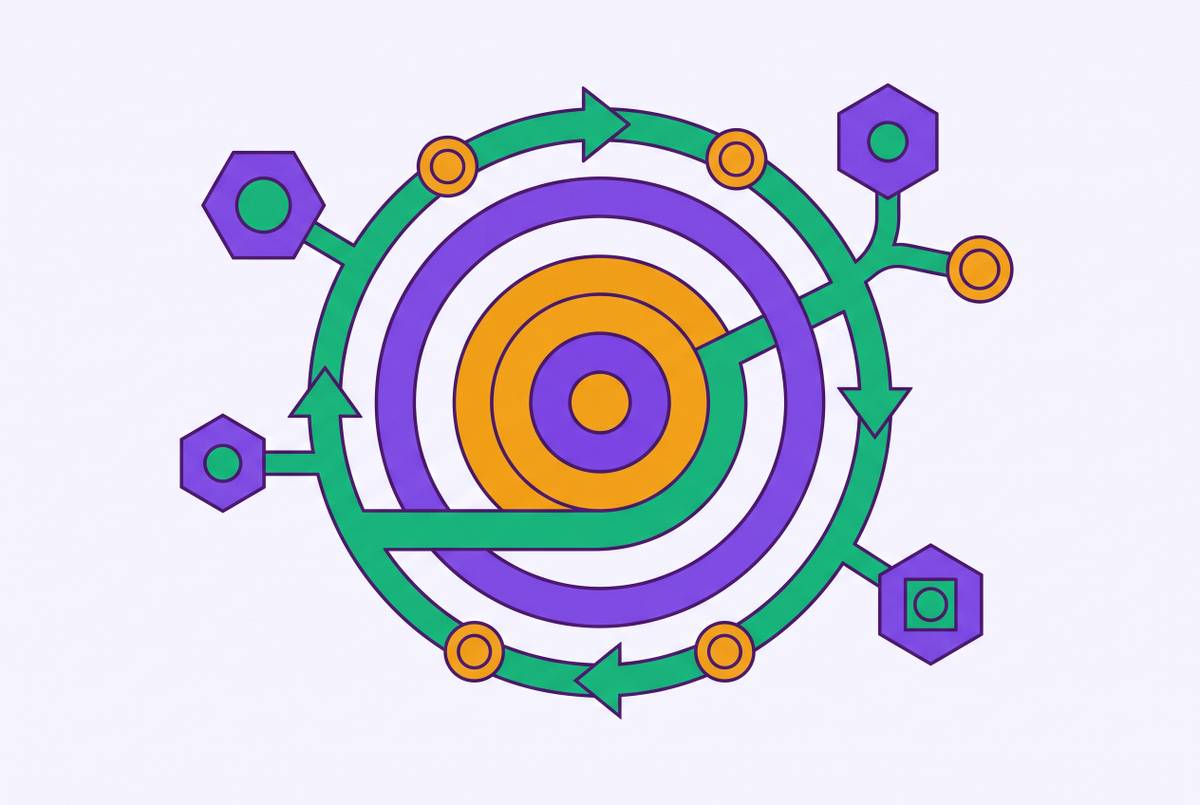
The CORE Loop is worth borrowing here: Capture, Organize, Execute, Review. Every failure pattern in this piece traces back to one of those four links breaking. So before diagnosing anything, ask the simpler question first: is the friction inside your control, or outside it? Outside, and no system fix applies, full stop. Inside, keep reading.
Over-engineering: when the system costs more to maintain than the work it manages
Getting Things Done, David Allen's 2001 method, is still the clearest case study in this failure mode. The weekly review alone commonly runs about two hours. Skip one, and the backlog doesn't just double, it compounds, because two weeks of undigested input are now competing for the same two-hour slot. One missed review drags the rest of the chain down with it.
Setup feels like work. That's what makes the trap so easy to fall into. Color-coding a system, building templates, watching one more tutorial on the "ideal" tagging structure: all of it delivers the reward of being organized with none of the discomfort of doing something hard. Elaborate maintenance can become a more respectable form of procrastination than scrolling a phone, but it's procrastination all the same, just wearing a nicer outfit.
Most people over-build long before they ever under-build, and that's worth saying plainly. The fix is almost insultingly simple. Start with pen and paper, or one notes app, and add complexity only when a specific bottleneck actually demands it, never because a video suggested a new layer. A good system is the minimum structure that supports real decisions. Anything past that is overhead dressed up as progress.
One diagnostic question cuts through most of the confusion: skip maintenance for a week, and does the whole thing collapse? If yes, it was over-engineered from the start.
Productivity theater: planning that substitutes for execution
Deloitte's 2025 data puts a number on something a lot of office workers already suspect about their own days: 43% spend more than 10 hours a week looking busy without producing real output. That's a full workday, every week, spent on activity that resembles work closely enough to fool a calendar, but not closely enough to move anything forward.
Why does this happen so consistently? Planning pays off immediately. There's no ambiguity in making a list, no judgment attached to color-coding a calendar, no real risk of doing it badly. Execution carries all three costs at once, so given a choice between a cheap loop and an expensive one, the brain takes the cheap one, over and over, without the person ever deciding to do so on purpose.
Microsoft's research shows the gap directly: 68% of workers report not having enough uninterrupted focus time, yet those same people average 4.1 hours a day on activities they'd call low-value if asked honestly. That daylight between what people say they need and what they actually do with their hours is the theater gap, measured in hours instead of vibes.
The wrong fix here is more planning tools. The right one is shrinking the planning surface, starting with time-boxing the ritual itself. If planning a task takes longer than a fraction of the time doing it would take, that ratio is the tell. Implementation intentions, the if-then triggers studied across 94 experiments by psychologist Peter Gollwitzer, work because they swap open-ended deliberation for an automatic trigger at the exact moment of execution. The research on implementation intentions suggests daily use of these triggers builds automaticity over time: the behavior gets easier to repeat the more it runs, not harder.
The planning fallacy: building schedules for an idealized self
Daniel Kahneman and Amos Tversky named this pattern in the 1970s: people underestimate how long tasks take, consistently, even when their own history says otherwise. Not once. Repeatedly, project after project, with the evidence sitting right there in last month's calendar the whole time.
This isn't a knowledge gap. People know their track record, they just believe that this time, things will go according to plan. Best-case thinking crowds out the base rate every time a new task lands on the list, and no amount of past evidence seems to interrupt it.
Monday's plan gets built for a version of the person with full energy, zero distractions, and no unplanned meetings on the books. Tuesday shows up instead: bad sleep, a surprise call, a decision that eats more willpower than budgeted. Most people blame themselves for falling short, but the actual failure was a plan built on a Tuesday nobody has ever lived through. No amount of discipline fixes a schedule written for a person who doesn't exist.
Building for the person who actually shows up means working from real data instead of hope: how long did the last three similar tasks take, on average, not at their fastest? Buffer time isn't an admission of weakness. It's a structural acknowledgment that capacity moves around day to day, and pretending otherwise is where the fallacy lives. Energy and context belong in the plan as inputs, not as excuses that show up after the fact to explain the miss. Keeping an "ideal week" and a "realistic week" as two separate planning modes helps here, because collapsing them into one is exactly how Monday's optimism turns into Tuesday's disappointment.
Energy mismatch: scheduling cognitive demands against depleted resources
Time management, as a concept, got built for factory output: fixed hours, fixed output, one input mattering more than any other. Knowledge work doesn't run on that logic. It runs on energy, and treating hours as the only unit that counts is where a lot of otherwise sound systems quietly fall apart.
The brain burns roughly 20% of the body's total energy despite being a small fraction of its weight, and different kinds of work drain that budget at different speeds. Creative work costs more than routine execution. Deciding costs more than simply doing something already decided. The body also runs on ultradian rhythms, cycles of peak focus lasting somewhere around 90 to 120 minutes followed by a natural dip. Scheduling demanding work into one of those dips isn't a discipline failure. It's a mismatch between the task and the fuel actually available to run it.
It follows that cognitive resources don't stay constant across a day or a week, shifting with whatever demands have already run through the system. Stable output doesn't come from a rigid schedule demanding identical performance every day. It comes from a system loose enough to bend around the days that don't go as planned, and most systems aren't built with that give.
The fix starts with tracking energy and focus for a trial stretch, long enough to see the personal pattern, since peak windows differ from person to person. Once the pattern's visible, cognitively demanding work goes into the peaks, and administrative work goes into the dips. Some AI-assisted tools now surface these patterns automatically across a calendar and task history, flagging low-energy slots without manual tracking, which removes a layer of meta-work that used to be its own separate burden. And on the days the ideal schedule falls apart entirely, the fix isn't more willpower. It's a deliberate low-capacity mode built into the system on purpose, one that keeps the whole thing alive instead of demanding a perfection it was never going to deliver that day anyway.
Context switching and tool sprawl: how fragmented environments destroy focus
Okta's 2025 Businesses at Work report found the average company now runs 101 apps, after years of hovering below 90. That's not a gradual drift. That's a jump, and every one of those apps is a place attention has to travel, even briefly, before it can come back to the actual work.
Asana's 2023 study found employees switch between 10 or more apps daily, at a cost of 3.6 hours a week in lost efficiency. Microsoft's 2025 Work Trend Index puts interruptions during core work hours at roughly 275 per day, close to one every two minutes. Under that kind of fragmentation, 45% of workers say switching made them less productive, and 43% report outright fatigue from the constant shifting between contexts.
Research has found something sharper still: heavy multitasking can produce a temporary IQ drop of up to 10 points. That's not a metaphor. That's a measured cognitive cost, and it shows up in the quality of every decision made mid-switch. Gartner puts the financial version of the problem at around $90 billion globally, roughly 30% of SaaS spend wasted on licenses nobody uses, features nobody opens, and apps duplicating something another tool in the stack already does.
More apps is almost never the answer here, and it's worth saying plainly since it's the instinct most people reach for anyway. Fixing this starts with an audit, one blunt question run against every tool: which of these is actually load-bearing, and which one just duplicates a function covered somewhere else already? Notification policy deserves the same deliberate design that task management gets, since an unmanaged stream of pings undoes whatever prioritization work sits underneath it. Some newer AI tools pull context forward across a fragmented stack instead of adding one more silo to check, lowering the switching cost without asking for another login to remember. Fewer transitions in the first place, that's the actual target, not more apps to manage the transitions between apps.
Misdiagnosis: applying the wrong fix to the right symptom
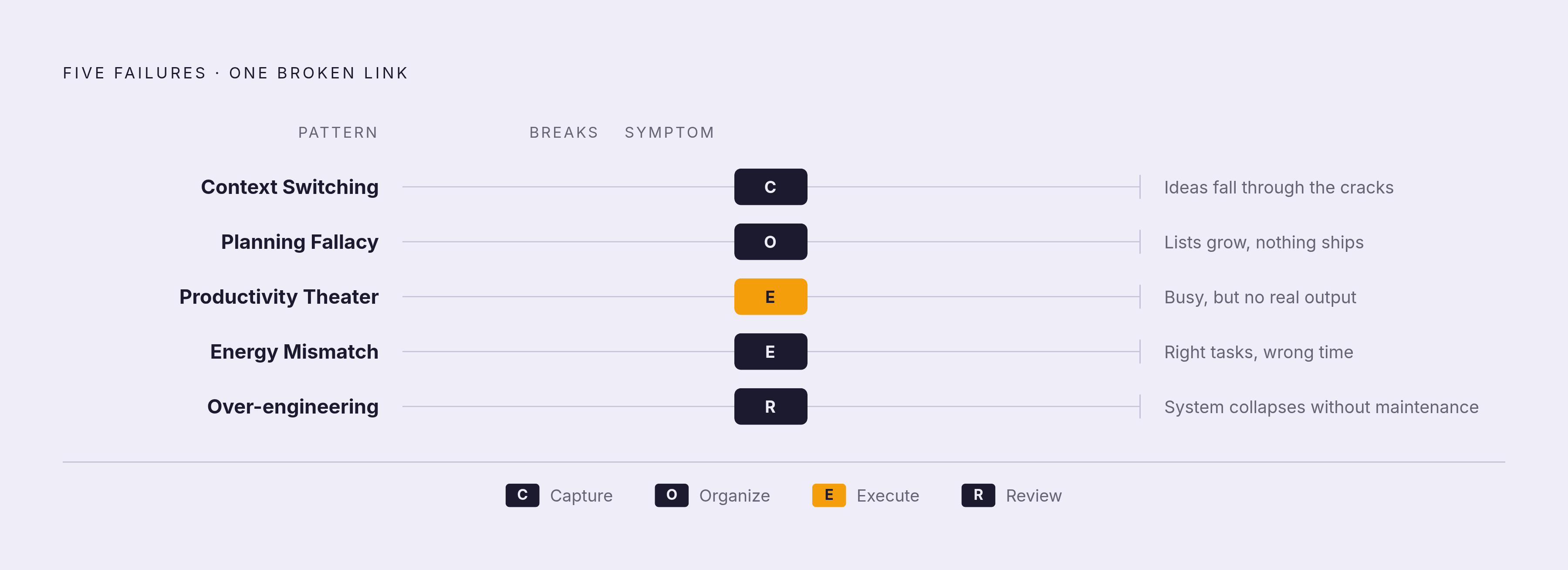
Most people who go looking for a new productivity system start from a vague feeling: not getting enough done. That feeling, on its own, isn't a diagnosis. It's a symptom with at least five possible causes, and the fix depends entirely on which one actually applies. That's exactly the step most people skip.
Replacing the entire system is almost never the right call, and it's worth arguing against directly, since it's the default move the moment something feels broken. Usually one link in the CORE Loop is broken, not all four. Tasks falling through the cracks points to a capture failure. Working hard on the wrong things points to a prioritization failure. Plans that only work for a person who doesn't show up by Tuesday point back to the planning fallacy or an energy mismatch. Constant interruption and never reaching flow points to context switching and tool sprawl. Spending more time managing the system than doing the work points to over-engineering or productivity theater.
One case deserves its own callout: ADHD and executive function differences. A lot of the maintenance work that popular productivity methods demand, sorting, reviewing, categorizing, is itself an executive function task, sitting between the person and the work they're actually trying to start. The diagnosis matters here specifically because the fix looks different: lower-friction triggers, and handing more decisions over to the system itself instead of asking the brain to hold them all in working memory.
One more thing worth knowing before abandoning a fix too early: habit formation timelines vary widely from person to person. There's no single universal number of days that applies across the board, and knowing that prevents the common mistake of dropping a good fix simply because it hasn't gone automatic yet.
The best productivity system isn't the one that looks impressive on a good day. It's the one that still holds up on the worst one, when sleep was bad, the calendar got wrecked by surprise meetings, and nothing went according to plan. Durability under a bad week says more about a system's design than elegance ever says about it under ideal conditions that mostly don't exist anyway.