ADHD Task Avoidance Versus Procrastination in Knowledge Workers
ADHD task avoidance and procrastination look identical but require different fixes.
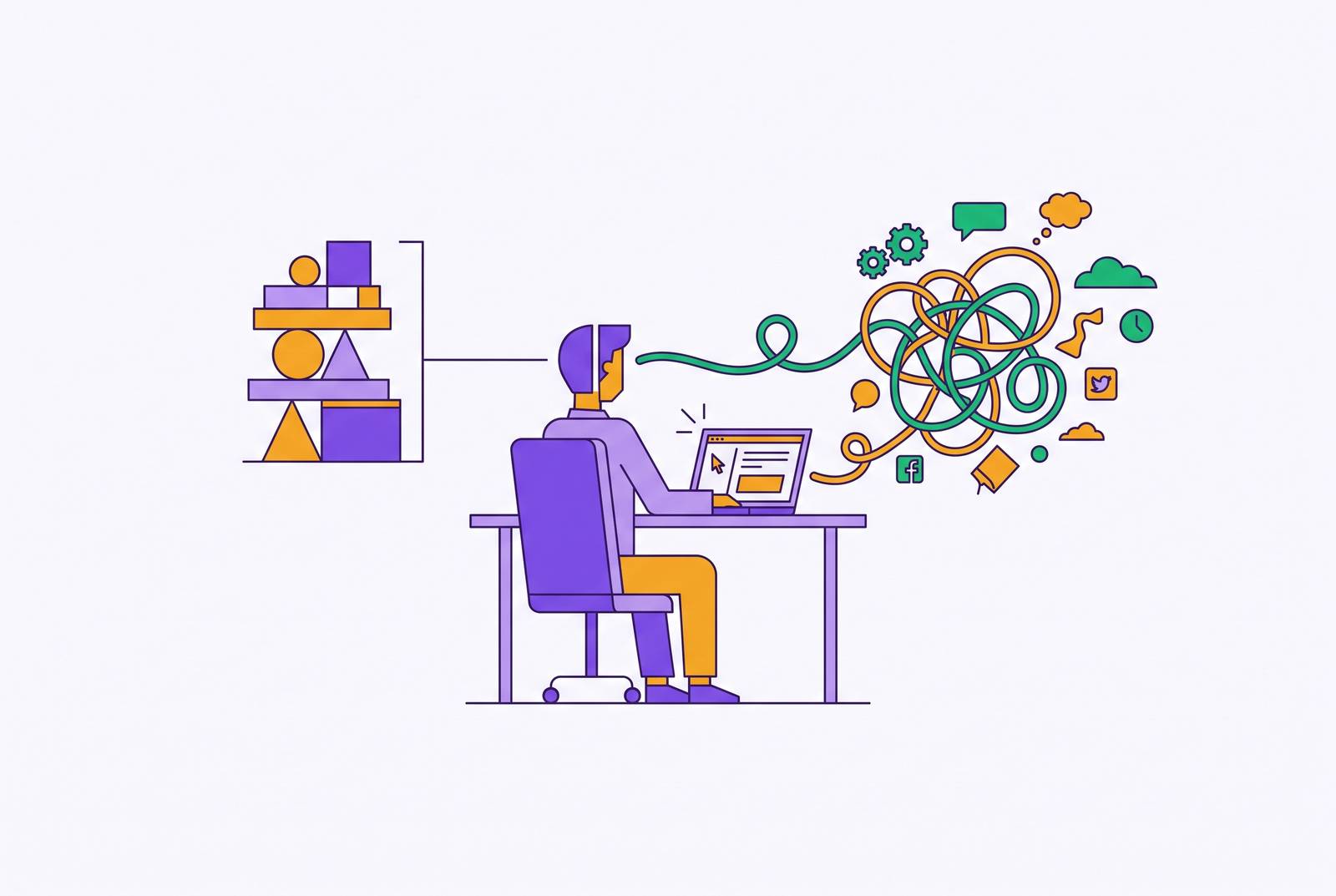
An important deliverable sits untouched on the calendar, but three smaller, easier tasks get knocked out around it. The inbox fills with guilt. The deadline gets closer. For knowledge workers, this pattern can come from ordinary procrastination or from ADHD-driven task avoidance, and from the outside, nobody can tell which. Both end in missed starts, deferred deliverables, and the same guilt-laden inbox. A task not done looks identical whether its cause sits in a neurological difference or a situational one. That surface sameness is why managers, colleagues, and the person stuck in the loop reach for the same generic fixes, no matter what's actually driving the avoidance. Those fixes work sometimes and fail other times, with no clear pattern the person can point to, and that inconsistency chips away at self-trust in a way that often deepens the avoidance it was meant to solve.
The surface similarity is precisely why generic fixes fail inconsistently: they treat two neurologically distinct problems as one. Tools built to learn a person's patterns and contextual triggers, including AI assistants with persistent memory, can make the difference visible by tracking not just when tasks get deferred but the emotional and environmental conditions surrounding each instance of avoidance. That kind of tracking can start to reveal whether the root cause looks like procrastination's reward loop or ADHD's structural differences, which matters because the two call for different fixes.
What procrastination is, stripped of the moral framing
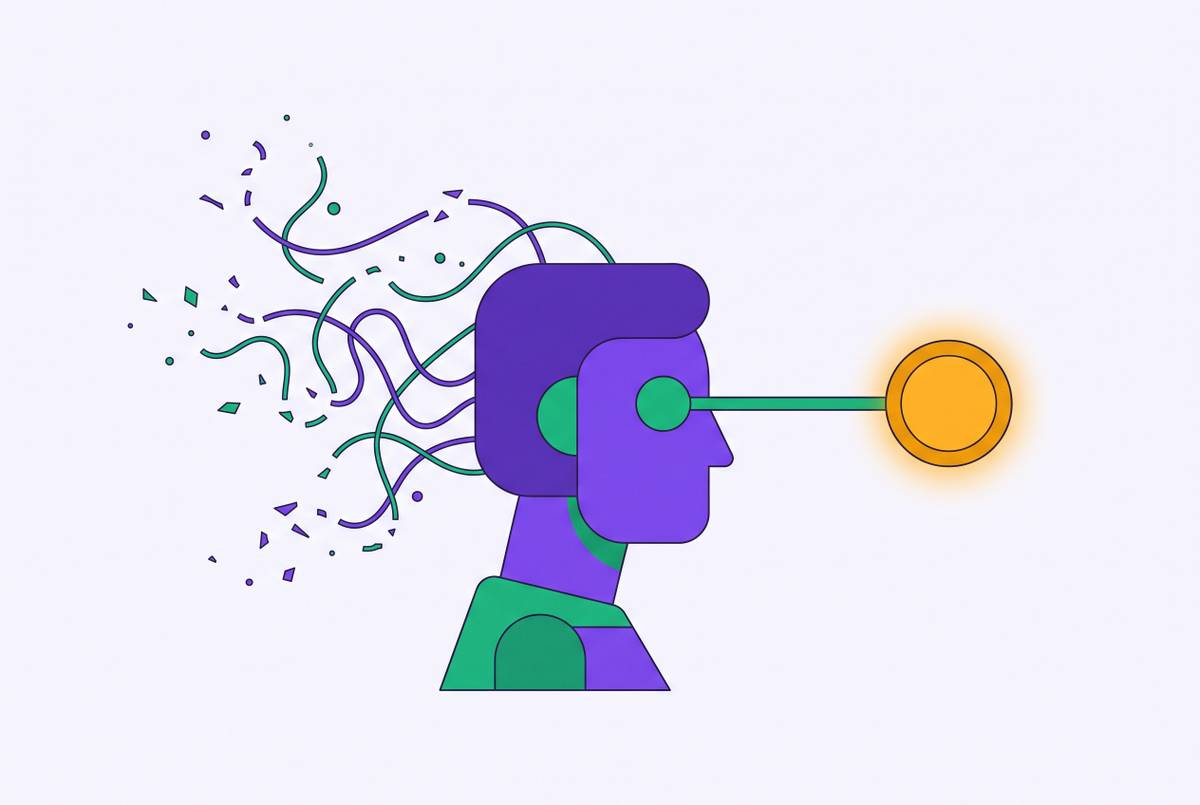
Procrastination is a habit loop the brain builds because avoiding a task delivers a small, immediate payoff: relief from whatever uncomfortable emotion that task produces. The loop runs in a predictable sequence. A task creates discomfort, whether that's anxiety, boredom, overwhelm, or fear of doing it badly. The person avoids the task. The discomfort drops, if only for a few minutes. The brain logs that drop as a reward and files "avoid this type of task" as the correct move next time.
Dr. Jud Brewer, a psychiatrist and neuroscientist at Brown University, frames this as a habit loop that runs automatically once it's learned, and it doesn't respond to willpower because willpower doesn't touch the reward signal driving it. In most procrastinators, the prefrontal cortex still works, and it's the part of the brain that overrides short-term reward signals in favor of longer-term goals. It gets outvoted by the reward signal in the moment, but it can be re-engaged. A systematic review out of Sapienza University of Rome, published in Behavioral Sciences in 2023, put it precisely: a lack of focus, not task avoidance, makes the difference between procrastinators and non-procrastinators. For most people without ADHD, procrastination is an attentional and coping-style problem. It isn't an act of emotional evasion so much as a focus failure that happens to produce the same delay.
How ADHD changes the same loop
ADHD doesn't invent a new kind of procrastination. It takes the exact same loop described above and runs it through a brain where every stage of the loop behaves differently. Three things change at once, and they compound each other.
The triggers get stronger. Emotion dysregulation is a core symptom of ADHD, not a side effect that shows up occasionally. Discomfort from an aversive task registers at a far higher intensity than it would for someone without ADHD, which makes the urge to escape that discomfort more urgent and harder to sit with.
The brakes get weaker. Executive function deficits mean the prefrontal cortex can't override the reward system as reliably as it does in a neurotypical brain. A systematic review published in Research in Developmental Disabilities found that the inattention dimension of ADHD, more than hyperactivity, is the most robust correlate of procrastination across the studies it examined. That finding points toward executive dysfunction, not impulsivity, as the primary driver of ADHD-linked procrastination. The brakes are underpowered relative to the signal they're supposed to be managing.
And the loop automates faster. Stronger triggers plus weaker brakes mean the avoidance pattern runs more often and hardens into habit more quickly, a compounding effect that builds on itself with each repetition. Much of this also runs below conscious awareness: ADHD makes it harder to catch the loop while it's active, so by the time a person notices they've been avoiding something, the behavior has already been reinforced. This produces a sharp contrast with the Sapienza finding on neurotypical procrastinators. Where someone without ADHD typically ramps up activity as a deadline closes in, because the approaching deadline rebalances the loop in favor of action, an ADHD worker may not experience that same rebalancing. A separate mechanism dampens deadline urgency itself.
Time blindness: the ADHD-specific driver that has no neurotypical equivalent
Time blindness in ADHD is a measurable neurocognitive feature, rooted in prefrontal working-memory deficits, dopamine dysregulation, and differences in frontostriatal-cerebellar timing circuits. It isn't a motivation problem, and it's the reason the deadline-urgency signal that rescues so many neurotypical procrastinators is largely unavailable to ADHD workers.
ADHD brains tend to experience time as binary: there's "now" and there's "not now." A deadline two days away and a deadline two weeks away can register as functionally the same thing right up until the moment either one becomes "now." That's a structurally different problem from a neurotypical procrastinator who simply misjudges how long a task will take. In that case, the estimation faculty is intact, just poorly calibrated. Someone without ADHD can be taught to pad their estimates and the correction holds. In ADHD, the internal clock generating the urgency signal is unreliable, so there's no stable estimate to correct toward.
This is why so much standard time-management advice quietly fails ADHD workers. Calendar blocking, working backwards from a deadline, estimating how long a task will take: all of it assumes a reliable internal sense of time passing and time remaining. That assumption holds reasonably well for most people. The natural corrective mechanism that saves many neurotypical procrastinators, rising urgency as the deadline nears, doesn't reliably fire in an ADHD brain. Avoidance can persist right up against a hard deadline with no gradual ramp-up in between, which is part of what makes the pattern so disorienting to the person living it.
Rejection Sensitive Dysphoria: the emotional engine behind avoidance that procrastination theory doesn't account for
A specific form of emotional dysregulation known as Rejection Sensitive Dysphoria drives a different kind of avoidance. It's about whole categories of work, not one aversive task, and no standard procrastination intervention is built to touch it. RSD is dysphoria triggered by perceived or real rejection or criticism, and the perception of potential rejection tends to do more damage than any actual rejection that follows. People organize their behavior around avoiding a situation before they even know the outcome.
At work, this appears in not applying for a role to avoid the possibility of being turned down, not submitting a piece of work to avoid criticism, or staying quiet in a meeting to avoid being wrong in front of others. The avoidance is organized around anticipated emotional pain, not the actual difficulty of the task. Qualitative research into RSD in workplace settings found a participant who had avoided applying for career opportunities just to pre-empt the experience of rejection. The avoidance happened at the application stage, long before any rejection could have actually occurred.
Compare that to a neurotypical procrastinator putting off a tax return. The object of avoidance there is the task's tedium or complexity. With RSD, the object of avoidance is the anticipated social and emotional fallout of how the work, or the person, might be judged. RSD isn't classified as a mood disorder, but it's often read behaviorally, by managers and by the person experiencing it, as simple reluctance. Someone avoiding a task driven by RSD is far more likely to describe it to themselves as "I just don't want to do this" than as "I am protecting myself from anticipated pain," which keeps the real mechanism invisible even to the person living inside it.
How knowledge work environments hide and worsen ADHD avoidance
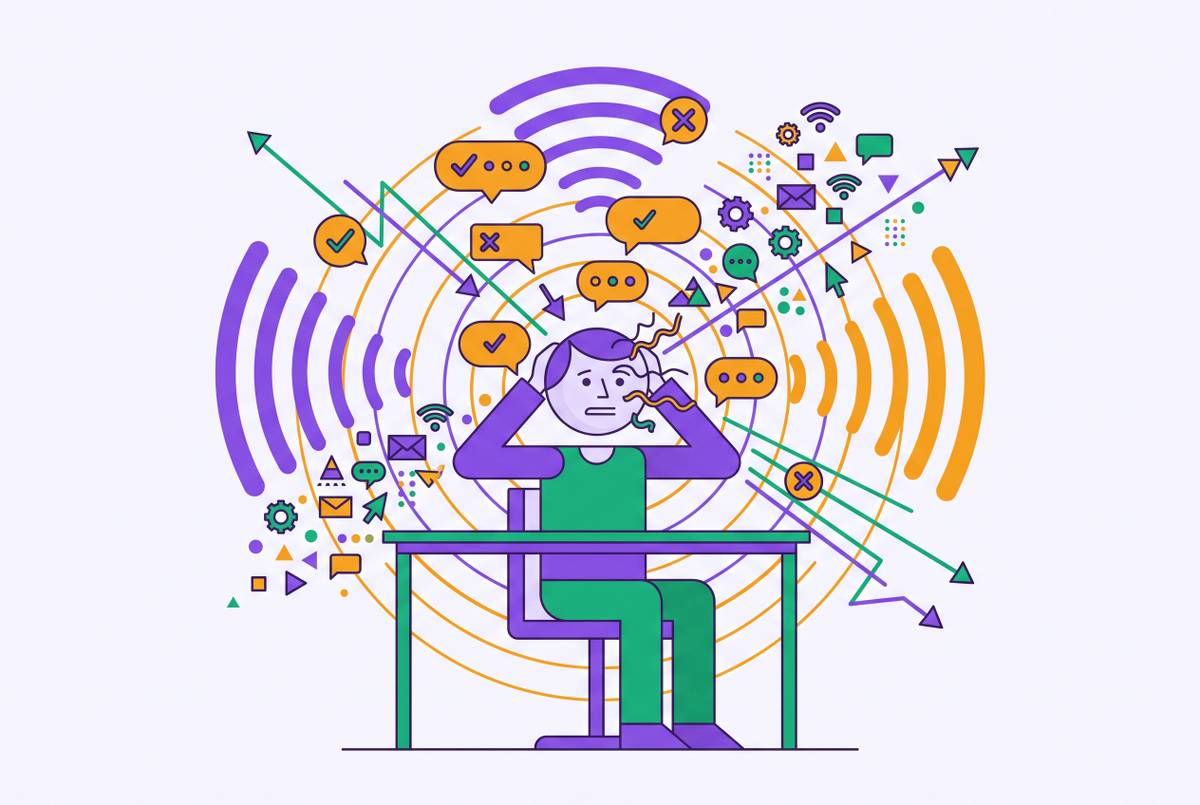
Knowledge work has a particular structure: high autonomy, constant context-switching, asynchronous communication, and task scopes that are often left deliberately open-ended. So that structure strips away the external scaffolding that would otherwise keep ADHD avoidance loops in check. Digital knowledge work in IT and other knowledge-based sectors demands sustained attention management, constant task juggling, and ongoing self-regulation, which are exactly the executive functions ADHD impairs.
Hyperfocus muddies the picture further. ADHD workers in flexible roles can genuinely produce strong bursts of output, periods where real, high-quality work gets done quickly, and these bursts can mask an avoidance pattern running alongside them. Good work in one area doesn't mean the avoided tasks have gone anywhere. They accumulate quietly alongside it. Most standard productivity systems, structured schedules, task-management frameworks, timed work-interval methods, assume stable attention, a reliable sense of time, and a task-oriented coping style. They're built for neurotypical procrastination and don't reach the ADHD-specific mechanisms described above.
Asynchronous tools make this worse in two directions at once. Email and Slack create unstructured demand: tasks arrive without fixed deadlines attached, which feeds time blindness directly. Those same channels are socially loaded, since a delayed or awkward response can be read, or anticipated to be read, as a failure, which activates RSD-driven avoidance on top of the timing problem. A study from Northumbria University, presented at INTERACT 2023, looked at knowledge workers with ADHD and found persistent challenges around prioritization, time estimation, and task switching, even among participants who were actively using a range of strategies and tools. The standard toolkit left those specific gaps unfilled.
A diagnostic framework for knowledge workers
Because the two conditions produce the same visible behavior but diverge sharply on mechanism, the useful question is what the avoidance loop is protecting against, and whether that protection looks more like an amplified neurological system running hot, or a timing and focus failure that a deadline would eventually correct.
A few signals tend to point toward ordinary procrastination. Output tends to rise as the deadline closes in, showing the urgency signal is present and doing its job. Avoidance tends to track with how difficult or boring a specific task is, rather than spreading across unrelated categories of work. Shame and guilt appear, but they're manageable, and sometimes they're even the thing that finally prompts action. Breaking a task into smaller steps tends to reliably lower the barrier to starting.
A different set of signals points toward ADHD-amplified avoidance. Urgency doesn't reliably build as a deadline approaches, or it arrives suddenly and overwhelms rather than motivates. Avoidance spreads across entire categories of work, anything with open-ended scope, anything with social evaluation attached, staying unmoored from specific tasks. The emotional response to a given task feels out of proportion to the task itself, described less as mild reluctance and more as dread, overwhelm, or a kind of physical resistance to starting. Standard fixes like breaking tasks down, scheduling blocks, or setting up accountability check-ins bring short-term relief, but the same avoidance pattern comes back in more or less the same form. And the pattern isn't new to this job or this season of life. It has followed the person across different roles, different projects, and different stages of life.
A signal specific to RSD is avoidance that clusters around tasks with a social-evaluation component attached, emails to senior stakeholders, presentations, performance reviews, applying for a new role or promotion, where what's being avoided is the judgment that might follow the task, not its difficulty. None of this replaces a professional evaluation, but asking these questions with real curiosity, rather than frustration, is itself a useful first step toward understanding which mechanism is actually running.
Strategies calibrated to the actual mechanism, not to the visible behaviour
Because procrastination and ADHD-amplified avoidance fail at different points along the same loop, the fix that works has to target the actual failure point. Applying a procrastination fix to an ADHD mechanism, or the reverse, is exactly what produces the inconsistent results so many knowledge workers describe: a strategy that works brilliantly for a colleague and does almost nothing when they try it themselves.
For ordinary procrastination, where the issue is focus and timing rather than an overwhelmed emotional or executive system, the entry point is mapping the loop itself. Brewer's framework starts with identifying the specific emotion a task triggers, since naming the discomfort makes it possible to work with rather than just push against, and from there, reverse-engineering what makes certain tasks easy to start, a clear beginning and end, a sequential structure, manual steps, and applying those same features to the avoided task can turn something vague and overwhelming into something bounded and concrete. Implementation intentions, a specific plan like opening a document at 3pm on Tuesday and writing one paragraph, tend to work well here because the braking system is intact and mainly needs a clear activation cue to fire. Moving a deadline earlier works for the same reason: the urgency ramp-up is a real, functioning mechanism, so shifting the deadline forward borrows that mechanism earlier than it would naturally activate.
ADHD-amplified avoidance needs a different approach, because the internal systems that would normally regulate the loop (strong brakes, a reliable sense of time, stable emotional responses to criticism) aren't reliably available from the inside. The goal is building external structure that does the regulating the brain isn't doing on its own: concrete, time-bound external deadlines rather than vague target dates, environments and tools that make a task's current status visible without requiring the person to hold it in working memory, and support that catches avoidance early rather than waiting for a crisis near a hard deadline. Because ADHD amplifies triggers, weakens brakes, and lets the loop run largely below awareness, an autonomous assistant that operates quietly in the background and learns a person's avoidance patterns over time can surface the mechanism while it's still active. Vellum is one example of a tool built around that kind of persistent tracking, designed to make visible what an attention deficit makes hard to notice in the moment. Making the pattern visible while it's running, rather than after the deadline has already passed, is the first real step toward interrupting a loop that otherwise operates almost entirely out of sight.
Sources
- ADHD vs. Procrastination: What's Actually Happening
- A systematic review on the association between ADHD and procrastination - ScienceDirect
- A Lack of Focus, Not Task Avoidance, Makes the Difference: Work Routines in Procrastinators and Non-Procrastinators
- The mediation effect of general self-efficacy in relation to procrastination and sense of coherence among adults with attention deficit hyperactivity disorder
- The lived experience of rejection sensitivity in ADHD - A qualitative exploration
- The lived experience of rejection sensitivity in ADHD - A qualitative exploration - PMC
- The mediation effect of general self-efficacy in relation to procrastination and sense of coherence among adults with attention deficit hyperactivity disorder
- A Lack of Focus, Not Task Avoidance, Makes the Difference: Work Routines in Procrastinators and Non-Procrastinators