ADHD Decision Paralysis in High-Stakes Work Scenarios
How ADHD brains freeze under ambiguous pressure, not clear deadlines.
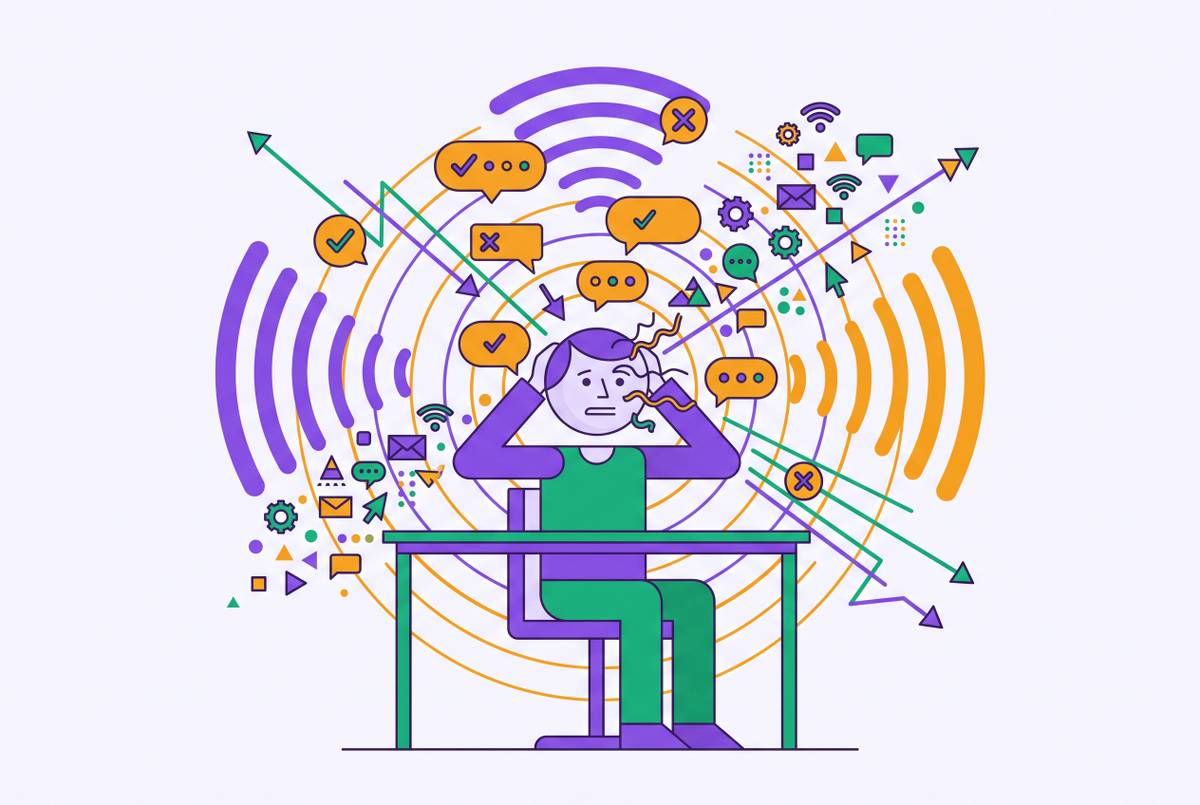
A deadline sits two hours away. The cursor blinks in an empty document. The person at the keyboard wants, badly, to start writing, and cannot. That gap between wanting to act and being able to act is ADHD decision paralysis, and it is a different thing entirely from procrastination.
Procrastination is a trade. Someone weighs the task against something more appealing, like a load of laundry or a video, and picks the laundry. It's a choice, even a bad one, and it comes with a payoff: relief, distraction, a short escape from discomfort. ADHD decision paralysis offers no such payoff. The person stuck in it wants to move forward and cannot find the door. What's left is frustration and urgency, both running at full volume, with no motion underneath them.
Decision paralysis isn't a clinical diagnosis; it is a popular term for a real pattern that occurs inside executive dysfunction, when the brain's management system buckles under too many options, or under the fear of choosing wrong. University of Rochester Medicine's behavioral health team describes it exactly this way, as executive functioning breaking down under that weight.
The distinction carries real consequences for what actually helps. An accountability partner or a pep talk about motivation might nudge someone out of ordinary procrastination, because the obstacle there is a choice to avoid something. Decision paralysis has no such choice at its center, so those same tools miss the target. Any strategy aimed at the freeze has to address the mechanism producing it, not just the stalled behavior an onlooker sees from across the room.
The brain of an ADHD professional in freeze
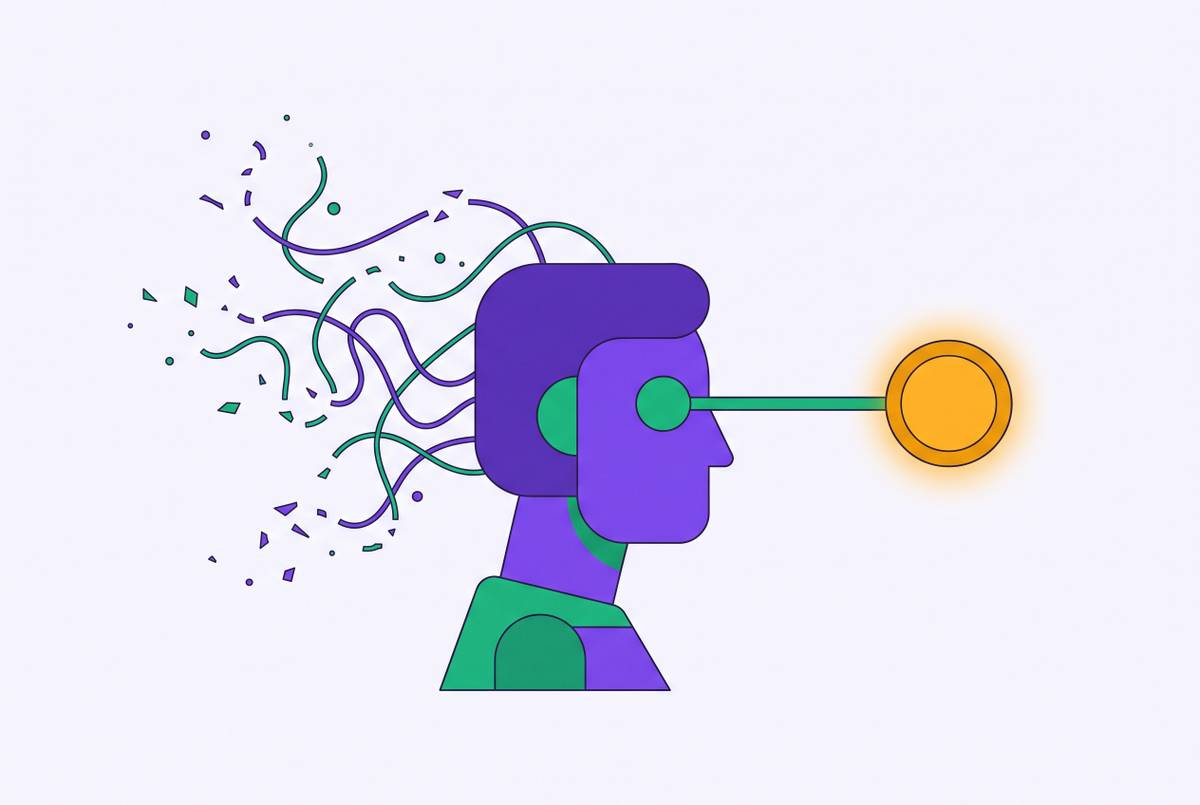
The freeze isn't mysterious once you break down what's failing. Three specific executive functions give out at once: working memory, inhibitory control, and cognitive flexibility. Dopamine dysregulation compounds all three, which is what turns an ordinary hard decision into a full stop.
Executive function works like a brain's management system. It prioritizes tasks, organizes them, and initiates action on them. The management system, rather than crashing loudly, simply stops issuing orders.
Working memory is the first casualty. Picture someone holding four options in mind, say, four possible ways to open a client proposal. By the time option four comes into view, option one has slipped off the mental screen. It has to be reloaded, reconsidered, and compared again, and that reloading happens over and over before a single choice gets made. Each pass costs energy. By the tenth pass, there's no energy left to decide anything.
Inhibitory control is the second piece. A functioning filter lets someone set aside irrelevant thoughts while they weigh real options. When that filter runs weak, stray considerations keep forcing their way back in: what a colleague might think, an unrelated email sitting unanswered, a vague worry from Tuesday. None of it gets suppressed, so the mental load on every decision balloons past what the decision itself actually requires.
Cognitive flexibility is the third. Shifting between two different ways of judging a decision (price versus speed, say, or short-term gain versus long-term relationship) takes real effort for an ADHD brain. Neurotypical brains make that shift automatically, almost without noticing. An ADHD brain pays for it deliberately, every time.
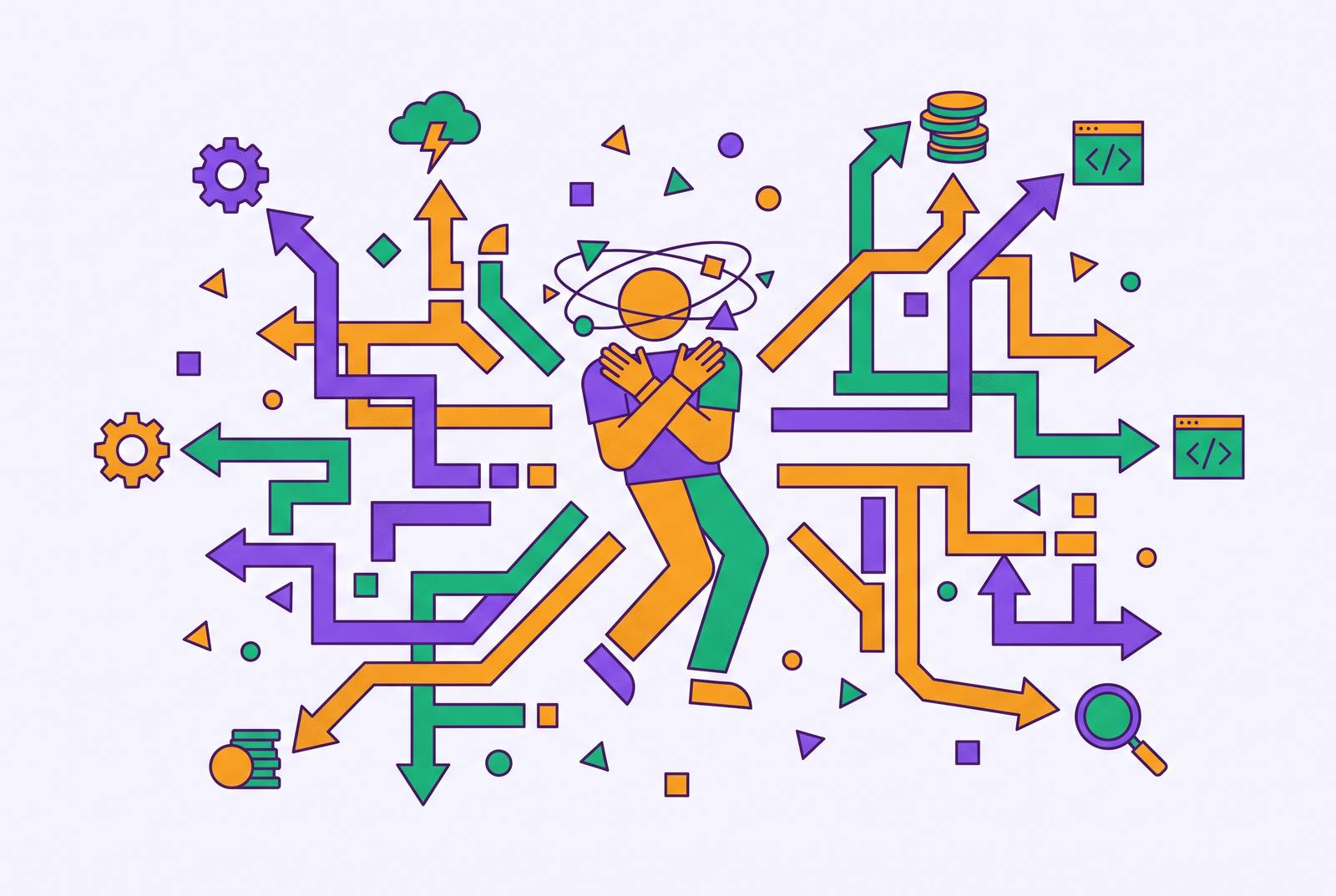
Dopamine's job runs deeper than reward alone. It normally assigns motivational weight to options before conscious thought even gets involved, doing a first-pass sort so the brain doesn't have to deliberate over everything from scratch. Without reliable dopamine signaling, that pre-sort doesn't happen, so the ADHD brain has to run conscious, effortful processing on choices other brains handle automatically and below awareness. That's why three options can all feel equally urgent and equally appealing at once. Nothing has been pre-ranked, so the brain loops endlessly between the options.
Add one more piece of biology: the prefrontal cortex, the brain's decision-making hub, matures roughly three years later in people with ADHD. That delay helps explain why this difficulty doesn't fade with age or experience the way some assume it should. A 45-year-old executive can carry the same freeze a 22-year-old does, because the underlying timeline runs on its own schedule.
Why the paralysis hits hardest in high-stakes, ambiguous situations
Pressure doesn't act on ADHD decision-making the way it acts on most assumptions about performance under stress. High stakes paired with a clear, unambiguous deadline can actually unlock strong performance. High stakes paired with ambiguous urgency, or a pile of competing options, produce the worst paralysis of all. The two look similar from outside. They are fundamentally different situations.
ADHD brains respond strongly to novelty, urgency, and genuine interest. A real, hard deadline, the kind with no room for negotiation, generates enough dopamine salience to cover for the executive deficits described above. That's why some ADHD professionals perform at their best during an actual crisis: a server outage, a client emergency, a plane to catch. The urgency is external, unambiguous, and impossible to misread.
Strategic planning rarely offers that kind of signal. Neither does a career decision, or a complex client proposal with no hard due date attached. The urgency there is diffuse, self-generated, or invented by the person themselves, and a brain that depends on clear external signals has nothing solid to grab onto. Picture a senior professional staring down a decision about which market to enter next year. Nobody is demanding an answer by 3 p.m. The stakes are enormous and the timeline is soft, and that combination is close to the worst possible setup for an ADHD brain trying to act.
ADHD also comes with distorted time perception, and that distortion stacks on top of everything else. A decision can feel both unbearably urgent and endlessly postponable at the same moment. When every option on the table feels equally pressing, the brain can't triage. It freezes instead, because there's no felt hierarchy telling it where to start.
This is why the same person can look brilliant in one context and stuck in another. Someone executing flawlessly during a genuine emergency, then unable to decide which of three ordinary projects to open on a plain Thursday morning, isn't inconsistent in any meaningful sense. The paralysis concentrates specifically in ambiguous, high-stakes territory. It doesn't spread evenly across every hard moment, and it isn't a character flaw showing up only when convenient.
Fear of error adds its own weight. Perfectionism runs common among high-achieving ADHD adults, and it raises the emotional cost attached to each option on the table, which narrows the window during which any choice still feels defensible. A decision that looks simple from outside often carries several hidden jobs nobody accounts for: remembering every option under consideration, comparing their downstream consequences, guessing what next month's version of yourself will actually need, tolerating the discomfort of not knowing the answer yet, and eventually telling another person what was decided. Fear of disappointing that other person adds a separate, unspoken weight to the whole process.
The hidden tax that high-achieving professionals pay to keep the freeze invisible
A pattern appears often among high-achieving ADHD professionals: strong, even exceptional output on complex, high-novelty work, paired with private paralysis on the small stuff. Scheduling a meeting. Replying to an email that needs ten seconds of thought. Picking a vendor from a short list. The gap between the two isn't laziness, and hiding that gap from coworkers costs real cognitive capacity on its own.
Masking, the ongoing work of monitoring and adjusting behavior to look neurotypical, runs close to universal among working adults with ADHD. That monitoring isn't free. Every bit of attention spent watching how a stalled task looks to a manager or a teammate is attention pulled away from actually finishing it. The stalled pile grows, shame attaches to it, and the shame itself becomes one more thing competing for the same limited cognitive bandwidth.
Workplace structures rarely make this easier to address out loud. Many professionals hesitate to disclose an ADHD diagnosis at work. Even among those who do disclose and go on to request an accommodation, the request gets turned down close to three-quarters of the time: Deloitte's 2024 Disability Inclusion @ Work survey found that among employees who had disclosed a disability or neurodivergence and requested an accommodation, nearly three-quarters had at least one request rejected. The practical effect is that most people carrying this freeze are carrying it alone, without much institutional support to lean on.
The cost accumulates over a career, not just over a week. Some paths get avoided because a decision at the entry point felt impossible to make. Some promotions get missed because an application deadline passed while deliberation was still unresolved. Some people leave roles they were genuinely good at because sustained masking eventually produced burnout the job itself never caused directly.
Why most productivity advice backfires for ADHD decision paralysis
Generic productivity systems assume a kind of brain that doesn't match what's described above. They assume stable attention, a planning process that runs in a straight line, and a reasonably accurate sense of how time is passing. Those are exactly the functions most impaired in ADHD. That is why these systems tend to help less than they're supposed to, and sometimes do real harm.
SMART goals, GTD, fixed time-blocking: each one assumes the person using it can start a task on command, hold a full plan in working memory without it degrading, and feel time move accurately enough to stay on schedule. None of those assumptions holds reliably for an ADHD brain, so the system ends up demanding the very capacities that are already running short.
Telling someone to "just decide," or to make a pros-and-cons list, treats the problem as a shortage of information or willpower. The actual bottleneck is the neurological machinery needed to compare options and commit to one, and a list on paper does nothing to repair that machinery. It also does nothing for the fear or emotional weight that's often the real source of the stall, since a pros-and-cons list has no column for dread.
There's a genuine split between two different kinds of fix, and picking the wrong one for the situation wastes time and adds shame on top of the original problem. Structured external scaffolding, like a timer or a decision tree, works when the missing ingredient is urgency: the structure manufactures a deadline the brain can respond to. Motivation-driven approaches, like finding a genuinely interesting angle on a boring task, work when the missing ingredient is dopamine salience. Applying a rigid task-management system to a motivation problem, or applying a motivational pep talk to a structure problem, tends to fail in a way that gets blamed on the person, the actual problem being the mismatch.
Rigid systems carry a particular risk here: they can add a new layer of executive demand right on top of the one already failing. A 2025 conference paper presented at CHItaly, studying software developers with ADHD, found that conventional productivity tools fall short of supporting the cognitive variability and overload these professionals actually experience day to day. The tool becomes one more thing to manage, not a way to manage less.
One principle cuts against almost every mainstream goal-setting framework: separate what a decision needs to solve today from everything it could theoretically solve. Most planning advice pushes toward comprehensive, future-proofed thinking. For a brain already drowning in held options, comprehensive is the opposite of helpful. The strategies that actually work start from that same narrower instinct.
Strategies that address the mechanism rather than the symptom
Four mechanisms are doing the damage described earlier: overloaded working memory, missing urgency, an option set too large to hold, and decisions left trapped inside someone's head. Effective strategies target one of these four directly, rather than asking the person to simply try harder at the whole tangled mess at once.
Reducing working memory load starts with getting the decision out of the head and into the physical world. A written list, a quick diagram, a sticky note, even a voice memo recorded on a walk, all do the same job: they let the brain stop re-loading and re-checking the same options over and over. One sharp technique names the exact decision in a single sentence: "By Friday, I am choosing whether to ___." That sentence forces clarity about what's actually being decided right now, and it blocks the common slide into also deciding three or four related things at the same time.
Narrowing the option set works on a different point in the chain. Cut the active list down to two or three choices that meet the basic requirements, and set the rest aside in a "later" list. Nothing gets permanently lost, but the brain no longer has to hold every possible path in active consideration while trying to choose. University of Rochester Medicine treats limiting options as a direct move against the overwhelm that triggers the freeze. A related move: fix two or three criteria before comparing anything, and hold to those criteria once comparison starts. Adding new criteria mid-comparison, as new options come to mind, is the exact pattern that turns a decision into an endless research spiral.
Creating artificial urgency uses a plain kitchen timer. Set a fixed window, say twenty minutes, to weigh the options and land on one. The constraint itself manufactures the urgency an ADHD brain needs to shift out of looping and into committing, the same kind of unambiguous signal a real deadline provides. This timer approach fits decisions that are genuinely reversible, a vendor choice, a meeting time, a first draft of an email, and a ten-minute timer has no business being applied to a decision that will reshape someone's career or their family's life. Save the timer for stakes that can be revisited later if the first call turns out wrong.
Breaking a large decision into smaller, reversible steps addresses the emotional weight sitting on top of all three mechanical fixes. A big decision feels heavy because it seems to carry every one of its consequences at once, all arriving in a single moment of commitment. Splitting it into sub-decisions, each one changeable later if it doesn't hold up, lowers the emotional charge attached to any single step. Nobody has to get the whole thing right in one pass. They just have to get the next piece moving.
Sources
- How to Navigate Decision Paralysis
- ADHD and Decision Paralysis: Overwhelm in a World of Choices
- ADHD and Decision Paralysis: Overwhelm in a World of Choices
- Work Performance Challenges and Needs of Adults with ADHD: Exploring Lived Experiences - PMC
- A Socio-Technical Grounded Theory on the Effect of Cognitive Dysfunctions in the Performance of Software Developers with ADHD and Autism