Inductive vs Deductive Thinking in Root Cause Analysis
Your choice of reasoning direction determines what evidence you'll find.
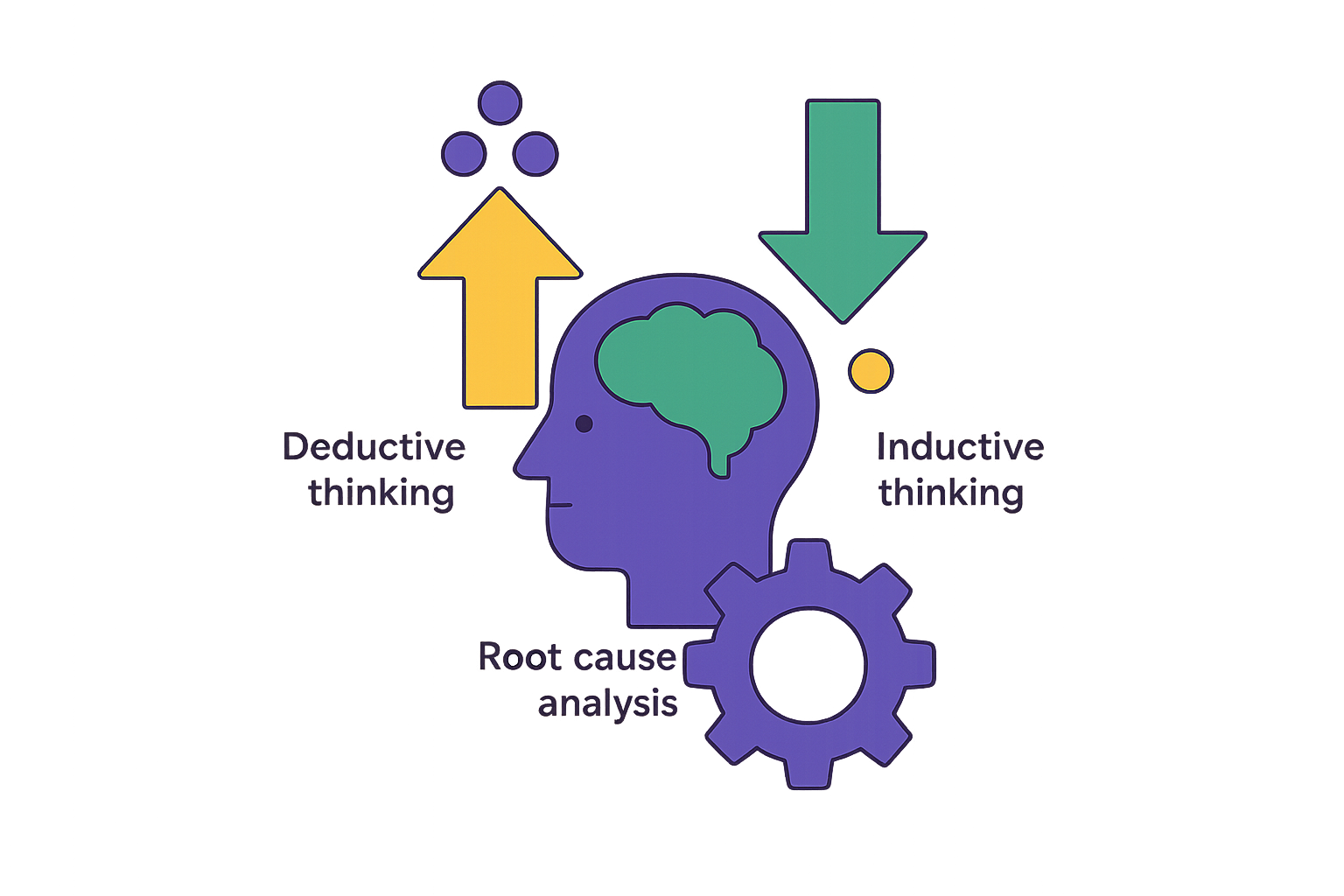
Inductive and deductive reasoning are opposite directions of travel, and in root cause analysis, the direction you choose first decides which evidence you gather, what order you gather it in, and what kind of conclusion you are actually entitled to at the end.
Inductive and Deductive Reasoning in RCA
Deductive reasoning starts with a general premise and narrows it down to a specific, testable prediction. CASRAI's reasoning guide frames this through the validity-versus-soundness distinction: if the premises are true and the logical form is valid, the conclusion has to follow. Inductive reasoning runs the opposite direction. It starts with specific observations and builds upward toward a general pattern or theory, and its conclusions stay probable, supported by the weight of evidence. That asymmetry has teeth. A deductively valid argument can still land on a false conclusion if one of its starting premises is wrong, but an inductive conclusion stays open to revision, because no number of confirming observations can logically prove a general claim. Apply that to root cause analysis: starting with a symptom and asking what it implies is a different act of investigation than starting with a hypothesis and asking whether the evidence confirms it. One builds a case up from the ground. The other tests a case that's already been imagined. Both can be done rigorously, and both can be done badly, but they fail in different places, and that's the asymmetry the rest of this piece has to work through.
Reasoning Modes and the Standard RCA Tool Families
Every major RCA tool is built around one of these two postures, and that posture tells you what it can find before you've run a single investigation. Failure Mode and Effects Analysis is explicitly inductive: a bottom-up method that starts with individual component failure modes and asks what effects ripple upward through a system. The fishbone, or Ishikawa, diagram works the same way. It's a qualitative brainstorming tool, and it sorts potential causes into categories, but it never assumes in advance which branch holds the answer. The 5 Whys sits in the inductive family by impulse, since it follows a symptom upward through a chain of iterative questions, but investigators often run it deductively: they start the chain with a suspected answer already in mind and build toward it. Fault Tree Analysis sits on the other side of the map. It's conventionally classified as deductive: a structured, top-down method that begins with an undesired top event and maps out the combinations of failures, using Boolean AND and OR gates, that could produce it. Hypothesis trees built on MECE logic (mutually exclusive, collectively exhaustive) go the same way. A quality issue gets decomposed into a fixed set of candidate causes, say poor design, wrong materials, bad manufacturing, shipping mishandling, and each branch gets tested in turn until one survives. None of this is incidental. FMEA and fishbone diagrams are open-ended by construction, built to welcome whatever the investigator finds. FTA and hypothesis trees ask something different of the investigator: they require the failure modes to already be imagined before the analysis can even start.
The specific failure modes each reasoning posture generates
Confusing the two modes doesn't cancel their risks out. It compounds them, and each posture breaks in a way that's specific to its own direction of travel. The 5 Whys is especially exposed to one particular failure: investigators frequently start with a presumption about the root cause and then build the why-chain backward to arrive at it, which is confirmation bias in its plainest form. Its linear structure makes this worse. When a failure has more than one contributing cause, a single chain only ever captures one of them, usually the most visible one. Fishbone diagrams carry a related gap. They're good at surfacing candidate causes but carry no built-in mechanism for weighing or eliminating them, so the tool stops right where the deductive work would need to begin. Deductive tools fail in the opposite direction. Fault Tree Analysis's central liability is that the undesirable events it models have to be imagined by the analyst first, without any guidance from the technique itself, so a failure mode nobody thought of simply never appears in the tree. A misapplied AND gate or a missing branch can produce a result that looks rigorous and is actually hollow, because the deductive form carries an appearance of precision even when one of its premises is absent or wrong. A deductively valid tree built on incomplete premises isn't a sound analysis, no matter how clean the logic gates look. FTA is the only one of the three major tool families that systematically accounts for multiple failures interacting at once, and it can reveal that no single failure alone caused the top event, a finding that stays invisible inside a 5 Whys chain by design. The worst outcome occurs when the two failure modes meet: deploying an inductive tool like 5 Whys on a discrete, multi-causal system failure that actually needs deductive exhaustiveness exposes the investigation to confirmation bias and missed causes at the same time.
Why the stronger objection, that FTA is inductive, has practical stakes
Not everyone accepts the conventional label on Fault Tree Analysis, and the disagreement isn't just a matter of what to call the technique. A contrarian position from systems engineering argues that when you build a fault tree, you infer causes from observed effects and model future conditions from historical data, and that is induction, no matter how top-down the tree looks on the page. The visual structure runs downward from a top event, but the content feeding that structure was built by generalizing from past failures, the same move the fishbone diagram makes. That has a practical consequence: even when investigators use explicitly deductive frameworks, they still tend to ignore information that doesn't fit their working hypothesis and to seek out information that confirms it. The deductive label doesn't immunize anyone against that pull. If that's right, the fix was never about picking the tool with the more rigorous-sounding name. What matters is whether the investigator observes before testing a hypothesis, because that sequence is what reduces bias, not the label on whichever technique carries it out. That reframing matters for everything that follows: the point isn't choosing the "correct" tool family, it's building the sequence that keeps either mode honest.
When to reach for inductive tools versus deductive ones
The right starting mode depends on what the investigator already knows at the moment the investigation begins, not on how severe the incident looks. When no prior hypothesis exists, or the incident is a novel type nobody has a mental model for yet, fishbone diagrams and FMEA do their job by preventing premature closure. They force the investigator to enumerate candidate causes before committing to any single one. A product manager watches warehouse workers dropping products and concludes, inductively, that shipping must be the cause. Without a MECE hypothesis tree forcing a fuller accounting, three other candidate causes, design, materials, and manufacturing, never get investigated at all, and the conclusion rests on whichever explanation happened to be visible first. Inductive tools also earn their keep before a failure has even happened: FMEA's canonical use is prospective, built to catch component failure modes before they propagate into system failures. The case for switching to deductive tools applies once the cause space can actually be bounded. If a discrete, mutually exclusive, collectively exhaustive set of hypotheses can be built, FTA and hypothesis trees become the right instruments, because their power depends entirely on how complete that initial enumeration is. Safety-critical domains, aerospace, nuclear, chemical processing, healthcare, lean deductive for a reason: failure modes interact, the probability of recurrence has to be quantified, and FTA's Boolean logic gates can show that no single failure alone produced the top event. Regulatory reporting adds its own pull toward deduction, because a documented, structured causal chain is often what the reporting requirement demands. Speed and domain shape the choice too. Most software engineering postmortems do fine with a fishbone combined with 5 Whys, since it's fast and FTA's overhead is disproportionate when the failure modes in play don't interact with each other. Safety-critical systems and multi-hop fault propagation in complex distributed infrastructure call for something more than inductive enumeration. They need the deductive step of bounding the cause space and testing each branch against evidence.
Sequencing Induction and Deduction to Close the Gap Neither Can Close Alone
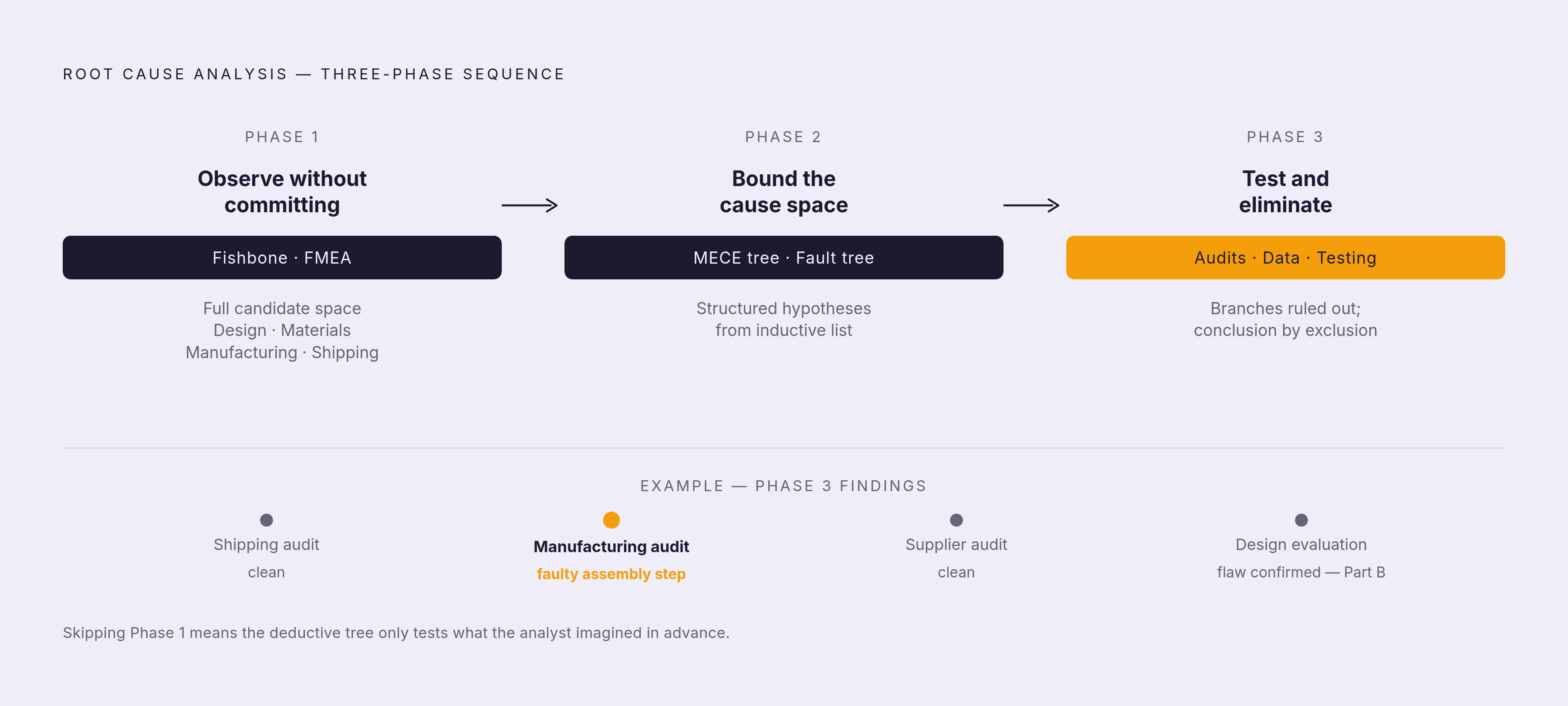
If you observe inductively before you test deductively, your conclusion ends up more complete and more defensible than either mode could produce on its own. The sequence has three phases. First, observe without committing: use fishbone or FMEA to enumerate the full candidate cause space before any single hypothesis gets privileged, which is what protects against the premature convergence that makes 5 Whys chains unreliable on their own. Second, bound the cause space deductively: build a MECE hypothesis tree or fault tree out of that inductive enumeration, so the deductive structure gives a systematic path toward elimination. Third, test and eliminate: prove or disprove each branch with targeted evidence, audits, data analysis, controlled testing, so the final conclusion rests on having ruled alternatives out rather than on having piled up instances that happen to confirm a favorite one. The consulting quality example runs this sequence end to end. Inductive observation starts it: products are arriving broken. A MECE hypothesis tree bounds it: design, materials, manufacturing, shipping. Deductive elimination finishes it: the shipping audit comes back clean, the manufacturing audit turns up a faulty assembly step, the supplier audit comes back clean too, and a design evaluation confirms the real flaw sits in Part B's design. Each stage depends on the one before it. If you skip the inductive enumeration, the hypothesis tree only ever tests what the analyst happened to imagine in advance. Without deductive elimination, the inductive observation stays a set of hunches that never gets narrowed into something provable. The sequence isn't just a consulting habit, either. Researchers working on automated root cause analysis at machine scale have arrived at the same pattern independently: observe patterns across signals first, then test hypotheses against them. The sequence holds at computational speed the same way it holds in a conference room.
The structural choice between these two directions also shapes something less visible: which evidence an investigator reaches for first, often before they've consciously decided to reach for it. Systems that learn an investigator's patterns over time can show whether a given habit is pattern-matching upward from symptoms or testing downward from a premise, so that implicit choice becomes explicit before confirmation bias gets a foothold.
AI Tooling and the Inductive-Deductive Sequence in RCA
Automated RCA tools inherit the same failure risks that human investigators carry, and the evidence suggests those failures are structural, so more compute can't dissolve them. Multi-hop fault propagation, where a symptom appears far from its actual cause inside a distributed cloud system, is the setting where the gap between symptom and cause runs widest, and it's exactly where inductive and deductive failures compound each other most. For teams running AI-assisted RCA, that changes what the investigator's job actually is. The work shifts from generating hypotheses by hand to auditing the reasoning trace a model produces, which requires knowing whether that model is running an inductive enumeration, a deductive test, or quietly blending the two without saying so. The research world has noticed the same gap. The HYDRA 2026 workshop, co-located with LPNMR 2026 in Klagenfurt in September 2026, is dedicated to bridging deductive and inductive reasoning, with particular interest in integrating logical and statistical models and in designing algorithms that can reason under incomplete or uncertain knowledge. That a dedicated research workshop exists for this integration problem confirms it hasn't been solved by scale alone, and that neither inductive nor deductive methods on their own count as fully comprehensive.
Human judgment stays load-bearing in three specific places: catching when an AI-generated hypothesis tree is missing a branch, the same failure of imagination that affects FTA recurring at machine scale, recognizing confirmation bias inside a model's reasoning trace, and deciding when the cause space a deductive tool has bounded is actually too narrow for a failure type nobody has seen before. Because inductive failures and deductive failures come from opposite sources, one from converging too early, the other from missing a premise, knowing which failure an investigator is most prone to depends on knowing that investigator's own habits. An AI assistant that carries memory of how someone has reasoned through past investigations can flag the moment a 5 Whys chain starts narrowing into a single, familiar-looking answer before the investigation has actually earned that conclusion. Vellum's approach, building AI that understands context, learns patterns, and augments human judgment rather than standing in for it, bears directly on this problem. In an RCA workflow, the value sits in surfacing the reasoning trace and the pattern context that let a human investigator audit the sequence, not in handing the sequence itself over to the model.
Sources
- Inductive vs. Deductive vs. Abductive Reasoning in Research
- Stalled, Biased, and Confused: Uncovering Reasoning Failures in LLMs for Cloud-Based Root Cause Analysis
- Vellum: Your Personal Intelligence
- Deductive Risk Modeling Fault Tree Analysis (FTA)
- FTA vs FMEA: What Are The Differences? • Infraspeak Blog