Decision Fatigue in ADHD and Its Effect on Evening Productivity
ADHD brains spend dopamine faster on routine decisions, leaving little by evening.

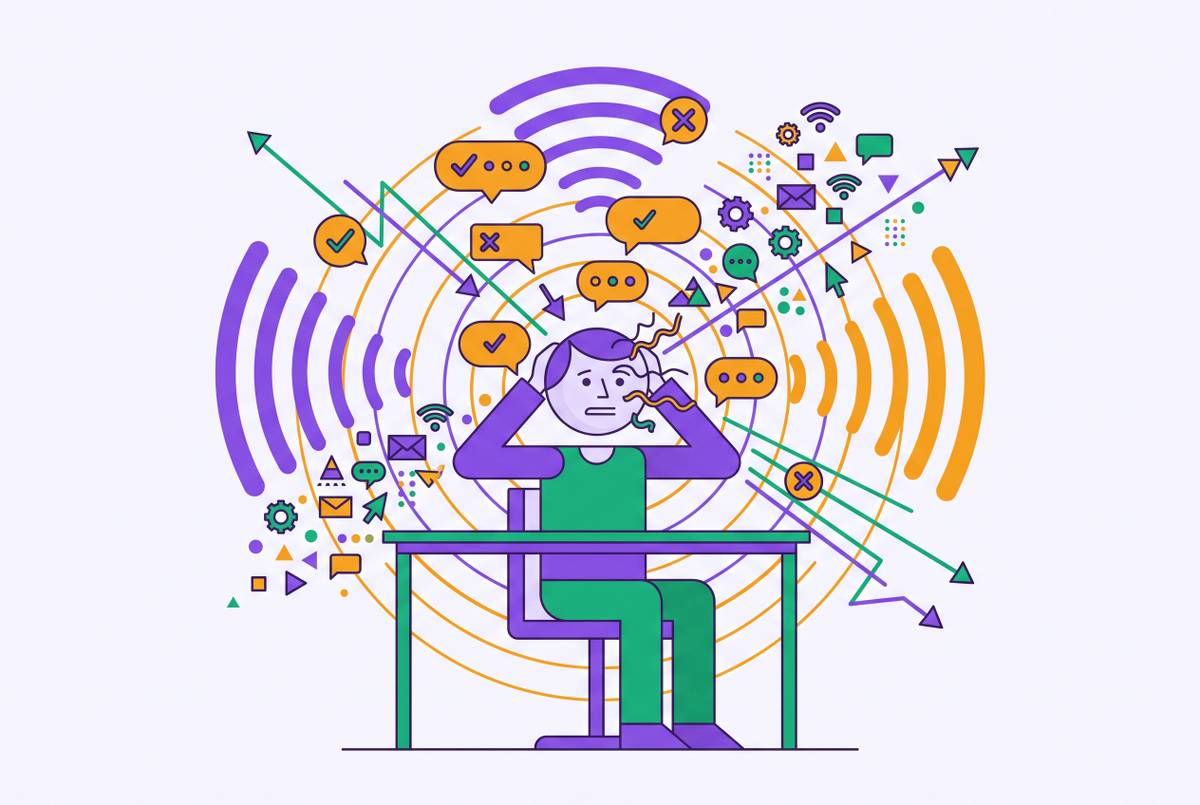
In the morning, the closet is full of clothes, yet nothing feels wearable, and at lunchtime, despite genuine hunger, the menu of options produces no decision at all, just a stall. These moments look like indecision from the outside. From the inside, they are the visible edge of a neurological difference: the ADHD brain runs routine decisions through a process that, in a neurotypical brain, happens automatically and mostly out of sight.
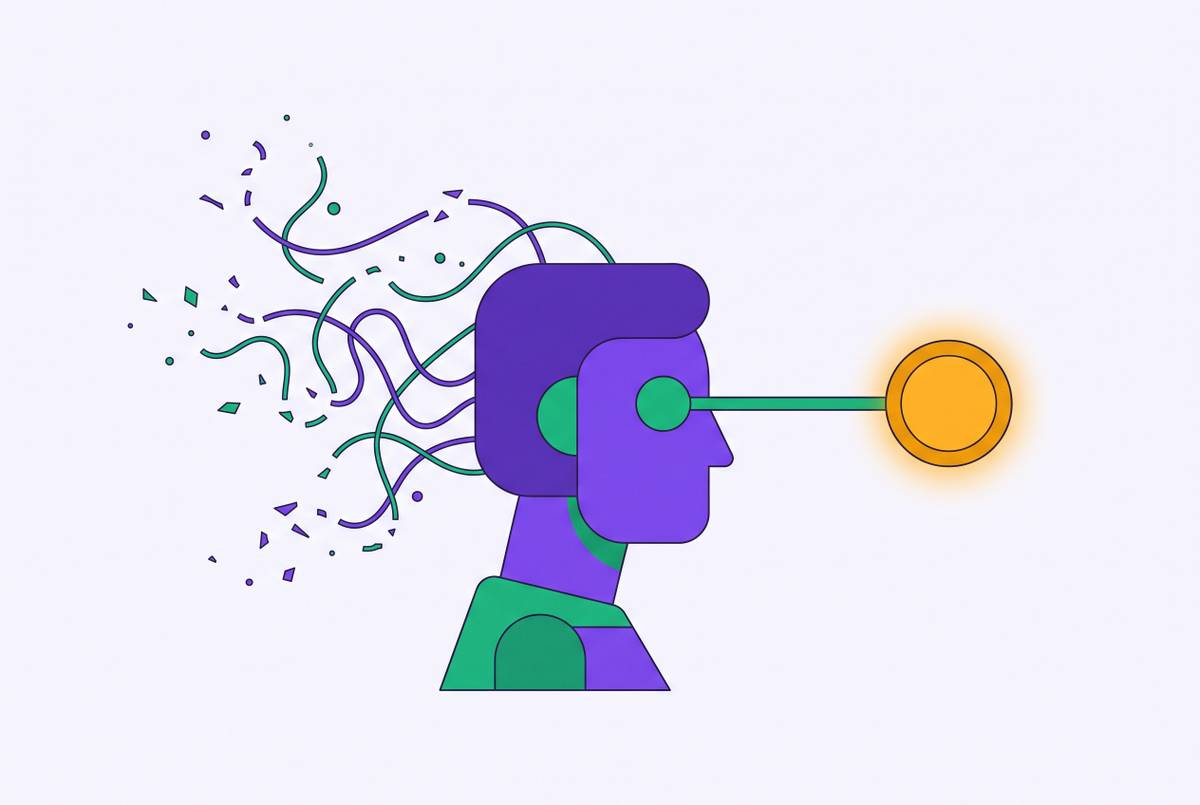
Dopamine is the reason. It works less like a mood chemical and more like currency, spent every time the brain evaluates an option, weighs a consequence, or commits to an action. When that currency runs short, as it does in ADHD due to dopamine dysregulation, each of those sub-steps costs more to complete. The prefrontal cortex carries out the planning, inhibition, and working memory that decisions depend on, and in ADHD that region is underactivated. For a neurotypical brain, one often runs on autopilot while the other gets conscious attention. In ADHD, both draw on the same limited, deliberate effort.
Brain imaging backs this up. A 2026 fNIRS study found reduced dorsolateral prefrontal cortex activation in adolescents with ADHD during cognitive control tasks, and higher DLPFC activity tracked with better complex attention. That is a picture of the executive engine running under-powered, not absent, just slower to reach the output a task requires. A separate study of 50 adults diagnosed with ADHD found that the mediators between ADHD symptoms and decision-making trouble were specific: working memory and inhibitory control, not attention or mood in some general sense. That precision matters. It means the difficulty is not a vague fog of distraction but a measurable shortfall in two identifiable executive functions.
None of this is limited to big decisions. Which email to open first, what to eat for lunch, whether to text back now or later: these pull from the same limited executive pool as the decisions that feel weighty. There is no category of choice that comes free. That is the starting condition this entire piece works from, a lower cognitive budget, spent faster, on every decision regardless of size.
Cumulative load, not clock time, explains the evening collapse
If every decision costs more, the hour at which a person runs out of capacity tracks the volume of decisions made, not the clock. It is fixed to how many decisions have already been made that day. The tipping point into exhaustion arrives earlier and more completely for ADHD brains than for neurotypical ones, and what drives it is volume of decisions, not time of day.
A workday is a continuous stream of small judgments: sequencing what to do next, answering an email in one tone rather than another, reading a meeting correctly, calibrating a social response. Each of those draws on the same dopamine-dependent executive system described above. By the time evening arrives, that system has been drawn on hundreds of times, whether or not any single task felt hard in isolation.
The collapse rarely looks dramatic. Spending a long time deciding what to watch on TV, defaulting to the same meal eaten all week because deciding on something else feels impossible, avoiding a conversation because finding the right words takes more than what's left in the tank, buying something on impulse, and scrolling a phone because no task can get started are recognizable behaviors that appear when the executive system runs out of budget. These get read, often by the person experiencing them, as laziness or disengagement. They are better read as the predictable output of a system that has already spent its budget.
An ADHD coach working with clients across California has documented a pattern: people who are highly productive at 2 a.m. but can't start a ten-minute task at 2 p.m.. That is not a body clock issue. Nighttime brings fewer demands, less sensory noise, and lower social expectation, all of which shrink the cost of each remaining decision. Which raises a real question about how this piece frames "evening" at all: protecting the evening hours is a secondary goal. The primary goal is managing the cumulative load across the whole day, so that the tipping point arrives later, or doesn't arrive at all. Research reviewed in 2025 supports the idea that ADHD symptoms shift day to day and that these shifts affect attentional control, which in turn affects work engagement. Productivity in ADHD is not a fixed daily trait; it moves.
Decision fatigue's emotional and professional harm
An unfinished to-do list is the easiest cost to see, but it is not the most serious one. When executive resources are depleted, the harm extends well beyond work non-completion: DLPFC underactivation under high cognitive load raises affect lability, and the same fatigue pattern visible at home appears as job burnout in ADHD workers.
Neuroimaging published in Biological Psychiatry: Cognitive Neuroscience and Neuroimaging found that reduced DLPFC and ventral lateral PFC activation during high cognitive load with emotional distractors tracked with more severe affect lability in adults with persisting ADHD symptoms. Evening depletion, in other words, raises the odds of an emotional outburst, a conflict with a partner, or an impulsive purchase, not only a missed task. Rejection sensitivity dysphoria, common in ADHD, adds another draw on the same account: it amplifies emotional response to anything with social or performance stakes, and the amygdala activation it produces pulls resources away from the executive system, speeding the whole depletion cycle along.
This pattern isn't confined to evenings at home. A field study of 171 employees found that the relationship between ADHD and job burnout runs through specific executive function deficits: weak self-organization and problem-solving drove emotional exhaustion and cognitive weariness, while weak self-management of time drove physical fatigue. That study is the first large workplace sample to put numbers on this pathway. Put together with the neuroimaging findings, a fuller picture forms: a person can look entirely functional at work while running on partial depletion that only becomes visible once they're home, showing up as irritability, withdrawal, or impulsive decisions. The evening, then, is often just the first place the cost becomes visible. It is not where the cost started.
Because the harm reaches this far, past missed tasks into relationships and work performance, the fix can't be a matter of gritting through it. It has to change the conditions that produce the depletion.
Why the willpower-fuel explanation is disputed
Before going further, the most obvious objection to this whole argument deserves a direct answer. Most people, on hearing "decision fatigue," reach for one specific idea: willpower as a fuel tank that drains with use. That is Roy Baumeister's ego depletion framework, and it is the concept most commonly attached to the phrase. Baumeister's ego depletion framework is also contested science.
A 2025 multi-lab synthesis found that the ego depletion effect might be real, but only under stronger conditions than the studies that first proposed it used. That leaves the phenomenon looking narrower than advertised: possibly present under intense conditions, but not the universal daily experience early research claimed. If general ego depletion is not robust, then framing any person's evening collapse as "running out of willpower fuel" is mechanistically weak, and doing so for ADHD specifically may be misleading.
The neurobiological account laid out in the first two sections doesn't have that problem. ADHD depletion is structural and chronic. It rests on documented DLPFC hypoactivation and dopamine dysregulation, confirmed through neuroimaging, and it doesn't need ego depletion to be true in order to hold. One finding can be shaky while the other stands on its own evidence.
The distinction changes what kind of fix makes sense. Ego depletion points toward rest and refueling, wait it out, recharge, try again tomorrow. The ADHD account points somewhere else entirely: redesign the environment so fewer decisions get demanded of the system in the first place. That is a different kind of intervention, and it's the one the rest of this piece builds toward.
Structural approaches that reduce daily decision demand before fatigue sets in
The goal is not to power through fatigue once it arrives. The goal is to not arrive there, or at least to arrive later and with more capacity left. Because the underlying problem is a depleted system facing too many decisions, the fix has to work on the decision volume itself, not on building more tolerance for depletion. The most effective interventions for ADHD decision fatigue work by externalizing or eliminating the decision queue rather than asking the brain to resist fatigue after the fact.
Any decision made in advance, handed off to a system, or removed from the daily queue entirely, preserves cognitive fuel for the decisions that can't be pre-empted. Decision batching puts that principle into practice by grouping similar choices into one block of time, scheduled during a higher-energy part of the day, which cuts the cost of constantly switching between different kinds of decisions and concentrates the load when there's more capacity to absorb it. Narrowing the option set before a decision even arises works the same way from a different angle: picking a week of dinners in advance, rotating a small capsule wardrobe, or setting a fixed evening default, the same dinner, the same wind-down sequence, removes the decision rather than simply making it easier to make.
A structure known as the "Today 3" system takes this same logic and applies it to daily prioritization. It limits the active decision set to three must-do items each day and includes a fallback protocol for the days when none of that feels reachable. Practitioners report that it reduces cognitive load, raises task completion, and eases the background anxiety of forgetting something important. The mechanism is the same one running through every technique in this section: the prioritization decision gets made once, in advance, instead of being re-litigated all day long.
Environment design carries the same logic into physical and digital space. Clothes laid out the night before, the next task left visible on screen before a work session ends, a phone moved into another room during wind-down: each of these arranges the environment so the default action needs no decision at all, shifting the cost of that decision to a moment earlier in the day when capacity was higher. Implementation intentions do something similar for action itself. The format is "when X happens, I will do Y," and it replaces a real-time decision with a trigger that was already decided in advance; research reviewed in 2025 lists this among the better-supported planning techniques for ADHD task structure. Even brief physical movement in the middle of the day fits the same pattern from the neurochemical side: short bouts of activity raise dopamine and norepinephrine availability, giving the executive system a partial reset before the next stretch of decisions arrives.
What ties all of these together is timing. Every one of them moves the cost of a decision to a point in the day when there's more capacity to pay it, rather than leaving it to be paid at the moment of collapse.
Body doubling and social scaffolding as external decision support
Body doubling gets misunderstood constantly, usually as a form of accountability, the idea that another person's presence keeps someone honest about getting work done. That is not the mechanism. Having another person physically or virtually present activates social attention circuits, and those circuits can supply the activation signal that a depleted executive system can no longer generate by itself.
That explains something that would otherwise look strange: body doubling works even when the other person says nothing, offers no feedback, and is doing completely unrelated work of their own. The intervention is presence itself, activating a different neural pathway built around social motivation, standing in for the dopaminergic drive that normal self-initiated decision-making needs and can't supply on a depleted day.
Virtual versions extend the same effect across distance. Platforms including Focusmate and ADHD Discord communities are cited by practitioners as effective, and the physical distance does not appear to fully cancel the activation effect. Applied to the specific window this piece has been building toward, the hour in the evening when depletion tends to peak, scheduling a virtual co-working session can supply exactly the activation needed to start a task that would otherwise feel out of reach when attempted alone.
One fair objection: doesn't this just build dependency on external conditions that won't always be available? The concern is reasonable, but it's secondary to the larger point. Consistent external scaffolding preserves executive fuel that would otherwise get burned fighting the same initiation battle alone, night after night, and that trade tends to produce better outcomes than solo effort against a system that is already running on empty.
Dopamine pairing and reward-front-loading as initiation tools
Everything in the previous two sections works by cutting the number of decisions the brain has to make. This last approach works on a different part of the problem: the reward signal itself. ADHD depletion is partly a failure of that signal to make starting a task feel worth the cost, so pairing a genuine dopamine source with the act of starting, not the act of finishing, can supply the motivational push the depleted brain can't generate on its own.
Most productivity advice gets the timing backward. "I'll treat myself when I'm done" places the reward at the finish line, and for ADHD, that's the wrong location entirely: the brain needs the reward signal at the moment of initiation, because an endpoint that hasn't happened yet doesn't register as real enough to motivate the first step. Front-loading the reward places it at the moment of initiation, matching what the depleted brain needs to register the task as worth starting.
In practice, this looks like playing one specific playlist only during a task that's being avoided, working from a café or some other setting that offers a bit of ambient novelty, or pairing a boring task with a favorite snack or drink, as described by practitioners working in this space. The playlist example does double duty. Beyond the immediate mood lift, it builds a conditioned association over repeated use: the brain starts to register the playlist itself as the signal that work has begun, which gradually lowers the deliberation cost of starting the next time around.
Put next to the structural techniques covered earlier, batching, narrowing options, environment design, body doubling, dopamine pairing rounds out the picture. Some interventions reduce how many decisions the ADHD brain has to make in a day. This one addresses the chemical signal that makes starting any one of them feel possible. Together, they describe a way of getting through a day that doesn't depend on willpower holding out until the sun goes down.