ADHD Routine Building Strategies for Adults
Understanding why standard routines fail ADHD brains and how to build ones that stick.
15.5 million adults in the U.S. currently carry an ADHD diagnosis, roughly 6.0% of the adult population, up from the 4.4% figure researchers relied on for years. Staley and colleagues put that number together in 2024 using National Center for Health Statistics data from late 2023, and one detail in there matters more than the headline: 55.9% of diagnosed adults got that diagnosis as adults, not as kids. Most of the people reading this spent a decade or two, sometimes three, without an explanation for why the systems that worked for everyone else never quite worked for them.
That history is the real starting point for this article. This piece is about why the standard productivity playbook, the one built around planners and willpower and "just be consistent," fails a specific kind of brain in specific, predictable ways, and what to build instead.
What the ADHD brain is actually doing when routines fall apart
ADHD is a disorder of executive function. That's the clinical phrase, and what it means in practice is that the mental infrastructure most people use without thinking, planning, prioritizing, tracking time, is less reliable here. Some research puts the developmental lag at 30 to 40%: a 30-year-old with ADHD may be operating with the executive function capacity of someone in their early twenties. Between 30% and 70% of adults with ADHD report real, day-to-day difficulty with these skills specifically. That's a wide range, but even the low end is a lot of people.
Time blindness is the piece that trips up the most well-meaning advice. This is a genuine difference in how the brain tracks elapsed time, and it shows up in two distinct ways: losing track of how much time has actually passed, and badly misjudging how long a task is going to take before you start it. Both are structural. Telling someone with time blindness to "just check the clock more" is a bit like telling someone with poor eyesight to squint harder, advice that misses the mechanism entirely.
Then there's dopamine. ADHD involves dysregulation in dopamine pathways, which means boring or abstract tasks, even genuinely important ones, don't generate the internal signal that gets most people moving. Inattentive ADHD, the most common presentation in adults, gets misread constantly as laziness or disorganization, when the more accurate description is a neurological pattern where the brain isn't rewarding you for starting.
And here's the cruel twist with routines specifically: ADHD brains crave novelty. What feels fresh and engaging on day one of a new routine can feel flat and aversive by day five, precisely because it's no longer new. So the very thing routines require, repetition, works against the thing ADHD brains are wired to seek.
None of this means routines are impossible. It means they have to be built around these mechanisms rather than against them. Less willpower, more scaffolding.
Why routines help ADHD specifically — and why most advice misses the point
A well-built routine takes work off the brain's plate and hands it to the environment. When the next step is already decided, you're not burning working memory figuring out what comes next; you're just doing it. That's the entire value proposition, and it's worth sitting with, because it reframes what a routine is even for.
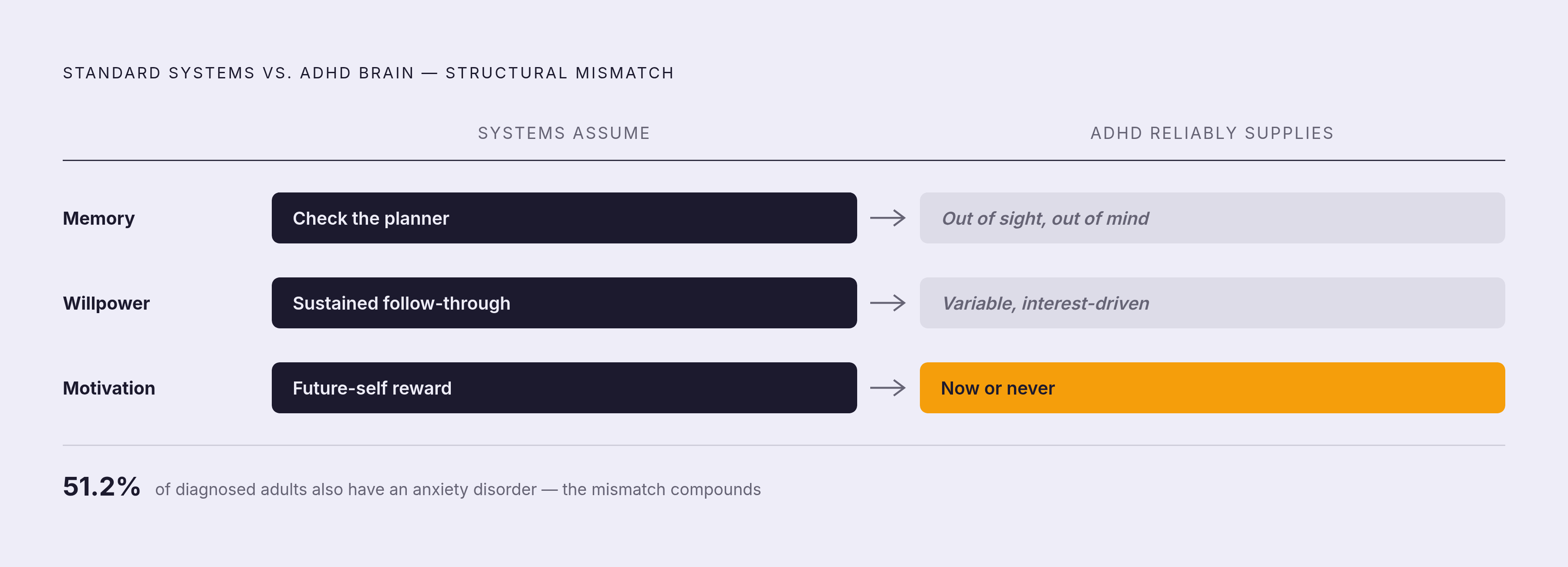
Every decision a routine eliminates is capacity you get to keep for the stuff that actually matters. Decision fatigue is real, and it compounds across a day. There's also an anxiety angle worth naming directly: 51.2% of adults with ADHD also have a diagnosed anxiety disorder, making it the most common co-occurring condition. Predictability lowers anxiety. A routine, done right, is doing double duty.
So why does so much productivity advice fall flat here? It assumes three resources the ADHD brain doesn't reliably supply: memory, willpower, and motivation sustained by an abstract future payoff. Most systems are built on the assumption that you'll remember to check the planner, that you'll want to follow through, and that the reward of "future you will thank present you" is enough to carry the moment. For ADHD, that's asking the exact muscle that's already weaker to do the heavy lifting.
The better frame treats routines as external scaffolding, built to compensate for internal scaffolding that doesn't hold weight reliably, rather than as a discipline problem. Everything from here forward works because it reduces the load on memory, willpower, or distant-future thinking.
Building the skeleton: anchor tasks and time blocking done the ADHD way
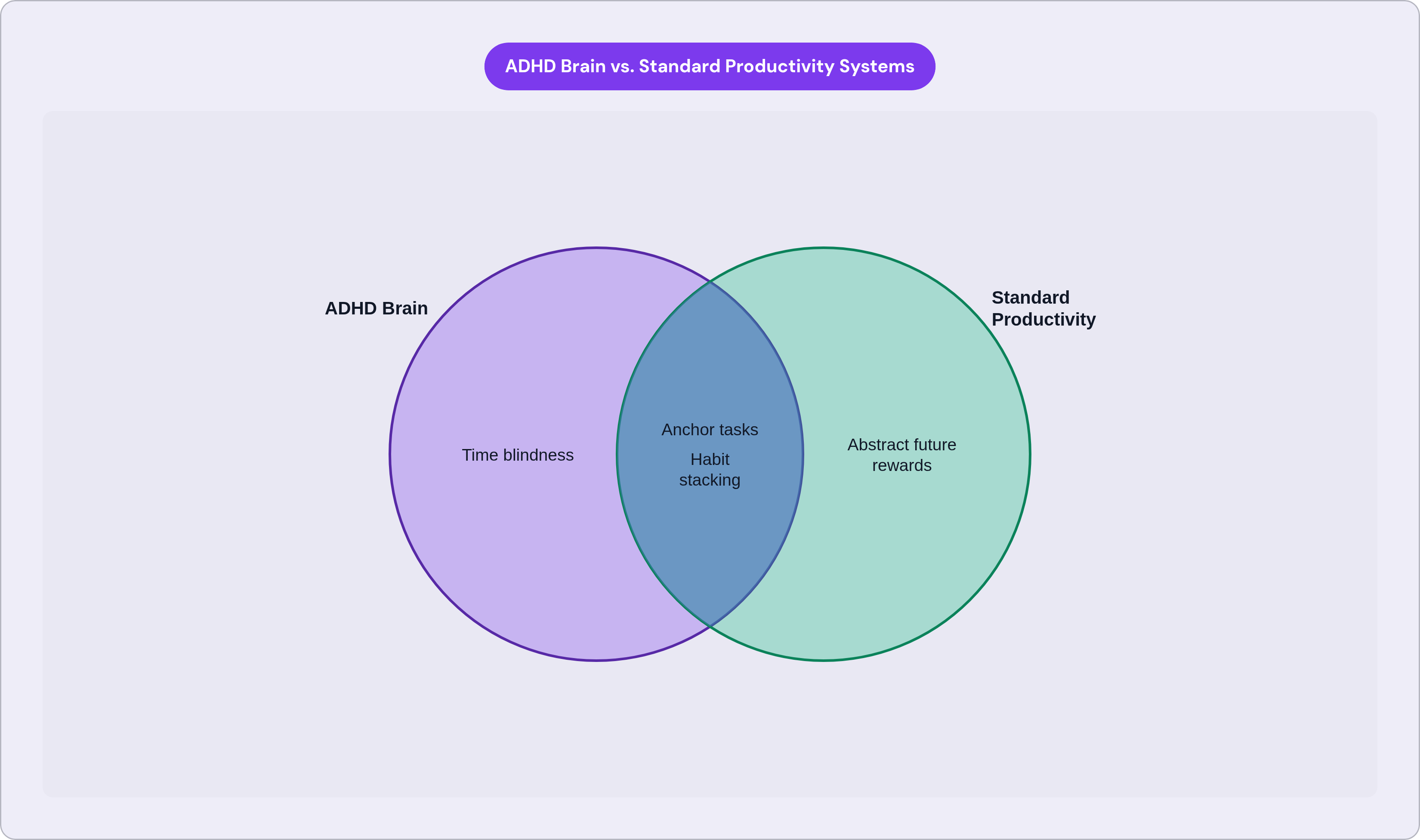
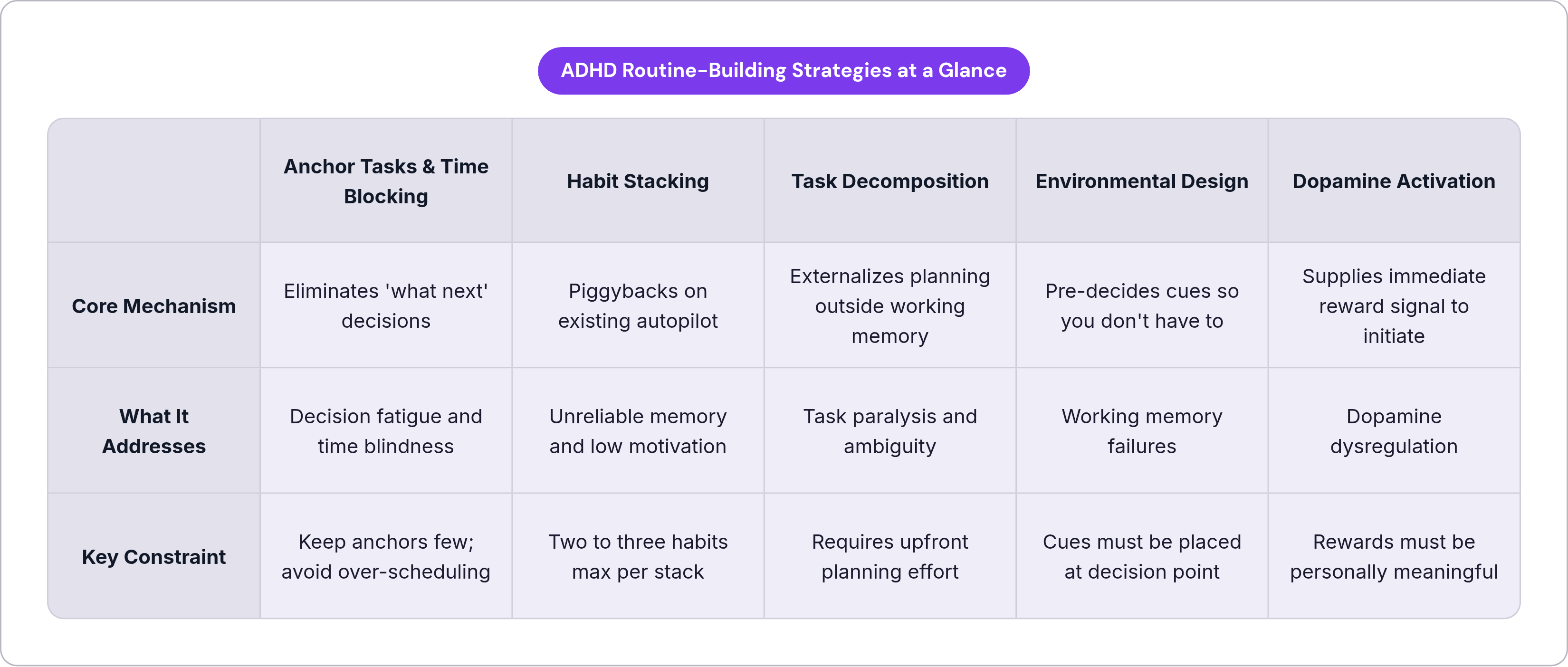
Start with three to five anchor tasks. Wake time, meals, the start of your workday, wind-down at night. These become fixed points, and everything else in the day organizes around them rather than getting scheduled minute by minute. The goal is a small number of moments you never have to negotiate with yourself about, more than a packed calendar.
This works because it collapses the number of "what do I do now" decisions down to almost zero at exactly the moments those decisions are hardest to make. Smaller tasks slot in around the anchors naturally, without needing their own scheduling.
Time blocking for ADHD looks different from the version in most productivity books. A few adjustments that actually matter:
Assign categories to chunks of time, not individual tasks. An "admin block," rather than "reply to email, then file the expense report, then schedule the dentist." The category gives you room to move within the block without the whole thing collapsing if one item takes longer than planned.
Pair every block with a timer or alarm. This is the direct countermeasure to time blindness: an external clock standing in for the internal one that isn't giving reliable readings. Set the alarm to say something like "wrap up now," not just "beep." Specificity does real work here.
Build in a flex block. Every day. Something unexpected is going to happen, and without a buffer already accounted for, that one surprise knocks over the entire schedule like the first domino.
Mornings deserve extra attention. A consistent morning sequence builds momentum that carries forward into the rest of the day, and it front-loads the hardest part, getting started, before the day has a chance to throw anything else at you.
One mistake I see constantly: over-scheduling. A calendar packed tight, task after task with no slack, becomes just as unworkable as no schedule at all. One missed step and the whole thing cascades.
Habit stacking: attaching new behaviors to what already runs on autopilot
The mechanic is simple: pair something new with something that already happens automatically. The old habit becomes the cue for the new one, which means you're not relying on memory or a reminder to trigger it. It's already firing.
Some examples that show up constantly in ADHD daily life: taking medication while the coffee brews, reviewing the day's tasks while the kettle heats up, doing a two-minute tidy of the desk while waiting for a call to connect. None of these require you to remember a separate cue, because the cue is a thing you were already doing.
This works for a few specific reasons. It bypasses working memory entirely, since there's no new trigger to store and recall. It lowers the friction of starting, because the new behavior rides in on the coattails of a sequence that's already in motion. And with repetition, the whole stack gradually automates, so the cognitive cost drops over time instead of staying flat.
One real constraint: keep the stack short. Two habits, maybe three at most. Pile on too many steps and you break the automaticity that made the whole thing work in the first place, and now you're back to needing to remember a sequence, which defeats the purpose.
This approach depends on the anchor habit happening, and the anchor habit is going to happen regardless of your mood, your sleep, or how the morning's gone, rather than on how motivated you feel on any given day.
Making tasks small enough to actually start
Task paralysis is real, and it's not the same thing as procrastination. A project can feel so large and undefined that starting it becomes neurologically difficult, even when you genuinely want to do it and even when you know exactly why it matters. That distinction matters, because procrastination implies avoidance, and this is closer to a stall.
Task decomposition is the fix, and it works as a form of externalized planning. Break "clean the kitchen" into "clear the counters, load the dishwasher, wipe the table." The sequence now lives outside your head, on paper or in an app, so your working memory isn't being asked to generate the plan in real time while also executing it.
The two-minute rule helps here too: if something takes under two minutes, do it the moment it comes up rather than adding it to a list. Otherwise these small tasks pile up quietly until the backlog itself becomes its own source of paralysis.
Pair this with batching. Group similar small tasks into one session, because switching between unrelated tasks carries a real cost, and that cost is higher for ADHD brains than for most. Answering five emails back to back is cheaper, cognitively, than answering one email, then making a phone call, then reviewing a spreadsheet.
The core principle underneath all of it: make the first step so small that not doing it feels almost strange. Specificity is what dissolves the ambiguity that triggers the paralysis in the first place. "Work on the report" stalls. "Open the doc and write one sentence" moves.
I'll be honest about the tradeoff: decomposition takes real effort upfront. You're doing planning work before you've done any task work. But that's the exchange, front-load the thinking so that later, when your energy's lower, all that's left is execution.
Designing the environment to do the cueing your brain won't
Every decision about what to do next, where something is, or how to begin, costs mental energy. Good environmental design pre-decides as many of those as it can, so you're not spending willpower on things that shouldn't require willpower at all.
Working memory in ADHD is unreliable, which means the environment has to pick up the reminding. Wall calendars. A whiteboard with the day's schedule written out where you'll actually see it. Post-it notes placed at the exact decision point, not on a random surface where they'll blend into the background within a day. Phone alarms named for what they actually mean, "leave for the meeting now," not just "alarm 3." Objects placed with intention: the gym bag by the front door, medication sitting right next to the coffee maker.
The same logic runs in both directions. Reduce friction for what you want to do, and add friction to what you don't. Keep the charger across the room from the bed. Pull social apps off the home screen so they take an extra step to open. These small frictions add up.
Digital environments count just as much as physical ones. Notification management, distraction blockers during focus blocks, consistent folder structures so you're not hunting for a file, all of it reduces the number of tiny decisions draining your attention throughout the day.
The underlying logic is consistent across every example: when the environment does the cueing, you don't have to remember. The trigger is already sitting there in the room, waiting.
Using dopamine deliberately instead of waiting for motivation to appear
Here's the problem with a standard to-do list: it's just tasks, with no motivational signal attached to any of them. The ADHD brain needs more immediate feedback than a neurotypical brain does to get moving, and a bare list of chores doesn't supply any.
A dopamine menu fixes this. It's a list, built ahead of time, of activities that are genuinely rewarding to you, ready to pull from rather than invented on the spot when you're already running low on motivation. Vary the intensity: small items like a favorite playlist, a five-minute walk, a good snack, work well before a task to generate some activation energy. Save bigger rewards for after completion.
The sandwich technique puts this into practice directly: a small dopamine hit before the hard task to get the engine turning over, and a larger reward after finishing it, one that's concrete and specific, not a vague "treat yourself later" that never quite materializes.
This approach is designed around the ADHD brain's need for immediate, tangible, anticipated payoff, distinct from a generic reward chart built around some distant future benefit that's too abstract to generate any pull right now.
One honest caveat: the rewards only work if they're actually rewarding to you. This has to be your list, built from what you know gets you moving, not copied wholesale from someone else's routine.
Body doubling: why working alongside someone else changes the equation
Body doubling means working alongside another person, in person or over video, on tasks that have nothing to do with each other. And it produces measurable effects on getting started, staying focused, and finishing.
A 2024 study published in ACM Transactions on Accessible Computing was the first formal look at the practice specifically, and it found that neurodivergent participants overwhelmingly used body doubling to help initiate tasks, stay motivated through them, and see them to completion. That's a meaningful shift, moving this from something people swap tips about online to something with actual evidence behind it.
A 2025 VR study, though small, with just 12 participants, found that both human and AI body doubles helped people finish tasks faster and reported greater sustained attention compared to working alone. The interesting part is what that suggests about the mechanism: it may be the sense of social presence doing the work, not physical proximity itself.
I want to be straight about the limits here. Controlled research on this is still thin, and the exact mechanism isn't fully worked out yet. The evidence is promising and it's growing, but it's not settled science.
In practice, this can look like co-working with a friend or colleague, using a virtual body doubling platform such as Focusmate, Flow Club, or Flown, or something as simple as leaving a video call open while you each work on your own thing in silence. It fits the broader pattern running through this whole piece: an external structure that does the work of accountability so you don't have to generate motivation from nothing.
Building flexibility into the routine so that missing one day doesn't end it
Here's a pattern worth naming honestly: one missed step, and suddenly the whole day feels lost. "I already broke the routine, so what's the point now." That's partly an ADHD cognitive tendency, all-or-nothing thinking shows up a lot here, and it's partly a design failure in routines that are too rigid to bend without snapping.
Flexibility has to be built in on purpose, as a design feature rather than a lowered standard. A few ways to do it: keep those flex blocks in the schedule so one disruption doesn't cascade into three. Decide ahead of time which anchor tasks are genuinely non-negotiable versus which ones are just preferred, so you have permission to triage on a rough day without that feeling like failure. And build a minimum viable version of the routine, one or two anchors instead of the full five, for the days when that's all you've got.
Novelty matters too. Rotating small elements, a different playlist, a new location to work from, a different reward, can keep the routine from going stale without touching the structure underneath it.
Self-compassion functions here as a practical tool, not a throwaway line. Research on ADHD and emotional regulation shows that shame and self-criticism after a slip actively make it harder to start the next day's tasks. Treating a missed day as data, not failure, is about not sabotaging tomorrow because of how you talked to yourself about today.
And routines age. What works during one stretch of life or in one job might not transfer cleanly to the next one. Review it every so often. Treat it as something alive, revisited and adjusted rather than passed or failed once.
Where AI tools fit into an ADHD routine — and what they can't replace
Most productivity apps have a built-in flaw for this population: they require you to maintain the system. You have to input the tasks, update the lists, decide what's a priority. That's exactly the executive function work that's already the hard part. Handing someone a more elaborate app to manage just relocates the burden rather than lifting it.
What actually helps is a tool that lowers the cognitive load instead of adding to it, something that surfaces the right thing at the right moment without requiring you to remember to open it and check. That's a meaningfully different design goal than most task managers are built around.
AI tools that hold context across sessions and adapt to patterns over time are addressing a real gap here. Working memory failures mean context gets lost constantly, you close a project on Tuesday and by Thursday you're reconstructing where you left off from scratch. A system that retains that context and hands it back to you removes a cost that used to fall entirely on you.
But it's worth being clear-eyed about the limits. No tool replaces the anchor tasks, the environmental cues, or the person sitting alongside you on a body-doubling call. AI can reduce friction and hold context, though it can't manufacture the will to open the laptop in the first place, and it can't replicate the specific effect of another human's presence in the room. The best routines I've seen use these tools as one more piece of scaffolding among several. The scaffolding still needs anchors, cues, and people in it; the tool just makes the load a little lighter to carry.