ADHD Morning Routine Checklist for Working Adults
Working adults with ADHD need external systems, not willpower, to salvage their mornings.
I've rebuilt this morning system more times than I can count. Every time it fell apart, I learned something about why, and it usually came down to the same mistake: I built the routine for the brain I wished I had, not the one I actually woke up with. That gap is the whole story here.
15.5 million adults in the U.S. carry an ADHD diagnosis as of 2023. More than half, 55.9%, got that diagnosis as adults, which means most of us are building morning scaffolding from nothing. No childhood routine to fall back on, no muscle memory to lean on. And over a third, 36.5%, got zero treatment last year. No meds, no counseling. For that group, the morning routine isn't a nice add-on. It's the only intervention they've got.
The three neurological barriers that stack up before 8 a.m.
Here's the thing nobody says out loud: mornings ask for the exact mental skills the ADHD brain has the least access to, and they ask at the worst possible time. Three things are working against you at once.
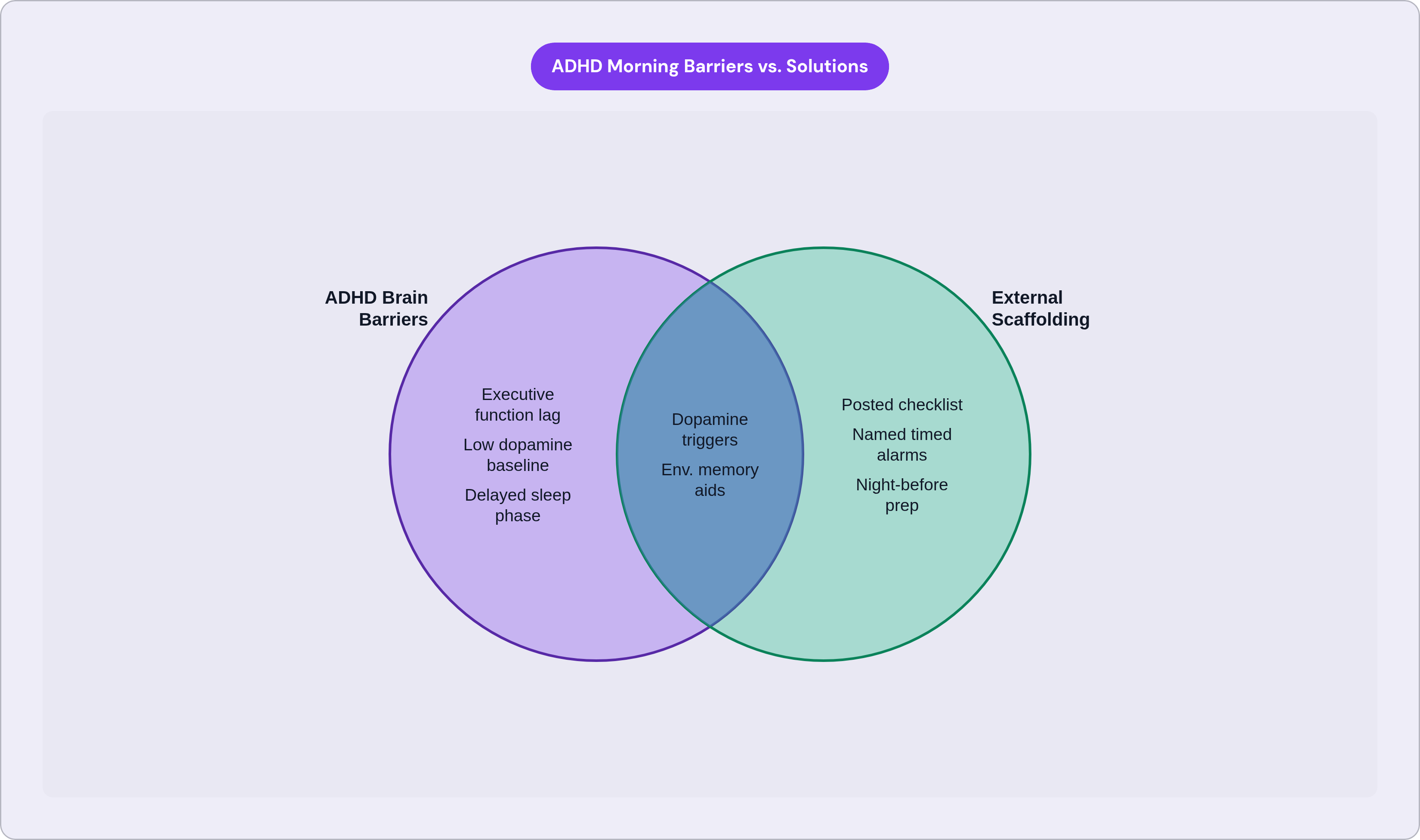
First, there's boot-up lag. Executive function doesn't fully switch on until 60 to 90 minutes after you wake up. Working memory is shaky, impulse control is thin, and starting a task can feel like trying to move a couch by yourself. "Just make a list" fails as advice for exactly this reason; following a list is itself an executive function task. You're telling someone to use a muscle that hasn't loaded yet.
Second, dopamine bottoms out in the morning, for everyone, but the ADHD brain starts lower to begin with. Research has linked that dip directly to sleep quality and how rough mornings feel. And a routine, by definition, is repetitive. Repetitive means low stimulation, which means it barely registers against that dopamine gap. The routine goes invisible to your own brain. It's also why "five more minutes" turns into two hours; guessing how long an interval feels and actually tracking one as it passes are two different skills, and the second one's usually the broken one.
Third, sleep. Everything sits on top of this. Cortese and colleagues ran a 2020 meta-analysis in Nature and Science of Sleep and found more than 75% of people with ADHD deal with sleep problems: delayed sleep phase, poor quality, all of it. Self-report numbers run even higher, up to 83% among adults assessed for ADHD. A lot of us are running a delayed circadian rhythm, so a 7 a.m. alarm hits like 5 a.m. would for someone else. Dr. Thomas Brown calls the resulting state "sleepy but wired." Exhausted, but the mind won't slow down. Standard advice about calm, gentle mornings just doesn't know what to do with that combination.
None of these three barriers waits patiently for the other two to finish. Bad sleep deepens the dopamine trough, the trough deepens executive dysfunction, and no single trick fixes all three at once. Whatever you build has to hit them together.
What these morning struggles cost at work
Adults with ADHD report 21.6 more lost workdays a year than neurotypical coworkers. Most of that isn't calling out sick. It's presenteeism: sitting at your desk while executive dysfunction quietly eats your output from the inside.
Almost 48% of adults with ADHD say they're frequently late to work. That's not a one-time inconvenience; it compounds over years and starts shaping how people see you professionally. Between 60% and 70% report struggles at work tied specifically to executive function: planning, prioritizing, starting the task sitting right in front of them. And there's a disclosure gap worth sitting with. Deloitte's 2024 Neurodiversity at Work survey found only 24% of employees with an ADHD diagnosis had told their employer, even though 72% said it affects their daily performance. Most people are carrying this quietly, which means most workplaces have no idea how much load their own people are hauling around.
It usually starts small. A rough morning doesn't stay contained to breakfast and getting dressed; it cascades into a late arrival, missed context from the morning huddle, a whole day spent reacting instead of running a plan you actually chose. By 3 p.m. that shows up as burnout. Fix the morning, and you get a real slice of those 21.6 days back. That's hours, in a literal sense, not a motivational one.
The design principle behind every step: externalize what your brain won't do automatically
Harold Meyer at the ADD Resource Center put it about as plainly as it can be put: ADHD morning routines need to externalize executive function, not lean on internal regulation systems that are neurologically compromised from the jump. Everything from here down is just that sentence, worked out in practice.
What does externalizing actually look like once you get past the theory?
- A physical trigger or sound instead of an internal reminder you'll forget you even set
- A default you locked in last night instead of a decision you're making groggy at 6:45
- An environment that pulls you forward instead of motivation you don't have yet
Research backs this: ADHD adults report more daily functioning trouble not from lack of ability, but because most tools assume a level of executive function that just isn't reliably available at 6:45 in the morning. That's a design flaw in the tools. Worth saying plainly, because the person using the tool usually gets blamed for it instead.
Someone reading this is probably thinking, this just sounds like more structure, more stuff to remember. Fair. But look at what the checklist is actually doing: it takes weight that's already sitting in your head and moves it out into the world, where it costs nothing to access. Weight relocated, not weight added. And no step in this system should ever run on willpower, because willpower is precisely the resource least available first thing in the morning. If a step needs motivation to function, it's built wrong. Simple as that.
The night before: moving decisions out of the morning entirely
If one change pays off more than the rest combined, it's this: every decision you make the night before is a decision your groggy morning brain never has to touch. A lot of us, especially on stimulant meds that have worn off by evening, actually think more clearly at night than we will for the next twelve hours. That's a window most people spend on Netflix instead of using.
So what goes on the night-before list? Each item is aimed at a spot where mornings reliably jam up.
- Lay out the full outfit, accessories included, so "what do I wear" never turns into a fifteen-minute spiral
- Pack the bag and set it by the door. This one move kills the frantic search-and-gather routine on its own
- Keys, badge, wallet: one hook. Just one. No "I'll remember where I put it this time," because you won't
- Name your alarms instead of using generic tones. "Take meds." "Leave now." The label does the thinking your groggy brain can't do yet
- Write down tomorrow's one most important task, so you're not standing at your desk trying to figure out where to even start
- Prep breakfast. Overnight oats, a coffee setup ready to go, whatever cuts one more decision and lowers the odds you skip eating
This is cognitive labor, shifted to the hours your brain can actually carry it. A small move that changes what the morning is asked to hold. The morning really does start the night before.
Waking up: building in a dopamine signal before you do anything else
The ADHD brain gets up because something makes it worth getting up, some hit of interest or stimulation, far more reliably than because it "should." Discipline barely moves this needle. Stop leaning on it.
Set your alarm to a song or podcast you actually like, not a tone that makes you want to throw the phone across the room. Wake at the same time every day; consistency softens a delayed sleep phase over months, even when the first few weeks feel arbitrary and pointless. And here's a trick a lot of ADHD adults swear by: set a first alarm just to take medication, then go back to sleep for another 30 to 45 minutes. By the time the real wake-up alarm goes off, the medication's already kicking in. People describe this as the single biggest change they've made to their mornings. I believe every one of them.
But what if medication isn't part of your picture at all? That's not a fringe case. Roughly a third of adults with ADHD took a stimulant in the past year, and of those, 71.5% reported trouble getting the prescription filled because of shortages, per 2023 CDC data. A checklist that only works on medicated mornings is quietly leaving out a huge share of the people who need it most.
For the non-medication version: get light on your face the second you're up. Open the blinds, step outside for thirty seconds, whatever it takes. That alone nudges your circadian clock and supports arousal, no pill required. Or stage a small reward in the kitchen: coffee you actually look forward to, a breakfast that's worth getting up for. That's interest-based motivation, working with the brain instead of against it.
One thing to skip, no exceptions: the phone. Reaching for it first thing hijacks your dopamine system through social media's variable reward loop, right when you need your attention pulling itself together, not scattering further.
The phone-free first phase and why the sequence of the first 30–45 minutes matters
A workable no-scroll morning holds off phone access until three things are done: waking with a dopamine trigger, medication and breakfast, getting dressed. In practice that's a 30 to 45 minute window with no screen at all. The phone's variable reward structure is the single most competitive stimulus in your environment, and it will hijack task initiation every time you let it in during the boot-up window.
Anchor one: wake plus dopamine trigger. Named alarm, medication if you take it, music or light or just physically getting out of bed.
Anchor two: breakfast plus hydration, already prepped the night before, so nothing gets decided on-site. Eating also helps medication absorb and keeps blood sugar steady, both of which affect attention more than people give them credit for.
Anchor three: dressed and ready to walk. The outfit's already chosen, so this step is purely mechanical. Bag's at the door, keys are on the hook, nothing left to figure out.
Only after all three are done does the phone come out, and even then it's bounded: calendar, messages, done. Named, timed alarms mark the handoff between each anchor, because your internal sense of time is exactly the thing least trustworthy right now.
Morning exercise as a non-medication dopamine strategy
Exercise raises dopamine and norepinephrine, the same two neurotransmitters stimulant medication targets directly. That overlap isn't a coincidence. It's why exercise keeps coming up in ADHD management conversations that have nothing to do with fitness culture at all.
Pairing medication with regular exercise is a combination many clinicians and researchers point to in ADHD management discussions. If you're medicated, many ADHD medications peak within one to two hours of ingestion, so morning exercise falls naturally within that active window. If you're not medicated, morning exercise might be the strongest evidence-backed lever available to you without a prescription involved.
It doesn't take much. A brisk ten-minute walk counts. The goal is neurochemical priming, not a workout, so slot it right after breakfast or fold it into the commute instead of treating it like some someday-project. People who've added early movement often say it frees up mental bandwidth that carries through the whole day, not just the first hour.
Here's the honest catch: exercise requires starting it, and starting things is the exact deficit this whole piece is built around. So keep it short, and chain it to something you're already doing. Let it ride the momentum of an existing anchor instead of demanding a fresh start all its own.
Visual and environmental scaffolding that replaces memory
Working memory can't be trusted in the boot-up window, so the environment has to remember for you. That's really the whole idea here.
A few tools that do the remembering so you don't have to:
- A laminated or printed checklist posted right at the exit, not a phone app, because opening the phone risks the scroll trap every time
- One launch pad spot: a hook, a shelf, a tray, wherever everything leaving the house with you lives. Bag, keys, badge, meds
- Named, time-anchored alarms for every transition, not just the wake-up: "Eat now." "Leave in 10." "Leave NOW."
- Clothes and gear staged the night before, so the environment shows you the next step instead of asking you to pull it from memory
The posted checklist works because it offloads sequencing, arguably the most executive-function-heavy part of any morning, onto something static and dumb. No charging, no unlocking. It's just there, doing its one job, over and over.
Digital tools have a place too, mostly at night rather than the morning itself. Some digital tools can help you review tomorrow's context, surface the one task that actually matters, and lock in the sequence in advance, all before your half-awake brain has to touch anything in real time. Plan digitally at night. Execute physically in the morning.
The bar here is simple, honestly: build a morning someone with almost no working memory could still get through start to finish. If a step depends on remembering, assume it gets forgotten, and design around that instead of hoping this time will be different.
Making the routine stick: what personalization and failure tolerance look like in practice
ADHD routines fall apart for structural reasons, not moral ones. Either the routine was built for a neurotypical brain from the start, or one disruption, a trip, a cold, a rough week, snaps the chain and there was never a plan for getting back in. Lack of discipline is rarely the real cause, no matter what it looks like from the outside.
Which is why personalization isn't a nice extra, it's the whole point. A night owl with a delayed circadian rhythm needs a different anchor time than someone who's naturally up at 6 a.m., and that's fine; the structure matters more than the exact clock time attached to it. Someone without medication access needs heavier environmental scaffolding to close the gap: more visual cues, more named alarms, more of the environment doing work medication might otherwise cover.
When the routine breaks, and it will, success isn't whether it stayed perfect. It's whether there's a way back in. A missed morning shouldn't mean starting over from zero or scrapping the whole system out of frustration. It should mean picking the next anchor and continuing from there. A routine that only survives when everything goes right was never built for an ADHD brain in the first place.