Pareto Principle Applied to Personal Workload Management
Focus your effort on the small slice of work that actually drives results.

Vilfredo Pareto noticed something odd in 1896: about 80% of Italy's land belonged to roughly 20% of the population. He checked other countries. Same pattern, more or less. Land, wealth, ownership, all clustered in a small slice of people rather than spreading out evenly.
It sat as an economic curiosity for decades until Joseph Juran picked it up in 1941 and gave it a name that actually does something: "the vital few and the trivial many." Juran turned a description into an instruction, telling quality control managers where to point their attention.
Richard Koch later took this into personal productivity with The 80/20 Principle, and this is where I think most people get the message wrong. Koch was arguing for smarter selection of where effort goes: the Pareto Principle is about which tasks produce results, more than about how hard you work on them.
You still bring full intensity to your vital 20%. The gain comes from figuring out which 20% deserves that intensity in the first place. And the 80/20 split itself isn't a law of physics. Depending on the domain, you might find a 70/30 pattern or something closer to 90/10. What holds steady is the asymmetry, not the exact numbers. So the real question the principle hands you is this: of everything on my plate, which small slice is actually driving most of what matters?
How unequal input-output ratios show up across domains
Once you start looking for this pattern, it shows up everywhere, and that consistency is what makes it worth taking seriously rather than treating as a cute statistic.
Asana's data shows roughly 80% of a company's profits tend to come from about 20% of its customers. In software engineering, a well-known finding holds that the vast majority of crashes trace back to a small fraction of the bugs reported, which is exactly why triage exists as a discipline. Sales floors show the same shape internally: 80% of revenue often comes from 20% of the sales team, same product, same leads, same training. And it's not limited to business. A Transportation Research Safety Board study found that 20% of drivers accounted for 79% of accidents and 76% of violations.
None of these are related fields. Software bugs have nothing to do with traffic violations. But the underlying shape keeps repeating: output almost never scales evenly with input. If that's true in customer profitability, engineering defects, and sales performance, why would your own task list be any different? It almost certainly isn't. Somewhere in your recurring meetings, projects, and commitments, a small number of activities are doing most of the real work, and the rest is noise wearing a busy costume.
The workload audit: a one-week process for finding your vital 20%
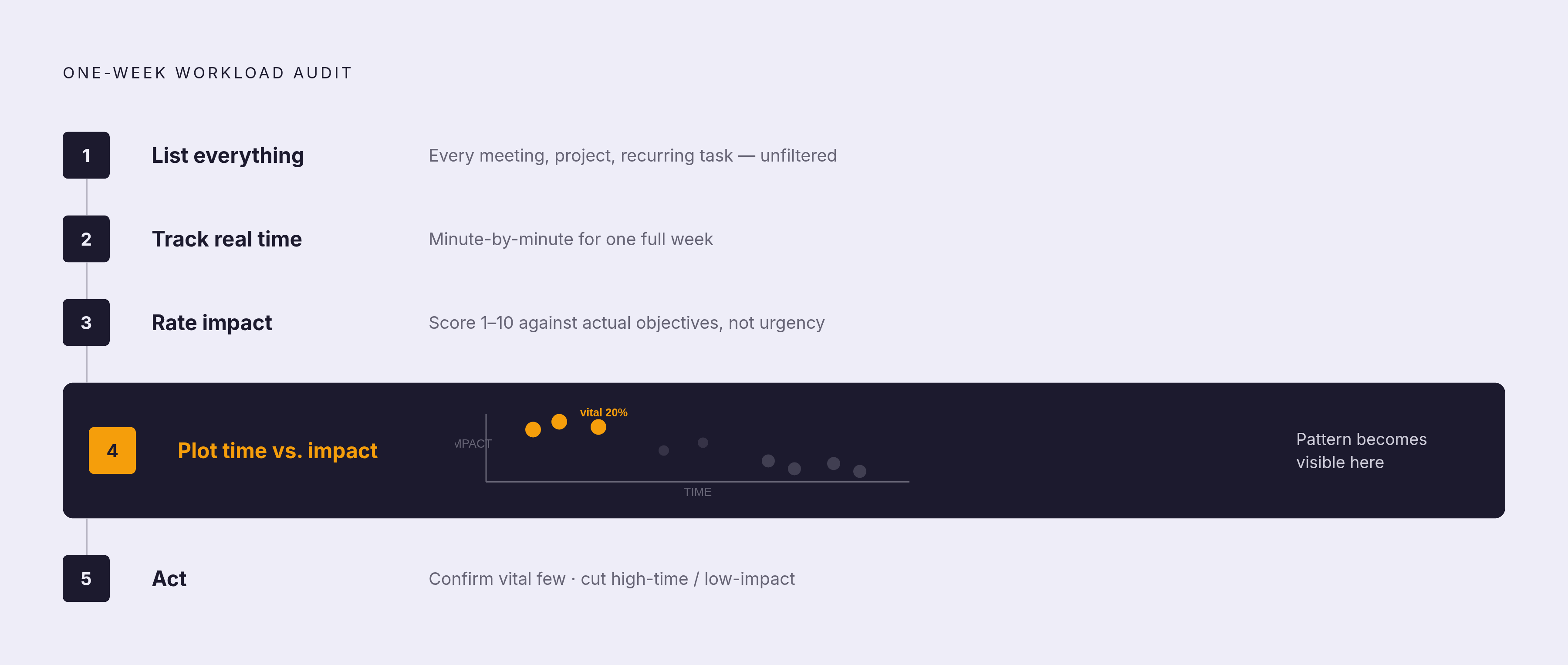
Here's how you actually find that vital slice instead of guessing at it.
Start by writing down everything. Every recurring meeting, every project, every task that shows up on your calendar or your list, whether it feels important or not. Don't filter yet, that comes later.
Then track, for one full week, how much time each of those things actually takes. Your estimate matters less than the reality: what you actually spent, minute by minute if you can manage it. The gap between estimated time and real time is usually where the trouble lives; we tend to think that report takes 20 minutes when it's really eating 90.
Next, rate each activity's impact on a 1 to 10 scale against your real objectives, whether that's revenue, a skill you're building, or a strategic position you're trying to reach. This is the step people rush, so slow down here. The rating has to track outcomes over effort and urgency. A task can feel important because it's loud, or because it's been sitting on your list for three weeks. That's not the same as producing results. Separate those two things deliberately, because your gut will try to conflate them.
Once you've got time and impact logged for everything, plot them against each other. The tasks that eat a lot of time and generate high impact: that's your confirmed vital few. The tasks eating a lot of time and generating almost nothing: those are your first candidates for the cutting room.
Look at the pattern across the full week too, not just individual scores. Recurring meetings and daily check-ins tend to be where the low-return hours quietly pile up. One meeting a week might not look like much. Four hours of them absolutely does.
I'd recommend doing this audit weekly rather than daily. Daily tracking creates decision fatigue; planning once and holding the plan for five days is more sustainable. And treat the whole exercise as a snapshot, not a verdict carved in stone. What's high-impact today may not be high-impact in two months, which is exactly why the review cycle matters later on.
Acting on what the audit reveals: prioritize, delegate, and eliminate
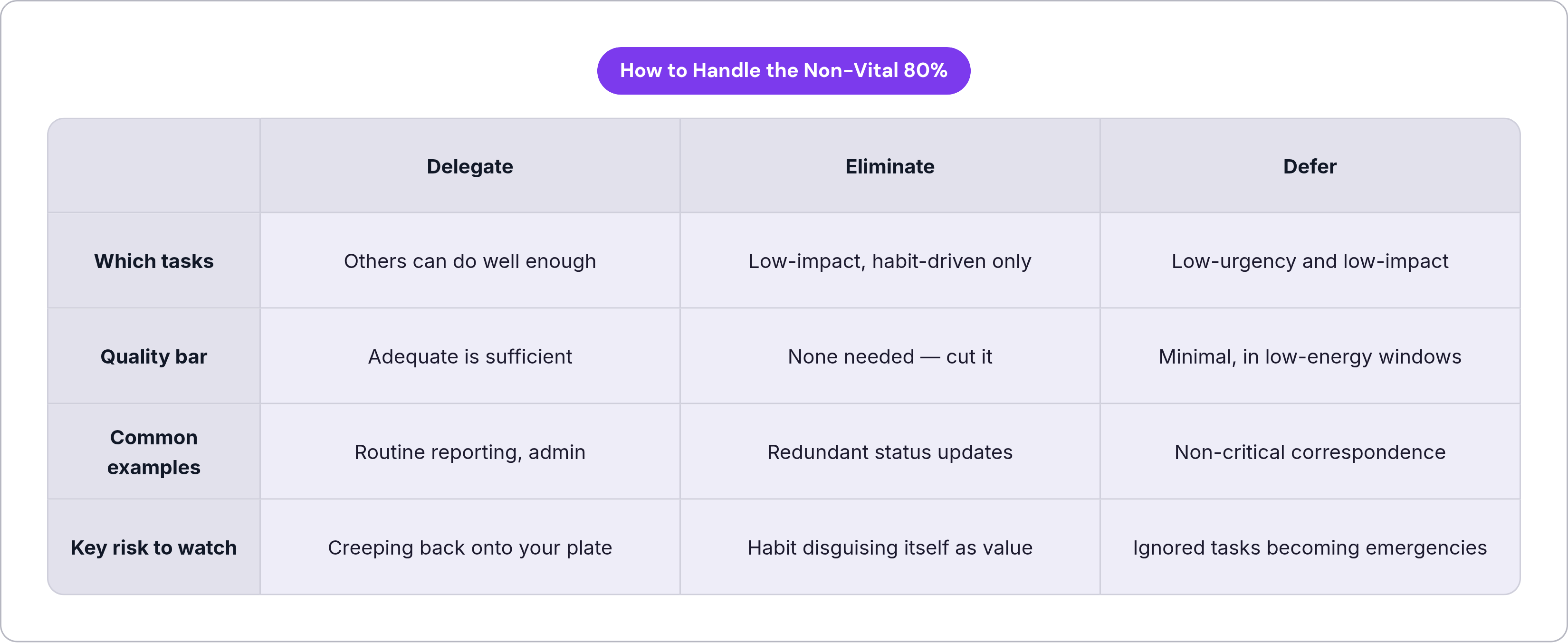
Once you know your vital 20%, it goes to the top of your schedule, structurally, blocked into your calendar before reactive work has a chance to eat the time.
The remaining 80% doesn't disappear, but it gets handled differently.
Delegate what someone else can do well enough. Adequate is the right bar for low-impact work; it doesn't need your personal touch. Eliminate what scores low and only survives out of habit, the recurring meeting that produces nothing, the report nobody reads, the status update that duplicates three other channels. And defer what's genuinely low-urgency and low-impact into a specific low-energy window, rather than letting it compete for space with your priority work.
Meetings deserve special attention here. Workers sit through an average of 31 hours of meetings a month, and attendees themselves rate around half that time, about 15.5 hours, as unproductive. That's most of a work week every month spent in rooms that aren't earning their keep.
Before you delegate or cut anything, ask one question: what actually breaks if this doesn't happen, or happens at less than full quality? Sit with that question honestly. Most of the time, the answer is nothing, or something much smaller than you assumed. Protecting your vital 20% means saying no to things that feel reasonable on their surface. The audit is what gives you the evidence to say no without spending the next three days second-guessing yourself.
Layering in complementary tools to protect high-impact time
Pareto tells you what to work on. It doesn't make you do it, and that gap is where a lot of good intentions quietly die.
The Eisenhower Matrix is a useful second pass. Once you've found your vital few through the audit, run each item through the urgency and importance quadrants to decide whether to do it now, schedule it, hand it off, or drop it. Most of your vital 20%, if I had to guess, lands in Quadrant 2: important but not urgent. Strategic planning, skill-building, the relationships you're supposed to be investing in. This is exactly the kind of work that distractions displace first, because nothing forces it onto your calendar the way a deadline does. It needs active protection or it just won't happen.
Time blocking helps here. Put your priority tasks in your sharpest hours of the day, not whenever there happens to be a gap, and treat that block like an actual appointment you can't skip. Some people take this further with day theming, dedicating whole days to one category of work instead of jumping contexts every hour. Fewer context switches, less friction rebuilding focus each time.
For the execution itself, something like the Pomodoro Technique breaks your blocked time into focused intervals with real recovery built in. That matters more than it sounds like it should: a single interruption can cost around 23 minutes of refocus time. Protect the block, and protect it from yourself too.
And to keep the other 80% from clogging up your head, a system like Getting Things Done, with its capture-clarify-organize-reflect-engage loop, makes sure the low-scoring items get parked somewhere reliable instead of rattling around in working memory, becoming the exact distraction your audit was trying to eliminate.
This is also where AI tools can genuinely earn their place. Some tools can help track which tasks keep recurring, which ones quietly drain more time than they should, and surface that pattern for you instead of forcing you to rebuild the audit from scratch every single week.
Where the principle breaks down and how to keep it honest
I want to be straight about the limits here, because treating 80/20 as gospel will get you into trouble.
The split is an observation, not a law. Depending on your work, the real ratio might be 70/30, might be 90/10. Treating "80/20" as a fixed formula gives you a false sense of precision that the underlying pattern doesn't actually support.
The most common misuse I see is short-term bias. You over-index on whatever's generating results this quarter and neglect the slow-build work (developing a new skill, cultivating a relationship, exploring a market that hasn't paid off yet) that compounds over years rather than weeks. That slow work often scores low on a one-week audit precisely because its payoff sits outside the measurement window. Don't let a snapshot fool you into starving your future.
There's also a real risk in the tasks you defer indefinitely. Correspondence, compliance work, basic maintenance: ignore these long enough and they don't stay low-priority, they turn into emergencies. A "low-impact" task today can become the most urgent thing on your list next month if you let it rot.
And watch for burnout. If you're constantly squeezing more out of your productive 20% without any recovery, you deplete the exact cognitive resources that made that work high-quality to begin with. High output that isn't sustainable amounts to a short sprint that ends in a wall.
One might argue the vital few should stay fixed once you've found them. They don't. What drove 80% of your results six months ago on a project might be irrelevant now that the project's moved into a new phase. The audit isn't a classification you run once and file away; it's a lens you keep picking back up.
Building a sustainable review cycle so the focus holds
Without a scheduled review, your vital 20% gets swallowed back up by reactive work within a few weeks. That 82%-with-no-system statistic marks a default state that pulls you back in if you're not actively resisting it, not a starting point people escape once and for all.
So build the resistance into the calendar. Weekly, re-score your task list against whatever your current objectives actually are. What produced results last week isn't guaranteed to be the highest-leverage thing this week; priorities shift faster than most people admit. Quarterly, run the full audit again, the entire one-week tracking exercise, because roles change and goals change and the asymmetric tasks shift right along with them.
A few questions worth asking at each review: Are your high-impact tasks actually sitting in the first hours of your day, or have they slid into the afternoon because something reactive keeps jumping the line? Has anything you delegated crept back onto your plate wearing a disguise (a meeting invite, a check-in request, a "quick review" that isn't quick)? Are the outcomes from your vital few still connected to what actually matters, or have your priorities moved without you noticing?
This is also where you check yourself for burnout. Aim for sustainable output you can keep producing month after month, rather than maximum extraction from a shrinking window of energy.
Tools that track these patterns over time, logging what recurs, tagging what drains disproportionate time, reflecting on what's actually working, cut down the friction of doing this review honestly and consistently. Tools built for context and pattern recognition can support exactly this kind of ongoing workload intelligence, the sort of thing that makes a weekly review take ten minutes instead of an hour.
Put together, the audit, the prioritization, the tools layered on top, and the review cycle form a loop that doesn't close. That's the point. The Pareto Principle is a practice you keep returning to, a way of keeping your effort honest against what it's actually producing.