AI Assistants That Protect Cognitive Bandwidth Without Overriding Your Decisions
Delegating tasks without delegating decisions keeps you thinking while AI handles the work.

An AI productivity layer protects deep work and human agency when it takes on bounded tasks without taking over the decisions those tasks support. The useful distinction is between offloading drafting, summarizing, and retrieving, and accepting a finished conclusion without scrutiny. The right assistant cuts context switching and decision fatigue while keeping you thinking.
The design choice hidden inside every AI assistant
Consider drafting an email about a difficult decision. One assistant supplies a complete message, including the position to take and the reasons for taking it. Another helps put a position you have chosen into words, with room for you to question, revise, and rewrite. Both can produce a polished email. But in the first case, accepting the text can also mean accepting a judgment you never made.
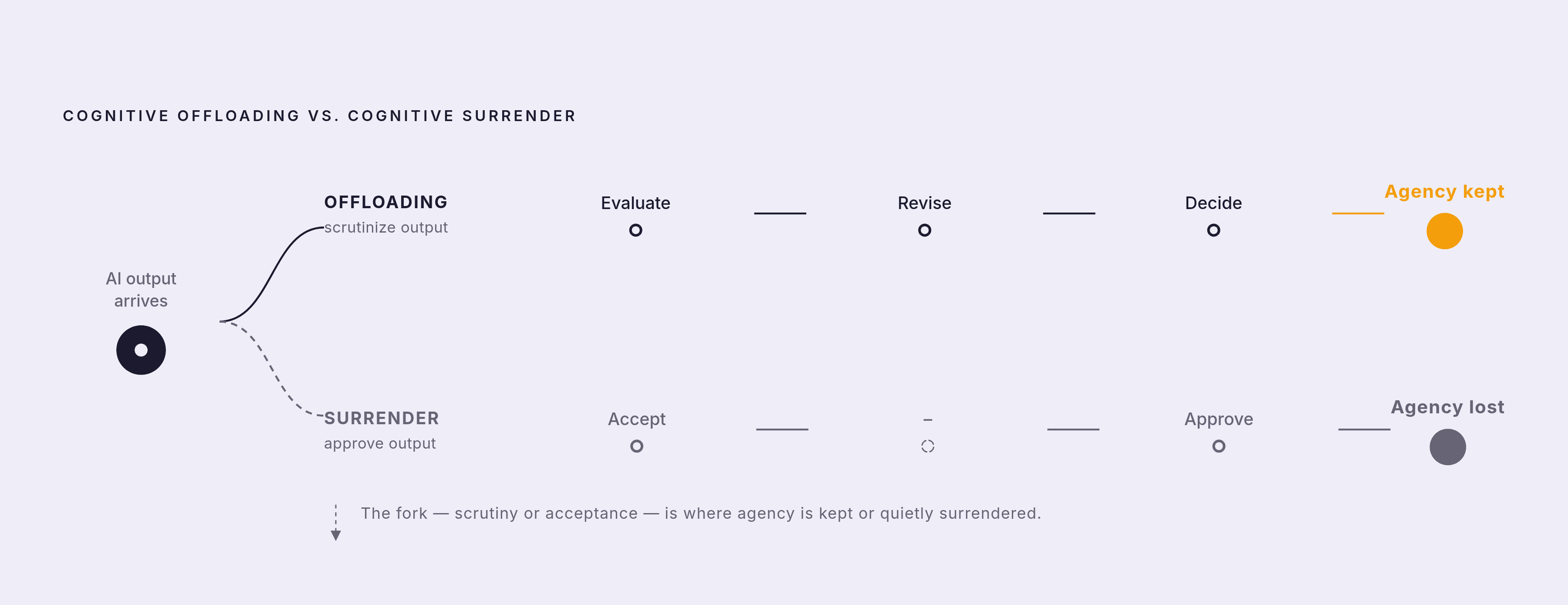
That difference is the design choice beneath the interface. Cognitive offloading means delegating a bounded task while your own reasoning stays engaged. Cognitive surrender means taking an AI output with little scrutiny and handing over agency along with the work. The dividing line is whether the collaboration leaves you deciding what the work should say and do, or merely approving what appears.
Why the frictionless design default is not neutral
The commercial design dogma that “frictionless interaction equals optimal user experience” favors the second path. A complete answer that reads well is easy to accept and pleasant to receive, which helps win approval in the short term. Scrutiny takes a separate effort. When an interface makes acceptance the default and questioning the detour, even someone who genuinely wants to think carefully faces pressure in the other direction.
Fluency makes that pressure harder to notice because good writing acts as a cue for expertise. A confident answer can feel trustworthy regardless of whether it is accurate or fits the user’s values. Researchers call the tendency to conserve mental effort “cognitive miserliness.” The International AI Safety Report 2026 identifies automation bias as over-reliance on automated outputs while discounting contradictory information, and explains that it undermines competence by discouraging active reasoning and verification.
Can users simply decide to scrutinize more carefully? They can, but that requires resisting the interface. Becker et al. (2025) found that people coded 19% more slowly with AI assistance, even though they expected it to speed them up. The people most averse to thinking were also the least accurate judges of its costs. The miscalibration was not merely random error. Those most inclined to hand work over were least well placed to recognize what doing so cost them.
What repeated cognitive surrender does over time
The University of Central Florida’s autonomy surrender model proposes that these small transfers can compound. Its “silent cost” describes autonomy shifting incrementally, without any single interaction feeling like a capitulation. Its “surrender threshold” describes a point beyond which reclaiming independent function becomes cognitively and psychologically difficult. Recovery is therefore part of the model. Dependence can outlast the interaction that helped build it.
GPS-reliant users show measurably poorer spatial memory. Kosmyna et al.’s 2025 essay-writing study found that users who leaned on LLMs had weaker neural connectivity and remembered less of their own writing. Budzyń et al.’s 2025 study found declining adenoma detection rates in unassisted procedures among colonoscopists after routine AI assistance was introduced.
Mitchell, Ghosh, and Passi describe the corresponding problem in AI agent oversight. Extended automation use can weaken the cognitive capacities needed to supervise automated systems, so the tool erodes the skill required to catch its own errors. This extends beyond personal habits. Deloitte’s 2026 Global Human Capital Trends survey found that a majority of executives regularly use AI to support decisions, making tool design a question of organizational decision quality.
The model’s sharpest warning, however, concerns preference inversion. Functional dependence may come to feel not like a lost ability but like the preferred way to work. That changes the problem being solved. Someone who sees dependence as a benefit may see little reason to regain the ability to work on their own. At that point, restoring autonomy is not only a design challenge but a cultural and political one, because the sense of what counts as good assistance has itself shifted.
Why "human in the loop" does not automatically fix this
Having a person approve the work seems like an obvious way to guard against that course. Yet approval is not the same as judgment. Mitchell and colleagues identify a design flaw in systems optimized for speed, accuracy, and volume while the cognitive needs of overseers remain a separate consideration. Under time pressure, monitoring many autonomous inferences per hour can produce fatigue and reflexive rubber-stamping. A checkpoint can leave people in charge on paper with little ability to act on it.
The AIES-2026 controlled experiment on child maltreatment risk assessment tested safeguards that appear more substantial than a simple approval button. Accountability requirements increased deliberation time but did not reduce over-reliance. More time spent on a decision did not better protect people against the AI’s influence, so effort alone is a poor measure of how well oversight works.
The same experiment also tested sequential disclosure, in which people made their own judgment before seeing what the AI recommended. That did not reliably protect their initial view. People often gave up an assessment that agreed with experts and went with the AI recommendation they saw afterward. The finding challenges a comforting assumption. Thinking first can be useful, but the interface must also support what happens when the two judgments conflict. Human oversight needs to shape the workflow from the start.
What features actually keep reasoning engaged
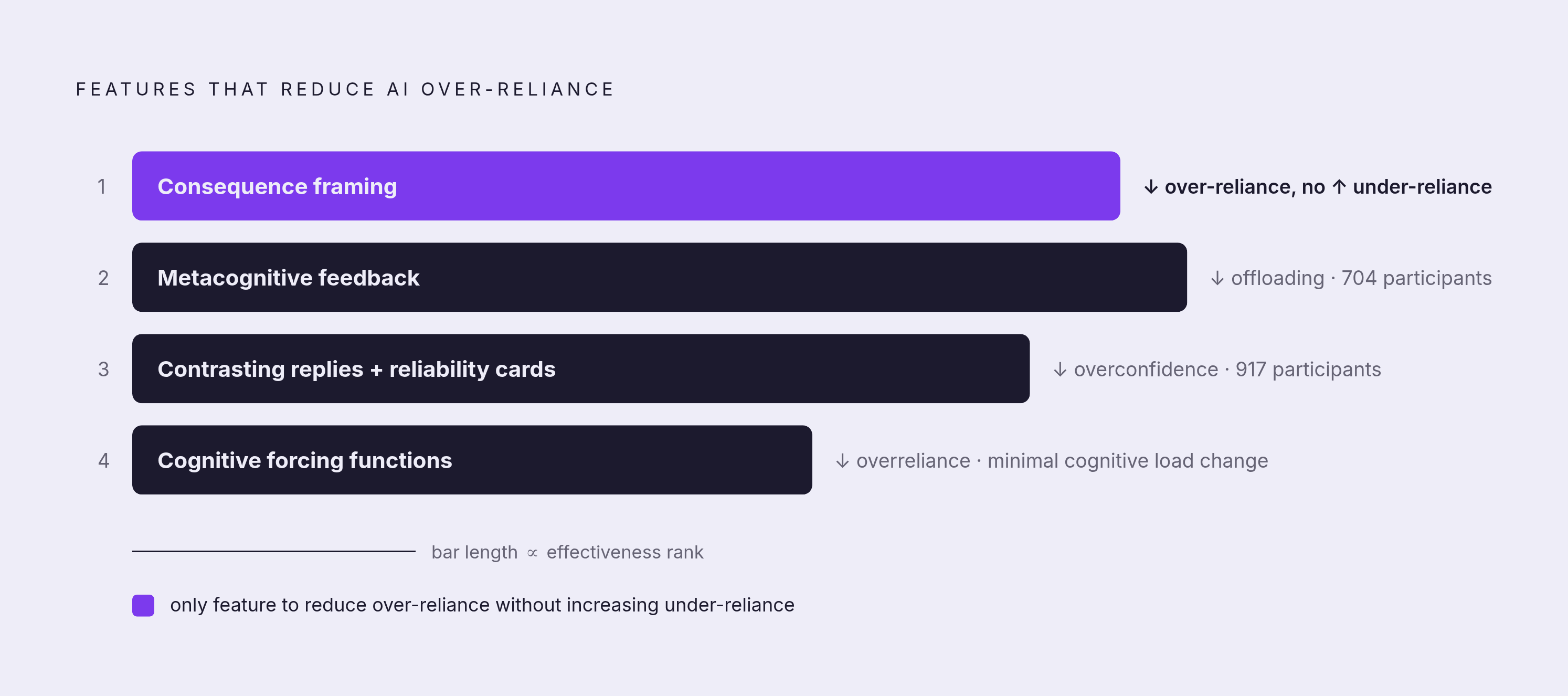
Features that direct attention toward the decision are worth looking for. Consequence framing is the most intuitive example. The AIES experiment found that it reduced over-reliance without increasing under-reliance and produced the highest rate of decisions consistent with expert judgment. In practice, this means surfacing who is affected, what is irreversible, or what the user would need to explain to someone else. The prompt changes what the decision is about, drawing attention away from the answer’s fluency and toward its consequences.
Metacognitive feedback takes a less obvious route by showing people how they are using the assistant. Maier et al.’s preregistered experiment with 704 participants tested this approach in fraction arithmetic with LLM assistants. The feedback combined a process mirror of actual assistant use, information about what that pattern meant for cognitive practice, and a cue to assess an aspect of understanding. Answer offloading decreased and test performance improved. Financial rewards for accuracy showed no effect, suggesting that reflection on the process did something an incentive alone did not.
A practical version would show whether a user repeatedly accepted the first suggestion, rather than reporting only whether the final output was good. That distinction shifts attention from results to participation. Wei et al.’s ownership survey found that people retained felt ownership when they led, iterated, or rewrote, but disowned work when they merely approved AI suggestions. An interface can therefore support ownership by making revision a natural part of collaboration. A polished result is not a substitute for that involvement.
Contrasting replies appear to move in the wrong direction because they add apparent complexity. Yet a between-subjects experiment with 917 participants found that contrasting replies and per-task reliability cards led to less estimation error and overconfidence, and better aggregate confidence discrimination. Microsoft’s AI-assisted writing study also found that the Assumptions cognitive forcing function led to less overreliance with little change in cognitive load. The shared mechanism is a redirection of attention toward consequences, understanding, or alternative interpretations.
The limits of friction-first design and what fills the gap
There is a serious limit to this prescription. People often turn to AI because their bandwidth is already depleted, and another demand for reflection can become another burden. When work moves fast, time pressure and repeated checks can lead to fatigue, automation bias, and rubber-stamping even with safeguards in the interface. A well-placed prompt in an experiment does not establish that constant prompting is sustainable at work. Friction can fail when the person it asks to engage has little capacity left.
The motivational objection goes deeper than fatigue. Self-monitoring research suggests that knowing about overreliance can protect cognitive control without bringing back motivational ownership. When AI does the core thinking, users may lose the sense that they are working on their own and doing it well, even when they know exactly what is happening. Awareness is not authorship. Knowing that the assistant supplied the thinking does not recreate the experience of having developed the work yourself.
This is why interface design needs a complement that builds the user’s capacity to engage. Komissarov’s AI literacy framework proposes that people be guided through failure modes, including sycophantic validation and authority projection, as well as being taught declarative knowledge. Its inoculation-theory approach uses experience of misleading AI behavior to help people get ready to resist it. The PAUSE project adds a way for people to assess themselves with a privacy-preserving, no-backend tool that helps them think about their cognitive offloading patterns. Together, these directions support a combined standard, with system-level safeguards helping at the decision point and user-level literacy helping people recognize when those safeguards are needed.
What to look for when choosing an AI assistant that works with your judgment
A tool suited to cognitive offloading handles bounded tasks such as drafting, summarizing, and retrieving, then leaves meaningful decisions open. For scheduling and admin, the same standard is a clear boundary between the repetitive work being delegated and the consequential choices being retained. The aim is to interrupt you less without quietly giving the assistant more say.
Look next for visible places to intervene. Signs that you can step in include uncertainty, alternative framings, and iteration points where your input changes the work before it is done. A tool that reflects your interaction patterns can also help reveal whether assistance has turned into habitual acceptance. Does the workflow leave you leading, iterating, and rewriting, or mostly approving a finished answer?
Speed and satisfaction alone are weaker signals. Sharma et al. (2026) looked at 1.5 million Claude.ai conversations and found that users gave higher approval ratings to interactions with more potential for disempowerment. That limits what approval can establish. A fluent, seamless experience may feel helpful while narrowing the user’s role. The stronger design standard is an assistant that understands context and learns patterns to augment human judgment.
For consequential decisions, form a view first and use the AI to stress-test it rather than replace it, remembering that sequential disclosure alone offers no reliable protection. Periodically review your offloading patterns, and rotate assisted tasks with unassisted practice, following Mitchell and colleagues’ recommendation for skill preservation. Guided exposure to sycophancy, authority projection, and confident confabulation can further strengthen that practice. Understanding the distinction between offloading and surrender gives you a firmer basis for using any assistant, because you know which work to hand over and which decisions remain yours.
Sources
- Ownership in AI-Assisted Everyday Tasks
- From Diagnosis to Inoculation: Building Cognitive Resistance to AI Disempowerment
- AI Agents Push Humans Out of the Loop
- The Silent Cost of Artificial Intelligence Assistance: A Theory of Autonomy Surrender, the Recovery Mechanism, and the Restoration of Human Agency
- International AI Safety Report 2026
- Frontiers
- Who's in Charge? Disempowerment Patterns in Real-World LLM Usage
- Limits of Interventions in AI-Assisted Decision Making