Cognitive Load Theory Applied to Complex Knowledge Work
Protect the mental bandwidth your team needs to actually learn on the job.
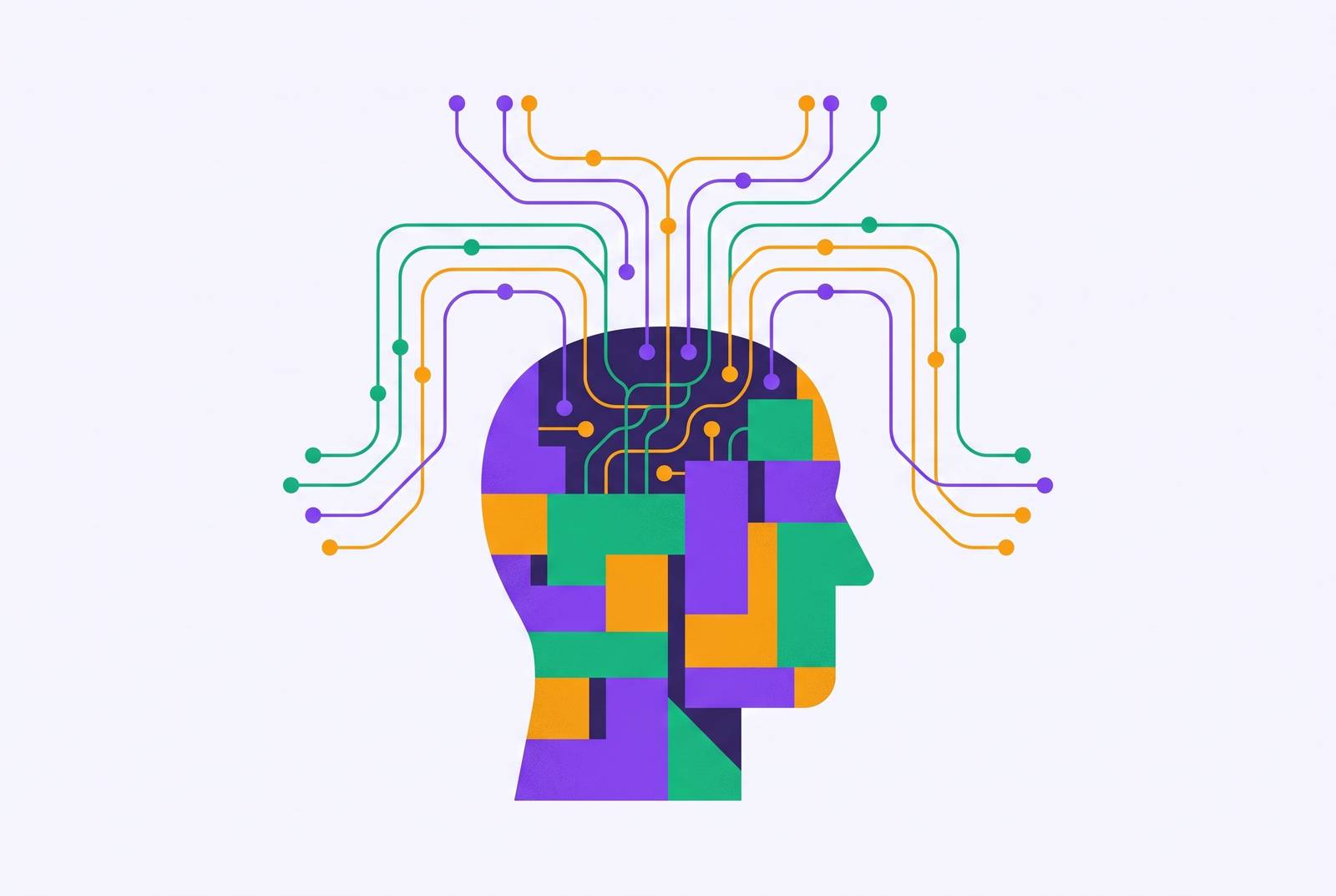
Cognitive Load Theory started as a way to explain why students stall out on certain lessons, but its real value appears in the workday. The three load types it names, once understood, work as a diagnostic for where mental effort in complex knowledge work actually goes and why so much of it never turns into anything useful.
The classroom version of Cognitive Load Theory undersells it
The mechanism is almost mechanical in its simplicity. Working memory holds around four chunks of information at a time, and it dumps them within seconds if nothing is done with them. Long-term memory, on the other hand, is effectively bottomless. Learning, in Sweller's framing, is the process of moving information out of that fragile, tiny holding area and into the permanent one, and it does this by building schemas: structured, reusable chunks of knowledge that can later be recalled as a single unit rather than reassembled piece by piece worklytics.co. A schema, once developed, lets an expert treat something enormously complex as if it were one simple idea. That is what "automation" means in this context, and it is why an experienced person can do in seconds what took a beginner an hour.
Three types of mental effort compete for that same narrow bandwidth. Intrinsic load is the load baked into the task itself, set by how many elements interact and how much the person already knows. It cannot be erased, only sequenced around. Extraneous load is the load created by bad presentation or a cluttered environment, irrelevant information, poor formatting, confusing structure, none of it necessary to the task, all of it burning capacity anyway. Germane load is the productive kind: the effort spent actually building and integrating schemas, the part of the process where learning happens.
Here is the detail most summaries skip. In the newer CLT models, germane load is not treated as its own independent source of demand anymore. It is better understood as what happens in the room that gets freed up once extraneous load is stripped out, meaning germane load can only be permitted rather than added directly. That is a significant technical correction: germane load cannot be added directly, only permitted, by first getting the waste out of the way. Which means the entire design imperative collapses into a sequence: cut extraneous load close to zero, sequence the material so intrinsic load doesn't spike all at once, and then protect whatever capacity that frees up for the real work of understanding. Most interventions, in classrooms and in offices alike, stop after step one, if they even get that far.
None of this needs to stay confined to instructional design. The next section makes the case that it maps onto adult professional life with almost no translation needed.
The cognitive constraints that break learning and also break knowledge work
Knowledge work is continuous learning under time pressure.
The load types translate cleanly. A tangled technical problem or a multi-party negotiation carries intrinsic load that cannot be wished away; that is simply the shape of the work. Disorganized documentation, five different chat tools, redundant meetings covering the same ground: none of that is inherent to the task, and all of it eats into the same working memory budget https://hackernoon.com/askreaderquestion. The moment a practitioner starts recognizing a pattern faster, developing a feel for when a shortcut applies, actually getting better at the job rather than just getting through it, is the germane load worth protecting. That only happens when the other two loads leave room for it.
A June 2026 perspective in Frontiers in Organizational Psychology pushes this argument further than most workplace commentary does. It argues cognitive overload deserves classification alongside physical hazards, as a formal ergonomic risk, not a soft complaint about being busy. Overload occurs, per that framing, when cumulative demands exceed working memory capacity, and it worsens specifically when extraneous load from badly designed systems stacks on top of intrinsic complexity that was already substantial.
The clearest empirical support for this line of thinking comes out of clinical training, where the stakes of a bad decision are immediate and visible. A 2024 path-analysis study of 151 nursing students at Shahid Sadoughi University of Medical Sciences, conducted between 2021 and 2023, found that decision-making quality tracked more closely with extraneous cognitive load than with intrinsic load University of California, Irvine worklytics.co. It wasn't the complexity of the medical scenarios that predicted worse decisions, it was the noise around them. That has a direct implication for any workplace program trying to sharpen judgment: fix the noise before assuming the task itself is the problem.
Which raises a fair question for anyone managing a team or designing a workflow. Instead of asking how to make people more productive, in general, ask which load type is actually consuming the budget that should be going toward germane work. That's a narrower question, and a much more answerable one. Knowledge work is continuous learning under time pressure (an analyst, engineer, or product manager is constantly processing novel information, forming judgments, and building mental models, which matches what CLT describes).
Extraneous load generated by the work environment itself
Extraneous load doesn't announce itself as extraneous. It usually looks like ordinary busywork. The Frontiers piece frames it precisely this way: badly organized workflows, redundant communication channels, and constant disruption can degrade cognitive efficiency substantially, even when the actual difficulty of the task hasn't changed at all.
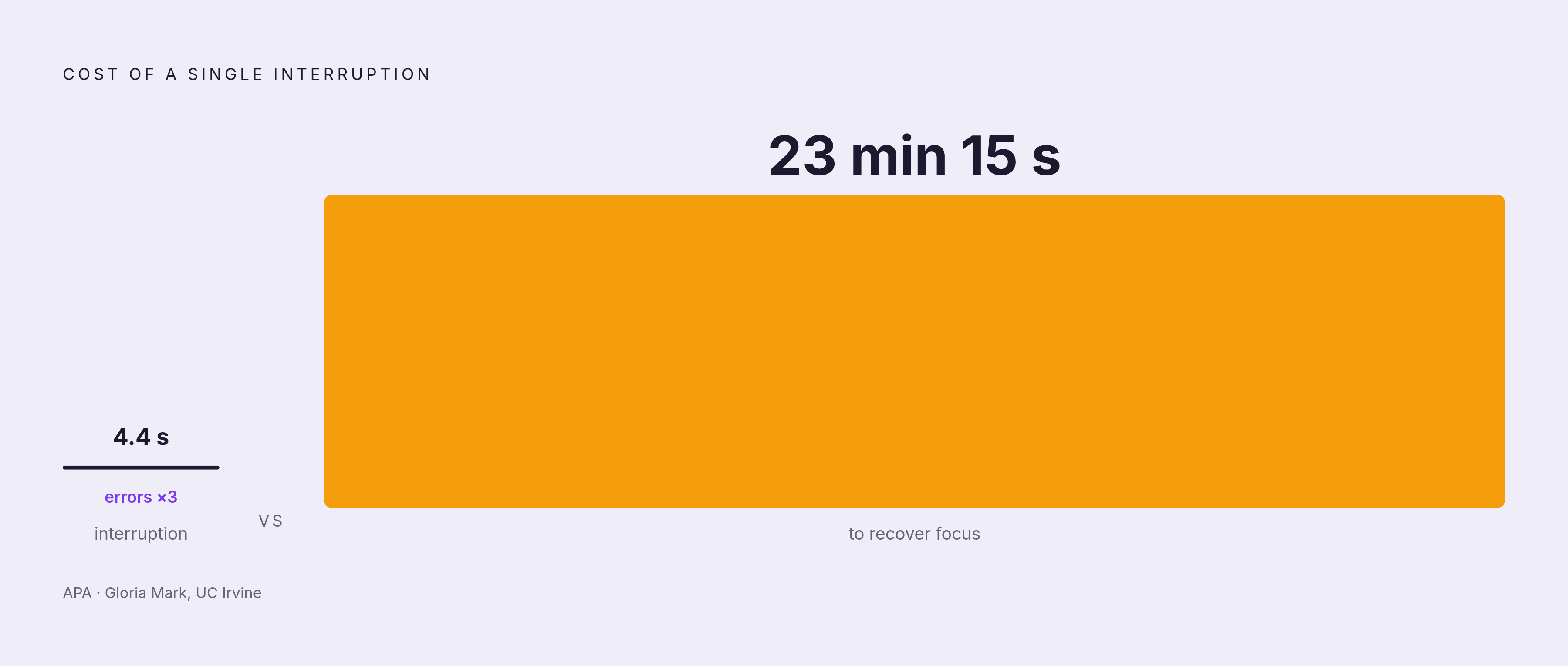
Context switching is the clearest case study. The switch itself takes an instant. Recovery does not: the same body of research found it takes an average of 23 minutes and 15 seconds to fully regain focus after a significant interruption University of California, Irvine worklytics.co. That gap, seconds to break concentration against nearly half an hour to rebuild it, is the actual mechanism of the damage, not the interruption itself.
The scale of the error cost from interruption demands attention. The American Psychological Association found that interruptions as short as 4.4 seconds triple error rates in complex cognitive work. Four seconds, shorter than it takes to read this sentence aloud. Sophie Leroy, at the University of Washington Bothell, gives the mechanism a name: attention residue. The switch away from a task completes, but working memory doesn't fully follow. Part of it stays behind, still allocated to whatever was just interrupted.
Tool fragmentation compounds the same problem from a different angle. Harvard Business Review estimates knowledge workers toggle between applications over 1,200 times a day, at a cost of roughly four hours of productive time per week. Research cited by LumApps finds 38% of employees dealing with excessive communication volume, with productivity and engagement both suffering as a result lumapps.com. And knowledge workers reportedly spend up to 2.5 hours a day just searching for information scattered across different platforms lumapps.com. None of that searching builds a schema. It just feels like work because it's effortful.
Collaboration itself has quietly become a load source. Time spent in meetings, email, and other collaborative activity has grown by 50% or more over two decades, and some employees now spend up to 80 to 85% of their time in collaborative work of some kind worklytics.co. The substance of that collaboration might carry real intrinsic value. But the overhead wrapped around it, the scheduling, the redundant threads, the meetings that restate what an email already covered, is pure extraneous cost, and it crowds out the deep processing that collaboration was supposed to enable.
None of this is a discipline problem. It's a design problem, which is actually good news: design problems can be fixed at the system level, not just by asking individuals to concentrate harder. Gloria Mark and colleagues at UC Irvine found that knowledge workers switch tasks every 3 minutes on average, spending roughly 11–12 minutes in a working sphere before switching or being interrupted Gloria Mark / UC Irvine.
Data on focus time and cognitive performance thresholds in knowledge work
If extraneous load is the leak, focus time is the tank. Research consistently shows that knowledge workers who get at least 3.5 hours of daily focus time report being noticeably more productive than those who get less worklytics.co. That number maps almost exactly onto the germane load zone: the window where schemas actually get built rather than just accessed.
But how many of those hours does a person actually have available? Fewer than the workday suggests, which reframes the whole question: effectiveness isn't about total hours logged at a desk.
Organizations that actually structure focus time into the day see it pay off. Worklytics' 2025 productivity benchmarks associate structured focus-time policies with 15 to 25% improvements in project completion rates and code quality metrics worklytics.co. On the flip side, the APA's switching-cost research finds that task-switching can cut productivity by as much as 40% American Psychological Association lumapps.com. Reading that figure through a CLT lens, it stops looking like a vague productivity statistic. It's the gap between the germane capacity a worker actually has available and the germane capacity they're able to use once switching costs eat into it.
None of these thresholds are motivational targets, the kind of thing a productivity coach might set as a stretch goal. They describe an actual capacity limit in working memory for sustained, schema-building processing. Designing a workday around them is an ergonomic decision, the same category as adjusting a chair height or a monitor angle, not a lifestyle preference. Studies suggest many knowledge workers hit their cognitive peak for only 2–4 hours a day, making effectiveness more about how those hours are protected than total hours logged memtime.com.
The right cognitive design for a novice actively burdening an expert
One complication, though: the "right" design isn't fixed. It moves depending on who's doing the work. Kalyuga and colleagues documented what's now called the expertise reversal effect, published in Educational Psychologist: instructional techniques that work well for inexperienced learners can lose their effectiveness, and sometimes actively backfire, once the learner gains experience.
The mechanism runs in opposite directions depending on where someone starts. A novice, lacking schema, benefits from external scaffolding: worked examples, step-by-step guides, structured templates. Without that scaffolding, a novice falls back on inefficient trial-and-error that overwhelms working memory fast. An expert already carries the schema internally, though, so the same scaffolding becomes redundant information they're forced to process anyway, which increases load rather than reducing it.
Play that out in an office. The detailed onboarding doc that saves a new hire from getting lost in an unfamiliar system becomes friction for the senior engineer who's navigated that system for years. The step-by-step checklist that keeps a junior analyst from making errors slows down the analyst who long ago automated the judgment the checklist is trying to enforce. There's no universally good design sitting out there waiting to be discovered, only good design for a specific person's current schema, at this specific point in their development.
That has teeth for anyone building documentation, workflows, or tools meant for a whole team at once. Uniform documentation, one workflow for everyone, one-size AI assistance: none of that is neutral. Each one quietly imposes a load cost on whichever end of the expertise spectrum it wasn't built for. Which raises the obvious next question: if design has to adapt to expertise level to actually help, does AI assistance, fast becoming the dominant design layer across knowledge work, actually do that? The research so far says: it depends.
The dual effect of AI assistance on cognitive load
The optimistic case is real and deserves to be stated. Research from the augmentation perspective shows generative AI can raise work efficiency, free up cognitive resources for creative work, and strengthen self-efficacy in ways that support knowledge sharing. Read through CLT, that's the germane load dividend: extraneous load gets offloaded onto the tool, and the freed-up capacity goes toward the thinking that actually matters.
But that dividend depends entirely on how the tool gets used, and the evidence on that point is not comforting. A 2025 CHI study by Lee and colleagues, covering 319 knowledge workers across 936 real instances of GenAI use, found that higher confidence in the AI's output predicted less critical thinking actually applied to it Lee et al., CHI 2025. The workers who trusted the tool most were the ones least likely to check its output against their own judgment. Critical thinking, in that study, appeared specifically when workers used GenAI to ensure quality: setting a clear goal, refining the prompt, and assessing the result against their own expertise. That's germane load in action, effort spent actively, not surrendered to the tool by default.
Hallucinations are where this turns into a distinct extraneous load problem of their own. Even trained users struggle to reliably catch AI-generated errors, and workers who lack the underlying knowledge to spot a wrong answer end up confused, forced into extra verification, and sometimes chasing a wrong lead down an unproductive path. That's extraneous load with zero upside attached: no intrinsic value, no germane payoff, just cost.
A 2026 grounded-theory study covering 310 participants names this pattern AI fatigue, with cognitive overload as its most prominent dimension, appearing through two specific indicators. Output Overwhelm is the difficulty of handling the volume and density of AI-generated responses. Verification Strain is the exhaustion of checking that output for mistakes, over and over. Separate research from Tian and Zhang found that cognitive fatigue partially explained the link between AI dependence and reduced critical thinking. Heavy AI use accumulates mental effort over time, and eventually it wears down the exact judgment the tool was supposed to be supporting.
That's the same design failure CLT was built to diagnose in classrooms, just wearing a different outfit. A tool meant to cut workload becomes a source of it once implementation goes wrong. It's worth being honest about how early this research still is. One widely cited study on AI and critical thinking has already drawn a published methodological comment (Kohrs et al., 2026) flagging problems in its analysis and reporting. This is a field still being mapped, not one with settled conclusions.
Still, a working standard falls out of all this fairly cleanly. Good AI design, through a CLT lens, cuts extraneous load by surfacing the right information at the right moment, reducing how often someone has to switch context, and adjusting to the user's actual expertise level, without crowding out the user's own schema-building and judgment in the process. That's augmentation. Automation, the version where the tool just replaces the thinking rather than supporting it, is a different product entirely, and a different bet.
A cognitive-load-based diagnostic for knowledge workers and the teams that support them
All of this collapses into a fairly practical set of questions, and they work whether the subject is a struggling new hire, a burned-out senior contributor, or a badly adopted AI tool. Instead of asking why someone is struggling, ask which load type is eating the budget that should be going to germane work.
Start with intrinsic load. Is the difficulty here actually built into the task, or has bad sequencing made it feel harder than it is? Van Merriënboer and Sweller, writing in Medical Education in 2010, recommend ordering tasks from simple to complex and moving people from low-fidelity to high-fidelity environments as they build competence. That applies just as well to onboarding plans and project ramp-ups as it does to medical training. Does this person have enough schema built up to absorb the new task, or are they being asked to build the schema and execute at full speed simultaneously?
Then extraneous load. Count the tool switches. Count the notification interruptions. Look at whether documentation is organized to help someone find an answer fast, or organized mainly to cover the organization if something goes wrong later. The 23-minute recovery cost of a single significant interruption is a concrete number to hold up against any policy that treats interruptions as free University of California, Irvine.
Then germane capacity. Is there protected time on the calendar for the reflection and pattern-recognition work that can't happen while getting interrupted every few minutes? The 3.5-hour focus-time threshold, paired with the 2-to-4-hour cognitive peak window, together sketch what "enough" germane time actually looks like in practice worklytics.co.
Run the expertise-reversal check next. Is the support on offer calibrated to where this specific person actually stands, or to some average person who doesn't exist? Whether a given piece of guidance helps or gets in the way depends on the answer. And run the same check on any AI tool in the stack: is it cutting extraneous load, finding information faster, formatting cleanly, surfacing patterns, or is it generating a new kind of extraneous load through verification strain, output overwhelm, or hallucinations that have to be hunted down and fixed?
None of this amounts to a new productivity hack. What CLT actually offers is a way of seeing cognitive load as a finite, allocatable resource, and a shared vocabulary for deciding, on purpose, where that resource goes instead of letting default habits decide it. Organizations willing to treat cognitive overload as an ergonomic risk, in the spirit of that June 2026 Frontiers framing, rather than a personal failure of focus or discipline, are the ones positioned to build work systems that actually protect the mental bandwidth the real thinking depends on.