AI Prompt Examples for Everyday Personal Tasks
Provide better AI results by giving the model your actual constraints instead of generic context.

Here's the bluntest way I can put it: the AI isn't guessing because it's dumb. It's guessing because you didn't tell it enough. And when it guesses, it reaches for the statistical center of everything it's ever processed, which is roughly the answer a well-meaning stranger would give you at a cocktail party. Technically coherent. Useless for your actual life.
The fix isn't mysterious. It's just specificity about four things: who the model is supposed to be, what your situation actually looks like, what you need produced, and how you need it formatted. Skip any of those and you're handing the model a blank to fill in however it sees fit.
Think of it the way AI researcher Andrej Karpathy framed it when he coined the term "context engineering" in June 2025. The skill isn't discovering incantations. It's briefing a very capable assistant who walked in this morning knowing nothing about you. You wouldn't hand a new hire a one-sentence assignment and expect a finished deliverable. You'd give them the background, the constraints, the format, the deadline. Same principle here.
Most one-line prompts require three rounds of editing before the output is usable. Not because the technology is failing, but because the communication was incomplete from the start. That's the problem worth solving.
Meal Planning Prompts That Account for Your Actual Kitchen
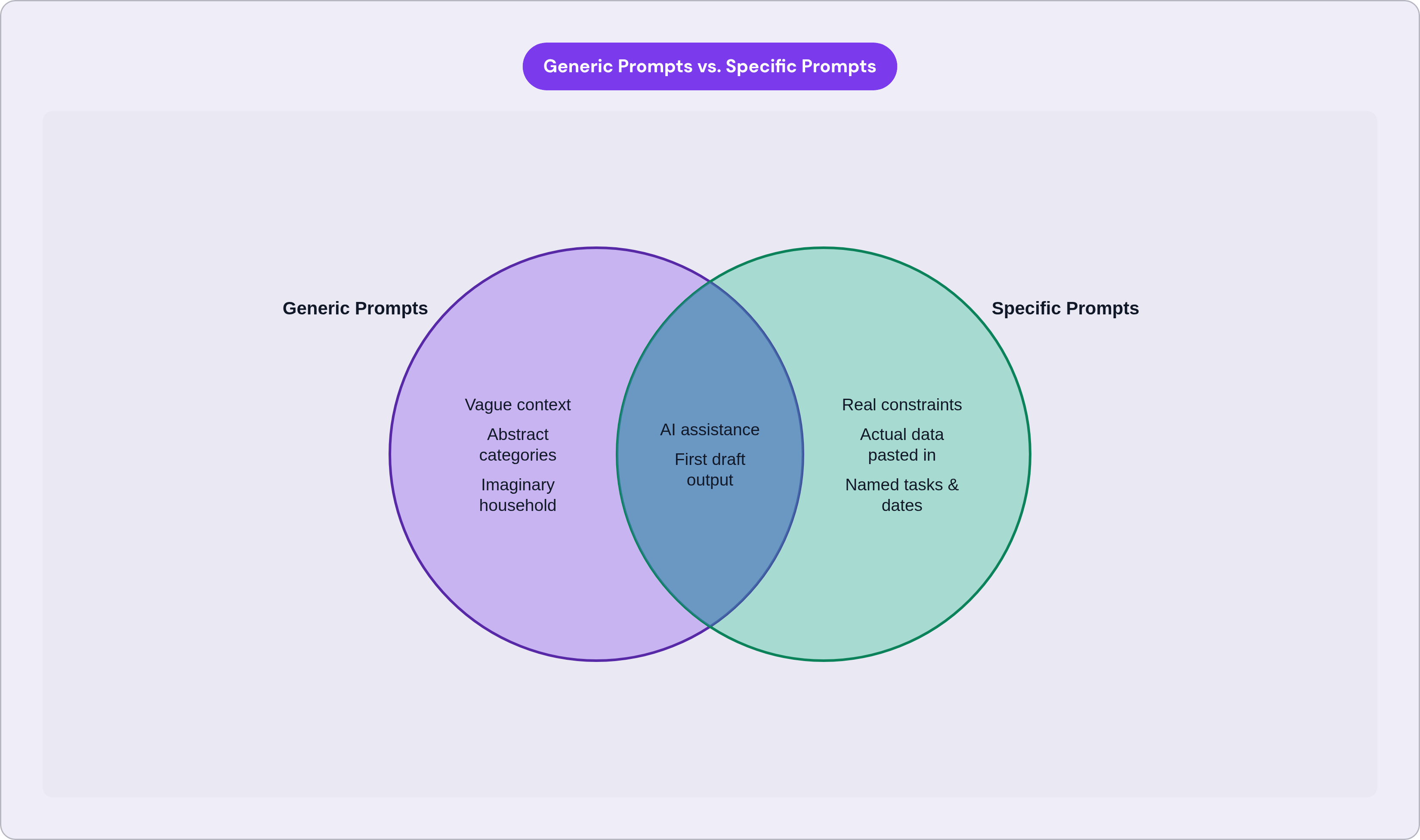
Meal planning is one of the clearest demonstrations of why generic prompts fail. "Make a healthy 7-day meal plan" returns something optimized for an imaginary household with a fully stocked pantry, unlimited prep time, and no one who happens to despise cilantro. That output is useless not because it's wrong in some abstract sense, but because it has nothing to do with you.
The corrective is forcing the model to work inside your actual constraints, not an idealized version of them.
If you want to use what's already in the refrigerator, try: "Plan a 7-day meal plan with healthy recipes using these ingredients I already have: [list]. Include a shopping list for the gaps." The phrase "ingredients I already have" does real work. It collapses the model's interpretive latitude to your actual pantry rather than a hypothetical one.
If time is the binding constraint: "I don't eat red meat, but I eat chicken, fish, and most vegetables. I have 30 minutes maximum per meal on weeknights. Build me a week of dinners around that." Dietary preference plus a hard time ceiling. Together they eliminate an enormous amount of guessing.
If budget is tighter: "Create a 5-day dinner plan for two people with total grocery cost under $40. Use staples: rice, beans, lentils, potatoes, seasonal vegetables. Group the shopping list by store section. No specialty ingredients." A restrictive budget constraint does something useful on its own. It nudges the model toward ingredient overlap across meals, which reduces waste without you having to ask for that explicitly.
One thing worth knowing before you start: general-purpose AI tools treat every conversation as a clean slate. There's no memory of what you cooked last Tuesday, or that bag of lentils that's been in your pantry since February. You have to paste that context in fresh each time. Minor inconvenience, but worth building into the habit rather than discovering it mid-conversation when the output suggests you buy lentils you already have.
Personal Finance Prompts That Produce Useful Guidance Instead of Generic Advice
The gap between a useful financial prompt and a useless one is almost embarrassingly concrete once you see it.
"Create a monthly budget for a family of four with $8,000 monthly income" returns something that looks like a financial planning brochure. Technically valid. Applicable to no one in particular. Compare that to pasting in three months of actual transaction data and asking the model to categorize and analyze your real spending patterns. The input quality is the entire variable. Without your data, the model can only describe categories in the abstract; with it, it can tell you something you didn't already know.
MIT's Andrew Lo, director of MIT's Laboratory for Financial Engineering, has put the distinction clearly. A question like "How should I retire?" is too vague to be tractable. The useful version specifies a fiduciary role, then supplies goals, constraints, tax bracket, state of residence, assets, risk tolerance, and timeline. That front-loading converts a philosophical question into something the model can actually work with.
For goal-based saving, the same principle applies. "Help me save more money" is a sentiment, not a prompt. "Create a savings plan to build a $25,000 emergency fund over three years, starting from roughly $400 per month available" is a problem with real parameters.
Here's the counterintuitive limitation that catches people off guard: AI handles high-level financial frameworks reasonably well, but it's unreliable on precise tax calculations. People assume numbers are where these tools should be most trustworthy. The opposite is true for anything involving actual tax figures and jurisdiction-specific rules. Treat that output as a framework to interrogate and verify, not a final answer you act on directly.
On privacy: consumer-facing versions of most major AI tools train on conversations by default in many configurations. Don't paste in account numbers, Social Security numbers, or other sensitive financial identifiers. The analytical value isn't worth the exposure.
Scheduling and Daily Routine Prompts That Turn Loose Tasks into a Workable Plan
The single most common mistake in scheduling prompts is describing your day rather than showing it. "I have a busy morning" gives the model almost nothing. Pasting in that you have a 9 AM call, a 10:30 AM deadline, a meeting at 1 PM, and two kids to pick up at 3 PM gives it everything it needs to actually help.
That distinction matters more than any specific prompt structure. So paste the actual schedule: "Here's my current daily schedule: [paste]. Suggest an optimized version balancing work, chores, exercise, and a reasonable stopping point."
For time-blocking a specific day, name real tasks instead of categories. "Handle communications" is a category. "Reply to five emails" is a task the model can place somewhere with a realistic time estimate. "I have the following tasks today: finalize a blog draft, reply to five emails, call my sister, clean the kitchen. I'm available 9 AM to 6 PM with a one-hour lunch at noon. Build me a prioritized, time-blocked schedule with short breaks." That prompt produces something you can follow without reinterpreting it first.
For scattered notes across texts, emails, and to-do apps: "Turn this information into a step-by-step action plan. Include priorities, deadlines, dependencies, and any risks I should plan for: [paste details]." This structure transfers surprisingly well across very different situations: work projects, home renovations, event planning, personal goals. Wherever you have information that exists but isn't organized, this consolidates it.
For habit tracking specifically, ask for a template rather than advice. Advice gives you something to read and then still have to act on. A template gives you something to use tomorrow morning.
Home Management Prompts That Reduce the Mental Load of Running a Household
The logistical overhead of running a household is real, pervasive, and rarely distributed evenly across the people living in it. AI doesn't solve the distribution problem. But it can remove some of the friction from the planning layer, which is useful even if it's a partial solution.
For a chore chart that actually fits your household: "I have [X] family members, ages [list]. Create a weekly chore chart that rotates tasks fairly and matches each person's age and physical abilities." The age and abilities constraint is the load-bearing piece. Without it, you'll get a generic list that assigns tasks regardless of who can actually do them.
For a solo cleaning plan that doesn't assume you're going to spend all of Saturday on this: "Build a low-effort weekly cleaning plan for my 2-bedroom apartment. I live alone, work from home, and do better with small daily tasks than one big session. One or two manageable tasks per day." That preference (small tasks daily versus a single cleaning marathon) is exactly the kind of personal context most people omit. Without it, the model defaults to the Saturday marathon, which works well for a specific type of person and badly for most everyone else.
For tasks that have been sitting on your list for weeks: ask the model to decompose them into steps small enough that the first one is nearly impossible to skip. "Clean the garage" is a task that survives on to-do lists for months. "Move three boxes off the floor" happens on a Tuesday afternoon when you have twenty minutes. The model doesn't have any psychological resistance to starting, so it will produce the smallest logical first step without drama. That asymmetry is useful.
Email and Communication Prompts That Save Time Without Sounding Outsourced
For routine professional messages, the efficiency gain from AI drafting is real and relatively uncomplicated. Deadline reminders, follow-ups, feedback requests, scheduling conflicts, polite-but-firm boundary-setting: anywhere the goal is clear communication rather than warmth, a prompt like "Draft a polite, direct message about this situation. Concise, professional, clear about the next step: [describe situation]" will save you time without meaningful cost.
For harder workplace conversations, role-framing prompts are worth the extra setup. Asking the model to respond as a professional mediator, or as a conflict resolution expert, pulls the output toward a specific professional framework rather than a generic list of suggestions. "Act as a professional mediator. I need to give critical feedback to a defensive employee. Draft a structured approach that minimizes defensiveness and leads toward constructive action." You get a scaffolded approach rather than platitudes about "using I-statements."
Now the tension that's worth being honest about. A 2025 study found that when managers leaned heavily on AI for emails, only forty percent of employees rated those messages as sincere. For managers who used AI lightly or not at all, that figure was eighty-three percent. Employees weren't opposed to AI assistance in the abstract; they reacted badly to messages that felt clearly outsourced, particularly communications where trust or relationship was the actual subtext. A Fast Company piece from May 2026 made the point directly: outsourcing a difficult conversation to AI bypasses the relational work that makes teams function. The difficulty of the hard conversation is often precisely what makes it land.
The practical line I'd draw: use AI for structure and a first draft, then edit your own voice back in before anything goes to someone who knows you, or anyone for whom the humanity of the message is part of its content.
How to Adapt Any of These Prompts to Your Own Situation
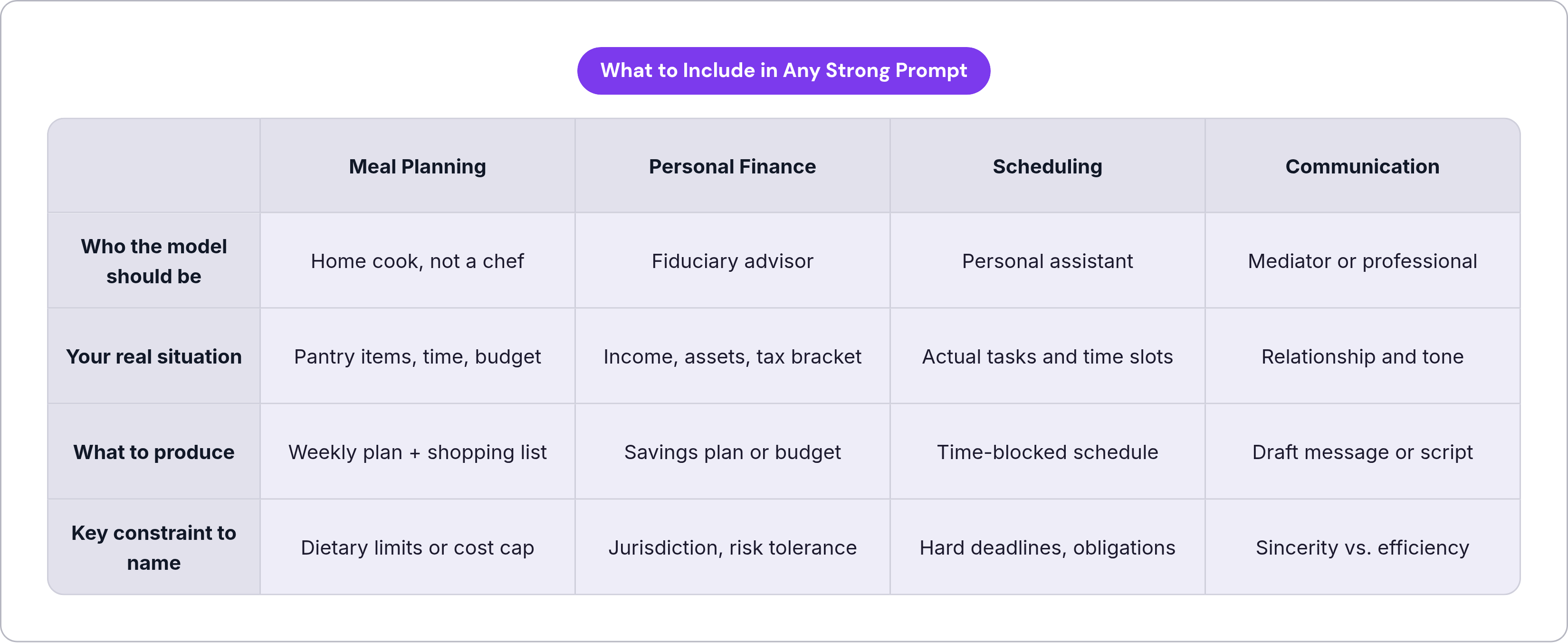
If there's a single modification worth making to every prompt you currently use, it's this: add one more piece of actual context. Not a category, an actual detail. Your real schedule, not "busy mornings." Your specific dietary constraints, not "healthy." Your actual tone with this particular person, not just "professional." One additional specific detail consistently reduces the back-and-forth more than any structural adjustment.
For recurring tasks, save your best prompt and update the variables each cycle rather than rebuilding from scratch. A weekly meal planning prompt and a monthly budget review prompt are worth keeping somewhere accessible. The architecture stays the same; only the specifics change.
And there are places where your judgment stays essential, worth naming plainly rather than implying. AI drafts a structure; you decide whether it fits your actual situation. For finance and tax questions, treat the output as a framework to pressure-test, not a final answer. For communication with people who know you, or where trust is the real stakes, edit your voice back in before sending.
The thing these prompts are actually doing is reducing the cognitive overhead on the mechanical, repetitive, logistical layer of daily life, so your attention stays available for the decisions that require you to make them. That's a modest but defensible claim, and it holds up in practice.