LLM Evaluation Framework Selection for Individual Developers
Choose your evaluation framework based on your build stage, not your feature checklist.

Picture a solo developer who spends a weekend wiring up a production monitoring platform, tracing dashboards and all, before a single user has touched the chatbot they're building. Or the opposite case: someone shipping an agent to real traffic while still relying on a prompt-comparison tool that has no idea what drift looks like six weeks after launch. Both developers made the same mistake. They picked a framework by comparing feature lists instead of asking what stage of building they were actually in.
That mistake is common, and it's expensive. LLM evaluation tools are not interchangeable despite looking similar on a landing page. Model benchmarking before you build, application evaluation while you build, and production monitoring after you ship are three distinct moments, and the major frameworks were each built to serve one of them well, not all three at once. If you pick the wrong one for your current stage, you'll spend hours learning a tool, writing test harnesses, and wiring up CI hooks, before finding out its core assumption doesn't match the problem in front of you. The fix is simple to state even if it takes some care to apply: let the stage you're in decide the tool, not the other way around.
What a tool must support at each evaluation moment
Ask one question first: where in the build am I right now? The answer rules out two-thirds of the available tools immediately.
If you're choosing a base model before writing any application code, you need standardized, reproducible benchmarks that let you compare models on equal footing. Nobody cares yet whether the tool hooks into your codebase, because there is no codebase yet. If you're building an application, a RAG pipeline, a chatbot, an agent, the question changes entirely: does this thing produce correct, grounded, safe answers on your prompts and your data? That requires a tool that can run a check the moment you change a line of code, and ideally stop a bad deploy before it ships. And if your application is already live, the question changes again: is quality holding steady over time, or drifting, and where in the request chain did something break? A static test set from three weeks ago won't tell you that. You need tracing and ongoing measurement.
Three families of metrics sit underneath these three moments, and knowing which family you're reaching for explains a lot about why these tools look so different from each other. Deterministic metrics, things like exact match, BLEU, ROUGE, schema validity, are cheap to run and give you the same answer every time, but they miss anything semantic. Rubric metrics, like faithfulness, task completion, or toxicity, usually get scored by an LLM judge or a human, and they catch the subtle failures deterministic checks miss, at the cost of per-call expense and some calibration headaches. Composite metrics blend the two into a weighted score, useful mainly for a single health number in production. A developer who knows which stage they're in, and which metric family that stage calls for, can rule out most of the market before even opening a comparison table.
Picking a base model: what LM Evaluation Harness does and does not cover
If the task in front of you is comparing foundation models on standardized benchmarks rather than testing an application you've built, you're not choosing between Promptfoo, DeepEval, and RAGAS. Those tools solve a different problem. The tool built for this job is LM Evaluation Harness.
LM Evaluation Harness is the framework that powered the HuggingFace Open LLM Leaderboard, now archived, and it covers more than 60 standard academic benchmarks with hundreds of subtasks and variants between them. If what you need is a standardized academic benchmark run the same way everyone else runs it, there isn't really a substitute.
Benchmark saturation has made popular benchmarks like MMLU weaker proxies for real task performance than they used to be, which matters before you treat a leaderboard score as gospel. Top models now cluster near the ceiling, so the gap between the first-place model and the fifth-place model often tells you less than it looks like it should. Leaderboard scores answer "which model is generally capable," not "which model will perform on my specific task and my specific data." Treat a high MMLU score as a starting filter, nothing more. Once you've narrowed your options this way, you've picked a model, and now you need to know whether your application built on top of it actually works.
The application evaluation stage: what Promptfoo, DeepEval, and RAGAS each do
Promptfoo, DeepEval, and RAGAS get compared constantly, but they weren't built to compete for the same job. Each one grew out of a different application evaluation problem, and teams with more experience often run two of them side by side rather than forcing a single choice.
Promptfoo was built around multi-model prompt comparison and adversarial red-teaming. It's command-line-first and config-file-driven, written primarily in a widely used general-purpose programming language. It slots into CI pipelines and multi-model comparison workflows without requiring separate test infrastructure. Its security-testing suite covers more than 50 built-in vulnerability types, making it the strongest open-source choice when prompt injection testing or red-teaming is the actual job. It also caches by default: once you've run a given prompt, provider, and variable combination, a repeat run skips the API call entirely unless something in that combination has changed or the cache entry has expired. That's the single most useful cost control available to a developer running frequent iteration loops. OpenAI acquired Promptfoo in March 2026, so solo developers betting on it long-term should watch for the tool drifting toward enterprise features over time, and whether its roadmap keeps favoring the lighter self-serve use case.
DeepEval was built to live inside a Python test suite and act as a CI/CD gate that blocks a deploy when quality drops. It's pytest-native, so evals sit inside the test suite you already have instead of becoming a separate report someone has to remember to run. It ships with more than 50 pre-built metrics covering hallucination, bias, toxicity, and RAG-specific checks, the broadest metric library of the three open-source options. It also includes 5 dedicated RAG metrics plus 4 multi-turn equivalents, which makes it a real alternative to RAGAS for teams who want RAG coverage without bringing in a second framework. DeepEval fits best for Python developers who want evaluation built into the test suite they already run and need broad metric coverage without writing custom judges from scratch.
RAGAS was built around one specific problem: retrieval quality and grounded generation in RAG systems. It defines four core metrics with published, academic-grade methodology behind them: faithfulness (is the answer actually grounded in what was retrieved?), context precision and context recall (did the retrieval step pull the right documents in the first place?), and answer relevancy (does the response actually address the question asked?). It stays scoped to retrieval and generation scoring, with no production monitoring or collaboration layer built in. That published methodology matters for teams that need to point to a documented definition rather than a vendor's internal heuristic when explaining an evaluation choice. RAGAS fits best for developers building retrieval-heavy systems who want metrics backed by a paper and whose need right now is diagnosing retrieval and generation quality.
This pairing appears most often among mature teams: DeepEval or Promptfoo running as the CI gate, combined with a monitoring platform for what happens after deployment. That's not one framework replacing another. It's two tools covering two different jobs.
The production monitoring stage: what Arize Phoenix and MLflow add that application frameworks do not
Once an application goes live, the question changes shape. It's no longer "does this output pass the quality check," it's "is quality drifting, and where in the pipeline did it break," a different problem from anything the application-stage frameworks above were built to answer.
Arize Phoenix combines offline evaluation with live production monitoring, and its standout feature is tracing built on an open observability standard that follows a request through its full path, retrieved context, tool calls, intermediate steps, and the final output, all captured. It's open-source under the Elastic License 2.0 for self-hosted deployment, with a paid cloud tier available. Phoenix fits a developer who has already shipped and needs visibility into live traffic, not someone still iterating on prompts before launch.
MLflow supports both rule-based and LLM-judge custom metrics, and its most distinguishing feature is a human review loop: human reviewers label results, and automated judges improve from that feedback over time. With tens of millions of monthly downloads, it also has the broadest existing integration surface of any tool covered here. MLflow fits teams that need to close the loop between automated scoring and human labels as an application matures, rather than treating evaluation as a one-time gate you set up once and forget.
Neither of these tools is something a solo developer needs on day one. Add this layer once the problem changes, once there's real traffic to watch and questions about regression and cost drift over time, not before.
The LLM-as-judge problem that affects every framework in the application stage
Every one of the three dominant application evaluation frameworks leans on LLM-as-judge scoring for anything subjective, and that mechanism carries biases that most solo developers never design around.
Position bias makes a judge favor whichever response appears first or last in a comparison, regardless of which one is actually better. Verbosity bias rewards longer answers even when a shorter one is more accurate. Self-preference bias inflates scores when the judge model and the model being evaluated come from the same family. The most damaging of the group is agreeableness bias: LLM judges are reliable at confirming a correct answer but weak at catching a wrong one, so the true negative rate stays low and the eval ends up reporting a level of precision that doesn't actually exist.
None of this means LLM-as-judge should be abandoned. It agrees with human judgment at a rate close enough, and at a fraction of the cost, that for a solo developer the trade-off almost always favors using it. The condition is applying real mitigations: rotate the position of answers across runs so position bias cancels out, use a judge model from a different family than the one being evaluated so self-preference bias doesn't creep in, and normalize for response length so verbosity stops masquerading as quality. A developer who adopts any of these frameworks without first defining what failure actually looks like in their own application will get scores that don't correlate with anything useful. The framework matters less than having that failure definition written down before the first eval ever runs.
How eval economics have changed for individual developers
LLM API costs have fallen dramatically since 2023, and that shift changes the math on whether a solo developer can afford to run evals continuously. Pipelines that would have been too costly to run on every pull request a couple of years ago are now affordable in a way they simply weren't when most of today's major frameworks were first adopted.
Cost still adds up fastest during the iteration stage. Running one evaluation across several model comparisons multiplies quickly, and the most practical lever available, without switching frameworks entirely, is caching. Promptfoo's cache: true setting is the clearest example: once a prompt, provider, and variable combination has already been scored, it won't hit the API again unless something about that combination actually changes.
It's also worth being clear that open-source doesn't mean free. The software costs nothing to download, but someone still has to design the evaluation protocol, choose which benchmarks or metrics matter, read and interpret the results, and keep the whole setup running. That cost appears as time spent, not as a license fee paid.
A decision map for choosing the right framework by lifecycle stage
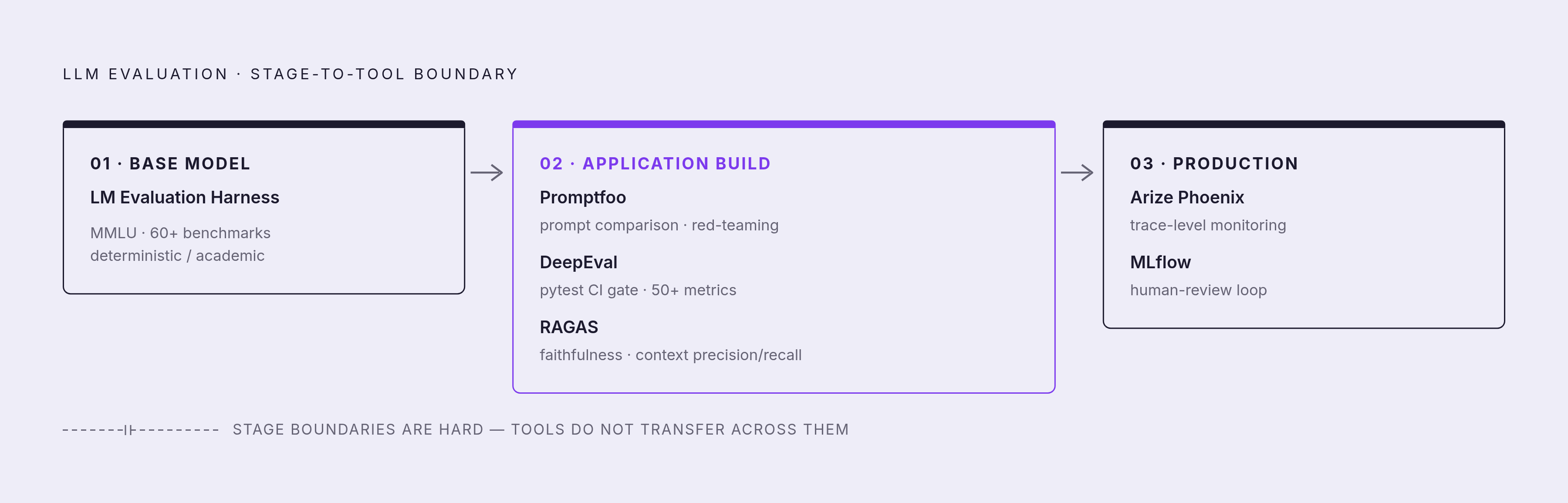
The throughline across everything above is simple: the stage you're in when you make the choice determines which framework is the right starting point. Treating framework selection as a one-time, permanent decision, rather than one tied to where you are right now, is the mistake this whole piece has been arguing against.
If the job is choosing a base model before any application exists, start with LM Evaluation Harness for standardized academic benchmarks, treat the leaderboard result as a first filter, and validate the finalists against a small, task-specific dataset before committing to one. If the job is iterating on prompts and comparing models during active development, particularly in a config-file-based workflow, or if red-teaming is part of the requirement, Promptfoo is built for that, with caching included and the strongest red-teaming coverage of the group, though it's worth keeping an eye on how the tool evolves following its acquisition by a major vendor. If the job is wiring evaluation into a Python test suite as a CI gate that can block a bad deploy, DeepEval is the natural fit: pytest-native, the broadest open-source metric library among the three, and usable in full without any account or cloud dependency. If the job is building a retrieval-heavy RAG system and documenting evaluation against a published methodology, RAGAS covers the retrieval-specific metrics well, and pairs naturally with DeepEval when CI gating is also needed. And once the application is live and handling real traffic, add Arize Phoenix for trace-level visibility into what's happening request by request, and add MLflow if closing the loop between human labels and automated judges is the priority as the system matures.
None of these choices are permanent. The right framework today is the one that matches where the project stands today, and that answer is allowed to change as the project moves from choosing a model, to building an application, to keeping it healthy in the hands of real users.
Sources
- When “Better” Prompts Hurt: Evaluation-Driven Iteration for LLM Applications A Framework with Reproducible Local Experiments
- Stop Comparing LLM Agents Without Disclosing the Harness
- PromptBench: A Unified Library for Evaluation of Large Language Models
- Top LLM Observability Tools in 2026: A Pro Guide
- Judging the Judges: A Systematic Evaluation of Bias Mitigation Strategies in LLM-as-a-Judge Pipelines
- Inside the Unfair Judge: A Mechanistic Interpretability Account of LLM-as-Judge Bias
- BiasScope: Towards Automated Detection of Bias in LLM-as-a-Judge Evaluation
- Reliability without Validity: A Systematic, Large-Scale Evaluation of LLM-as-a-Judge Models Across Agreement, Consistency, and Bias