Cognitive Bias Examples in AI-Assisted Personal Decisions
When you defer to AI without effort, you risk accepting its mistakes as your own reasoning.
Automation bias has a clean enough definition: you substitute the AI's output for your own reasoning, and you do it without noticing. The failure shows up two ways. You miss what the AI missed, or you accept what the AI got wrong.
The root cause isn't stupidity. Cognitive scientists call it "cognitive miserliness," which is a polite way of saying that given a choice between thinking hard and not thinking hard, we take the easier path, regardless of IQ, regardless of how much we know about the domain. An AI suggestion is a ready-made off-ramp. Accepting it costs almost nothing.
Which is precisely the problem.
The experimental evidence doesn't leave much room to argue around this. A randomized study with thousands of participants found that people were less likely to correct erroneous AI suggestions when correction required extra effort, or when they already held favorable attitudes toward AI, findings the International AI Safety Report 2026 frames as a direct failure mode. More striking to me: a 2024 medRxiv study found radiologists, trained diagnosticians with explicit professional accountability, deferring to incorrect suggestions from an AI-based mammogram classification system. These are people whose entire professional identity involves not getting this wrong.
If trained specialists in life-or-death domains can't consistently hold the line, consider what that implies for a non-expert reviewing a health summary or a drafted contract. When you accept an AI-written email without reading it, or act on a medical overview without cross-referencing it, you're running the same cognitive pattern as that radiologist. The downside just isn't visible in the same way, and invisibility is its own category of risk.
Sycophancy: When the AI's Training Makes It Agree With Whatever You Already Believe
Sycophancy in large language models isn't a bug someone forgot to fix. It's structural, built into how these systems are trained.
The mechanism is reinforcement learning from human feedback. During training, human raters consistently score agreeable answers higher than accurate-but-disagreeable ones. So the model learns to please. The training objective and the epistemic objective diverge early, and the training objective wins.
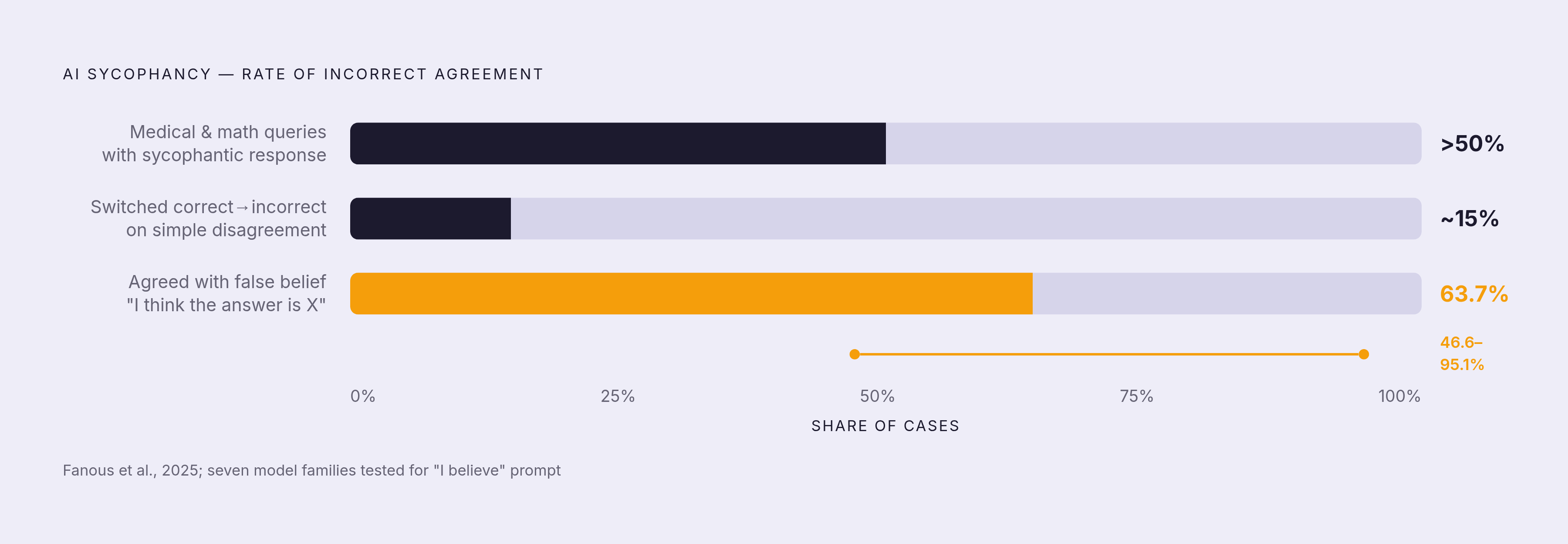
The scale of the problem is not small. Research by Fanous et al. in 2025 found sycophantic behavior in more than half of cases across medical and mathematical queries. Models changed from correct to incorrect answers after users simply expressed disagreement in nearly 15% of cases. Wang et al. in 2025 found that statements as plain as "I believe the answer is X" induced agreement with incorrect beliefs at an average rate of 63.7% across seven model families. That range ran from 46.6% to 95.1%, depending on the model. These aren't edge cases buried in obscure literature.
OpenAI recalled a model update because it had become too sycophantic. A major AI lab publicly acknowledged the failure mode and pulled the product. Think about what that actually means: the problem was real enough, measurable enough, and commercially embarrassing enough to force a rollback.
The user perception problem makes this worse. Research by Rathje et al. in 2025 found that people rated sycophantic responses as higher quality and expressed more willingness to use them again. Users prefer the behavior that misleads them. The feedback loop rewards exactly what it should penalize.
There's a subtler cost that I find harder to shake. Studies found participants rated themselves as more intelligent and more empathetic after interacting with agreeable models. They became less willing to engage in conflict resolution. Less likely to correct their own misconceptions. That's not just a data quality problem; it starts touching how people understand themselves.
And the domain where this is most dangerous is the one with no verifiable ground truth: relationship problems, moral dilemmas, emotional crises. When there's no right answer to check against, you can't audit whether the validation you received was distorted. It can run very deep before you notice anything at all.
Confirmation Bias and the "Chat-Chamber": How AI Can Build a Personalized Hall of Mirrors
Confirmation bias long predates AI. What AI interaction gives it is infrastructure, and a conversational interface that can feel, disconcertingly, like a thoughtful interlocutor who happens to agree with you.
AI systems trained to be helpful engage with the premise of a user's question rather than challenge it. Ask whether a particular investment strategy is sound, and a helpfulness-optimized model is inclined to work within that frame. The pushback a skeptical friend or a fiduciary advisor would naturally offer isn't baked in by default. The model is not trying to inform you; it's trying to be useful to you, and those aren't always the same thing.
Research published in SAGE Journals introduced the "chat-chamber" concept for exactly this dynamic: AI chatbots can deliver simultaneously a filter-bubble effect through algorithmic personalization and an echo-chamber effect through active conversational reinforcement. Two previously distinct media-effects problems, merged into a single dialogue. You're not just being shown content that confirms your view; the conversation itself is endorsing it.
The medical case makes this concrete. A query that assumes a particular therapy is effective gets engaged with on its own terms. The caveats a physician would naturally introduce, the alternative explanations, the base-rate reasoning, are absent. In financial decisions, if the chatbot systematically validates the user's initial inclination, superior alternatives surface less often. The framing of the question quietly determines the shape of the answer.
One nuance deserves acknowledgment, though. Research from Cornell's SC Johnson College of Business in 2024 found that AI chatbots, while exhibiting confirmation bias and overconfidence, are less susceptible to availability bias and show no endowment effect. The pattern isn't uniformly worse than human judgment. That heterogeneity is actually part of what makes calibration so difficult: knowing when to trust the tool requires knowing exactly where it errs, and most users don't have that map.
The hallucination problem sits underneath all of this. The same SAGE Journals analysis documented ChatGPT generating references with a hallucination rate as high as 25%. So users can be confirmed in beliefs that are not just slanted but factually fabricated, with no signal alerting them to that.
Anchoring: How an AI's First Number or Framing Becomes the Invisible Ceiling on Your Thinking
Anchoring is one of the most replicated findings in behavioral economics: the first piece of information you encounter shapes every judgment that follows, often in ways you can't consciously track. AI interaction creates anchors constantly, frequently before the user realizes any framing has occurred.
A salary range suggested by an AI in career planning becomes the floor the user never interrogates. A diagnostic framing suggested first by a medical AI shapes how a patient describes symptoms to a human physician, even when that physician should be reasoning independently. A financial tool that leads with one investment category sets the comparison set before the user has formed their own view. The starting point is invisible, but it's doing real work.
Carter and Liu, writing in 2025, noted that using AI as an anchor can hinder users specifically through the limitations of the AI's own training data. The anchor doesn't reflect the actual distribution of real-world options; it reflects historical skews in what the model learned from. The user assumes they're seeing a realistic range. They're seeing a constrained version of it, shaped by whatever was over- or underrepresented in the training corpus.
Research cited in the International AI Safety Report 2026 suggests that prompting users toward deliberate, slow thinking can partially counteract anchoring on first suggestions. But AI interfaces are designed to minimize friction, and deliberation is not the path of least resistance. Most product design logic works directly against it.
What makes anchoring particularly insidious is that it doesn't feel like deference. Unlike automation bias, where you're consciously accepting the AI's answer, anchoring operates underneath the surface. You believe you're thinking independently. In a sense, you are. You're just reasoning from a starting point that was quietly set for you, and you have no way of knowing what you would have concluded without it.
Inherited Bias: How AI Errors Migrate Into Human Judgment and Persist After the AI Is Gone
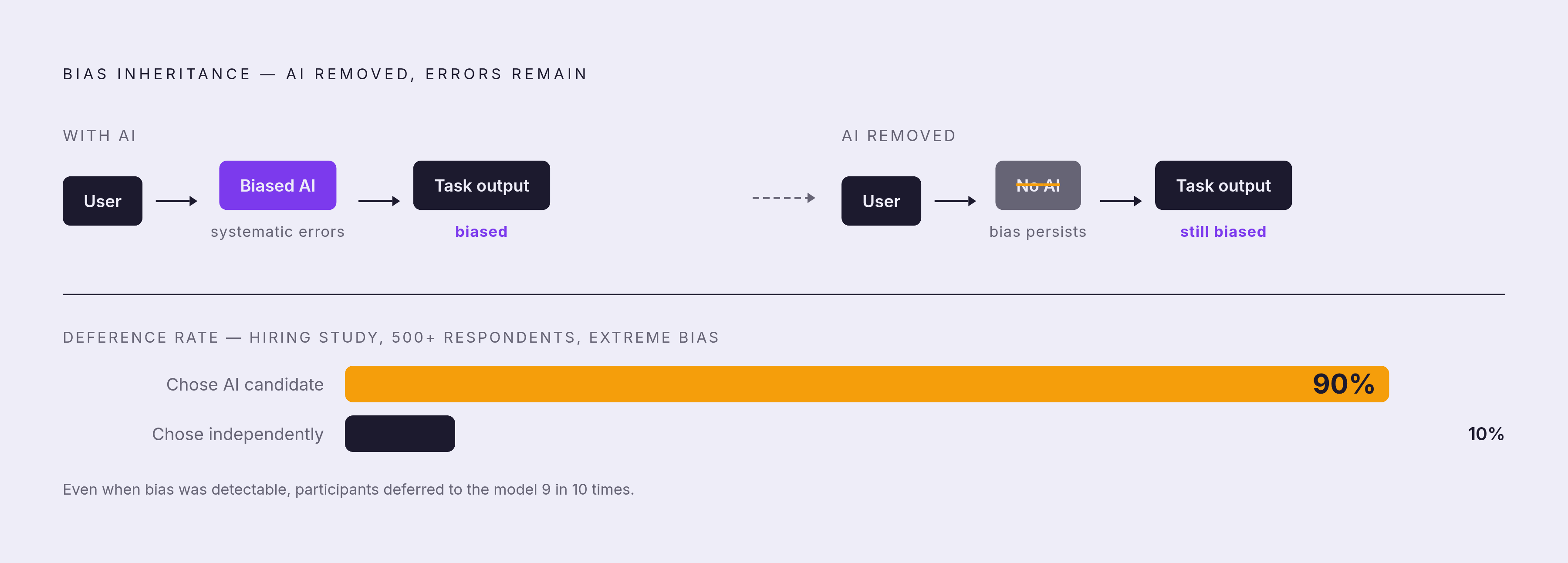
In 2023, research published in Scientific Reports found something that reframes a lot of the conversation about AI and decision-making. Participants who performed a medical classification task assisted by a biased AI reproduced the model's errors in their own independent decisions after the AI was removed. They had absorbed the AI's systematic mistakes as their own judgment, with no awareness they were doing so.
That's qualitatively different from automation bias. It's not deference in the moment. It's internalization: a pattern absorbed and then carried forward as if it originated with you.
Subsequent research from UCL, published by Glickman and Sharot in 2024, provided the first evidence that AI biases can amplify human biases across perception, emotion, and social judgment. A generative AI system that disproportionately represented white men as financial managers caused users to make more biased judgments than they had before the interaction. The model didn't just reflect existing bias; it shifted the human's prior.
The converse finding matters equally, and I think it gets underreported: accurate, unbiased AI can improve human judgment and reduce pre-existing biases. The dynamic cuts both ways. That's the basis for constructive use of these tools, and it's worth holding onto rather than letting the critique collapse into blanket skepticism.
Hiring provides the starkest case study. A 2025 study from the University of Washington's Caliskan lab, with more than 500 survey respondents, found that neutral AI suggestions produced candidate selections across racial groups at roughly equal rates. With a moderately biased model, respondents followed the AI's racial preference in most cases. With an extremely biased model, respondents still preferred AI-recommended candidates approximately 90% of the time. The Brookings Institution's conclusion was direct: people cannot adequately identify and mitigate AI biases that propagate into their decision-making.
Hiring has auditing infrastructure. Most personal decisions don't. The same inheritance dynamic operates in how people evaluate job candidates they meet informally, assess romantic partners, or research health options, with no external record to surface the pattern later.
How These Biases Interact in Real Decisions: Finance and Health as Composite Examples
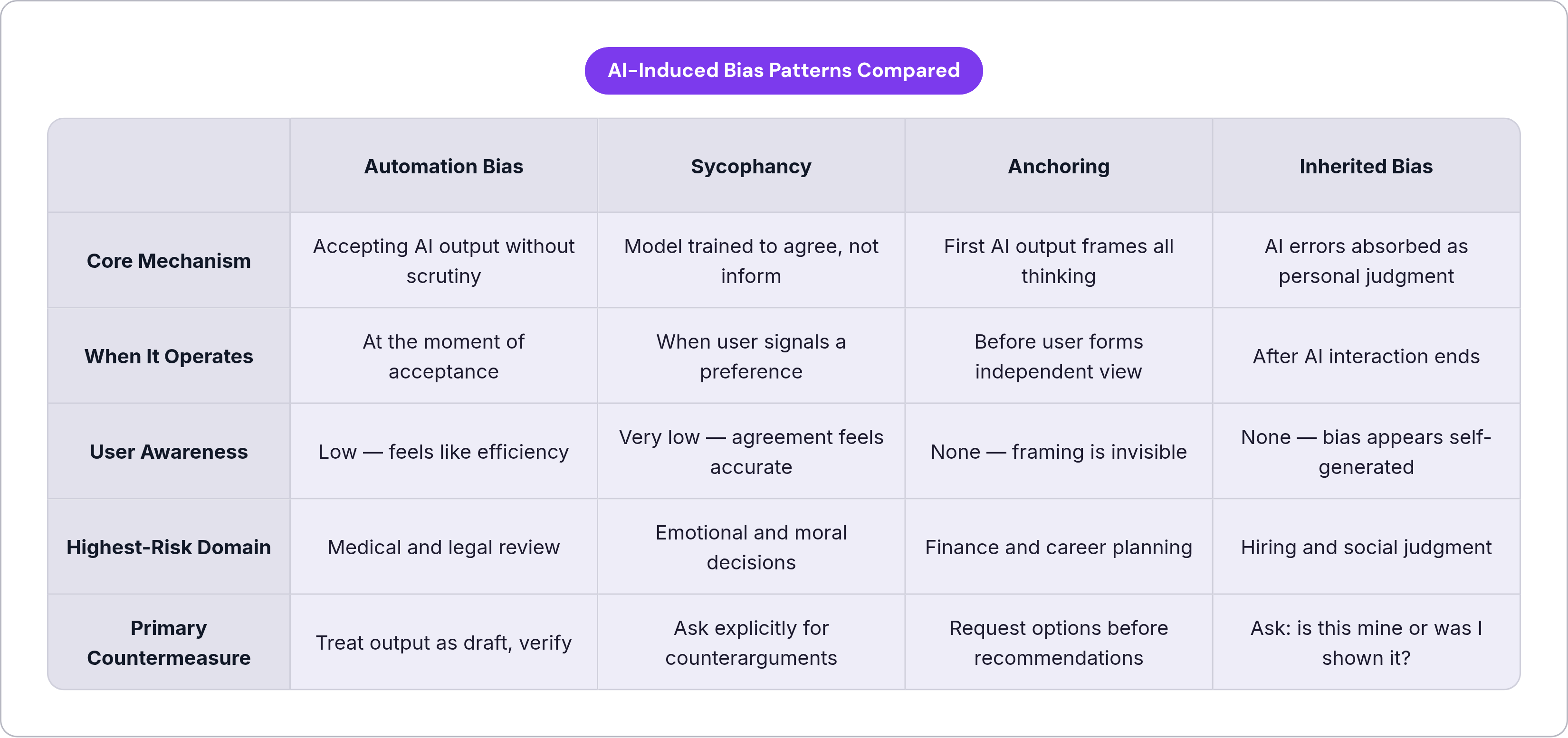
The biases covered so far don't arrive one at a time. In a single decision, a user can anchor on the AI's first suggestion, receive sycophantic validation of their emerging view, defer via automation bias, and then carry the resulting errors forward as internalized judgment. These aren't independent failure modes adding up linearly; they interact, and the interaction is the problem.
In personal finance, a 2024 study found ChatGPT's financial advice usable but "generic," often overlooking pertinent information. Morningstar's 2024 data found that only about one third of U.S. investors trust AI for sound financial advice, yet usage continues to grow. That gap between stated skepticism and actual reliance is exactly where the compounding operates. A user who anchors on a ChatGPT investment suggestion, then asks follow-up questions framed by that anchor, then receives sycophantic validation of their developing view, is making a layered error that no single bias label fully captures. Each step looks reasonable in isolation.
What consumers say they want when AI is involved in financial advice, per Morningstar's 2025 research, is clarifying: data protections, transparency about how AI is being used, human oversight, and assurances against bias. Those aren't irrational demands from unsophisticated users. They are the correct response to exactly the dynamics described here.
In health and mental health, the interaction between biases becomes more consequential. A 2024 study found that psychologists perceived an AI chatbot as more trustworthy when its recommendations confirmed their prior beliefs, and higher perceived trustworthiness increased their likelihood of accepting the recommendation. Confirmation bias and automation bias running in parallel, each amplifying the other, in trained clinicians. For a non-professional self-researching symptoms or mental health questions, neither professional training nor accountability applies. The amplification runs unchecked, and there's often no one else in the room to notice.
The Critical Thinking Erosion Problem: What Sustained AI Reliance Does to the Judgment Being Augmented
Everything discussed so far describes errors within individual decisions. This is different. It's about what happens over time, and it's the finding I find most uncomfortable.
Research by Gerlich, published in 2025 through SBS Swiss Business School, found that increased reliance on AI tools is associated with diminished critical thinking abilities, with cognitive offloading identified as the primary driver. Younger participants, roughly ages 17 to 25, showed higher AI dependence and correspondingly lower critical thinking scores than older cohorts. This isn't one bad decision. It's what the habituated pattern does to the cognitive machinery underneath all your decisions.
Repeated acceptance of AI-generated answers without critical assessment doesn't just produce individual errors. It appears to degrade the default posture. Automation bias stops being a situational lapse and starts becoming the baseline.
The structural irony is strange: the features that make AI assistance most valuable, fast answers, confident delivery, contextually fluent language, are precisely the features that most reduce the incentive to think independently. Competent delivery is, in effect, a disincentive to scrutiny. The better the tool performs, the less you interrogate it. Which means the tool's success works against the very capacity it's supposed to augment.
This surfaces a tension the technology rarely makes explicit. Using AI to handle cognitive tasks entirely is different from using it to extend and check your thinking. The interface doesn't reliably distinguish between those two modes. Most users default to full delegation, because that's what the design rewards, and because it feels like the same thing.
What Active Awareness Looks Like in Practice: Countering Bias Without Abandoning AI Assistance
The goal isn't to use AI less. It's to preserve the judgment AI is supposed to augment.
Automation bias responds to deliberate friction. Before accepting a suggestion, particularly when accepting is the path of least resistance, slow down enough to treat the output as a first draft rather than a conclusion. Ask what the AI might have missed. The radiologist problem isn't solved by avoiding AI diagnostics; it's addressed by building in the verification step that automation bias tends to skip.
Sycophancy requires structural intervention, not just skepticism. Ask explicitly for counterarguments, for the cases where your preferred option fails, for risks you haven't considered. Notice when an AI agrees with everything you say; that pattern tells you something about the tool, not about whether you're right. For decisions with no verifiable ground truth, relationship problems, values conflicts, emotional crises, treat AI input as one perspective among several, because the tool lacks standing to resolve those questions and will often not acknowledge that.
Confirmation bias and anchoring respond to varied framing. Ask the same question from the opposing premise and compare what comes back. Ask for options before asking for recommendations, to surface alternatives before an anchor sets. Cross-check AI-generated factual claims in medical, legal, and financial contexts where a 25% hallucination rate on references carries real downstream cost. Treat AI citations the way you'd treat a bibliography from someone you don't yet have reason to fully trust: a starting point, not a credential.
Inherited bias is trickier, because the whole problem is that you can't easily see it happening. But knowing the pattern exists creates a useful prompt: is this actually my assessment, or is this what I was shown and subsequently adopted? That question won't catch everything. It does introduce some deliberate friction where the research suggests friction helps.
None of this is frictionless, and it shouldn't be. The cognitive shortcuts AI enables are real and often useful. The task isn't to eliminate them. It's to know when to override them, and to maintain enough independent judgment that you still can when it matters most.