platforms that add memory and integration layers on top of foundation AI models
These platforms turn stateless AI models into agents that remember users and act across their tools.
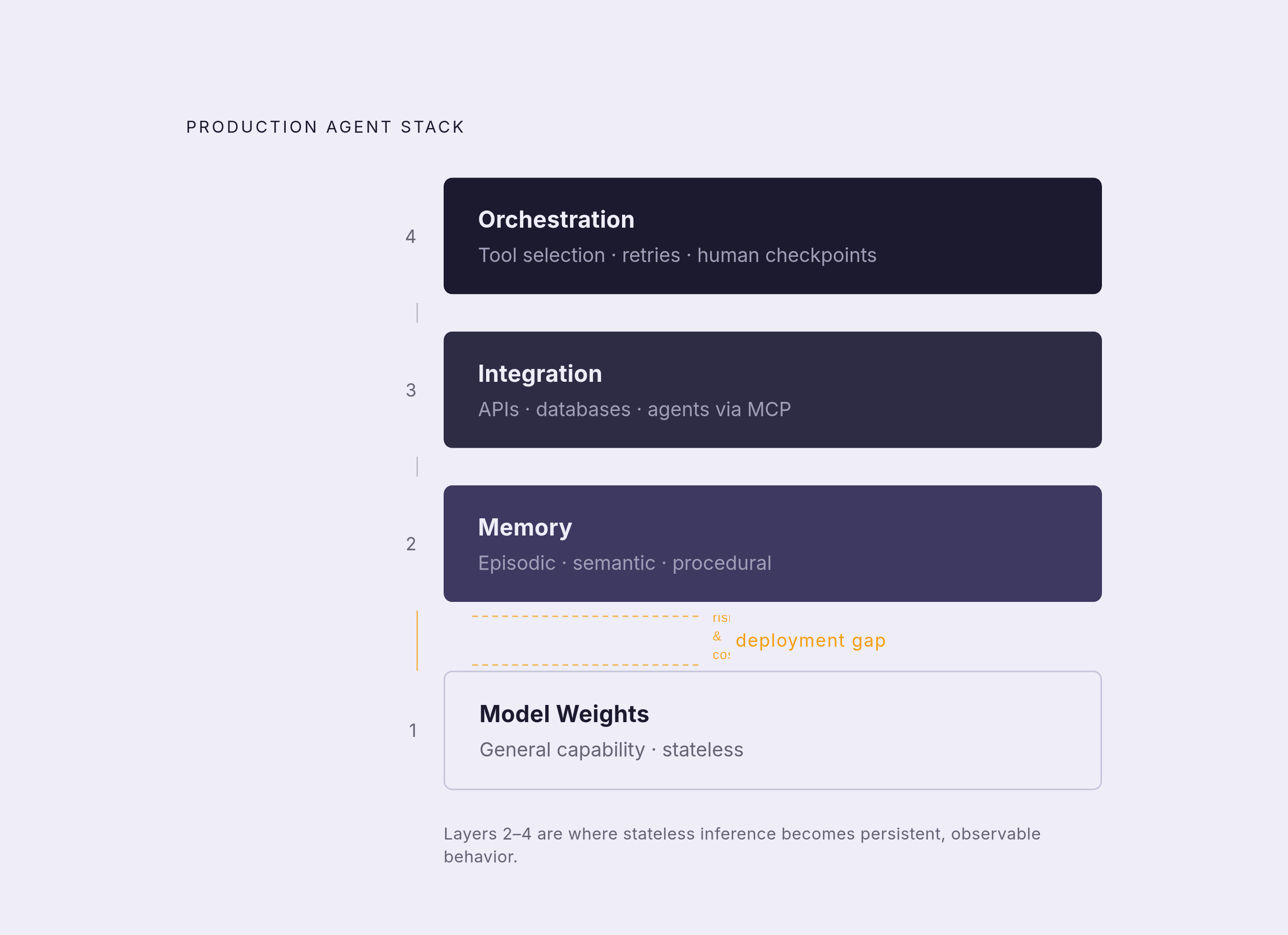
Foundation models forget everything the second a session ends. That's the whole problem, and every platform layering memory and tool access on top of GPT-5 or Claude is trying to solve it: make something stateless act like it isn't. Once you get what these layers actually do, the rest of this stuff stops feeling like buzzword soup.
What memory and integration layers actually do, in concrete terms
The mix-up I run into most: people think a long context window is memory. Feed a model hundreds of thousands of tokens and it'll read every one, but the second that session closes, it's gone. Nothing gets learned, nothing carries forward, and the model just got a bigger notepad for one conversation, not a better memory of who you are.
Memory layers fix that by capturing, storing, and pulling information back across sessions. Three kinds matter here.
Episodic memory logs what happened: past conversations, past decisions, a running history. Semantic memory holds facts that don't move much, your job title, your preference for answers under 200 words. Procedural memory is the odd one out: rules about behavior itself, where the agent rewrites its own instructions based on what worked last time.
Integration layers do something else entirely. They hook the model up to databases, APIs, other tools, other agents, so it can act on the world instead of just talking inside a chat box. A model with memory but no integration remembers your seat preference and does nothing with it. A model with integration but no memory books your flight fine, then asks for that same seat preference again next week.
Model weights encode general capability, the thing that lets GPT-5 write code or work through a math problem. Memory and integration encode something narrower: context and connectivity tied to one specific deployment. Production systems rarely lean on a single tool for everything. A team typically pairs a memory extraction platform, something that decides what's worth keeping, with separate storage: a vector database, a graph store, a cache. One tool extracts and reasons, and another holds the data. Treat those as the same job and your agent project stalls out around month two.
How large the market for these layers has grown, and why enterprise is driving it
Gartner puts 40% of enterprise applications running task-specific AI agents by the end of 2026, up from under 5% in 2025. That's a steep climb for enterprise software by any measure, and it explains the rush toward memory and integration infrastructure pretty directly. You can't run agents at that scale without somewhere to put what they learn and something wiring them into the systems they need to touch.
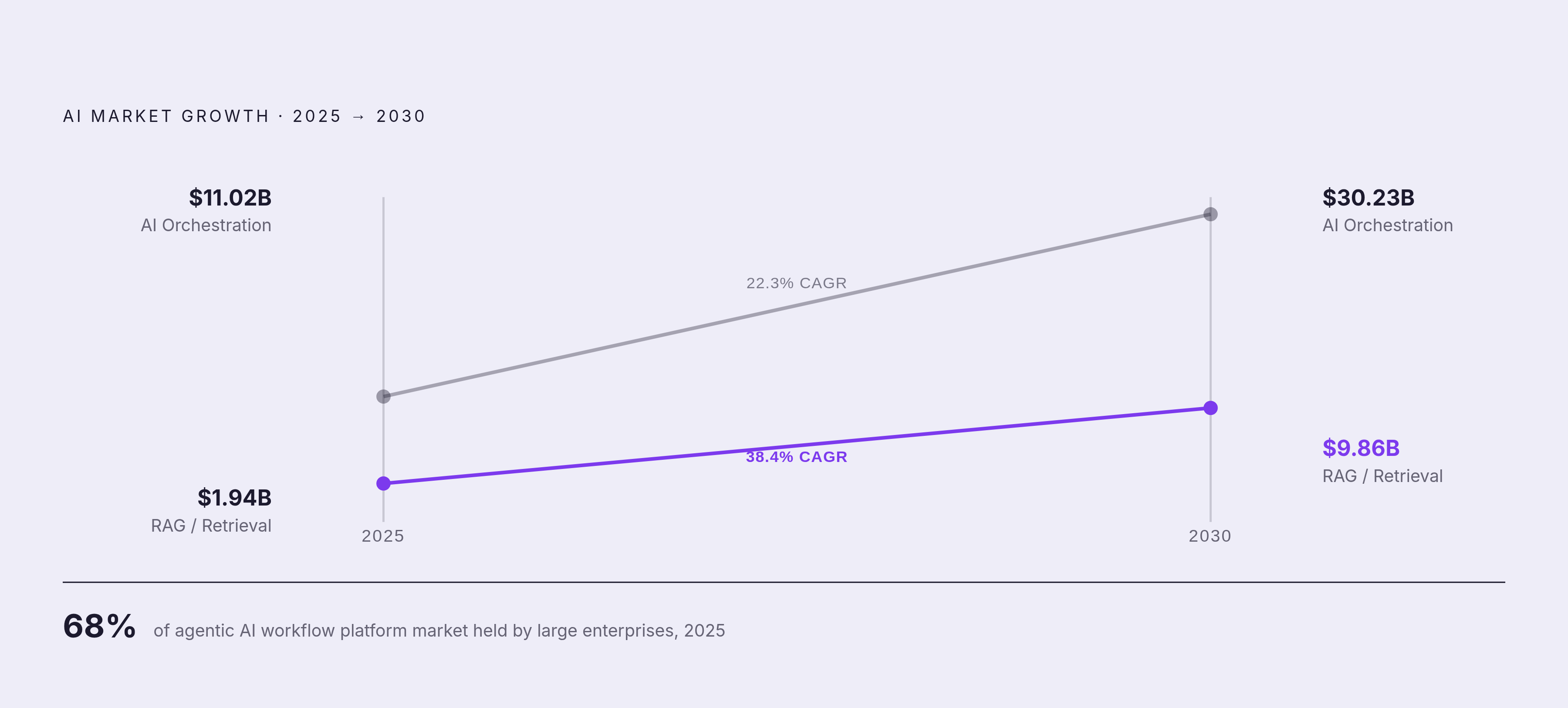
The category numbers back it up. MarketsandMarkets has the AI orchestration market, the umbrella memory and integration layers sit under, going from $11.02 billion in 2025 to $30.23 billion by 2030, a 22.3% compound annual growth rate. The retrieval slice, RAG specifically, grows faster still on their numbers: $1.94 billion in 2025 to $9.86 billion by 2030, a 38.4% CAGR.
Who's buying? Mostly large enterprises, who held 68.42% of the agentic AI workflow orchestration platform market in 2025, with 74.18% of that running cloud-based. McKinsey's 2025 State of AI survey found 23% of organizations already scaling an agentic system in at least one business function, with another 39% experimenting with one. Add those together and most surveyed organizations are somewhere on this path already, whether they've said so out loud or not.
I keep coming back to one thing: the layer between the model and the user is where the money and the deployment risk are piling up right now, not the model itself.
The three dominant technical approaches memory platforms take
Strip away the branding and pretty much every memory platform falls into one of three camps.
Vector extraction and semantic retrieval is the lightest option on the table. The platform pulls structured facts out of a conversation, drops them in a vector database, and pulls them back later by semantic similarity, whatever's conceptually close to your current question. It's fast and cheap to run. Where it falls apart is anything involving time or relationships between facts, and "what did I decide last Tuesday that contradicts what I said today" is a genuinely hard question for a flat vector store to answer.
Temporal knowledge graphs go a different route. Instead of a flat pile of facts, the platform builds a graph: entities, and the relationships between them, then combines graph traversal with vector search. That handles time-aware and relational questions in a way vector stores mostly can't. Building and running it costs more too, which is the tradeoff nobody puts on the landing page.
OS-inspired tiered memory borrows straight from how a computer manages RAM and disk. A core layer sits in context at all times. An archival layer is searchable but not always loaded, and a conversation-history layer sits underneath both. Developers get explicit, granular control over exactly what the agent is holding in its head at any given moment, and that matters when you're trying to figure out why an agent did something strange at 2am and nobody can tell you why.
None of the three wins outright. Speed, relational depth, and developer control pull in different directions, and the right pick depends on what the application is actually for. Vellum, for instance, is a memory-powered AI assistant that learns user preferences and acts across tools, not an infrastructure layer that exposes these tradeoffs to builders.
How the leading dedicated memory platforms compare
Mem0 runs the vector extraction approach and, by public numbers, has the widest adoption of the bunch: over 48,000 GitHub stars, $24 million in funding as of around October 2025, roughly 14 million downloads by May 2026. On the LOCOMO benchmark from an ECAI 2025 paper, Mem0 scored 67.13% on an LLM-as-a-Judge evaluation, with p95 search latency of 0.200 seconds. The token numbers are the part I keep citing to people: about 1,764 tokens per conversation against 26,031 for a full-context approach. That's north of a 90% cut, paired with a 91% latency improvement. Its graph variant, Mem0g, scored 58.13% on time-sensitive questions against 21.71% for OpenAI's approach, which tells you exactly where the graph layer earns its keep: temporal reasoning. Mem0 ships integrations for the Anthropic SDK, the OpenAI Agents SDK, and Google's ADK. Need lightweight, cheap retrieval at real scale? Start here.
Zep takes the temporal knowledge graph route. It pulls entities and relationships out of conversation with an LLM, combines graph traversal with vector search, and handles time-aware queries meaningfully better than a pure vector setup. Zep retired its self-hosted Community Edition in 2025, though the engine underneath it, Graphiti, stays open source and self-hostable. Pick Zep when the application cares more about evolving relationships and sequences of events than raw throughput.
Letta, formerly MemGPT, models memory the way an operating system models RAM and disk: a core layer always in context, an archival layer in an external searchable store, and a layer covering conversation history. Its developer tooling is oriented toward exposing what the agent did and why, which gives it a real edge on auditability. Its framing of memory as an OS resource has been influential in how the field talks about this problem, whether people credit it or not.
Then there's LangMem covers all three memory types, episodic, semantic, procedural, including agents that rewrite their own system instructions over time. It can be the path of least resistance if your team already lives inside one framework ecosystem. The real cost shows up later, when you try to switch frameworks and realize your memory system doesn't come with you.
Some platforms in this space are built specifically for teams where data residency or compliance rules take cloud-managed options off the table, with no negotiation and no exceptions.
Across nearly all of these, the same pattern shows up: the memory platform handles extraction and retrieval logic, and a separate storage layer, Pinecone, Redis, a dedicated graph database, handles persistence and scale. Very few tools try to do both, and the ones that do usually do one of the two worse than a specialist would.
Why foundation model providers are now shipping native memory — and what that changes
By mid-2025, several major model providers had announced or shipped some form of persistent memory. Memory stopped being a third-party add-on problem and became something the model providers decided they had to own themselves.
OpenAI's "Dreaming" feature, announced June 2026, curates ChatGPT's memory in the background and updates entries as time passes. It'll quietly rewrite "going to Singapore" to "went to Singapore" once the trip's actually happened. Anthropic staged its rollout more carefully, rolling out persistent memory to higher-tier plans before extending it more broadly. Microsoft's Copilot Memory became generally available, remembering preferences and recurring topics across Microsoft 365, with controls for both individual users and tenant admins. When providers outside the usual U.S. incumbents began shipping memory modules of their own, that was the real tell. Memory had gone from differentiator to table stakes, everywhere, all at once.
So what changes for a developer? The question shifts, from "should this agent have memory" to "how much sophistication does this specific application actually need." Native memory is convenient, and for a single-provider deployment it's often enough on its own. Still, it tends to be less configurable, less portable across providers, less auditable than a dedicated platform, and it does nothing for connecting to other systems or coordinating multiple agents. Native memory raises the floor for everybody, but dedicated platforms still hold the ceiling.
The integration side: how the Model Context Protocol is standardizing tool connectivity
Memory solves continuity. Connectivity is a separate problem, and an agent that remembers everything about you but can't reach your calendar or your database is still stuck behind glass.
That's the gap the Model Context Protocol, MCP, is designed to close. It provides a standard way for AI models to connect to external tools and data sources, so any tool built to the spec talks to any model built to the spec, no custom integration code per pairing. Before something like this existed, every tool connection was bespoke work. Multiply that across dozens of tools and several model providers, and the integration maintenance alone starts rivaling the actual model work.
Adoption of MCP has been spreading across providers and orchestration frameworks, and that's a real signal. This looks like it's turning into a durable standard rather than one vendor's private layer. Worth being precise about what it does and doesn't cover, though: MCP standardizes the interface. The decision of which tool to call, when to call it, or how to stitch three different tool outputs into one coherent answer still lives in the orchestration logic sitting above the protocol. Practically, a platform that speaks MCP natively cuts integration work by a lot. One that needs a custom connector per tool is quietly stacking up technical debt that gets heavier with every new integration you bolt on.
How orchestration platforms combine memory and integration into a coherent agent runtime
Above the model, above memory, above integration, there's one more layer: orchestration. This is the piece deciding what the agent does next: which tool to call, what to pull from memory, how to manage a workflow spanning multiple steps or multiple agents.
Some frameworks represent agent workflows as explicit graphs where state gets tracked at each step, and that fits complex branching workflows well. Some frameworks go a multi-agent conversation route instead, where agents coordinate across tasks through structured interaction. These frameworks tend to surface in enterprise contexts where a persistent memory store is already part of the platform. Role-based frameworks take a third path, organizing specialized agents into teams with defined jobs, where memory and integration become per-agent configuration rather than one shared layer everyone draws from.
What does orchestration add that memory alone can't? Error handling, retries when something breaks, branching logic, and checkpoints where an actual person signs off before the agent moves forward. This is the scaffolding that turns a model with good memory into something reliable enough to put in front of a paying customer.
For teams building at real scale, the orchestration choice ends up shaping everything downstream: which memory frameworks plug in cleanly, which tools are reachable through MCP, what you can actually see when something breaks. Some platforms work in this space by combining memory and integration into one orchestration layer so teams don't have to stitch several tools together by hand. What any of these platforms is really worth comes down to the plumbing they give engineers so an agent can carry context and take action, while a person still decides what that agent should be doing in the first place.
How to evaluate which platform combination fits a given production context
This is a stack decision, not a single product decision. Memory extraction, storage, orchestration, and integration protocol all need to fit together. Picking the flashiest tool in one category doesn't help much if it won't talk to the other three.
A few questions tend to narrow things down fast. Does the application need to reason about time and relationships between facts? Lean graph-native, Zep, Mem0g, Cognee, over a pure vector setup. Is token cost or retrieval latency the actual bottleneck at scale? Mem0's numbers, that 90%-plus token cut against full-context approaches, make a strong case for lightweight vector extraction on their own. Does the team need to audit exactly why an agent did what it did? Letta's tiered model and transparent tool-call logging earn their added complexity right there.
Is data residency or self-hosting a hard compliance requirement, not just a preference? Cognee or Zep's open-source Graphiti engine take cloud-managed options off the table for good reason, and no amount of convenience elsewhere makes up for that.
There's also the native-versus-dedicated question sitting underneath all of it. Native memory from OpenAI, Anthropic, or Copilot is a fine starting point for single-provider deployments and lower-complexity use cases; I wouldn't overthink it if that's you. Dedicated platforms earn their complexity once you need portability across providers, deeper customization, or a multi-agent setup a single vendor's memory feature was never built to handle. Whichever way a team leans, MCP compatibility is worth treating as a real selection criterion, not a nice-to-have. The alternative is custom integration debt that only gets heavier as the tool count grows.