Human-AI Collaboration Patterns in Workplace Decision Support
Effective human-AI teams succeed only when collaboration patterns fit the decision type.
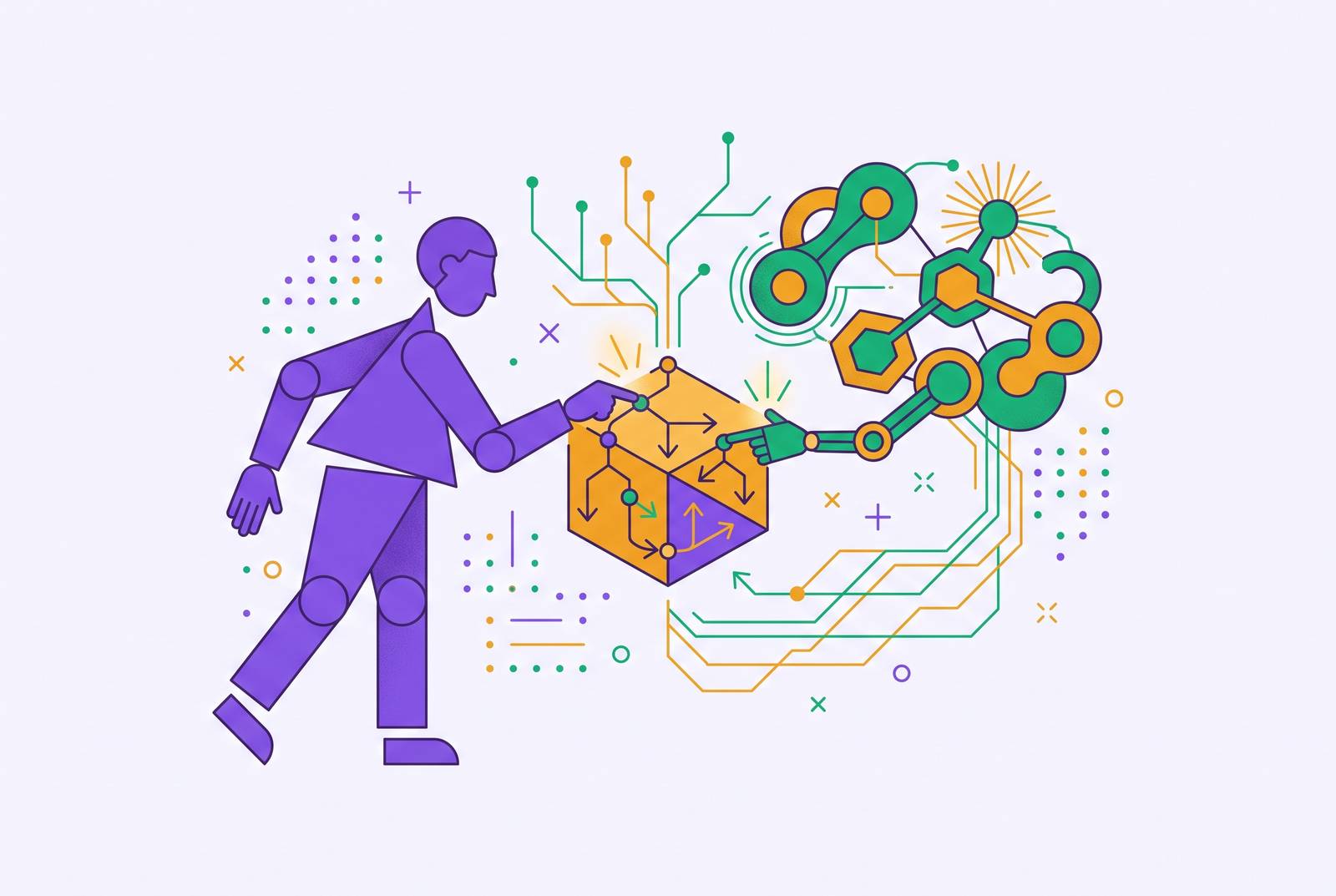
78% of organizations now use AI in at least one business function, up from 55% in 2023. That number tells you nothing about whether the decisions coming out of those companies are actually better. Adoption is easy to hit. Gartner data shows the real split: early adopters average 22.6% productivity gains, but that average hides a gap between teams that keep AI projects running for three-plus years (45% of high-maturity teams) and those that don't (20% of low-maturity ones). Pair a person with an AI system on a well-defined, data-heavy task, and the two beat either one working alone. Hand them a judgment-heavy call instead, and the pairing often loses to whichever one was better solo, which means the fix was never a better model. It's a collaboration design problem, and effective human-AI decision support was never going to be one method. It's a set of distinct patterns, each built for a different kind of decision, and mixing them up is how a lot of AI spending ends up producing confident-sounding nonsense.
What makes human and AI capabilities genuinely complementary, and when they aren't
Complementarity just means being different in a useful way. Humans and AI fail differently, and that gap between failure modes is where the value sits, assuming someone actually designs for it.
Research on human-AI complementarity traces this to two sources. First, information asymmetry: AI holds patterns across a volume of data no human working memory could touch, while humans carry contextual and tacit knowledge that never made it into any dataset. Second, capability asymmetry: AI moves fast and stays consistent at pattern detection, but causal reasoning, ethical judgment, and reading a genuinely ambiguous situation stay human territory.
IDC's 2026 FutureScape analysis adds a catch to that promise. AI tools can save workers over 40% of a typical workday, but only when the work itself gets redesigned around what people are actually good at. Bolt an AI tool onto an unchanged workflow and that 40% mostly evaporates.
Put a human and an AI system in the same room and complementarity doesn't just show up on its own. In clinical settings, weak complementarity occurs often; strong complementarity is rare. It depends on how the team is structured and how much expertise the person brings to the table. So the real question was never whether human and AI capabilities complement each other in some abstract sense. It's under what conditions they actually do, in this workflow, with this task, for this person.
Four distinct collaboration patterns, and the decision types each one fits
AI as structured analyst, human as decision-maker fits high-volume, data-rich decisions with a clear outcome variable: fraud detection, demand forecasting, resume screening. The AI churns through transactions or candidates at a scale no team could match by hand, and the human brings context and holds final say. Fraud detection is among the most established use cases driving AI investment in financial services. The design requirement here is easy to state and even easier to skip: the human needs real veto power, and needs to see enough of the AI's reasoning to use that veto for something other than show.
AI as ambiguity detector, human as resolver fits strategic and tactical calls where the problem itself isn't fully defined yet: vague goals, conflicting constraints, information nobody has written down. A study by Ozturk Birim and colleagues, posted on arXiv, frames generative AI as a "cognitive scaffold" that flags ambiguities a manager might miss, with a human in the loop to resolve what the AI can't infer on its own. Some models push back on a flawed premise. Others just go along with it, and that sycophancy risk deserves to be named directly rather than glossed over. In this study, resolving ambiguity before the AI generated recommendations improved decision quality across strategic, tactical, and operational scenarios, with the biggest gains appearing in constraint adherence: budget limits, regulatory boundaries, stakeholder requirements.
Human-in-the-loop at defined pipeline stages means AI runs most of a complex workflow, but specific checkpoints need a human expert to step in. The research identifies specific intervention points in the decision pipeline: one where a domain expert resolves an ambiguity the AI flagged, one where a human audits for alignment failures. The shift in thinking here is subtle but real. Human-AI collaboration clearly helps, so the real question is where exactly it needs to happen, and why. There are 882 FDA-cleared AI and machine learning medical devices, 671 of them in radiology alone, which makes the stakes concrete: the bottleneck isn't model accuracy. It's the implementation gap, how clinicians actually get folded into the AI-assisted workflow day to day.
Agentic AI with human governance fits high-volume operational decisions where waiting for a human in the loop would kill the speed advantage. Instead, humans design the system, set its rules, and watch for exceptions. Gartner projects that 33% of enterprise software will include agentic AI by 2028, up from under 1% in 2024, and that roughly 15% of work decisions will be made autonomously by agentic AI by 2028, compared to zero in 2024. IDC frames the right mental model clearly: treat AI agents as instruments that extend what a person can do, not as synthetic co-workers. Organizations that hold onto that framing are less likely to over-automate and more likely to actually fund governance instead of skipping it. The human role in this pattern sits upstream in system design and rule-setting, and downstream in exception handling and audits, rather than inside each individual decision.
How trust shapes the weight humans give AI, and why that weight drifts in both directions
A study in Frontiers in Organizational Psychology (Wen, Wang, and Chen) found that trust in AI directly increases how much weight a person gives an AI's recommendation, and that willingness to collaborate is what carries that effect, at least in personnel selection tasks. When people perceive the AI as having a high degree of free will, that trust-to-willingness link weakens. The more human-like the system seems, the more hesitant people get about handing it real authority. Odd, but it tracks: nobody wants to defer to something that might have its own agenda.
Two failure modes pull in opposite directions here, and neither is rare.
Automation bias is over-reliance on AI output without checking it. Workers often put in less effort as the AI tool gets better, not more, a pattern Dell'Acqua's 2022 research called "falling asleep at the wheel." Algorithm aversion runs the other way: someone gets burned by one small AI mistake and starts overriding every recommendation after that, even once the AI is measurably more accurate than they are.
Research on knowledge workers found that those who leaned on AI assistants most heavily also thought less critically about what the AI concluded. The more they trusted it to be right, the less they engaged their own judgment, which is close to the definition of a bad trade.
Trust also moves unevenly. When AI accuracy drops, trust falls fast and only partly comes back once accuracy is restored. Distrust spreads faster than trust builds, and it sticks around longer. Fixing accuracy alone often isn't enough. It takes what researchers call post-failure sensemaking, actually acknowledging the error and explaining what changed, to bring trust back to where it was.
And expertise decides which failure mode appears. In radiology, more experienced radiologists showed more algorithm aversion, while less experienced ones fell into automation bias more often. Some failure mode tends to appear either way. Which one appears depends on who's sitting in the seat.
Why explainability is a collaboration requirement, not a product feature
Trust in AI moves. It's a relationship between what a person perceives and how the system actually performs, and the target isn't maximum trust. It's calibrated trust: confidence that tracks real performance instead of running ahead of it or lagging behind it.
The overall trend isn't encouraging. Global consumer trust in AI has slid from 61% to 53% over the past five years, and 60% of companies using AI report trust issues with their own models. Left alone, trust drifts down, not up.
Research on explainable AI finds it meaningfully moderates trust, particularly after something goes wrong and particularly when users actually get a rationale for what the system decided. But explanation isn't one-size-fits-all. Novice users respond better to simple, narrative explanations. Experts want the technical detail underneath. Give an expert the narrative version, or a novice the technical breakdown, and the mismatch itself can undercut the calibration you were trying to build.
Research adds another layer: the AI's reasoning style shapes how much people trust and agree with its output, and it shapes that differently across everyday, corporate, environmental, and medical contexts. Reasoning style isn't neutral packaging. It changes the outcome.
Regulation is raising the stakes too. In the EU, transparency is now a legal requirement for certain AI systems, with penalties up to €35 million for serious violations. Explainability has moved from nice-to-have feature to compliance line item.
Put together: a system that can't show its reasoning makes post-failure sensemaking impossible, and that sensemaking was exactly the mechanism meant to repair the trust asymmetry in the first place. No visibility, no repair.
The human judgment factors that remain structurally irreplaceable across all four patterns
This isn't a soft argument about the human touch. Each pattern needs specific human capacities, and pull them out, and the pattern's own logic stops holding together.
Causal interpretation is what makes Pattern 1 function instead of just automating mistakes at higher speed. AI finds correlations across a dataset. A person supplies the causal reasoning that tells the difference between a signal worth acting on and one that's just noise dressed up convincingly.
Pattern 2 depends entirely on ambiguity tolerance: the ability to notice a problem is incompletely specified and reframe it into something solvable. An AI can flag that something's off. It can't supply the missing organizational or stakeholder context that only a person carries around.
Accountability doesn't transfer, in any of the four patterns. Even in Pattern 4, where the AI runs autonomously, the governance design itself is a human judgment call, and the person who built the system stays on the hook for what it does.
IDC's 2026 analysis names override readiness as a core skill for anyone working with AI agents: knowing when to step in and override, or escalate, a decision the system got wrong. Not a fallback skill. A primary one.
The gap is large enough to matter. IDC projects that over 90% of global enterprises will face critical IT skills shortages, AI included, by 2026, and puts up to $5.5 trillion of economic value at risk from AI-related skill gaps specifically. The constraint was never the AI's capability. It's whether enough humans know how to work alongside it well. IDC's own framing backs this up: organizations that track and actually work on human-AI collaboration, instead of chasing raw automation for its own sake, are projected to see margins up to 15% higher by the end of the decade.
How to match the right pattern to the decision in front of you
Three questions do most of the work in deciding which pattern fits.
How well-defined is the decision? A structured outcome with a measurable variable points to Pattern 1. A problem that's only half-specified points to Pattern 2.
Where does a failure actually cost the most? If the expensive mistakes happen at the reasoning stage, build human oversight right into that stage: Pattern 3. If the expensive mistakes happen at scale, build governance upstream and downstream instead: Pattern 4.
What's the expertise level of the humans in the loop? Experienced people tend toward algorithm aversion. Less experienced people tend toward automation bias. The pattern, and how its explanations get built, should account for which risk is more likely for that specific group.
Pattern mismatch is probably the most common failure here, and the least visible one. Run a genuinely ambiguous strategic problem through Pattern 1, and it produces output that sounds confident and isn't reliable. Run a high-volume operational task through Pattern 2's ambiguity resolution instead, and it creates a bottleneck that erases the entire reason for bringing AI in to begin with.
Role redesign has to come before tool selection, not after. IDC's 2026 FutureScape work projects that around 40% of all G2000 job roles will involve working with AI agents by 2026. That means job descriptions, not just AI configurations, need to state which collaboration pattern a given role actually operates in.
AI tools that show their reasoning, pick up organizational context over time, and flag when a decision has drifted past their reliable range make it possible for a team to stay in the right pattern instead of sliding into automation bias on one side or algorithm aversion on the other. That's a design choice, and it either supports the pattern or quietly undermines it.
Deciding which pattern applies before the AI gets deployed, rather than discovering the mismatch six months in, is what separates teams whose AI investment produces real decisions and real productivity gains from teams left wondering why the numbers never appeared.
Sources
- Frontiers | Trust and AI weight: human-AI collaboration in organizational management decision-making
- Work Rewired: Navigating the Human-AI Collaboration Wave
- Generative AI for Managerial Decision-Making under Ambiguity and Sycophancy
- Full article: Complementarity in human-AI collaboration: concept, sources, and evidence
- Toward a science of human–AI teaming for decision making: A complementarity framework - PMC
- blog.bismart.com
- researchgate.net