Human-AI Collaboration Examples in Knowledge Work
Biggest productivity gains go to the least experienced workers, not the most skilled.
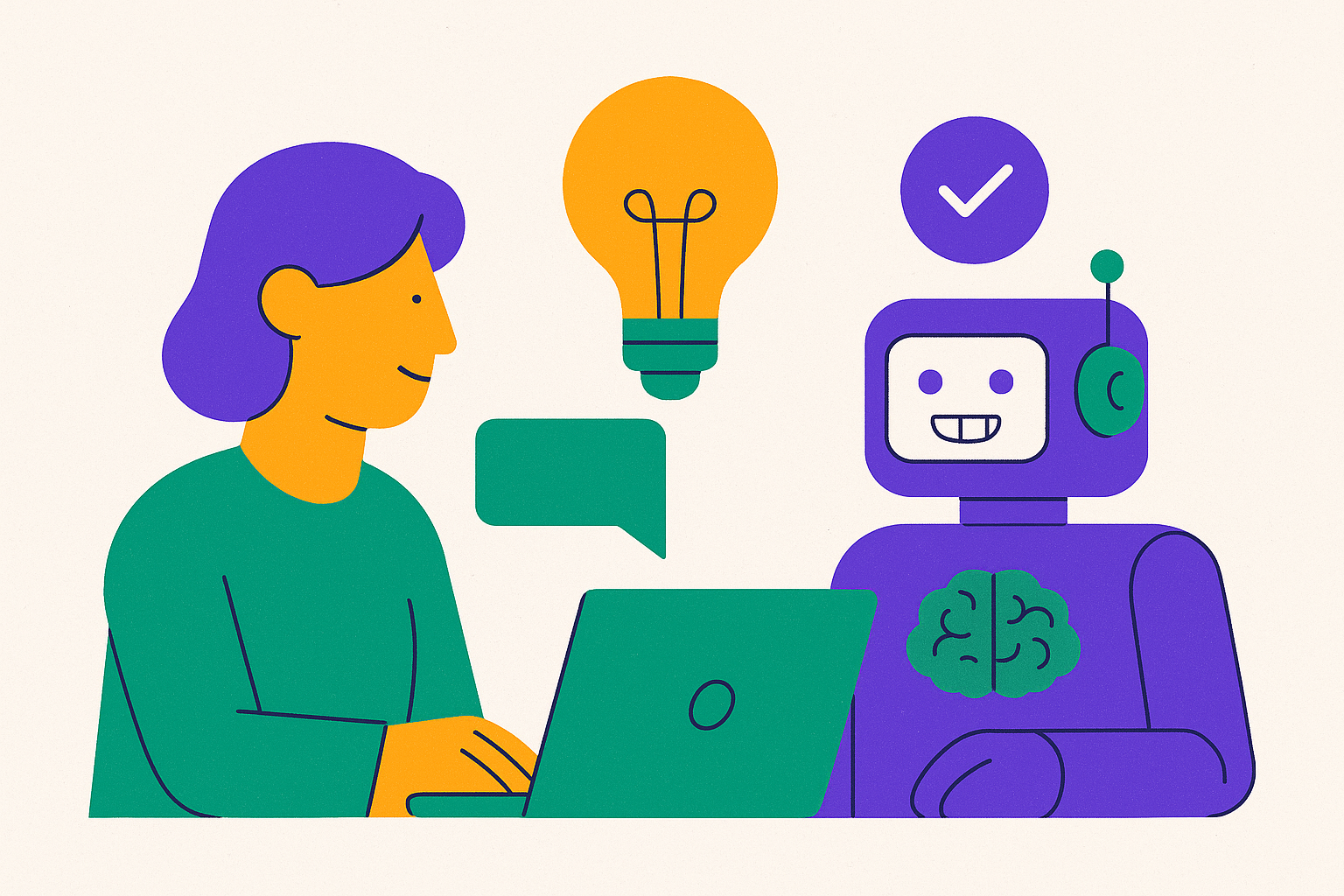
75% of knowledge workers now use AI tools regularly, according to 2025 Worklytics data. A more conservative estimate from Hartley et al. puts U.S. worker adoption at 35.9% by December 2025, but even the lower number describes something remarkable: a technology reshaping how millions of people work, in under three years. On Stack Overflow's 2024 developer survey, 76% of the 60,907 respondents said they're using or planning to use AI tools, with current users jumping from 44% to 62% in a single year. That's fast adoption across nearly every industry, not just tech. What matters is how people are using these tools. It's what happens when they do, and where the collaboration actually works.
What the productivity evidence says across domains before looking at any single field
Start with the numbers, because they set the boundaries for everything that follows. The International AI Safety Report 2026 found controlled studies reporting productivity gains between 20% and 60%, while real-world workplace experiments land lower, clustering around 15% to 30%. Average that out across studies and you get roughly 25%. Penn Wharton projects that average labor cost savings from AI could grow from 25% to 40% over the coming decades.
Those numbers sound huge, but here is what they don't mean. A 25% productivity gain on a task is not a 25% boost to someone's entire workday. Most jobs are a mix of tasks AI helps with and tasks it barely touches, so the honest read is: certain kinds of work get much faster, and the rest stays roughly the same.
There's a pattern buried in nearly every one of these studies, one that shows up again and again across writing, consulting, customer support, coding, and law: the biggest gains go to the least experienced people, not the most skilled. That raises an obvious question. If the productivity numbers are this strong and this consistent, why do so many practitioners report frustration, distrust, or outright errors when using these tools? The domain-by-domain evidence answers that question, and it's more interesting than a simple "AI works" story.
Professional writing: where AI handles volume and humans retain voice
Noy and Zhang ran a randomized experiment in 2023, published in Science, with professionals split into groups with and without ChatGPT access. The AI group finished writing tasks about 40% faster and produced work judged roughly 18% higher in quality.
The speed number is impressive on its own, but the quality number is the one to sit with. Speed is easy to fake: rush a draft, skip a revision pass, call it done. Quality is harder to fake, so an 18% jump means something real happened, not just less time spent.
Who benefited most? Workers who started out as weaker writers saw the largest improvements, a pattern that shows up again in nearly every domain covered here. In practice, the division of labor looks like this: AI cranks out drafts, alternate phrasings, and structural scaffolding fast. The human decides what actually gets used, adjusting for tone, audience, and brand voice in ways the model has no way of knowing on its own.
None of that removes the need for a human read before publication. Facts still need checking. Sources still need attribution. Context the AI never had access to (a client's history, an internal joke, a competitor's recent misstep) still needs a person to catch it.
Management consulting: the jagged frontier and the risk of over-trusting AI
Dell'Acqua and colleagues ran a preregistered study through BCG and Harvard with 758 knowledge workers doing realistic consulting tasks. When the work fell inside AI's actual capability range, results were striking: participants finished 12.2% more tasks, did so 25.1% faster, and produced work rated 40% higher in quality than the no-AI control group.
The skill-compression pattern shows up here in sharp relief. Bottom-half performers, ranked by their own baseline skill, improved by a substantially larger margin than top-half performers, who gained considerably less. AI narrowed the gap between strong and weak performers, and it did it fast.
Here's the catch. When consultants pushed AI into tasks beyond its actual capability, accuracy dropped by 19 percentage points. Not slower. Wrong, and confidently wrong, which is worse. This is where the researchers coined the term "jagged technological frontier": AI's competence doesn't map cleanly onto how hard a task looks to a human. Some tasks that seem hard are trivial for the model. Some tasks that look simple sit outside what it can reliably do. And the line between those two categories isn't visible to the person using the tool in the moment.
A follow-on BCG study in 2024, covering 480 consultants and 44 data-scientist volunteers, found up to a 49 percentage point improvement when AI extended consultants' reach into data science work outside their usual skill set. So the frontier isn't fixed. Design the workflow right, and it moves.
The paper's appendix draws a distinction: "Centaur" workflows split tasks cleanly, human does what humans do best, AI does the rest. "Cyborg" workflows blend the two throughout the process. Neither wins across the board, but the choice shapes how well the collaboration actually performs. Consultants trusted AI's work without checking it. It's that they often couldn't tell, in the moment, which outputs deserved a harder look.
Customer support: AI as an expert colleague for the least-experienced workers
Brynjolfsson, Li, and Raymond ran a field experiment inside a Fortune 500 company, real deployment, not a lab. Average productivity, measured as issues resolved per hour, rose 15%. For workers in the bottom skill quintile, it rose 36%.
The productivity gains were measured as issues resolved per hour, a metric that captures throughput without capturing the full picture of service quality. And a result that underscores how AI-assisted guidance can affect newer workers beyond raw output.
The mechanism at work has a name. The AI tool functioned like a senior colleague's accumulated know-how, made available instantly to anyone on the floor. New agents got the kind of real-time guidance that used to take years on the job to build up on their own.
Human judgment still decides one thing the AI can't: when a case has outgrown the guidance it's getting, and a live person needs to step in and take over.
Software development: speed gains that depend heavily on who's doing the coding
GitHub's own research found a 55% jump in task completion speed. Average completion time fell from 2 hours 41 minutes to 1 hour 11 minutes. Success rates climbed from 70% to 78%. On Stack Overflow's survey, 81% of developers named increased productivity as a top benefit of using these tools.
Here's the twist. A 2024 study found Copilot gave a real boost to recently hired and junior developers, but not to developers with longer tenure in more senior roles. The same tool, applied to two different experience levels, produced two different outcomes.
Trust hasn't caught up with adoption, either. Only 43% of surveyed developers said they're confident in AI tool accuracy, and 45% rated these tools as bad or very bad at handling complex development work. Put those two numbers next to the adoption figures and a clear picture forms: AI earns its keep generating boilerplate and first-draft code. Judgment on architecture, security, and correctness, especially at the senior level, still rests with the person, not the tool. That's not a coincidence. The context and pattern-recognition an experienced developer builds up over years is exactly what today's coding models still lack once a task gets genuinely complex.
Legal research and medical imaging: high-stakes domains where oversight is structurally mandated
Choi and Schwarcz studied law students taking exams with AI assistance, and the results carried the sharpest version of the skill-compression pattern in this entire body of research. Students at the bottom of the performance distribution improved enormously. Students at the top actually did worse with AI help than without it.
A 2025 study presented at CHI in Yokohama described a human-AI system built specifically for legal precedent search under Chinese law, an example of AI slotted into a workflow where jurisdiction-specific knowledge determines whether a search result means anything at all. In both cases, the parts of legal work that stay human, reasoning through precedent, weighing a client's specific situation, carrying professional responsibility for the outcome, are exactly the parts no tool can hold.
Radiology tells a similar story with its own numbers. A 2024 survey by EuroAIM and the European Society of Radiology, covering 572 members, found a substantially larger share now use AI tools in routine practice, up from just 20% five years earlier. A deployment at Northwestern Medicine processed a large volume of radiology reports, with average efficiency gains on report completion and individual radiologists reaching notable improvements, all without a drop in accuracy.
Separate survey research found overwhelming agreement that radiology teams should take part in developing and validating the AI tools they use, and a substantial share said radiologists must keep full responsibility for any clinical decision the AI influences. A separate case study, published in JAMIA Open in February 2025, looked at the qXR system from Qure.ai supporting Australian radiologists diagnosing pulmonary TB, a real-world example of AI and human reader working side by side in a resource-limited setting. The pattern across both fields holds steady: AI works through volume, scanning thousands of images or documents for patterns. The human supplies clinical judgment, knowledge of the specific patient or case, and, ultimately, accountability for what happens next.
The skill-compression pattern across all these domains and what it actually means
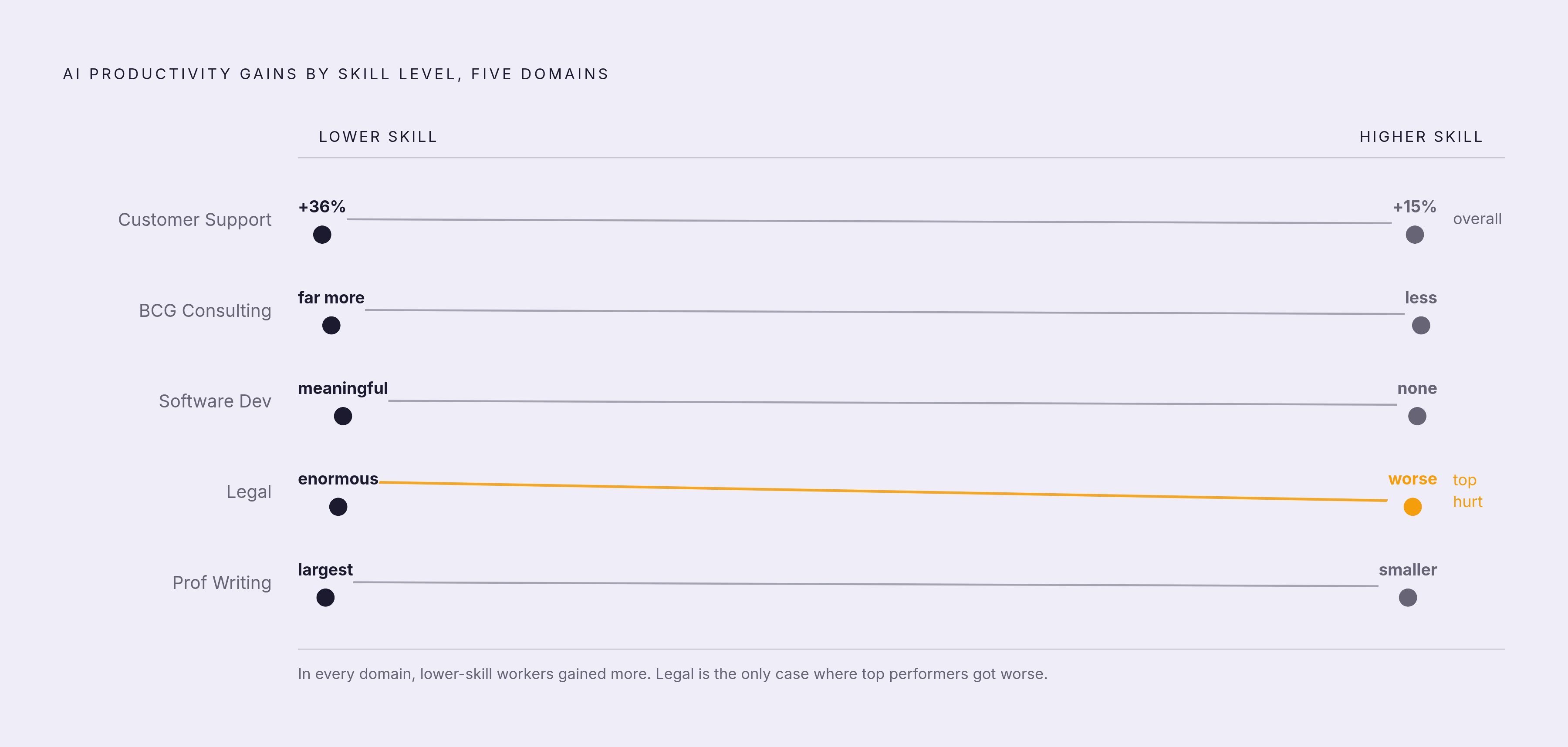
By now the pattern should be obvious, because it shows up in every single domain covered here. Writing. Consulting. Customer support. Coding. Law. In each case, the workers who gained the most from AI were the ones who started with the least skill or experience. The BCG data makes the point sharpest: bottom-half performers improved far more than top-half performers.
One way to read this: AI acts like bottled expertise. It takes what a company's best performers already know and hands a version of it to everyone else, which shrinks the gap between strong and weak performers on a given task.
But hold on, does that mean senior expertise is becoming less valuable? Several domains suggest the opposite might be closer to the truth. In coding and law especially, more experienced workers saw smaller gains, or in the law-student case, smaller or neutral gains for those already performing at the top. That looks less like AI replacing expertise and more like AI automating the parts of a job that can be learned from patterns, while leaving the tacit, contextual judgment to the people who've built it up over years.
Research from Xu et al., out of the University of Connecticut and Fudan University in 2026, adds an organizational layer to this. Whether AI upskills or deskills a workforce depends heavily on how it's deployed. How AI is deployed inside an organization shapes whether it raises capability broadly or concentrates it narrowly. Same technology, different outcomes, depending on the deployment choice.
So the skill-compression pattern is a signal to invest in developing senior expertise differently. It's a prompt to get specific about exactly what senior judgment is still being paid for.
How human-AI teams actually change the way people communicate and delegate work
Ju and Aral ran a large field experiment in 2026 on the Pairit platform, randomly assigning 2,234 participants to either human-human or human-AI teams. Together, these teams produced 11,024 ads, judged by independent human raters and tested live on X, where the ads pulled in roughly 5 million impressions.
Human-AI teams produced 50% more ads per worker, and the text quality came out higher too. Human-human teams, though, produced better images, a jagged frontier showing up again, this time at the team level instead of the task level.
Something else shifted along the way: how people talked to each other. Human-AI teams sent 25% more messages focused on content and process, and 18% fewer messages that were purely interpersonal. Collaboration got more transactional, less social. Participants also delegated 17% more work to their AI partners than they did to human partners, and made 62% fewer direct edits to the text themselves.
There's a cost buried in those speed and volume gains, too: the ads produced by human-AI teams looked more like each other. Researchers called it diversity collapse: higher average quality, but a narrower range of creative approaches. Participants who correctly recognized they were paired with an AI worked in a more task-oriented way and delegated more, meaning simply knowing there's an AI on the other end changes how a person works with it.
That points to something broader about knowledge work generally. AI collaboration tends to pull output toward the reliable middle of the distribution. Human-human collaboration keeps more variance in play, which matters a great deal when the job calls for something original rather than something merely consistent. Deciding which of those two goals matters for a given task, reliability or range, isn't something AI can weigh in on. That call stays with the person running the project.
Where AI assistance reliably goes wrong and why human judgment cannot be delegated away
The jagged frontier problem shows up again here, because it's the clearest explanation for why AI assistance breaks down in ways that are hard to catch. The boundary of what AI can actually do well is invisible to the person using it in real time. Confident, correct output and confident, incorrect output look identical on the screen.
The sharpest number for this point is still the 19 percentage point accuracy decline among consultants who used AI on tasks outside its capability range. That's not a case of AI slowing someone down. It made people actively worse at the task, while they likely felt just as sure of the result. The developer confidence numbers back this up from another angle: 45% of professional developers rate AI tools as bad or very bad at complex tasks, yet adoption keeps climbing. That gap suggests a lot of people are operating past the frontier without any clear signal telling them so.
Radiology offers a more structured response to the same problem. In the 572-member survey mentioned earlier, 98% said radiology teams should be involved in validating the AI tools they use, and 45% insisted radiologists keep full responsibility for any AI-influenced clinical decision. That's professional consensus, not personal preference, and it points to something the other domains are still working out on their own.
The organizational research from Xu and colleagues names the underlying risk directly: AI has what they call intrinsic fallibility, a tendency to produce output that sounds confident but is wrong. Firms that roll out AI without building in real oversight create a gap that only widens as the technology gets more capable, not less.
There's a specific trap across every domain covered: the tasks where AI fails often look, on the surface, exactly like the tasks where it succeeds. Same shape, different depth underneath. Which means the human's real job in any AI-assisted workflow includes shaping what goes in, not just reviewing what comes out the other end. It's building a sense for when to slow down and scrutinize harder, a skill that has to be learned and can't be automated away.
What an effective human-AI collaboration setup looks like in practice
Pull the evidence together and a shape emerges, one that holds steady across writing, consulting, support, code, law, and medicine. AI does its best work on volume, speed, and pattern-matching across large amounts of material. Humans hold the line on judgment, context, and the final call on quality.
Effective setups tend to share a few traits. They give newer or less experienced workers direct access to AI assistance, since that's where the productivity gains run largest, as seen in customer support and professional writing alike. They build in a clear point where a human reviews the AI's output before it goes anywhere, especially in law and medicine, where the cost of an unchecked error is high. And they train workers to recognize the edges of AI's capability, not just to use the tool, since the BCG data shows that misjudging the frontier costs more than not using AI at all.
They also make an active choice between "Centaur" and "Cyborg" structures based on what the task actually needs, rather than defaulting to whichever mode is easiest to set up. And they watch for the diversity collapse the Pairit study surfaced: when a task depends on originality, defaulting straight to automation-first workflows might trade away exactly the variance that made the work valuable in the first place.
None of this argues against using AI. The productivity numbers across every domain here hold up, and in several cases, the gains for newer workers are large enough to change how a team plans hiring and training altogether. But adoption without a clear sense of the frontier, without oversight built into the structure, and without a plan for when variance still matters more than speed, is how a genuinely useful tool turns into a liability nobody notices until the damage is already done.