Ambient AI in Apple and Google Ecosystem Devices
Apple and Google embed AI into chips and operating systems rather than apps you summon.
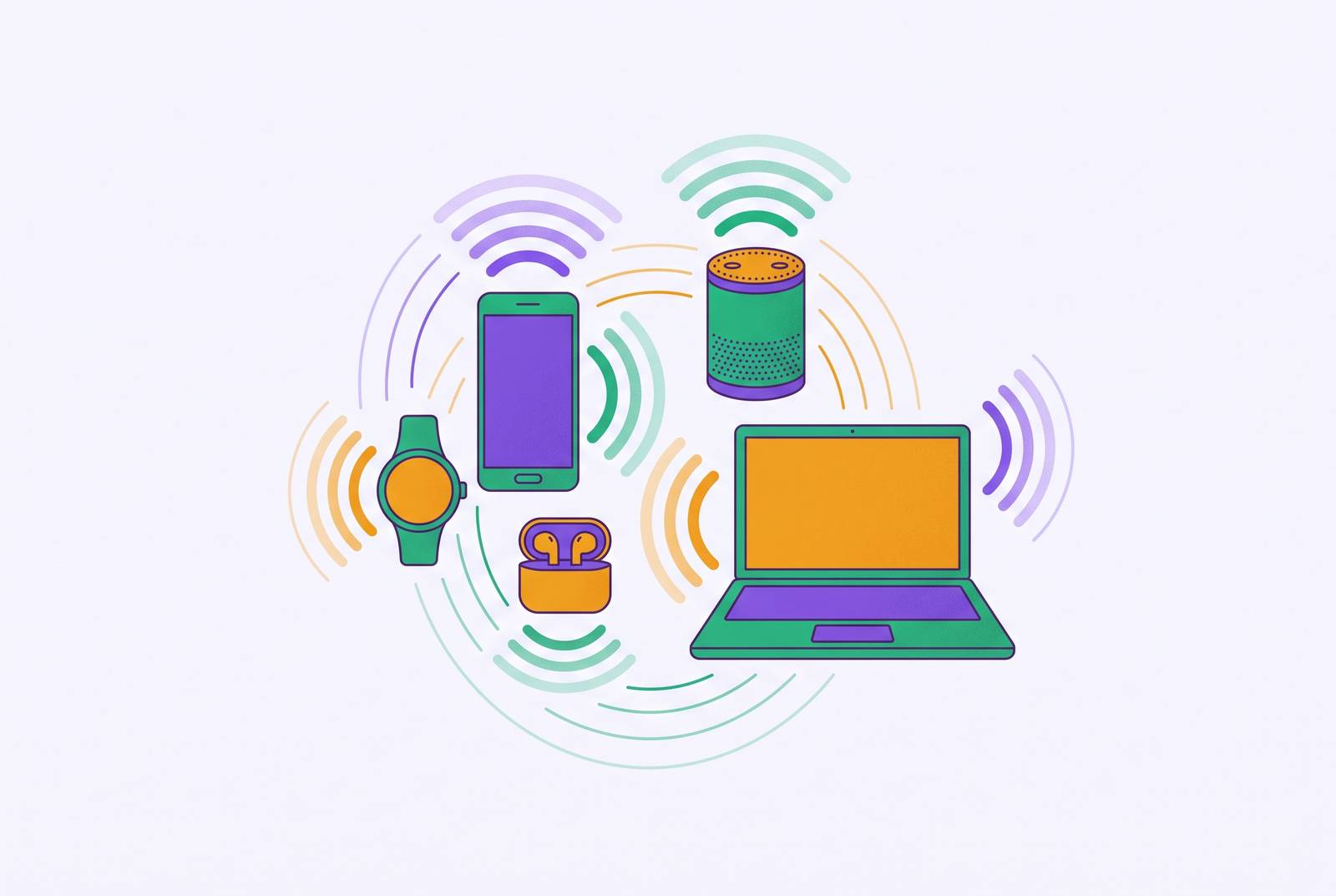
Ambient AI stopped being a feature sometime in 2026. It got baked into chips and operating systems instead of shipped as an app you open. Apple and Google both made that shift, and the way each one did it says a lot about how they think about privacy, hardware, and what a phone is even for.
Start with what makes ambient AI different from the kind you already know. Invoked AI waits for you: you type a prompt, tap a button, ask Siri something out loud. Ambient AI doesn't wait. It runs in the background, watching your screen, listening for context, tracking where you are and what you're doing, and it surfaces help before you think to ask for it. It's supposed to follow you too, from phone to watch to laptop, without you doing anything to carry it over.
Why does the infrastructure framing matter so much? Because once AI gets woven into the OS and the chip itself, the relationship changes. You stop using a tool and start having a capability. The tool disappears, and that disappearing act is the actual design goal, not a side effect. Apple and Google are chasing the same invisible layer, but they're building toward it from opposite directions: Apple is betting on hardware first, Google is betting on the cloud and the OS. Each deserves to be walked through on its own terms before anyone compares them.
Apple's foundational bet: ambient intelligence built into silicon and software
Apple describes its approach as AI that doesn't interrupt someone's sense of reality but sits "there in the background to help in an ambient way." That's a deliberate jab at the chatbot-you-summon model. Apple wants help to show up unasked, across iPhones, Macs, wearables, and now spatial computing, so AI becomes a property of the device rather than something running on top of it.
On-device processing is the mechanism behind that. Apple Intelligence handles personal information without collecting it, and Private Cloud Compute lets Apple scale up to server-grade horsepower without making your data readable by Apple or anyone else. Server power without the server seeing your stuff, that's the pitch.
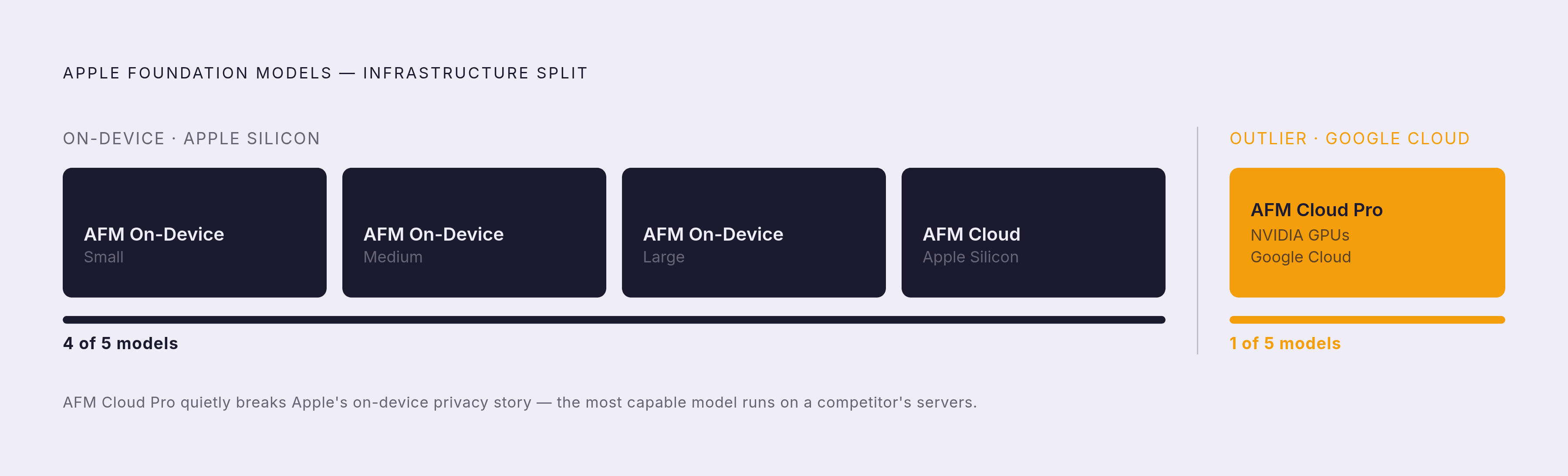
Apple Foundation Models are built for Apple Silicon and refined using outputs from Google Gemini, under a multi-year deal announced January 12, 2026. Apple Foundation Models are built for Apple Silicon and refined using outputs from Google Gemini, under a multi-year deal announced January 12, 2026. Four of the five Apple Foundation Models run entirely on Apple's own infrastructure. The fifth, AFM Cloud Pro, runs on NVIDIA GPUs hosted inside Google Cloud. Siri AI isn't the Gemini app or assistant, but its most capable model depends directly on Google's servers. So the company that has built its entire brand on on-device privacy still has a seam where it leans on a competitor's cloud, and it undercuts every claim Apple makes about silicon-first design as though it's total.
Siri AI, introduced at WWDC on June 8, 2026, is a genuinely new version of the assistant. It understands personal context, pulls from broad world knowledge, and reads what's on your screen, so it can dig something out of your messages, your email, or your photos without you ever opening those apps. The rollout followed Apple's usual rhythm: developer build June 8, public beta July 14, general release with iOS 27 on September 14, 2026.
Not every device qualifies, and that's a bigger deal than Apple's marketing lets on. Apple Intelligence and Siri AI need an iPhone 16 or later, iPhone 15 Pro or Pro Max, an iPad mini with the A17 Pro chip, a MacBook Neo with A18 Pro, an iPad or Mac with M1 or later, Apple Vision Pro, or Apple Watch Series 9 or later. That cuts out a meaningful chunk of people still carrying perfectly good iPhones.
Geography narrows the picture further. Siri AI isn't available on EU iPhones, iPads, or Apple Watches. The Watch restriction traces back to a dependency: watchOS Siri AI needs a paired iPhone that also runs Siri AI, so if the phone can't have it, the watch can't either. Other Apple Intelligence features do work on EU iPhones and iPads, and Siri AI works fine on Mac and Vision Pro there. China is out too, though regulatory clearance from the Cyberspace Administration came through on July 15, 2026, which should open that door eventually. For a company describing this as a global infrastructure layer, those are not small carve-outs.
Tom Mainelli, IDC's Group Vice President for Device & Consumer Research, put a name to the tension Apple is navigating: the company is "attempting to walk a fine line between always-listening ambient AI computing and its desire to respect the user's privacy." That line runs through nearly everything else in Apple's ambient AI story.
Audio Intelligence on Apple Watch: how ambient listening works without storing a recording
Apple Watch Series 12 ($399) and Ultra 4 ($799, rated for up to 50 hours of battery life) arrived at the September 9, 2026 hardware event carrying a feature set Apple calls Audio Intelligence. This is the clearest real-world test of that always-listening-but-still-private balancing act, and it holds up better than skeptics probably expected.
Siri Recap listens ambiently through the day and produces a short, high-level summary of conversations. Not a transcript. A summary. If you don't save it, it deletes itself from the Siri app after seven days. Live Rewind shows a transcription of the last 15 seconds of a live conversation, handy for catching something you missed without making someone repeat themselves. Sound Recognition alerts wearers to specific sounds like a doorbell, a siren, or a crying baby, aimed squarely at deaf and hard-of-hearing users. A faster version of Shazam rounds out the set.
The privacy engineering underneath produces the real story here, visible in how the S11 chip handles audio. The S11 chip includes a Secure Exclave, a hardware-isolated compartment that processes audio completely apart from the rest of the system, then deletes it the instant it's done. Raw audio never becomes accessible to the OS, to apps, to the wearer, or to Apple. Nothing gets recorded or stored, by design, not as a policy promise but as a hardware fact. Audio Intelligence also doesn't identify or attribute speakers, protecting both the wearer and whoever they're talking to. Siri Recap is built to strip out sensitive information too: financial details, government ID numbers, that kind of thing.
Apple built in visible signals to make the always-listening part less unsettling, though not evenly. Live Rewind plays an audible chime when it kicks in, even with the watch on silent, and shows a full-display animation plus a microphone indicator, so anyone nearby can see and hear it running. Siri Recap gets none of that. No continuous on-wrist indicator while it listens all day long. The feature that runs constantly gives the least visible sign of running.
Both features land in beta in late 2026, and they need an Apple Intelligence-enabled iPhone 16 or later (excluding the 16e). English only to start, and not available in the EU initially, matching the regional pattern already visible across Apple Intelligence generally.
Put this next to what already exists in the category. Amazon's Bee wristband and Plaud's note-taking devices record full conversations for later playback. Apple chose a different hill to plant its flag on: ambient intelligence without the audio archive. Whether that distinction matters more to users than raw transcript access is an open question. But it's clearly the bet Apple decided to make, and it's the more defensible one if the goal is actually earning trust rather than just collecting more data because you can.
Ambient sensing through AirPods and health wearables: the body as a sensor network
AirPods 5 launched at $129 at the same September 2026 event, shipping September 18, with noise reduction Apple says is 50% more powerful than before, enough that Apple calls it the best noise cancellation of any open-ear design on the market. They support hands-free Siri AI and live translation too, both ambient by nature since neither needs a button press to start. Battery life runs up to 4 hours of playback, or up to 20 with the case. A $149 upgraded model adds on-earbud volume control, up to 5 hours of continuous listening, and a wireless charging case.
But how does any of this connect back to ambient AI as an idea? Through health data, mainly, and this is where the pattern gets concrete. Apple Watch Series 12 adds hypertension detection built on photoplethysmography (PPG) data gathered continuously and run through an algorithm trained on data from 100,000 study participants. Apple's own white paper suggests this kind of monitoring could flag up to 1 million people who don't yet know they have hypertension. Heart rate sensing has spread to AirPods Pro 3 too, so the sensing surface isn't just the wrist anymore.
None of this waits for you to open an app and check. Background heart rate readings get taken every five seconds throughout the day, and heart rate variability gets sampled as often as every five minutes. That's continuous, passive monitoring that starts without you asking it to.
Ambient AI treats the body as a data stream the device reads around the clock, and it only speaks up when the data actually crosses a threshold that demands attention. Not conversation, not information retrieval. Biology, watched quietly, interrupted only when it needs to be.
A different axis of ambient intelligence shows up on the iPhone 18 Pro too, called Apple Reference Image. Rather than interpreting conversation or biology, it verifies what a camera captured, recording signed sensor data as an unalterable reference image whenever a photo gets taken in "reference mode." Deepfakes researcher Hany Farid told Axios that wide adoption will take time, since it needs new hardware and a deliberate opt-in from users, but he called the symbolism of Apple tackling the problem "significant."
Google's approach: Gemini as a system-level intelligence layer inside Android 17
Google made its framing explicit at The Android Show on May 12, 2026. Sameer Samat said: "We're transitioning from an operating system to an intelligence system." That's not a marketing line. It describes an actual architectural choice Google made about where intelligence lives.
Gemini Intelligence sits as a sub-layer built directly into the OS core, a persistent engine that watches the screen, predicts what someone probably needs next, and acts across several apps at once without making the user switch between them by hand. It's woven into notifications, text input, and system services rather than living in its own dedicated app. It also handles agentic navigation and background tasks, so it might go ahead and book a tour through Expedia while someone's attention is elsewhere.
Android 17 started rolling out to Pixel 6, 6 Pro, 7, 7 Pro, 8, 8 Pro, Pixel Fold, and Pixel Tablet on June 16, 2026. One real constraint on how far this reaches: Gemini Intelligence needs 12GB of memory minimum, a substantial hardware floor. Given how spread out the Android hardware ecosystem is across manufacturers and price points, that one number shrinks the feature down to a narrower slice of devices than the Android install base as a whole suggests.
Google built a specific answer to the "what is this invisible AI actually doing" problem, and it's called Android Halo. It's a persistent ambient indicator that shows, quietly and continuously, what background AI agents are up to right now. It's Google's explicit attempt to make invisible AI legible without burying the user in notifications, and Apple hasn't announced anything close to it.
On the developer side, Google introduced Antigravity 2.0, a standalone desktop agentic development platform, and Android 17's agentic developer tools lean on AppFunctions and UI automation frameworks so apps can expose actions the system-level AI is able to trigger on its own.
Gemini Spark and agentic background operation: AI that keeps working when the user has moved on
Gemini Spark pushes the ambient idea further out than anything Apple has shipped. It's a 24/7 personal AI agent inside the Gemini app that runs on dedicated virtual machines in Google Cloud, so it keeps working after the phone is off, the laptop is closed, and the person who set it running has moved on to something unrelated.
That's the logical extreme of the ambient AI premise. The agent's ambient presence shifts from the device to the cloud, working on its own whether or not anyone's around to check on it. Ambient doesn't mean unsupervised, at least not once money enters the picture, and Google has indicated that agentic transactions require explicit user approval before closing.
Project Astra is the vision that produced Spark. It sees and listens to the world through camera input, voice, memory, and context awareness, and it carries memory across devices, so someone can start a conversation on their phone and pick it back up somewhere else without repeating themselves. It currently runs on Android phones and on prototype glasses, and Google says it's working to push Astra's capabilities into Gemini Live, into Search, and into new hardware down the line.
That raises the stakes on trust considerably. Ambient sensing, the kind Apple Watch does with heart rate or Audio Intelligence, asks you to trust a device is watching responsibly. Ambient agency, the kind Gemini Spark represents, asks for something bigger: that an agent will make reasonable calls about what to do and what to leave alone, even while nobody's watching it work. That approval requirement is Google's own admission of where that trust needs a hard floor instead of a soft suggestion.
Glasses are where these two threads, sensing and agency, look likely to fuse into one wearable. Both companies seem to be circling that same conclusion, from very different starting points.
Smart glasses as the ambient AI form factor: where both companies are heading
Google's glasses roadmap is the more confirmed one, and it's not close. The foundation is Android XR, a dedicated operating system built on Android specifically for spatial computing, meant to blend digital content into the physical world around the wearer. Each model in the Google Gemini smart glasses lineup pairs the Gemini AI system with Project Astra's vision capabilities, giving the glasses real-time object recognition and contextual memory of what they've already seen.
On the consumer eyewear side, Google's partners are Warby Parker and Gentle Monster, chosen specifically so the glasses look like ordinary eyewear instead of an obvious gadget. Kering CEO Luca de Meo confirmed a Gucci collaboration with Google on April 16, 2026, with a 2027 launch window indicated. There's also Project Aura, built with Xreal: a wired AR glasses setup running Android XR, pairing the glasses (equipped with an X1S Spatial Coprocessor) to a separate compute puck powered by a Qualcomm Snapdragon Reality Elite processor, running Gemini AI and Google Play apps. Live demos of Project Aura showed up at Google I/O 2026.
Apple's version of this story is real but nowhere near as settled. Bloomberg reports the project, codenamed N50, is targeting a late 2027 launch, pushed back from an original plan for a late 2026 reveal and early 2027 shipment. It might lean on a connected iPhone to handle processing rather than working standalone, which would keep the glasses themselves light. The plan reportedly pairs computer vision for contextual help with the upgraded Siri from iOS 27. No partners, pricing, or final design confirmed yet.
There's an even earlier-stage Apple project too: a wearable AI pendant, described as a thin, flat, circular disc packed with multiple cameras, microphones, and a speaker, built to take in and respond to the world continuously through ambient intelligence and voice rather than touch. Sources told The Information a launch could come as early as 2027, but stressed the project is in very early stages and could still get killed.
Why do glasses matter this much to the whole argument? Because they're the end state ambient AI has been reaching for the entire time: always-on sensing without the deliberate act of picking up a device. The layer becomes something you perceive through rather than something you carry. Google's ecosystem here is considerably more developed and confirmed than Apple's, and that gap shouldn't get smoothed over as though both companies are equally far along. That gap shouldn't get smoothed over as though both companies are equally far along, because Google's ecosystem here is considerably more developed and confirmed than Apple's.
Privacy Architecture, Reach, and the Transparency Trade-Off
Both companies agree on where this is going. Where they split is how they get there, and that split says more about each company than any mission statement could.
Apple bets on silicon first: on-device processing, the Secure Exclave hardware isolation inside the S11 chip, privacy enforced physically by the chip rather than promised in a policy document somewhere. A privacy policy can change with a rewritten paragraph and a press release, while a hardware boundary that deletes audio the instant it finishes processing is a different kind of commitment. A privacy policy can change with a rewritten paragraph and a press release. A hardware boundary that deletes audio the instant it finishes processing is a different kind of commitment, and it's a lot harder to quietly walk back later.
Google bets on the OS layer and the cloud instead. Gemini Intelligence lives inside Android 17 itself, and Gemini Spark runs independently in Google Cloud on dedicated virtual machines, extending past the device into infrastructure the user never touches directly. That buys reach and continuity that on-device processing can't match, since a cloud agent doesn't care whether your phone is charged or your laptop is shut. It also means trusting a company's servers and policies in a way on-device processing tries to avoid.
The transparency trade-off cuts an interesting way too. Making invisible AI activity visible to users remains a design challenge Google has been working to address. Apple's Live Rewind chime does something similar in a narrower slice, alerting people nearby that a conversation is getting transcribed. But Siri Recap, the feature that listens all day long, carries no equivalent signal, and that's the real gap in Apple's story. Hardware-enforced privacy is a genuine safeguard, but it leaves untouched a separate question: do people nearby know they're being listened to? Both companies are pushing further into an infrastructure layer neither one particularly wants you to notice you're using.
Sources
- Apple's new AI features: Audio Intelligence and Apple Reference Image
- Apple bets on "ambient AI" without the always-recording baggage
- Apple takes on AI wearables with always-listening watch features
- Apple Takes on AI Wearables With Always-Listening Watch Features - Bloomberg
- The world of Apple, ambient AI, and privacy
- deepmind.google
- bloomberg.com
- techspot.com