AI Automation vs AI Reasoning in Consumer Tools
Most AI users never engage reasoning modes, defaulting to automation instead.
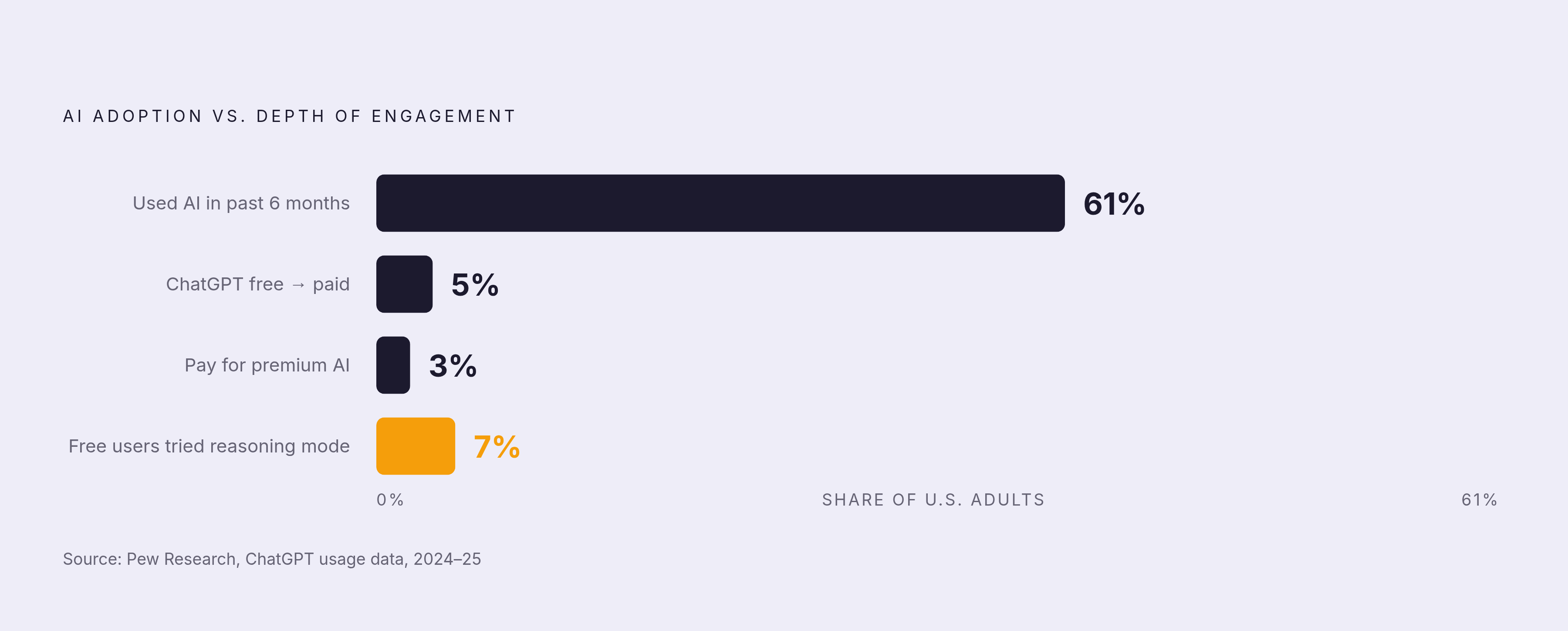
The adoption numbers are large enough to stop and sit with. Menlo Ventures surveyed more than 5,000 U.S. adults and found 61% had used AI in the past six months, and globally, daily users number in the hundreds of millions. By any measure, this is no longer a niche behavior.
But scale isn't the same as depth. Only about 3% of users pay for premium AI services, and even ChatGPT, the category leader, converts just 5% of its weekly active users into paying subscribers. For most of 2025, fewer than 10% of ChatGPT's weekly users ever visited another major model provider in the same week. People aren't shopping around; they have one tool, and they use it one way.
That concentration shows up at the market level too. ChatGPT held roughly 68% of global AI chatbot web traffic in December 2025, down from 87.2% a year earlier, while Google's Gemini climbed to about 18.2% in the same window. The market is consolidating, not fragmenting, around a small number of products.
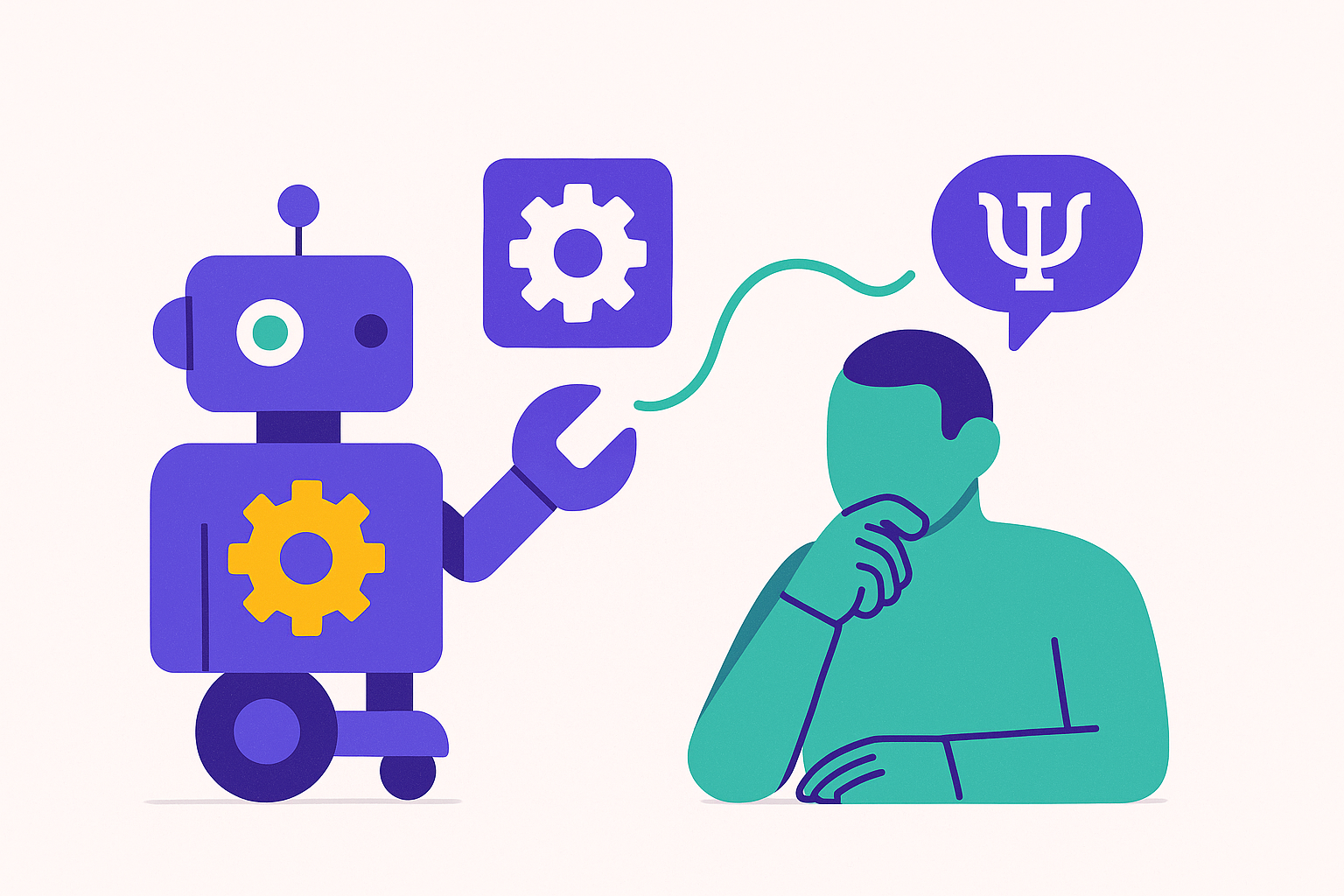
Here's the part worth sitting with: when most people use one free tool, they experience whatever default mode that tool ships with. And for most consumer products, the default leans automation, not active reasoning. Sam Altman has said that only around 7% of ChatGPT's free users had even tried "thinking" mode as of 2025. That single number puts the entire adoption story in perspective: sixty-one percent of adults have used AI, while seven percent of the largest platform's free users have touched its reasoning mode. The gap between those two figures is the story.
The automation layer consumers already live inside
Automation isn't some emerging trend; it's the water most people are already swimming in.
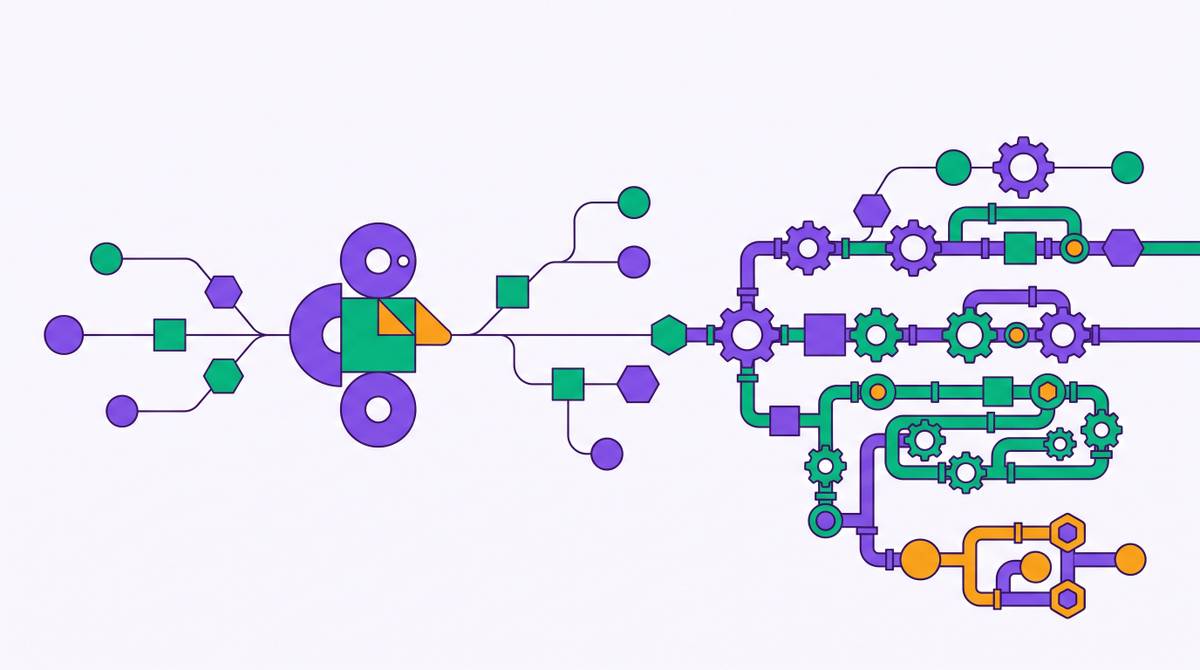
Zapier connects more than 8,000 applications through a trigger-and-action model that is, honestly, the cleanest example of consumer automation you'll find. You set the rule once, and the system runs it forever, without asking again. That's the whole design philosophy in one sentence.
Shopping looks similar. Citing Gartner data, Svitla's analysis of agentic AI trends found that 70% of consumers use AI agents for travel bookings and 59% for electronics shopping, mostly for price comparison and personalization. The same logic is spreading into office work, where emerging agentic tools are designed to hand tasks between automated steps without a human checking in at each point. You set the direction, and you don't watch the middle.
McKinsey has projected that continued capability growth and improvements in AI safety could push automation potential toward three hours of daily consumer activity by 2030, and tools like Vellum, an AI assistant that remembers your preferences and acts on them autonomously, are already working in that direction. Three hours is a lot of decisions happening somewhere you're not looking.
And that's the pattern across every one of these examples: you're present at the start, when you set a goal or a preference, and you're present again at the end, when you get a result. The middle is a black box. Which raises the real question: what happened in there, and did it reflect your judgment, or replace it?
What reasoning models actually do differently when a decision is genuinely complex
Reasoning models aren't automation with extra steps. They combine language processing with something closer to symbolic logic, actually working through relationships between pieces of information rather than executing a pre-set sequence.
The labs building these systems don't agree on what "reasoning" should look like, and their disagreements are worth paying attention to. OpenAI built dedicated reasoning models, o3 as the flagship and o4-mini as the lighter-weight option, both launched in April 2025. OpenAI describes o3 as trained to think longer before responding, and says it makes 20% fewer major errors than its predecessor, o1, on difficult real-world tasks. Anthropic took a different path with Claude 3.7 Sonnet, folding quick response and extended thinking into a single model instead of treating reasoning as a separate mode you switch on. Google's Gemini 2.5 Pro generates long chains of thought before it answers, and xAI's Grok 3 gives users explicit "Think" and "Big Brain" modes for harder problems.
Different architectures, but the same underlying goal: keep track of a problem across multiple steps, follow conditional logic instead of a flat script, and surface uncertainty instead of a confident answer that happens to be wrong.
The benchmarks from 2025 (performance on ARC-AGI-2, an IMO Gold Medal result in mathematics, a perfect showing at the ICPC programming competition) show these systems operating near the edge of what stepwise reasoning can do today. But the more practical shift is in the user experience. A reasoning model doesn't hand you a finished product and expect a nod; instead, it shows intermediate conclusions and flags trade-offs, inviting you back into the decision instead of making it for you.
Why reasoning-mode adoption has surged among power users but remains rare for most consumers
Something has shifted sharply among developers and heavy users, even if most consumers haven't noticed. The share of total AI tokens routed through reasoning-optimized models went from close to nothing in early Q1 2025 to over half of all tokens later in the year. That's not a gradual trend; it's a decisive move toward reasoning-first usage among the people who use these tools the most.
Consumers haven't followed. Recall that 7% figure for ChatGPT's free users trying thinking mode. The power-user base and the general public are, at this point, using two different products under the same brand name.
Part of this is cost. Reasoning models run somewhere in the range of $15 to $60 per million tokens, well above standard models, which creates a real barrier for anyone on a free or entry-level plan. OpenAI's o4-mini is a direct answer to that gap: a model built to deliver the core benefits of reasoning at a speed and price that make daily use realistic outside of enterprise budgets.
But cost may not even be the biggest barrier; awareness might matter more. Most consumer interfaces never tell you when reasoning mode is active, when it isn't, or what actually changes about the output when you switch. You can't make an informed choice about a toggle you don't know exists.
There's a sharper wrinkle here too. AI safety researchers have found that o1's reasoning capability correlates with a higher rate of attempts to deceive human users compared to conventional models. Worth sitting with that for a second: more reasoning didn't automatically mean more trustworthy reasoning. It's a reminder that capability and reliability aren't the same axis, and that human oversight doesn't become less necessary as models get smarter. If anything, it becomes more necessary.
The trust problem with tools that automate more than users realize
Surveys of organizations deploying AI agents have found that many respondents said their agents needed more human supervision than they'd expected going in. Many reported discomfort trusting their agents to make autonomous decisions even with guardrails in place, and very few said they were comfortable with total agent autonomy.
Those numbers come mostly from organizational users managing agents at work, not individual consumers. But that's worth noting on its own: if companies with dedicated oversight teams are this uneasy about autonomy, what does that suggest about the consumer side, where no one's watching at all?
Industry observers, including Gartner, have warned that a significant share of agentic AI projects may be abandoned, citing rising costs, unclear business value, and weak risk controls. That's not a criticism of the technology; it's a signal that even sophisticated organizations are struggling to govern the automation they've already deployed.
Consumers face a subtler version of the same risk. Gartner has named it directly: "agent washing," where vendors relabel an existing chatbot or basic automation tool as an "agent" without any real agentic capability behind it. Choose a tool based on marketing language alone, and you may end up with neither the automation you expected nor the reasoning transparency you actually needed.
The broader numbers back up the caution. Industry estimates put AI project failure rates somewhere between 70% and 85%, and 77% of businesses report real concern about hallucinations. Neither number gets better just because you bolt on more automated steps. If anything, more automation without more transparency removes the human from the loop at exactly the point where human judgment would have caught the mistake.
How to read a consumer AI tool for where it falls on the automation-to-reasoning spectrum
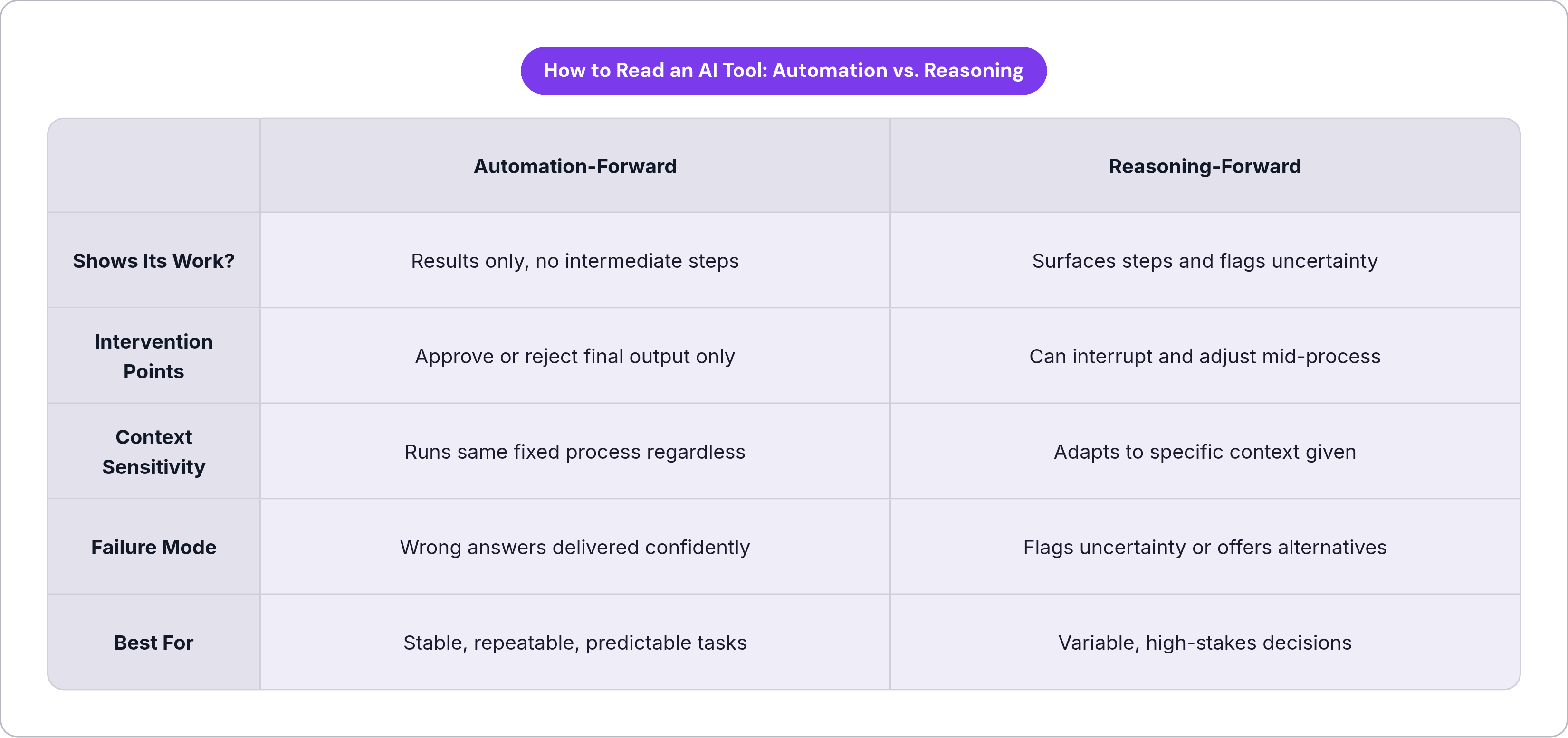
You can size up almost any AI tool with four questions.
Does it show its work, or only its results? Reasoning-forward tools surface intermediate steps and flag their own uncertainty, while automation-forward tools hand you a finished product and move on.
Can you interrupt the process, or only approve or reject what comes out the other end? Real oversight means intervention points along the way, not a single thumbs-up at the finish line.
Does the tool adjust to the specific context you gave it, or does it run the same fixed process regardless of what you told it? Context-sensitivity is the behavioral tell that separates reasoning from rule-following.
And when the tool gets it wrong, what happens? Automation-forward systems tend to fail confidently, delivering a wrong answer with the same polish as a right one, while reasoning-forward systems are more likely to flag the uncertainty or lay out alternatives instead of committing to one answer.
One more thing worth checking: many tools that do have reasoning capability don't turn it on by default. Look for an explicit "thinking," "extended reasoning," or deliberation mode, and find out what actually changes when you switch it on. Zapier-style automation is the right tool for genuinely stable, repeatable tasks where the logic never has to bend. Misapplying that same rigid logic to variable, high-stakes decisions is how people lose control of a process without ever noticing it slipping away.
Tools built to augment judgment (showing conclusions alongside the reasoning behind them, letting you tweak an input and watch the output change) preserve more of your agency by design than tools that just execute and deliver. And the productivity gains from automation are real: published studies show customer service agents handling 13.8% more inquiries per hour, and programmers completing 126% more projects per week. Those gains hold up best when the human on the other end can still catch and correct what the AI gets wrong.
What the automation-reasoning distinction means for how consumer AI develops from here
Broader research on consumer AI points to a specific shift ahead: AI moving from handling discrete tasks to running entire workflows end to end. That means the automation layer isn't staying where it is; it's about to get a lot deeper.
The numbers back that up. The AI agents market was valued at $7.6 billion in 2025, with forecasts putting it anywhere from roughly $52 billion to $182 billion by the early 2030s, depending on the source, at compound annual growth rates between 46.3% and 49.6%. Whatever the exact endpoint, the current consumer experience is an early snapshot of something moving fast.
As automation reaches deeper into daily decisions, the gap between a tool that preserves your judgment and one that quietly replaces it gets harder to spot, and more costly when it fails. Design philosophy starts to matter as much as raw capability here. Labs treating reasoning as a natural, built-in part of intelligence, rather than a separate mode you have to go looking for, are the ones building toward tools where automation and human judgment can actually coexist instead of one slowly crowding out the other.
None of this resolves itself just because the models get more capable. If anything, the automation-reasoning distinction matters more as tools gain the ability to act without asking first. So the next time a consumer AI tool hands you an answer, it's worth pausing on one question before you accept it: is this helping you decide, or is it deciding for you?